Bogus Purchases Addition Cut to 3%: Delhi ITAT Deletes Unsupported Accommodation Entry and Commission Additions
A bogus purchases addition cannot be sustained mechanically merely because a supplier is suspected of providing accommodation entries. At the same time, payments through banking channels and GST registration may not, by themselves, establish that disputed purchases are completely genuine when important supporting evidence is missing.
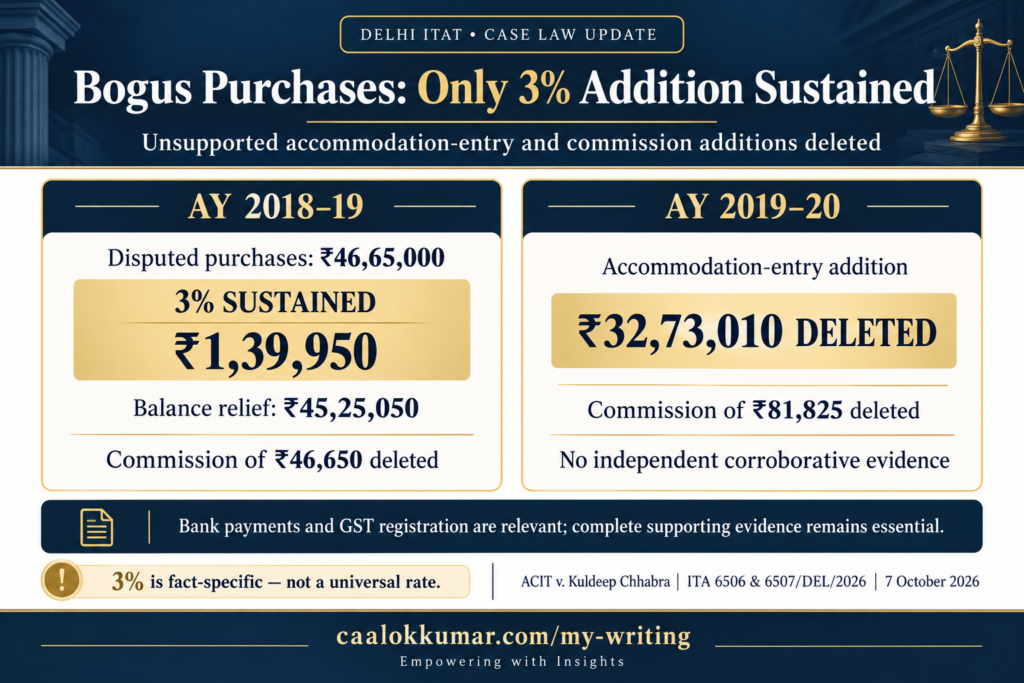
In ACIT, Circle-49(1), New Delhi v. Kuldeep Chhabra, the Delhi Bench of the Income Tax Appellate Tribunal adopted this balanced approach. For AY 2018–19, it sustained only 3% of disputed purchases of ₹46.65 lakh. For AY 2019–20, it deleted the entire alleged accommodation-entry addition because the Revenue could not independently establish that the disputed transaction had occurred.
The Tribunal also deleted the estimated commission additions for both years because no evidence demonstrated that the assessee had actually paid any commission.
Case Citation
Case: ACIT, Circle-49(1), New Delhi v. Kuldeep Chhabra
Appeal numbers: ITA Nos. 6506/DEL/2026 and 6507/DEL/2026
Assessment years: 2018–19 and 2019–20
Bench: ITAT Delhi Bench “G”
Members: Shri Satbeer Singh Godara, Judicial Member, and Shri Sanjay Awasthi, Accountant Member
Order date: 7 October 2026
Result: Revenue’s appeal for AY 2018–19 partly allowed; appeal for AY 2019–20 dismissed
Official List: ITAT Delhi pronouncement list dated 7 October 2026
Judgment at a Glance
| Assessment year | Disputed addition | ITAT decision |
|---|---|---|
| AY 2018–19 | Alleged bogus purchases: ₹46,65,000 | Only 3%, amounting to ₹1,39,950, sustained |
| AY 2018–19 | Estimated commission: ₹46,650 | Deleted |
| AY 2019–20 | Alleged accommodation entry: ₹32,73,010 | Entirely deleted |
| AY 2019–20 | Estimated commission: ₹81,825 | Deleted |
The resulting relief for AY 2018–19 was ₹45,25,050 out of the disputed purchase addition, apart from deletion of the entire commission addition.
Background of the Reassessment Proceedings
The assessments were reopened under Sections 147 and 148 of the Income-tax Act, 1961 based on information received from the Investigation Wing regarding suspected accommodation-entry providers.
Taxpayers facing similar proceedings may also read about the legal requirements governing reassessment under Sections 147 and 148.
For AY 2018–19, the case concerned purchases allegedly made from:
- M/s Dugong Enterprises; and
- M/s Big Marketing.
The Assessing Officer alleged that these concerns were dummy entities connected with an accommodation-entry network. Consequently, the AO added ₹46,65,000 under Section 68 and separately estimated commission expenditure of ₹46,650 under Section 69C.
For AY 2019–20, the Assessing Officer relied on information concerning Shri Daya Shankar, an alleged accommodation-entry provider. An amount of ₹32,73,010 was treated as an unexplained accommodation entry, with a further estimated commission addition of ₹81,825.
The CIT(A)/NFAC deleted the additions for both years. The Revenue therefore approached the ITAT.
AY 2018–19: Why the Tribunal Sustained 3%
The assessee relied on the following factors to support the disputed purchases:
- Payments were reportedly made through banking channels;
- The suppliers were registered under GST; and
- The assessee claimed that invoices, ledgers and purchase records supported the transactions.
However, the Tribunal also noticed significant deficiencies:
- The supplier concerns were non-filers;
- Summons issued to their principal officers were returned unserved; and
- The ledgers and other account details claimed to have been submitted were not actually uploaded before the Assessing Officer.
The Tribunal considered both sides. Banking transactions and GST registration supported the assessee’s position, but the non-filing status of the suppliers, unserved summons and absence of uploaded supporting records could not be ignored.
It therefore adopted what it described as a “middle path” and sustained 3% of the allegedly dubious purchases.
Amount sustained
The disputed purchases were ₹46,65,000.
Three per cent of ₹46,65,000 = ₹1,39,950
Accordingly:
- Addition sustained: ₹1,39,950
- Relief granted: ₹45,25,050
The Revenue’s appeal for AY 2018–19 was therefore partly allowed.
Is 3% a Standard Rate for Every Bogus Purchase Case?
No. The ruling does not prescribe a universal 3% rate for every alleged bogus-purchase case.
The percentage was adopted after considering the specific circumstances before the Tribunal. These included banking-channel payments and GST registration on one side, and non-filing suppliers, unserved summons and missing supporting uploads on the other.
The appropriate result in another case may depend upon:
- The assessee’s declared gross-profit rate;
- Industry-specific margins;
- Availability of invoices and delivery records;
- Quantitative stock reconciliation;
- Supplier confirmations;
- Proof of transportation and receipt of goods;
- Whether corresponding sales have been accepted;
- Whether the books have been rejected under Section 145; and
- The precise material collected during investigation.
Therefore, taxpayers should not cite the 3% figure in isolation. The evidentiary facts and trading results of the particular case remain decisive.
Banking Channels and GST Registration Are Relevant—but Not Conclusive
The judgment makes an important practical distinction.
Payment through banking channels and GST registration are relevant pieces of evidence, but they do not automatically prove that every purchase is genuine. Banking records establish movement of money; they do not necessarily establish actual delivery of goods.
Similarly, GST registration establishes the supplier’s registration status but may not conclusively demonstrate:
- Physical movement of goods;
- Delivery at the assessee’s premises;
- Entry of goods in stock records;
- Consumption or subsequent sale of goods; or
- Commercial capacity of the supplier.
Businesses defending a bogus purchases addition should therefore maintain the complete evidentiary chain instead of relying only on invoices, GST registration and bank payments.
AY 2019–20: Entire Accommodation-Entry Addition Deleted
The position for AY 2019–20 was materially different.
The Assessing Officer relied primarily upon:
- Information appearing on the Department’s Insight Portal;
- A general statement by the alleged entry provider; and
- The allegation that the assessee had entered into a transaction of ₹32,73,010.
The assessee consistently denied having any transaction with Shri Daya Shankar or an entity controlled by him. To support this denial, the assessee relied upon:
- Purchase register;
- GSTR-2A; and
- Audited financial statements.
The CIT(A) found no corresponding invoices, payments, transport records, delivery challans, stock entries or other material linking the assessee with the alleged transaction. The books had not been rejected, and the declared sales and trading results were not disturbed.
The Tribunal upheld these factual findings.
Third-Party Information Must Be Independently Corroborated
The ITAT found that the alleged transaction was based on third-party information and a generic statement by the alleged entry operator. No transaction-specific evidence connected the assessee with the disputed amount.
The ruling reinforces an important principle: investigation information may justify further inquiry, but it does not automatically establish taxable income in the hands of every alleged beneficiary.
The Assessing Officer must ordinarily examine whether there is:
- A purchase invoice in the assessee’s records;
- A corresponding entry in its books;
- Payment through banking or other channels;
- Movement or delivery of goods;
- A stock entry or evidence of consumption;
- Cash withdrawal or circulation of funds;
- Communication between the assessee and the alleged entry provider; or
- Any other transaction-specific financial trail.
This aspect may also be read with the earlier Delhi ITAT ruling holding that a third-party statement without effective cross-examination cannot, by itself, justify a substantial bogus-purchase addition.
Section 69C Requires Proof of Actual Expenditure
Section 69C applies where the assessee has incurred expenditure but cannot satisfactorily explain its source.
Accordingly, the foundational fact is the actual incurrence of expenditure.
For AY 2019–20, the Department failed to establish:
- That the assessee had incurred the alleged expenditure;
- That a payment was made to the alleged entry provider;
- That goods were received;
- That the transaction appeared in the books; or
- That funds moved between the assessee and the alleged provider.
A unilateral transaction reported by a third party could not, without further verification, establish unexplained expenditure in the assessee’s hands.
The ITAT therefore upheld the deletion of ₹32,73,010.
An Assessee Cannot Reasonably Be Required to Prove a Negative
The Tribunal also observed that the assessee could not be expected to prove that a transaction never occurred when the Department had not first produced reliable evidence showing that it did.
This does not mean that a bare denial will succeed in every case. The assessee in this matter supported its denial through its purchase register, GSTR-2A and audited financial statements.
The practical rule is therefore:
When the Department alleges an undisclosed transaction, it must first establish a credible connection between the assessee and that transaction. The assessee should then answer the specific evidence produced against it.
Estimated Commission Cannot Rest on Presumption Alone
For both assessment years, the Assessing Officer estimated commission allegedly paid for obtaining accommodation entries.
The additions were:
- ₹46,650 for AY 2018–19; and
- ₹81,825 for AY 2019–20.
Both were deleted.
The Tribunal found no statement, document, payment evidence or financial trail showing that the assessee had paid commission. The additions were therefore based on surmises and conjectures.
The mere allegation of an accommodation entry does not automatically establish:
- That commission was paid;
- The person to whom it was paid;
- The applicable commission rate; or
- The source of the alleged commission payment.
An estimated commission addition must have a reasonable evidentiary foundation.
Section 68 and Section 69C: An Important Distinction
Section 68 ordinarily concerns a sum credited in the assessee’s books for which the nature and source are not satisfactorily explained. Readers may refer to this detailed guide on unexplained cash credit under Section 68.
Section 69C concerns expenditure incurred by the assessee where the source of that expenditure is not satisfactorily explained.
Before applying either provision, the Assessing Officer must establish the relevant foundational fact:
- Under Section 68, the existence of a credit in the assessee’s books; and
- Under Section 69C, the incurrence of expenditure by the assessee.
The sections cannot be applied merely by repeating an investigation report without connecting the information to the assessee’s books, payments or actual transactions.
For AYs 2018–19 and 2019–20, the governing legislation remained the Income-tax Act, 1961. For understanding the corresponding provisions under the Income-tax Act, 2025, taxpayers and professionals may use the Income-tax section finder.
Why the Two Assessment Years Produced Different Results
The decision is valuable because it distinguishes between two materially different factual situations.
AY 2018–19: Transaction existed but genuineness was doubtful
The assessee acknowledged the purchases and relied on banking transactions and GST registration. However, deficiencies remained in the evidentiary record. The Tribunal therefore sustained a limited percentage.
AY 2019–20: Existence of transaction itself was unproved
The assessee denied the transaction and supported its denial through books, GSTR-2A and audited accounts. The Department could not produce invoices, payment records, stock entries, transport documents or a financial trail.
Consequently, the entire addition was deleted.
The ruling therefore distinguishes a disputed transaction from an unproved transaction. The same approach cannot automatically be applied to both.
Practical Lessons for Taxpayers and Businesses
Businesses facing a bogus-purchase or accommodation-entry allegation should preserve and submit:
- Purchase invoices and e-invoices;
- Supplier ledgers;
- Bank statements and payment proof;
- Purchase orders and correspondence;
- E-way bills and transport receipts;
- Goods-receipt notes and delivery challans;
- Gate-entry and warehouse records;
- Quantitative stock reconciliation;
- Evidence of consumption or subsequent sale;
- GSTR-2A or GSTR-2B reconciliation;
- Supplier confirmations;
- GST registration status during the relevant period; and
- Audited financial statements and tax-audit disclosures.
Most importantly, documents must actually be uploaded within the prescribed portal deadline. Maintaining evidence internally is not sufficient if it never reaches the Assessing Officer.
Professional support for preparing indexed submissions and responding to departmental allegations may be obtained through faceless assessment representation.
What Should a Taxpayer Do After Receiving Such a Notice?
A taxpayer receiving a notice concerning bogus purchases or accommodation entries should:
- Obtain the complete information relied upon by the Department;
- Ask for transaction-wise allegations instead of accepting general statements;
- Reconcile the alleged amount with books and GST records;
- Request copies of relevant statements and investigation material;
- Seek cross-examination where reliance is placed on a third-party statement;
- File a complete, indexed and properly cross-referenced response;
- Preserve portal acknowledgements and evidence of every upload;
- Request a video hearing where factual clarification is required; and
- Challenge an adverse order through the appropriate appellate remedy within limitation.
Where an adverse demand has already been raised, review the available options for an income-tax demand notice response. Complex cases involving CIT(A), NFAC or ITAT proceedings may require specialised income-tax litigation and ITAT representation.
Key Takeaway
The Delhi ITAT ruling does not say that every bogus purchases addition must be restricted to 3%.
Its more important principles are:
- Banking payments and GST registration are relevant but not conclusive;
- Evidentiary deficiencies can justify a limited addition in a disputed-purchase case;
- Investigation information and generic statements require independent corroboration;
- Section 69C cannot apply unless actual expenditure is first established;
- A taxpayer cannot be required to disprove an unsupported transaction;
- Estimated commission cannot be added without evidence of payment; and
- The outcome depends upon the quality of evidence available for each assessment year.
The ruling demonstrates that suspicion may justify investigation, but the final addition must rest on evidence.
Frequently Asked Questions
1. Can the Assessing Officer make an addition only on the basis of an investigation report?
An investigation report may justify inquiry or reassessment, but the final addition should ordinarily be supported by transaction-specific evidence connecting the assessee with the alleged entry.
2. Are banking-channel payments sufficient to prove genuine purchases?
No. They are relevant evidence, but taxpayers should also preserve invoices, stock records, e-way bills, transport documents, delivery evidence and supplier confirmations.
3. Does this judgment fix 3% as the standard addition for bogus purchases?
No. The 3% restriction was based on the particular facts of AY 2018–19. It is not a universal rate applicable to every bogus-purchase dispute.
4. Can Section 69C apply when the assessee denies that any expenditure was incurred?
The Department must first establish through credible material that expenditure was actually incurred. Only then does the question of explaining its source arise.
5. Can the Department add estimated commission on an alleged accommodation entry?
A commission addition should be supported by evidence or a reasonable factual foundation. Pure estimation based on presumption may not be sustainable.
6. What documents are most important in a bogus-purchase case?
Purchase invoices, supplier ledgers, bank statements, e-way bills, transport records, delivery challans, stock registers, GST reconciliation, supplier confirmations and proof of subsequent sale or consumption are particularly important.
7. What was the final outcome in Kuldeep Chhabra’s case?
For AY 2018–19, 3% of ₹46,65,000—₹1,39,950—was sustained, while the balance and commission addition were deleted. For AY 2019–20, the alleged entry of ₹32,73,010 and commission of ₹81,825 were deleted entirely.
Professional disclaimer: This article provides a general legal and tax analysis of the reported judicial decision. The applicability of the ruling depends upon the facts, evidence, assessment year and applicable law in each case. Taxpayers should obtain case-specific professional advice before responding to a notice or filing an appeal.
Leave a Reply