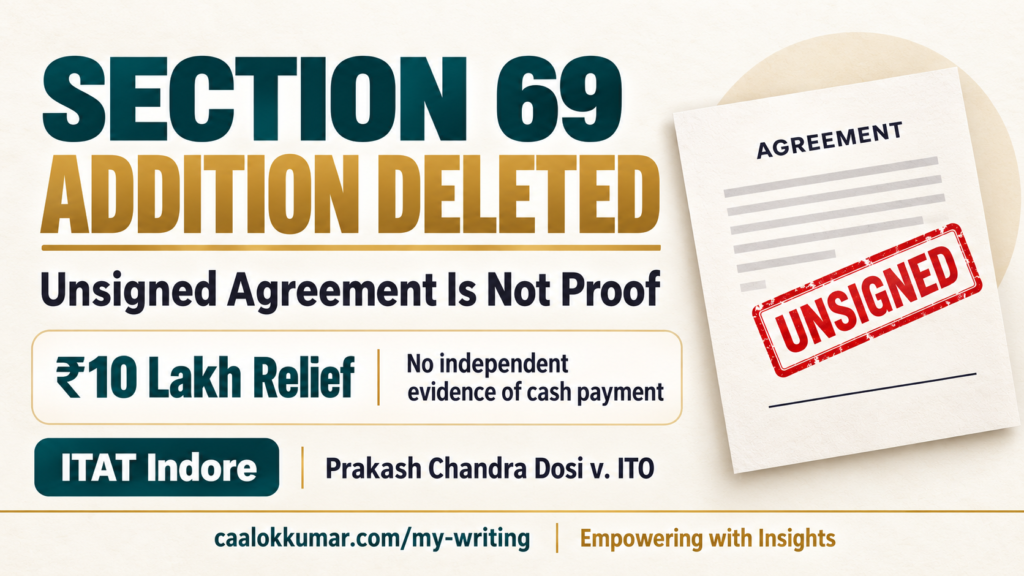
Can an unsigned agreement to sell and a seller’s affidavit establish that a taxpayer made an undisclosed cash investment and section 69 addition?
The Indore Bench of the Income Tax Appellate Tribunal has answered this question in favour of the taxpayer. In Prakash Chandra Dosi v. ITO, Neemuch, the Tribunal deleted a ₹10 lakh Section 69 addition, holding that the disputed documents did not independently establish that the assessee had actually made the alleged cash payment.
The agreement relied upon by the Income Tax Department was not signed by the assessee. More importantly, it was dated before the stamp paper on which it appeared had even been purchased. The property was ultimately registered in another person’s name, and the Revenue could not produce a credible financial trail connecting the assessee with the alleged payment.
The ruling reinforces an essential principle of income-tax assessment:
Suspicion may justify an investigation, but it cannot replace credible evidence proving that the taxpayer actually made the disputed investment.
Case details at a glance
| Particular | Details |
|---|---|
| Case | Prakash Chandra Dosi v. ITO, Neemuch |
| Tribunal | ITAT Indore Bench |
| Appeal number | ITA No. 658/Ind/2025 |
| Assessment year | AY 2011-12 |
| Order date | 12 October 2026 |
| Relevant section | Section 69, Income-tax Act, 1961 |
| Disputed addition | ₹10,00,000 |
| Alleged evidence | Unsigned agreement to sell and seller’s affidavit |
| Final outcome | Addition deleted; assessee’s appeal allowed |
How the alleged property transaction came under scrutiny
The assessee was an individual earning agricultural income. During assessment proceedings in the case of Shri Dhannalal Patel, the alleged seller, the Assessing Officer found an agreement relating to the proposed sale of agricultural land.
The purported agreement, dated 10 January 2010, recorded a total consideration of ₹40 lakh. According to its contents, the following cash payments had allegedly been made by the assessee:
- ₹24 lakh on 24 February 2010; and
- ₹10 lakh on 14 June 2010.
The remaining ₹6 lakh was stated to be payable subsequently.
The seller also furnished an affidavit alleging that the cash amounts had been received from the assessee. Relying upon this material, the Assessing Officer reopened the assessee’s assessment and treated ₹10 lakh as an unexplained investment under Section 69.
However, the apparent evidence contained several serious inconsistencies.
The disputed agreement was never signed by the assessee
The agreement did not bear the signature of the assessee, even though he was alleged to be the purchaser and the person who had supposedly paid a substantial amount in cash.
The assessee categorically denied:
- executing the agreement;
- agreeing to purchase the property;
- paying ₹10 lakh or any other cash amount;
- entering into any transaction with the seller; and
- even knowing the alleged seller.
He also filed his own affidavit denying the transaction.
The mere appearance of the assessee’s name in a private document could not conclusively establish that he had accepted the terms of the agreement or made the payments mentioned in it.
An agreement normally derives evidentiary value from its execution, acceptance and surrounding conduct. Where the alleged purchaser has not signed it and specifically denies the transaction, the Department must produce additional evidence connecting that person with the payment.
The agreement predated the stamp paper
The most serious defect was the chronology of the document.
The agreement was purportedly executed on 10 January 2010, whereas information obtained from the Registrar showed that the stamp paper had been purchased on 10 February 2010—one month after the agreement’s stated date.
A document cannot ordinarily be written on stamp paper that did not exist on the date mentioned in the document.
This discrepancy materially affected the document’s reliability. Instead of treating the agreement as conclusive, the Revenue was required to investigate:
- when the document was actually prepared;
- who prepared it;
- whether it was subsequently backdated;
- whether the assessee had authorised its preparation; and
- whether any payment mentioned in it had actually taken place.
No sufficient investigation or independent corroboration was brought on record to resolve these questions.
Property ultimately registered in another person’s name
The land was not registered in favour of the assessee.
The remaining consideration of ₹6 lakh was paid by Smt. Kesar Bai through cheque, and the registered sale deed dated 19 October 2010 was executed in her favour.
This created a significant evidentiary gap in the Revenue’s case.
If the assessee had already paid ₹34 lakh towards the purchase of the land, the Department needed to explain why:
- the property was ultimately registered in another person’s name;
- only ₹6 lakh was recorded as the sale consideration in the registered deed;
- the alleged earlier payments were not acknowledged in the registered document; and
- there was no independent evidence connecting the assessee with the final purchaser.
The Tribunal found that the necessary link between the alleged cash payments and the property ultimately conveyed to Smt. Kesar Bai had not been established.
Professional property valuation and transaction documentation becomes particularly important where the registered consideration, alleged cash component and actual ownership of property are questioned during assessment.
Why did the Assessing Officer make the addition?
The Assessing Officer relied principally upon:
- the alleged agreement to sell;
- the seller’s affidavit;
- the appearance of the assessee’s name in the document;
- the Registrar’s confirmation regarding the stamp paper; and
- the assessee’s alleged failure to explain the source of ₹10 lakh.
On this basis, the Assessing Officer treated the disputed amount as an unexplained investment. The CIT(A) subsequently confirmed the addition.
This approach, however, assumed the very fact that first required proof: that the assessee had actually made the investment.
What must be proved before invoking Section 69?
Section 69 applies where an assessee has made an investment that is not recorded in the books of account and either:
- offers no explanation about its nature and source; or
- provides an explanation that the Assessing Officer considers unsatisfactory.
The provision therefore requires the existence of an investment made by the assessee.
Before demanding an explanation about the source of money, the Revenue must first establish through credible material that the taxpayer made the disputed investment. Section 69 should not be invoked merely because an unreliable or disputed document mentions the taxpayer’s name.
For proceedings under the Income-tax Act, 2025, Section 69 of the 1961 Act broadly corresponds to Section 103. The renumbered provisions can be checked through the Income-tax Act 1961–2025 Section Finder.
What did the ITAT decide?
The Tribunal did not hold that every unsigned document must automatically be ignored. It observed that the agreement, the seller’s affidavit and the Registrar’s information had to be considered together.
However, their cumulative consideration still did not establish the alleged payment by the assessee.
The Tribunal identified the following deficiencies:
- The agreement was not signed by the assessee.
- The agreement was dated before the stamp paper was purchased.
- The assessee specifically denied the transaction.
- The property was ultimately registered in another person’s name.
- There was no reliable evidence tracing ₹10 lakh from the assessee to the seller.
- No sufficient independent material corroborated the seller’s allegation.
The seller’s affidavit could not, by itself, cure these deficiencies. In the absence of a financial trail or other credible evidence, the Tribunal held that the alleged investment had not been proved.
The addition of ₹10 lakh was therefore deleted.
An unsigned document may trigger inquiry—but is not automatic proof
The ruling draws an important distinction between information that can initiate an inquiry and evidence that can sustain an addition.
An unsigned agreement may create suspicion and justify further investigation. But an addition cannot be confirmed solely because the document:
- contains the taxpayer’s name;
- alleges payment of cash; or
- is supported by another person’s statement or affidavit.
The Department must investigate whether the document was genuine, accepted, acted upon and supported by the conduct of the parties.
A comparable principle was applied when the Pune ITAT deleted a Section 69 addition based on unauthenticated third-party WhatsApp chats. In both matters, the disputed third-party material lacked sufficient independent corroboration connecting the taxpayer with the alleged investment.
Judicial precedents supporting the assessee
The Indore ITAT particularly followed the reasoning adopted in the following decisions:
Kanta Devi Jain v. DCIT
The Jaipur ITAT held that an unsigned agreement, which was not shown to have been accepted or acted upon by the assessee, could not sustain an addition without independent inquiry and corroborative evidence.
Anil Bala Goyal v. DCIT
The Delhi ITAT held that an unsigned agreement and an uncorroborated allegation of cash payment were insufficient where the Assessing Officer failed to produce positive evidence that the taxpayer had actually made the payment.
The reasoning in those decisions also relied upon the Supreme Court’s established principle in Dhakeswari Cotton Mills Ltd. v. CIT that an assessment cannot be founded on pure guesswork or suspicion without supporting material.
Practical lessons for taxpayers facing similar additions
A taxpayer confronted with an alleged property investment should submit a specific, evidence-based response rather than a simple general denial.
Obtain the complete material relied upon
The taxpayer should request copies of:
- the disputed agreement;
- statements or affidavits relied upon;
- Registrar or stamp-vendor information;
- third-party assessment material; and
- any supporting reports or correspondence.
Examine the document carefully
The document should be checked for:
- signatures of all parties;
- stamp-paper purchase date;
- payment dates;
- witness details;
- property description;
- overwriting or alterations; and
- whether the agreement was ever acted upon.
Establish the actual ownership trail
The registered sale deed, mutation records, revenue records, possession documents and payment details of the final purchaser should be examined.
Reconcile the financial position
Bank statements, cash withdrawals, books of account, capital accounts, income-tax returns and cash-flow statements may help demonstrate whether the alleged payment was financially possible.
Consistent disclosures and professionally prepared income-tax returns can significantly reduce contradictions when a transaction is examined in later scrutiny or reassessment proceedings.
Request cross-examination where appropriate
If the addition is founded upon a statement or affidavit given by another person, the taxpayer should consider requesting an opportunity to cross-examine that person.
An untested third-party allegation should not ordinarily be treated as conclusive without giving the affected taxpayer a proper opportunity to rebut it.
What tax professionals should take from this ruling
The decision offers four important principles for handling unexplained-investment cases.
Suspicion cannot replace evidence
A doubtful agreement may justify further investigation, but it cannot substitute proof of actual payment.
The alleged investment must first be established
The burden of explaining the source arises meaningfully only after credible evidence indicates that the assessee made the investment.
Third-party allegations require corroboration
An affidavit, statement, loose paper or digital record originating from another person must be independently connected with the assessee.
The entire transaction must be examined
The registered owner, payment trail, possession, relationship between the parties and final conveyance are all relevant. One disputed document cannot be separated from the surrounding commercial facts.
These evidentiary issues frequently arise in income-tax scrutiny proceedings, reassessment, search-related cases and appeals involving alleged cash consideration.
Was the reassessment also quashed?
No.
The Tribunal granted relief by deleting the addition on merits. The challenge to reopening was treated as general and did not require separate adjudication.
The ruling should therefore not be presented as an order quashing reassessment under Sections 147 and 148. Its central importance lies in the deletion of the unexplained-investment addition for want of credible evidence.
Where an assessment has already resulted in a disputed demand, the taxpayer should separately evaluate the need for an appeal, rectification, demand response and an application for stay of income-tax demand.
Final outcome
The Indore ITAT allowed the assessee’s appeal and directed the Assessing Officer to delete the ₹10 lakh Section 69 addition.
The decisive finding was that the Revenue had failed to produce sufficient independent and credible evidence establishing the actual flow of money from the assessee to the alleged seller.
The unsigned agreement and seller’s affidavit, considered alongside the contradictory dates, the assessee’s denial and the registration of the property in another person’s name, were insufficient to prove the alleged investment.
Conclusion
The decision in Prakash Chandra Dosi v. ITO is a valuable authority on the evidentiary limits of unsigned agreements and third-party allegations.
An agreement to sell that is unsigned, chronologically unreliable and contradicted by the registered ownership of the property cannot, without more, establish an unexplained investment. Similarly, the seller’s affidavit may be relevant, but it does not automatically prove payment when the assessee denies the transaction and the Revenue cannot demonstrate the actual movement of money.
The ruling does not prevent the Income Tax Department from investigating suspicious property transactions. It simply requires that a tax addition be supported by evidence rather than inference alone.
Taxpayers facing additions based on disputed documents, third-party statements or alleged cash transactions should obtain professional income-tax litigation and appellate representation at an early stage. The quality of the factual rebuttal and supporting evidence often determines the outcome of such proceedings.
Frequently asked questions
Can a Section 69 addition be made solely on an unsigned agreement?
An unsigned agreement may justify investigation, but it should not ordinarily sustain an addition without evidence showing that the assessee accepted the agreement and made the alleged investment.
Is the seller’s affidavit sufficient to prove a cash payment?
Not by itself. The affidavit must be supported by independent evidence, particularly where the alleged purchaser denies the transaction.
Why was the stamp-paper date important?
The agreement was dated 10 January 2010, whereas the stamp paper was purchased on 10 February 2010. This discrepancy materially weakened the document’s authenticity and reliability.
What evidence could establish an unexplained property investment?
Relevant evidence may include a signed agreement, payment acknowledgment, bank or cash trail, witness testimony, possession records, correspondence and documents connecting the taxpayer with the property.
Did the ITAT quash the reassessment?
No. The Tribunal deleted the addition on merits. It did not separately adjudicate the general ground challenging reassessment.
What provision replaces Section 69 under the Income-tax Act, 2025?
Section 69 of the Income-tax Act, 1961 broadly corresponds to Section 103 of the Income-tax Act, 2025.
Leave a Reply