Income Tax Case Law Update | 16 November 2026 | Income Tax Litigation
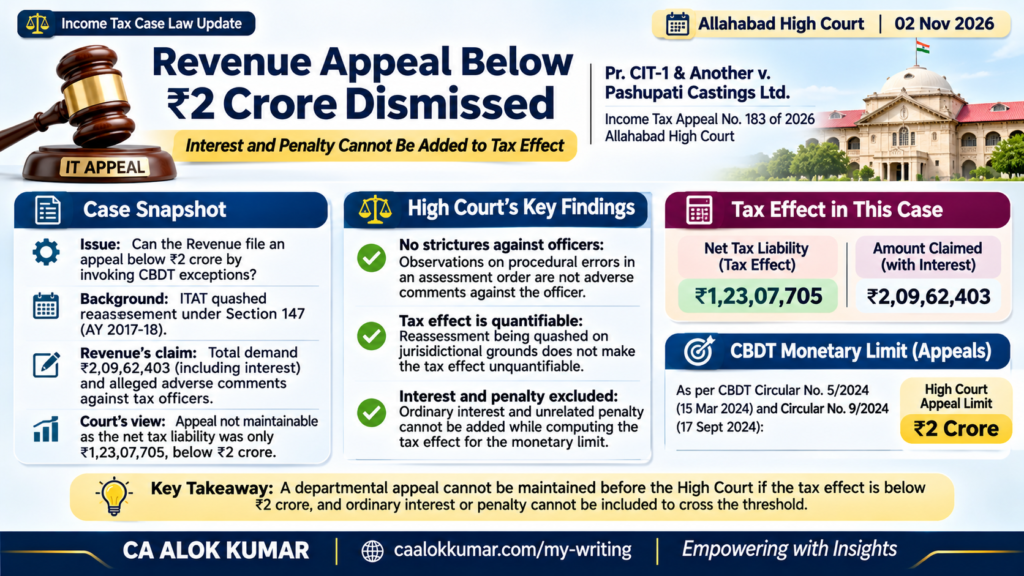
Income Tax Appeal Below ₹2 Crore: The Allahabad High Court has dismissed a departmental appeal because the relevant tax effect was only ₹1,23,07,705—below the prescribed ₹2 crore threshold for Revenue appeals before a High Court. The Department had relied on a larger figure of ₹2,09,62,403 that included interest.
In Pr. Commissioner of Income Tax-1 & Another v. Pashupati Castings Ltd., Income Tax Appeal No. 183 of 2026, decided on 2 November 2026, the Court rejected the Department’s attempts to treat ordinary interest as part of tax effect or to invoke exceptions for alleged adverse strictures and unquantifiable tax effect.
The key distinction: The ₹2 crore threshold arises from CBDT Circular No. 9/2024 dated 17 September 2024, which amended the monetary limits in Circular No. 5/2024 dated 15 March 2024. The rules for computing tax effect and relevant exceptions must be read together.
Income Tax Appeal Below ₹2 Crore Dismissed: What happened in Pashupati Castings?
For AY 2017–18, the Income Tax Department reopened the assessment under Section 147 of the Income-tax Act, 1961. The ITAT Agra, in ITA No. 19/AGR/2026 dated 17 March 2026, quashed the reassessment on jurisdictional grounds concerning compliance with the amended Sections 148A and 151.
The Revenue appealed to the Allahabad High Court. At the threshold, the company argued that the appeal was not maintainable because the applicable tax effect was less than ₹2 crore. The High Court therefore examined maintainability rather than deciding whether the reassessment additions were otherwise justified.
Why did the Revenue claim the appeal could proceed?
First, a higher demand including interest: The Department referred to a combined demand of ₹2,09,62,403. The net tax component was ₹1,23,07,705; the balance of ₹86,54,698 represented interest.
Second, alleged strictures against officers: The Department argued that the ITAT’s observations about procedural lapses attracted Clause 3.1(e) of Circular 5/2024. The Court found these to be observations about the assessment process, not strictures or personal adverse comments against a tax officer.
Third, allegedly unquantifiable tax effect: The Department invoked Clause 3.1(f), submitting that because the ITAT had quashed reassessment on jurisdictional grounds, there was no quantifiable tax effect. The Court rejected that approach: the relevant tax amount was readily ascertainable.
Tax effect: ₹1.23 crore versus total demand of ₹2.09 crore
Net tax liability: ₹1,23,07,705
Interest component: ₹86,54,698
Total demand cited by Revenue: ₹2,09,62,403
High Court departmental-appeal threshold: ₹2,00,00,000
Shortfall below threshold: ₹76,92,295
The Court held that ordinary interest could not be combined with the tax liability simply to cross the appeal threshold. The Revenue’s appeal was consequently dismissed as not maintainable.
What do CBDT Circulars 5/2024 and 9/2024 provide?
Circular 5/2024 explains the policy for departmental appeals, the definition of tax effect and exceptions. Paragraph 5.1 generally measures tax effect by the difference in tax payable with and without the disputed issues, including surcharge and cess.
Ordinary interest is generally excluded from tax effect. There is an important exception: where the *chargeability of interest itself* is under dispute, the disputed interest may constitute tax effect. For an appeal concerning a penalty order, the circular separately treats the amount of penalty deleted or reduced as tax effect; it is therefore incorrect to say that every penalty amount is always excluded.
Circular 9/2024 raised the monetary limits for departmental appeals to ₹60 lakh before ITAT, ₹2 crore before High Courts and ₹5 crore before the Supreme Court. These thresholds are subject to the specified exceptions. Official Government explanation of revised thresholds.
Why did the two exceptions fail?
Procedural criticism is not automatically a stricture
The ITAT referred to defects in the reassessment procedure and relied upon an earlier coordinate-bench decision in Aseem Sehgal v. ITO. The High Court held that identifying an error in an assessment order does not, without more, amount to a personal adverse comment or stricture against the officer who made it.
Quashing reassessment does not always make tax effect unquantifiable
An assessment can be annulled on jurisdictional grounds while the potential tax consequence remains known from the assessment record. Here the Department itself could quantify the tax component. Clause 3.1(f) could therefore not be invoked merely because the underlying merits were not examined.
Why is this judgment important?
The ruling offers an important procedural objection when the Income Tax Department appeals an ITAT order despite a tax effect below the applicable threshold. It also warns against treating *total demand* and *tax effect* as interchangeable numbers.
Taxpayers and professionals should check the relevant year, disputed issues, computation of tax effect and any exceptions invoked before raising a monetary-limit objection. For broader proceedings, see our income-tax litigation and appellate representation guidance and faceless assessment and reassessment defence resources.
This is not a universal bar on all appeals below ₹2 crore. Cases falling within valid CBDT exceptions may still be pursued by the Department. The High Court did not decide the substantive reassessment dispute in this appeal.
Frequently asked questions
What is the CBDT monetary limit for High Court appeals?
For departmental income-tax appeals, the general tax-effect threshold is ₹2 crore under Circular 9/2024, subject to exceptions.
Is interest added when computing tax effect?
Ordinary interest is excluded. If the appeal specifically disputes the chargeability of interest, the disputed interest can itself be the tax effect.
Is penalty always excluded?
No. In an appeal against a penalty order, the amount of penalty deleted or reduced is the relevant tax effect under the circular. Unrelated penalty should not simply be added to a tax assessment appeal.
Does quashing reassessment mean the tax effect cannot be calculated?
Not necessarily. The Allahabad High Court held the amount was ascertainable on these facts even though the reassessment was quashed on jurisdictional grounds.
Can the Revenue appeal below ₹2 crore?
Yes, if a specified exception applies. The Department must establish that exception; it is not enough to describe a procedural error as an officer-specific stricture.
Conclusion
In Pr. CIT-1 v. Pashupati Castings Ltd., the Allahabad High Court dismissed the Revenue’s appeal because the relevant tax effect of ₹1.23 crore was below the ₹2 crore High Court monetary threshold. It rejected attempts to add ordinary interest, treat procedural observations as personal strictures, or call an otherwise ascertainable tax effect unquantifiable.
Practical takeaway: For departmental appeals, calculate tax effect according to CBDT Circular 5/2024 as amended by Circular 9/2024—not merely from the gross tax-and-interest demand. For a review of disputed assessments and appeals, see income-tax litigation services and income-tax demand response.
Sources and case references
Main judgment: Pr. Commissioner of Income Tax-1 & Another v. Pashupati Castings Ltd., Income Tax Appeal No. 183 of 2026, Allahabad High Court, 2 November 2026. Reported case analysis.
Underlying ITAT order: Pashupati Castings Ltd. v. ITO, ITA No. 19/AGR/2026, 17 March 2026; AY 2017–18.
Supporting Tribunal case: Aseem Sehgal v. ITO, ITA Nos. 154–156/Del/2025, 30 July 2025.
Regulatory sources: CBDT Circular No. 5/2024 and CBDT Circular No. 9/2024.
*Editorial note: The signed High Court judgment was not independently obtained for this package; cross-check the text before quoting it verbatim. This article is informational and is not case-specific advice.*
Leave a Reply