By CA Alok Kumar | Updated 17 November 2026
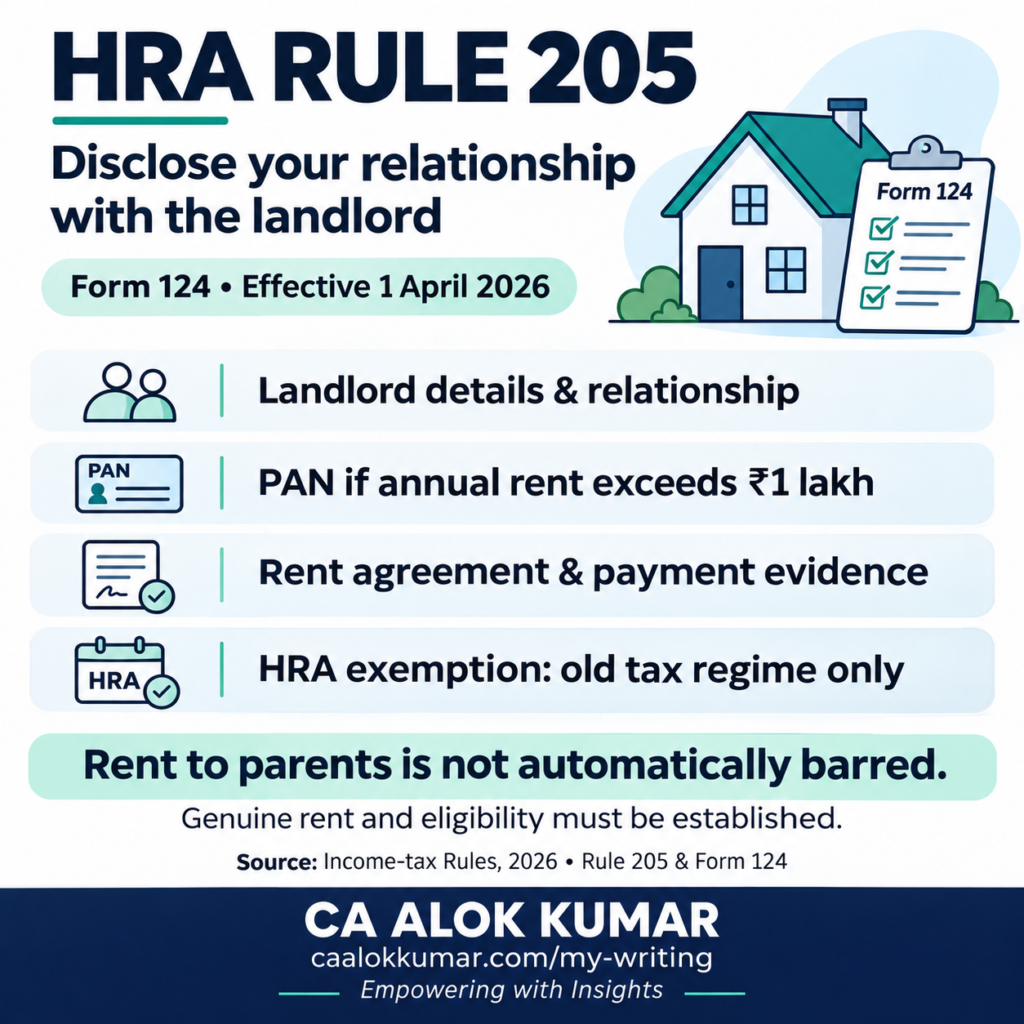
HRA Rule 205 requires employees seeking HRA relief through salary TDS to disclose their relationship with the landlord, if any, in Form 124. The requirement is genuine and forms part of the notified Income-tax Rules, 2026, effective from 1 April 2026. It does not, by itself, ban rent paid to parents or other relatives. [1][2]
For salaried taxpayers, the practical task is to disclose the arrangement accurately and support the claim with genuine records. A review of income tax return filing and salary tax claims should cover eligibility, evidence and the selected tax regime together.
Is the news about HRA Rule 205 authentic
Yes. CBDT notified the Income-tax Rules, 2026 through G.S.R. 198(E), dated 20 March 2026. Rule 205 and the notified Form 124 expressly provide for disclosure of the landlord relationship. This is an operative requirement, rather than merely the proposal discussed in reports about the draft rules. [1][2]
The correct legal description is Rule 205 of the Income-tax Rules, 2026, read with section 392(5)(b) of the Income-tax Act, 2025. Calling it Section 205, or treating it as a fresh November 2026 notification, would be inaccurate.
What Rule 205 requires employees to disclose
Rule 205 concerns evidence employees furnish to the employer for estimating taxable income and deducting tax from salary. Its HRA entry expressly includes “relationship with the landlord, if any”. [2]
The Department’s official guidance maps the earlier Form 12BB and Rule 26C to Form 124 and Rule 205 under the new framework. Form 124 is submitted to the employer; it is not an income tax return. [3]
What details are needed in Form 124 for HRA
The HRA portion of the notified form and its notes require the following information and supporting annexure. [4]
| Item | What the employee should provide |
|---|---|
| Landlord identification | Full name and address |
| Landlord PAN | Required where aggregate rent during the tax year exceeds ₹1,00,000 |
| Landlord Aadhaar | The form includes a field; the official FAQ says it is not mandatory unless the employer specifically requests it |
| Relationship | Disclose the actual relationship, if any |
| Rent amount | State the rent paid to the landlord |
| Supporting annexure | House rent agreement under Annexure A-1 |
The form allows the HRA details to be repeated where necessary, such as when there is more than one landlord. The Aadhaar clarification comes from the Department’s Form 124 FAQ. [3][4]
Practical approach: write “Father”, “Mother” or the correct relationship where relevant. For an unrelated landlord, “Not related” or “Not applicable” is clearer than leaving the field unexplained, subject to the employer’s format. These are suggested entries, not additional statutory categories.
Can you claim HRA when paying rent to parents
Rule 205 does not itself disallow an HRA claim merely because the landlord is a parent or another relative. This is an interpretation of the provision’s scope: it requires disclosure and evidence, while substantive eligibility must be examined separately.
Under Schedule III, Table serial number 11 of the Income-tax Act, 2025, the employee must actually incur rent for residential accommodation occupied by the employee, and that accommodation must not be owned by the employee. These conditions remain central to the claim. [5]
For a family rental arrangement, we recommend retaining:
- Evidence of the landlord’s ownership or legal entitlement to let the accommodation.
- A genuine rent agreement identifying the premises, period and payment terms.
- Rent receipts and a consistent payment trail; bank transfers make verification easier.
- Records supporting actual occupation.
- A review of the recipient’s rental-income reporting and return-filing obligations.
These records help explain the transaction; they do not guarantee exemption. A signed agreement cannot establish that rent was actually paid if the underlying transaction did not occur. Payments to a spouse, joint ownership or unusual fund movements deserve an individual review before a claim is made.
For assistance with the facts and supporting documents, consider income tax advisory services.
Is landlord PAN required below ₹1 lakh annual rent
The notified form’s Note 3 and the official FAQ specify the threshold as annual aggregate rent exceeding ₹1,00,000. This is not a ₹1 lakh exemption limit and does not remove the need to substantiate a claim below that amount. [3][4]
Do not assume that the same threshold excuses disclosure of an existing relationship. Form 124 contains a separate relationship field without a corresponding ₹1 lakh qualification. Complete it accurately when making the HRA claim. [4]
If a landlord does not provide PAN despite the applicable threshold being crossed, obtain case-specific advice before submission. Do not insert another person’s PAN or assume that Aadhaar automatically substitutes for the required PAN.
Is HRA exemption available under the new tax regime
No. Section 202(2)(a)(i) of the Income-tax Act, 2025 excludes the Schedule III serial number 11 exemption when computing income under the new regime. Completing Form 124 does not create eligibility for HRA exemption under that regime. [6]
Compare the overall tax liability under both regimes before deciding. HRA is one part of that comparison. Employees seeking help with salaried income tax return preparation should provide the complete salary structure and other relevant income and deductions.
How HRA exemption is calculated in Tax Year 2026 27
Rule 279 prescribes the least of:
1. Actual HRA received.
2. Rent actually paid minus 10% of eligible salary.
3. 50% of eligible salary for the specified cities, or 40% elsewhere.
The notified 50% list covers Mumbai, Kolkata, Delhi, Chennai, Hyderabad, Pune, Ahmedabad and Bengaluru. Use the relevant occupation period and the rule’s salary definition rather than total CTC. The exemption is subject to substantive eligibility and the applicable regime. [1]
Example of rent paid to a parent in Delhi
Assume an employee receives HRA, occupies a Delhi house owned solely by the employee’s mother and genuinely pays rent throughout the year. The employee is eligible to use the old regime. Assume the following annual figures, with eligible salary consisting only of basic salary:
| Particulars | Amount |
|---|---|
| Eligible salary | ₹8,00,000 |
| Actual HRA received | ₹3,60,000 |
| Actual rent paid | ₹3,00,000 |
| Rent less 10% of eligible salary | ₹2,20,000 |
| 50% of eligible salary | ₹4,00,000 |
The illustrative exemption is the lowest amount: ₹2,20,000. The remaining ₹1,40,000 of HRA is taxable. The employee should disclose “Mother” as the relationship and provide the required particulars and evidence. This calculation assumes all underlying conditions are satisfied; it is not automatic approval of a family rent arrangement.
What employees and payroll teams should do now
Employees should:
1. Identify the correct tax year and applicable regime.
2. Complete the current Form 124 accurately.
3. Reconcile the agreement, rent amounts, payment evidence and occupation period.
4. Give the correct landlord particulars and relationship disclosure.
5. Submit the form and supporting evidence within the employer’s payroll timetable.
Employers should update declaration templates, explain the information required, document queries and record the basis for accepting claims. Payroll review should focus on evidence and eligibility. A relationship disclosure alone is not a finding that a claim is false.
For support with employee declarations and salary withholding, see TDS compliance services.
Frequently asked questions
Is Rule 205 already effective
Yes. The Income-tax Rules, 2026 took effect on 1 April 2026. Apply the correct framework for the relevant tax year. [1]
Does paying rent to parents automatically disqualify HRA
Rule 205 contains no such automatic prohibition. Genuine payment, occupation, ownership, regime eligibility and the other applicable conditions must still be examined. [2][5]
Must Form 124 be uploaded on the income tax portal
The official FAQ says it may be submitted to the employer electronically or physically and need not be separately uploaded on the income tax portal. [3]
Is a rent agreement required with Form 124
The notified form lists the house rent agreement as Annexure A-1, and the official FAQ identifies a copy of the rent agreement as HRA supporting evidence. [3][4]
Is landlord Aadhaar compulsory in every case
The official FAQ says Aadhaar is not mandatory unless specifically requested by the employer. This clarification should be read separately from the PAN threshold. [3]
The practical takeaway
HRA Rule 205 makes accurate landlord relationship disclosure part of the employer declaration process. Employees should support genuine rental arrangements with consistent records, calculate the exemption correctly and confirm regime eligibility before claiming relief.
CA Alok Kumar
FCA, LLM, AICA, AML Specialist, B.Com(H)
caalokkumar.com/my-writing — Empowering with Insights
This article provides general information. The treatment of an individual claim depends on its facts and the law applicable to the relevant period.
Official sources
1. CBDT notified Income-tax Rules, 2026 — G.S.R. 198(E), 20 March 2026. See commencement on Gazette page 1533, Rule 205 on page 1687, Rule 279 on page 1776, and Form 124 on pages 2251–2252.
2. Income Tax Department — Rule 205.
3. Income Tax Department — Form 124 official FAQs, particularly Questions 1, 3, 4, 5 and 6.
4. Income Tax Department — notified Form 124.
5. Income-tax Act, 2025 — Schedule III, Table serial number 11.
6. Income-tax Act, 2025 — section 202, subsection (2)(a)(i).
Leave a Reply