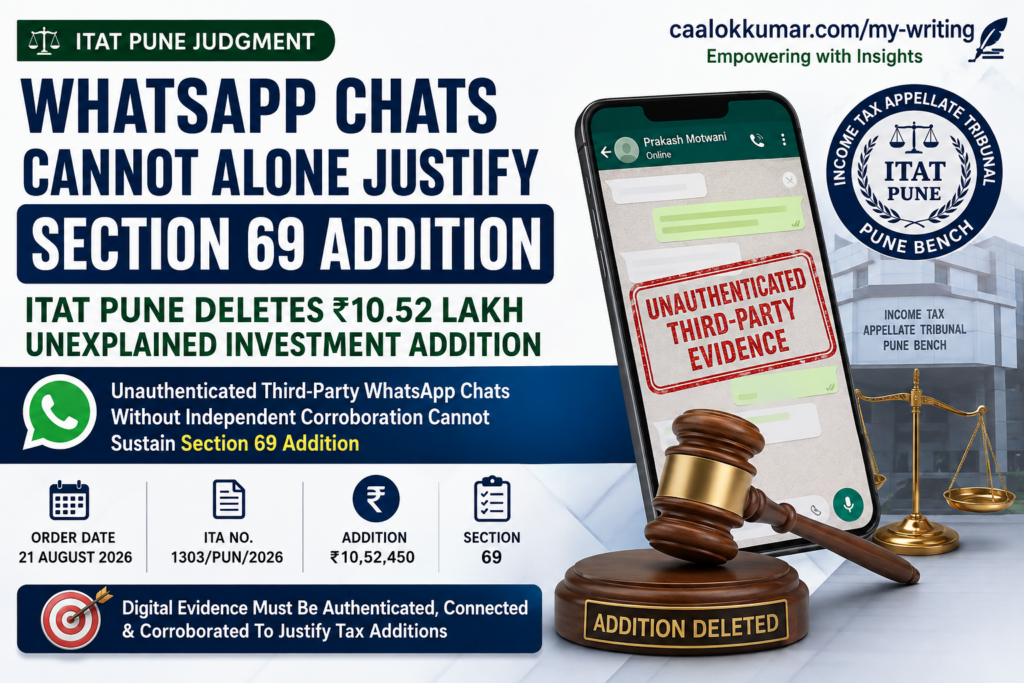
WhatsApp Chats Section 69 Addition : ITAT Pune Deletes ₹10.52 Lakh Addition
WhatsApp Chats Section 69 Addition has emerged as an important issue in income-tax proceedings involving digital evidence. In a significant ruling, the ITAT Pune has held that unauthenticated WhatsApp chats recovered from a third party’s mobile phone, without independent corroborative evidence, cannot by themselves justify an addition under Section 69 of the Income-tax Act.
Rameshwar Fakirchand Totala v. ITO, Ward-1(1), Aurangabad
ITA No. 1303/PUN/2026 | AY 2020-21 | ITAT Pune | Order dated 21 August 2026
Can the Income Tax Department make an addition merely because your name or mobile number appears in a WhatsApp conversation recovered from somebody else’s phone?
The Pune Bench of the Income Tax Appellate Tribunal has answered this important question in favour of the taxpayer.
In Rameshwar Fakirchand Totala v. ITO, the ITAT deleted an addition of ₹10,52,450 under Section 69 of the Income-tax Act, 1961, holding that WhatsApp chats recovered from a third party’s mobile phone, without proper authentication and without independent corroborative evidence, could not by themselves establish an unexplained investment by the assessee.
The ruling is particularly relevant in an era where income-tax search, investigation and reassessment proceedings increasingly involve digital material such as WhatsApp messages, mobile-phone data, spreadsheets, emails and other electronic records.
Taxpayers facing such proceedings should therefore carefully examine not merely what digital material has been cited by the Department, but also where it was recovered from, how it was authenticated and what independent evidence actually connects it with the taxpayer.
Case at a Glance
| Particular | Details |
|---|---|
| Case | Rameshwar Fakirchand Totala v. ITO |
| Forum | Income Tax Appellate Tribunal, Pune |
| Appeal | ITA No. 1303/PUN/2026 |
| Assessment Year | 2020-21 |
| Order Date | 21 August 2026 |
| Addition | ₹10,52,450 |
| Section involved | Section 69, Income-tax Act, 1961 |
| Evidence relied upon | WhatsApp chats recovered from third party’s mobile |
| ITAT decision | Addition deleted |
| Key principle | Unauthenticated third-party WhatsApp data without independent corroboration cannot by itself establish unexplained investment |
What Triggered the Income Tax Proceedings?
A search and seizure action under Section 132 of the Income-tax Act, 1961 was conducted on 30 November 2023 in the cases of the Manjeet Pride Group, Gadiya Group and associated entities.
During the search, the mobile phone of Shri Prakash Motwani was examined.
Certain WhatsApp chats were found which, according to the Income Tax Department, contained details relating to unaccounted “Bhisi” transactions involving several persons.
Information relating to the assessee, Rameshwar Fakirchand Totala, was thereafter forwarded by the Investigation Wing to his Assessing Officer.
Based upon this information, the assessee’s case was reopened by issuing notice under Section 148.
Taxpayers receiving similar reopening or scrutiny notices should not treat them as routine communications. A proper examination of the jurisdiction, underlying information and evidentiary material is essential while preparing an income tax notice and litigation response.
Why Was ₹10.52 Lakh Added Under Section 69?
The Assessing Officer alleged that the WhatsApp data indicated payments aggregating to ₹10,52,450 by the assessee towards Bhisi transactions during FY 2019-20.
The amount was consequently treated as an unexplained investment under Section 69.
Section 69 essentially applies where:
- an assessee has made an investment;
- the investment is not recorded in the books of account, where maintained; and
- the assessee either offers no explanation regarding its nature and source or the explanation is considered unsatisfactory by the Assessing Officer.
Therefore, an important factual requirement remains: there must first be material capable of establishing that an investment was actually made by the assessee.
A mere reference to a taxpayer in somebody else’s electronic records does not automatically establish an actual investment or cash payment.
What Was Missing in the Department’s Case?
This became the decisive issue before the ITAT.
The Department had the WhatsApp chats.
But what independent evidence established that the assessee actually paid ₹10,52,450?
The Tribunal noted the absence of independent material establishing an actual investment by the assessee.
There was no independent evidence such as:
- actual movement of money from the assessee;
- corresponding bank transactions;
- cash-book entries;
- asset acquisition;
- admission by the assessee; or
- other corroborative evidence independently proving the alleged investment.
The entire addition was effectively founded upon WhatsApp data retrieved from another person’s mobile phone.
That distinction proved crucial.
Section 132(4A): Presumption Cannot Automatically Travel to a Third Party
Another significant aspect of the judgment concerns the statutory presumption available during search proceedings.
Under Section 132(4A), where books, documents, money, bullion, jewellery or other valuable articles or things are found in the possession or control of a person during a search, certain presumptions may be drawn regarding their ownership and the truthfulness of the contents of such documents.
But whose possession was the mobile phone in this case?
It was the mobile phone of Shri Prakash Motwani — not the assessee.
The ITAT therefore observed that the presumption associated with material recovered during search could not simply be extended so as to bind another taxpayer.
In practical terms:
Material found from Person A cannot automatically become conclusive evidence against Person B merely because Person B’s name or mobile number appears in it.
The Revenue must establish an independent nexus between the seized material and the person against whom the addition is proposed.
This principle assumes considerable importance in search-related assessments involving diaries, Excel sheets, loose papers, mobile messages and other documents recovered from third parties.
Are WhatsApp Chats Valid Evidence in Income Tax Proceedings?
WhatsApp chats can certainly be relevant evidence.
But this judgment should not be interpreted as laying down a blanket proposition that WhatsApp messages can never be relied upon by the Income Tax Department.
The real issue is their authenticity, reliability and corroboration.
In this case, the Tribunal specifically noted that the authenticity of the WhatsApp material had not been established through the required electronic-evidence certification and that the Department had not demonstrated compliance with the requirements concerning extraction/authentication of electronic evidence.
The ITAT referred to the Supreme Court decision in:
Arjun Panditrao Khotkar v. Kailash Kushanrao Gorantyal, (2020) 7 SCC 1
concerning the requirements applicable to electronic records under Section 65B of the Indian Evidence Act, 1872.
The Tribunal also referred to Section 79A of the Information Technology Act, 2000 while considering the manner in which electronic evidence had been extracted/authenticated.
Most importantly, the WhatsApp data was not supported by independent evidence demonstrating an actual payment by the assessee.
WhatsApp Message Is Not Automatically an “Investment” Under Section 69
This is perhaps the most practically important takeaway from the decision.
Section 69 deals with an investment made by the assessee.
Therefore, before asking the taxpayer to explain the source of an investment, there must be sufficient material demonstrating that the investment was actually made by that taxpayer.
The existence of a chat mentioning an amount does not necessarily establish:
Chat → Payment → Investment → Unexplained Investment
Each factual link must be supported by reliable material.
Where there is no bank entry, cash trail, corresponding asset, admission or other corroborative evidence, jumping directly from an electronic conversation to an unexplained investment may not satisfy the evidentiary threshold required for an addition.
What Did ITAT Pune Finally Hold?
The Tribunal found that:
- the entire basis of the addition was WhatsApp chats retrieved from Shri Prakash Motwani’s mobile phone;
- the material was recovered from a third party;
- the presumption under Section 132(4A) could not automatically bind the assessee;
- the authenticity of the WhatsApp chats had not been established through the electronic-evidence requirements considered by the Tribunal;
- the Revenue had not demonstrated the required compliance concerning extraction/authentication of the electronic data; and
- there was no other independent evidence available with the Department apart from the WhatsApp chats to establish the alleged investment.
The ITAT accordingly set aside the CIT(A)/NFAC order and directed the Assessing Officer to delete the addition of ₹10,52,450.
The assessee’s appeal was allowed.
Important Supreme Court Decisions Relevant to Third-Party Evidence
The proceedings also involved reference to several important judicial principles.
1. Arjun Panditrao Khotkar v. Kailash Kushanrao Gorantyal
(2020) 7 SCC 1
The Supreme Court examined the requirements governing admissibility of electronic records and Section 65B certification.
2. CIT v. Odeon Builders Pvt. Ltd.
(2019) 110 taxmann.com 64 (SC)
Relevant to additions founded upon third-party information without adequate independent verification.
3. Kishinchand Chellaram v. CIT
(1980) 125 ITR 713 (SC)
Material relied upon against an assessee must be appropriately confronted and the taxpayer must receive an effective opportunity to controvert it.
4. Andaman Timber Industries v. CCE
(2015) 127 DTR 241 (SC)
An important authority concerning cross-examination where third-party statements are relied upon against a person.
5. P.R. Metrani v. CIT
(2006) 287 ITR 209 (SC)
Relevant to understanding the nature and scope of presumptions arising from search proceedings.
These decisions collectively reinforce an important principle: tax assessment may involve reasonable inference, but an addition still requires reliable evidentiary foundation.
Does This Judgment Mean Every WhatsApp-Based Tax Addition Will Fail?
No.
That would be an overbroad reading of the decision.
Suppose WhatsApp chats are supported by:
- bank withdrawals or deposits;
- cash books or parallel accounts;
- matching ledger entries;
- documents recovered from the taxpayer himself;
- property or asset purchases;
- statements specifically identifying the taxpayer;
- admissions made by the taxpayer;
- independently verified transaction details; or
- properly authenticated digital records.
In such circumstances, electronic communication could become a powerful piece of corroborative evidence.
The important distinction in Rameshwar Fakirchand Totala was that the WhatsApp data recovered from the third party essentially stood alone against the assessee.
The decision is therefore better understood as:
WhatsApp evidence may support a tax addition, but an unauthenticated third-party WhatsApp chat cannot automatically substitute proof of the underlying transaction.
What Should You Do If an Income Tax Notice Relies on WhatsApp Chats or Third-Party Data?
If an assessment, reassessment or search-related notice relies upon digital information recovered from another person, examine the evidence systematically.
Check 1 — Where was the material recovered?
Was it recovered from your own device or from somebody else’s phone, laptop or computer?
Check 2 — What exactly connects you to the material?
A name, abbreviation or mobile number appearing in a chat may not by itself establish the alleged transaction.
Check 3 — Has the complete material been provided?
Ask whether you have received the complete WhatsApp conversation, relevant extracts, statements and documents relied upon by the Assessing Officer.
Check 4 — Is the electronic record authenticated?
Examine how the data was extracted, preserved and authenticated.
Check 5 — Is there independent corroboration?
Look for the actual money trail — bank transaction, cash movement, books, property, investment, confirmation or other evidence.
Check 6 — Is a third-party statement being relied upon?
If so, consider whether an appropriate opportunity to rebut the statement or seek cross-examination is required on the facts of the case.
Check 7 — Does the material satisfy the charging/deeming provision itself?
For Section 69, the fundamental question remains whether the Department has established an investment made by the assessee before requiring an explanation regarding its source.
Where a matter has already progressed into assessment, reassessment, CIT(A) or ITAT proceedings, specialised income tax litigation and appellate representation may become important because factual evidence and legal objections should ordinarily be raised at the appropriate stage.
Income-tax Act, 1961 or Income-tax Act, 2025 — Which Applies?
This point needs clarity because the ITAT order was delivered in August 2026, after the new Income-tax Act, 2025 came into force.
The case, however, concerns Assessment Year 2020-21 and the proceedings arise under the Income-tax Act, 1961.
Professionals and taxpayers dealing with old and new provisions can use our Income-tax Act 1961 ↔ 2025 Section Finder to locate corresponding provisions and section numbers.
This is particularly useful while handling legacy assessments, appeals and current proceedings during the transition to the new Act.
Why This ITAT Pune Judgment Matters
Tax investigations are becoming increasingly digital.
Mobile phones can contain years of WhatsApp chats, screenshots, payment discussions, photographs, spreadsheets and documents. Search and investigation authorities can therefore uncover substantial digital information.
But digital availability is not the same thing as evidentiary reliability.
The Rameshwar Fakirchand Totala decision highlights three important safeguards:
Authentication: Is the electronic record genuine and properly established?
Connection: Does it actually relate to the taxpayer against whom it is being used?
Corroboration: Is there independent evidence proving the underlying financial transaction?
These questions can become particularly important while responding to an income tax reassessment or faceless assessment proceeding.
Final Takeaway
The ITAT Pune ruling provides an important safeguard against income-tax additions founded entirely upon unverified third-party electronic material.
The decision does not make WhatsApp chats irrelevant for tax proceedings.
Instead, it reinforces a more fundamental principle:
A digital message can be evidence, but it does not automatically prove the transaction alleged by the Revenue.
Where WhatsApp chats are recovered from another person’s mobile phone, the Department must establish a reliable nexus with the taxpayer and support the allegation with legally reliable and, where required, corroborative material.
For an addition under Section 69, there must ultimately be adequate material demonstrating that the assessee actually made the alleged investment.
In Rameshwar Fakirchand Totala v. ITO, that evidentiary foundation was found wanting. The ITAT therefore directed deletion of the ₹10.52 lakh unexplained-investment addition.
Case Citation
Disclaimer: This article is intended for professional and educational information and does not constitute legal or tax advice. The applicability of a judicial decision depends upon the facts, assessment year, statutory provisions and evidence involved in each case.
Leave a Reply