Income Tax Case Law | 2 November 2026 | Tax Litigation & Taxpayer Rights
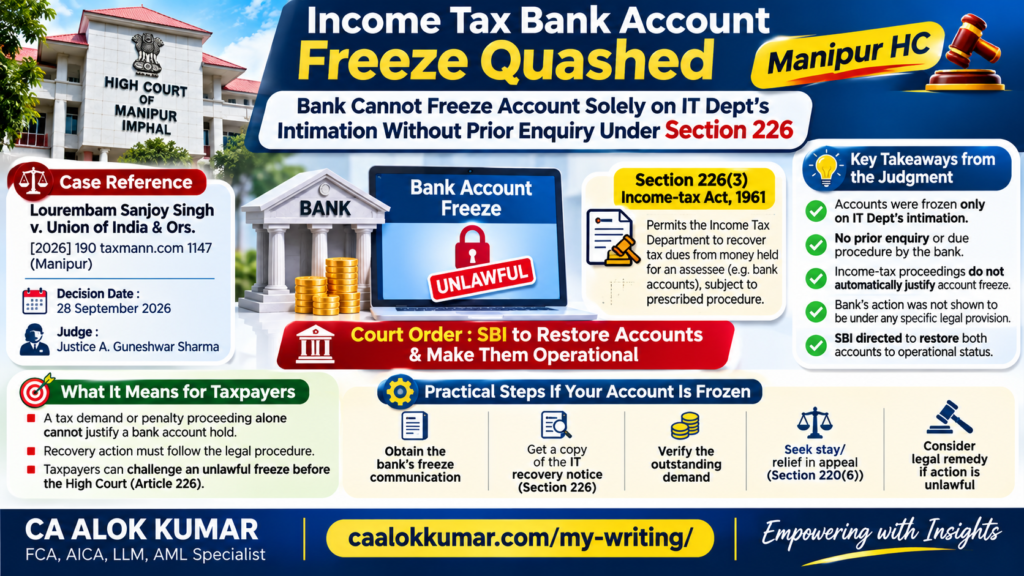
Income Tax Bank Account Freeze : In a significant ruling on recovery proceedings, the Manipur High Court set aside the withholding of two State Bank of India (SBI) accounts after finding that the bank’s action, based solely on an Income Tax Department intimation, was not shown to follow the necessary legal procedure.
In Lourembam Sanjoy Singh v. Union of India & Others, WP(C) No. 509 of 2026, decided on 28 September 2026, the Court directed SBI to restore both the savings and current accounts to operational status. Importantly, it did not cancel the underlying penalty or restrain the Department from pursuing proceedings in accordance with law.
The ruling highlights the difference between a lawful recovery notice under Section 226(3) of the Income-tax Act, 1961 and a bank-account hold without a demonstrated statutory basis.
Case Details: Lourembam Sanjoy Singh v. Union of India – Income Tax Bank Account Freeze under Section 226 quashed by Manipur High Court
| Particular | Details |
| Court | High Court of Manipur, Imphal |
| Case | Lourembam Sanjoy Singh v. Union of India & Others |
| Writ petition | WP(C) No. 509 of 2026 |
| Date of decision | 28 September 2026 |
| Bench | Justice A. Guneshwar Sharma |
| Reported citation | [2026] 190 taxmann.com 1147 (Manipur) |
| Relevant law | Section 226(3), Income-tax Act, 1961 |
| Result | SBI directed to restore both bank accounts; tax proceedings left open |
Core issue: Whether SBI could withhold the petitioner’s bank accounts solely on a tax-department intimation when its decision was not shown to follow the requisite legal procedure.
Background: Why Were the SBI Accounts Placed on Hold?
The petitioner maintained a savings account and a current account with SBI. Penalty proceedings were initiated for defaults related to Assessment Years 2019-20 and 2020-21. His challenge against the penalty was pending before the Commissioner of Income Tax (Appeals), Guwahati.
During the pendency of that appeal, the Income Tax Officer issued a notice to SBI under Section 226(3), seeking details of account balances and requesting an immediate stop on debit transactions. SBI thereafter placed both accounts on hold.
The petitioner moved the High Court but confined his challenge to the withholding of his bank accounts, without asking the Court to decide the correctness of the tax penalty.
Income Tax Bank Account Freeze Quashed: What Did the Manipur High Court Hold?
1. Accounts were withheld solely on the Department’s intimation
On examining SBI’s communication, the Court found that the accounts had been withheld because of the tax authority’s intimation. The bank’s letter did not reflect a prior enquiry and the action was not shown to have been taken under a specific legal provision or in accordance with due procedure.
2. Income-tax proceedings do not automatically authorise a freeze
The mere initiation of proceedings against an assessee does not, by itself, validate restrictions on bank accounts. Recovery actions must be tied to a legally available power and its prescribed safeguards.
3. Hardship caused by withholding both accounts was material
The Court considered the petitioner’s contention that the holds impeded his ordinary financial affairs and even his ability to meet current return-filing obligations. The Court also noted that he was pursuing the statutory appeal against the penalty.
4. SBI was directed to make the accounts operational
The High Court set aside SBI’s withholding letter and directed restoration of both accounts. It expressly refrained from commenting on the merits of the income-tax proceedings, leaving the parties free to pursue lawful remedies.
Section 226(3): How Income-tax Recovery Through Banks Works
Section 226(3) establishes a garnishee mechanism. Subject to its statutory conditions, an income-tax authority may require a person, including a bank, who owes or holds money for an assessee to pay the specified amount towards tax arrears.
The procedure contemplates a written notice, a copy to the assessee, and compliance by its recipient where the notice is legally valid. The law authorises recovery but not arbitrary restrictions divorced from the terms of the statute.
For taxpayers responding to tax demands, see our guidance on income-tax demand notice response and recovery proceedings.
Does a Bank Have to Independently Investigate Every Tax Notice?
No such universal rule should be inferred. The High Court highlighted the absence of a demonstrated enquiry and legal basis in SBI’s action in the facts before it. A bank receiving a valid Section 226(3) notice ordinarily has legal duties to comply with that notice; the judgment should not be presented as granting banks discretion to ignore a valid garnishee notice.
The distinction is between compliance with a lawful recovery direction and imposing an account hold that is not shown to rest on proper statutory authority and procedure.
Does an Appeal Before CIT(A) Automatically Stop Recovery?
No. Filing an income-tax appeal does not itself stay recovery. For cases governed by the Income-tax Act, 1961, Section 220(6) permits the Assessing Officer, subject to the statutory framework and appropriate discretion, to treat the taxpayer as not being in default during the pendency of an appeal.
Where the demand is disputed, taxpayers should consider the applicable stay mechanism and seek advice regarding tax litigation and appellate remedies.
What to Do If an Income-tax Notice Results in a Bank Freeze
- Obtain SBI’s or the relevant bank’s written freeze/hold communication and identify the authority, date and scope.
- Obtain the Section 226(3) notice or other statutory order relied upon; inspect the actual directions.
- Reconcile the disputed demand against assessment or penalty orders, challans, appellate records and portal data.
- Check whether the tax authority and bank acted within the relevant statutory procedure and whether restrictions exceeded the lawful notice.
- If an appeal is pending, consider an appropriate stay or non-default request under Section 220(6), where applicable.
- Where material procedural or jurisdictional defects remain, consider suitable representation and judicial remedies, including Article 226 proceedings where maintainable.
For professional help in understanding a tax notice, the original order and recovery communication should be reviewed together.
Practical Implications for Individuals and Businesses
Freezing a bank account can impede salary payments, vendor settlements, statutory payments and personal expenses. The Manipur High Court decision underscores that a taxpayer’s pending dispute and the validity of a bank-account restriction are two distinct questions, requiring separate legal assessment.
The judgment does not extinguish legitimate tax demands. It reinforces that coercive recovery measures must remain within statutory limits and should be open to effective challenge where the legal requirements are not met.
Taxpayers should also maintain timely income-tax return filing compliance and supporting records while disputing demands.
Frequently Asked Questions
Can the Income Tax Department freeze a bank account under Section 226?
A bank may be required to remit money or comply with a valid recovery direction under Section 226(3), subject to the prescribed conditions and the notice’s lawful scope.
Can a bank freeze an account merely because tax proceedings are pending?
The existence of proceedings does not automatically justify every account restriction. The action must be supported by an applicable statutory mechanism and due procedure.
What did the Manipur High Court decide in this case?
It set aside SBI’s account-hold communication and directed restoration of the petitioner’s savings and current accounts.
Does a CIT(A) appeal automatically stop recovery?
No. A separate application for protection from recovery may be required under the applicable law.
Can the account holder approach the High Court?
In appropriate circumstances, a writ petition may be considered where jurisdictional or procedural illegality is alleged, subject to maintainability.
Did the High Court cancel the income-tax penalty?
No. The Court expressly reserved the underlying tax proceedings and confined its decision to the bank-account hold.
Conclusion: Tax Recovery Must Follow Lawful Procedure
In Lourembam Sanjoy Singh, the Manipur High Court concluded that the account-hold action was not shown to have followed the required procedure. It directed SBI to restore both accounts without deciding the merits of the pending tax penalty dispute.
The practical lesson is that income-tax recovery powers are real and enforceable, but bank-account restrictions must be justified under the governing statute. Taxpayers should examine the precise notice, bank communication and status of any appeal before challenging a freeze.
For guidance on income-tax demand and recovery matters, properly documented representations and relevant orders are essential.
Case Citation and Official Legal References
Income-tax Act, 1961 — Section 226(3) (recovery through third parties).
Income-tax Act, 1961 — Section 220(6) (disputed demand pending appeal).
Constitution of India — Article 226 (High Court writ jurisdiction).
Disclaimer: This article is for general professional information. The legality of any attachment or recovery action depends on the individual record and the law applicable to the relevant tax year. The judgment should not be understood as cancelling the underlying demand or as a universal bar to a bank’s compliance with a valid garnishee notice.
Leave a Reply