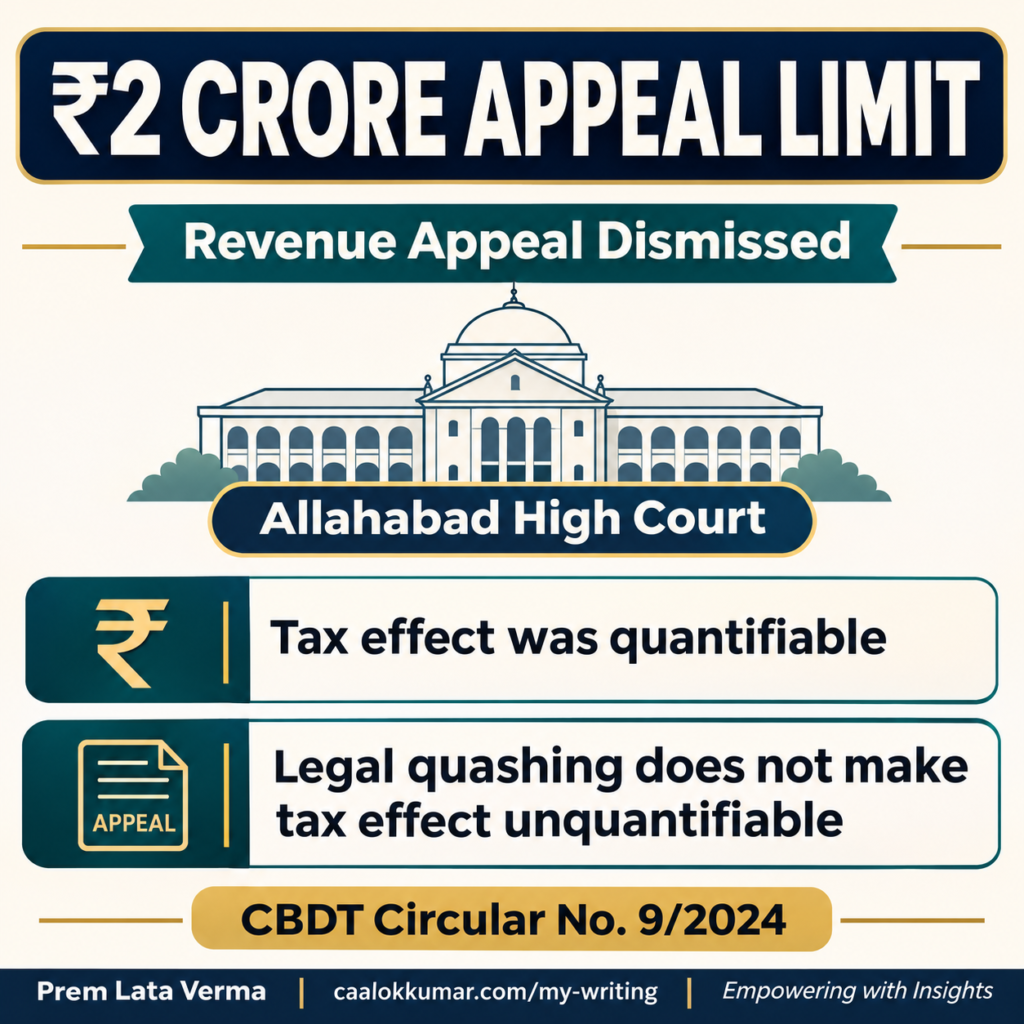
The Allahabad High Court has clarified an important aspect of the CBDT ₹2 crore appeal limit for departmental High Court appeals. Where an assessment has already produced a quantifiable tax effect, that effect does not become unquantifiable merely because the proceeding is later quashed on a legal ground.
The Revenue therefore cannot bypass the monetary threshold only by arguing that the Tribunal decided the matter on jurisdiction, limitation or non-service of notice rather than on the merits of the addition. Professional support may be obtained for departmental appeals and income-tax litigation.
Case at a Glance
| Case | Principal Commissioner of Income Tax-1 & Another v. Prem Lata Verma |
| Court | Allahabad High Court |
| Appeal number | Income Tax Appeal No. 181 of 2026 |
| Order date | 27 October 2026 |
| ITAT order | ITA No. 441/Agra/2025 dated 15 January 2026 |
| Reassessment order | 30 March 2021 under Sections 147/144 |
| Assessed income stated | ₹1,41,74,009 |
| Outcome | Revenue appeal dismissed as below the ₹2 crore tax-effect threshold |
Big Relief Under CBDT’s ₹2 Crore Appeal Limit: Background of the Dispute
The Assessing Officer completed reassessment under Sections 147 and 144 on 30 March 2021. The ITAT Agra Bench subsequently quashed the proceedings by its order dated 15 January 2026.
When the Revenue filed an appeal under Section 260A, the taxpayer raised a preliminary objection that the tax effect was below the prescribed High Court threshold.
What Is the Current Monetary Limit?
CBDT Circular No. 9/2024 dated 17 September 2024 revised the departmental thresholds to ₹60 lakh for the ITAT, ₹2 crore for the High Court and ₹5 crore for the Supreme Court. The official Circular No. 9/2024 applies subject to the exceptions in Circular No. 5/2024.
The circular also clarifies that an appeal should not be filed merely because the tax effect exceeds the limit; merits and the objective of reducing unnecessary litigation must still be considered.
Revenue’s “Unquantifiable Tax Effect” Argument
The Revenue relied on paragraph 3.1(f) of CBDT Circular No. 5/2024. That exception covers cases where tax effect is not quantifiable or not involved, with illustrations such as certain registration proceedings and some Section 263 matters.
It argued that because the reassessment had been quashed on a legal ground, the case should be treated as unquantifiable.
Why the High Court Rejected It
The reassessment order had already quantified the disputed income and tax consequences. Quashing that order for a legal defect did not erase the ability to calculate tax effect.
The exception is aimed at genuinely unquantifiable cases—for example, where a registration or revision order does not itself determine the ultimate tax liability. It is different from an assessment that has already computed the disputed income.
Since the case did not fall within the claimed exception and the tax effect was below ₹2 crore, the appeal was dismissed as not maintainable.
Assessed Income Is Not Tax Effect
The ₹1,41,74,009 figure referred to in the proceedings was the assessed-income figure, not automatically the tax effect. Tax effect is broadly the difference between tax on the assessed income and tax that would have been chargeable after excluding the disputed issue.
Interest is generally excluded unless chargeability of interest is itself disputed. Separate rules apply to penalties, losses and specified regimes. A proper issue-wise calculation is therefore essential.
Practical Implications
- Verify which CBDT circular applies on the relevant date and whether it covers pending appeals.
- Prepare an issue-wise tax-effect computation rather than relying on the addition or assessed-income figure.
- Examine every exception in paragraphs 3.1 and 3.2 of Circular No. 5/2024.
- Raise the monetary-limit objection at the earliest stage with the assessment order, computation, Tribunal order and circulars.
- Continue defending jurisdiction and merits because the exception and calculation may remain disputed.
Frequently Asked Questions
What is the High Court monetary limit? Circular No. 9/2024 prescribes ₹2 crore of tax effect, subject to exceptions.
Can the Department appeal below ₹2 crore? Yes, where a recognised exception applies.
Does the limit apply to taxpayer appeals? No. It regulates departmental litigation policy.
Does low-tax-effect dismissal affirm the Tribunal on merits? Not necessarily; it is a maintainability decision under the litigation policy.
Read Also
- Big Relief in Stay of Income Tax Demand: Allahabad High Court Verdict
- Section 147A Reassessment Notices: Supreme Court Remand
- Income Tax Notice and Reassessment Consultation
Disclaimer
This article is intended for general information and professional discussion. It does not constitute legal or tax advice. Applicability depends on the facts, procedural history and law governing each case. The signed judicial order, official circulars and statutory provisions should be examined before taking action.
#CBDTCircular #IncomeTaxAppeal #TaxEffect #RevenueAppeal #AllahabadHighCourt #Reassessment #Section260A #TaxLitigation #TaxpayerRights #CAAlokKumar
Leave a Reply