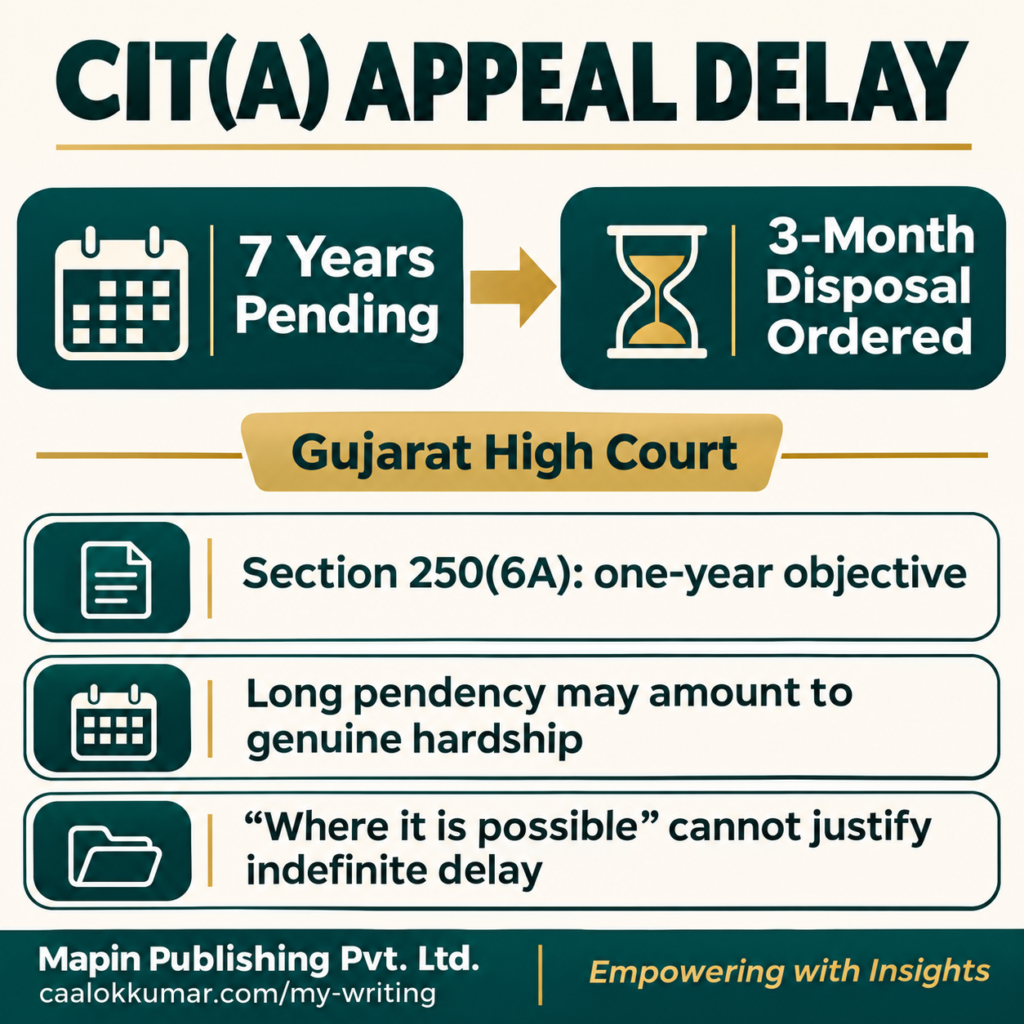
An income-tax appeal cannot remain pending indefinitely merely because Section 250(6A) uses the expression “where it is possible.” In an important ruling on CIT(A) appeal delay, the Gujarat High Court directed disposal of an appeal pending for approximately seven years within three months.
The Court held that prolonged pendency defeats the legislative intention of a reasonably time-bound appellate remedy and may amount to genuine hardship. Taxpayers dealing with old appeals may obtain CIT(A), ITAT and High Court representation.
Case at a Glance
| Case | Mapin Publishing Pvt. Ltd. v. ITO, Ward 2(1)(1), Ahmedabad & Ors. |
| Court | Gujarat High Court |
| Case number | R/Special Civil Application No. 8913 of 2026 |
| Order date | 22 October 2026 |
| Appeal filed | 19 January 2019 |
| Relevant provision | Section 250(6A), Income-tax Act, 1961 |
| Outcome | CIT(A) directed to decide the appeal within three months from receipt of the order |
Gujarat High Court Orders : What Was the Dispute?
Mapin Publishing Pvt. Ltd. filed its appeal before the Commissioner of Income Tax (Appeals) on 19 January 2019. Despite the passage of approximately seven years, the appeal remained undecided. The taxpayer approached the High Court seeking an expeditious-disposal direction.
The taxpayer relied on *Kulwinder Paul Singh v. CBDT*, where the Punjab and Haryana High Court had directed disposal of an appeal pending for almost five years within three months.
What Section 250(6A) Provides
Section 250(6A) states that the Joint Commissioner (Appeals) or Commissioner (Appeals), where possible, may hear and decide an appeal within one year from the end of the financial year in which it is filed or transferred. The official Income Tax Department limitation guide also records this one-year objective.
The provision is not an automatic limitation that invalidates the assessment when one year expires. It nevertheless expresses a clear legislative preference for prompt appellate decisions.
Gujarat High Court’s Findings
The expression “where it is possible” is not an unlimited escape clause. Administrative constraints may explain some delay, but cannot justify keeping an appeal unresolved year after year.
The Court referred to CBDT Letter F. No. 279/MISC./M-102/2021-ITJ dated 7 March 2024 on priority disposal. It held that an appeal pending beyond the contemplated period could fall within the fifth category, “any other case of genuine hardship.”
Considering the extraordinary delay, the Court directed the CIT(A) to decide the appeal within three months. It did not decide the underlying additions on merits.
Why the Ruling Matters
Prolonged appeal pendency can expose taxpayers to disputed demand, continuing interest, refund adjustment, recovery action, financial-statement uncertainty and difficulty in obtaining finance.
An appeal does not automatically stay recovery. Where a demand remains enforceable, the taxpayer should separately consider an income-tax demand response and stay application.
Practical Steps for Old Appeals
- Prepare a chronology covering the assessment, demand, Form 35 filing, acknowledgements, submissions, hearing notices and recovery events.
- Check whether the appeal is pending, allocated, defective or awaiting compliance on the portal.
- File a reasoned priority-disposal request explaining the age of appeal, taxpayer compliance and genuine hardship.
- Keep the paper book, written submissions and reconciliation hearing-ready.
- If representations remain unanswered and delay is extreme, obtain advice on appropriate writ relief under Article 226.
Frequently Asked Questions
Must every CIT(A) appeal be decided within one year? Section 250(6A) states a one-year objective “where it is possible”; it is not an automatic limitation cancelling the assessment.
Can a taxpayer seek out-of-turn disposal? Yes, a reasoned request may be made where CBDT priority categories or genuine hardship apply.
Does filing Form 35 stop recovery? No. A separate stay request may be required.
Did the High Court decide the tax dispute? No. It directed the appellate authority to decide it promptly.
Read Also
- Big Relief in Stay of Income Tax Demand: Allahabad High Court Verdict
- Income Tax Bank Account Freeze Quashed by Manipur High Court
- Income Tax Notice and Appeal Resolution Service
Disclaimer
This article is intended for general information and professional discussion. It does not constitute legal or tax advice. Applicability depends on the facts, procedural history and law governing each case. The signed judicial order, official circulars and statutory provisions should be examined before taking action.
#CITAppeal #IncomeTaxAppeal #Section250 #GujaratHighCourt #CBDT #FacelessAppeal #IncomeTaxDemand #TaxpayerRights #CAAlokKumar
Leave a Reply