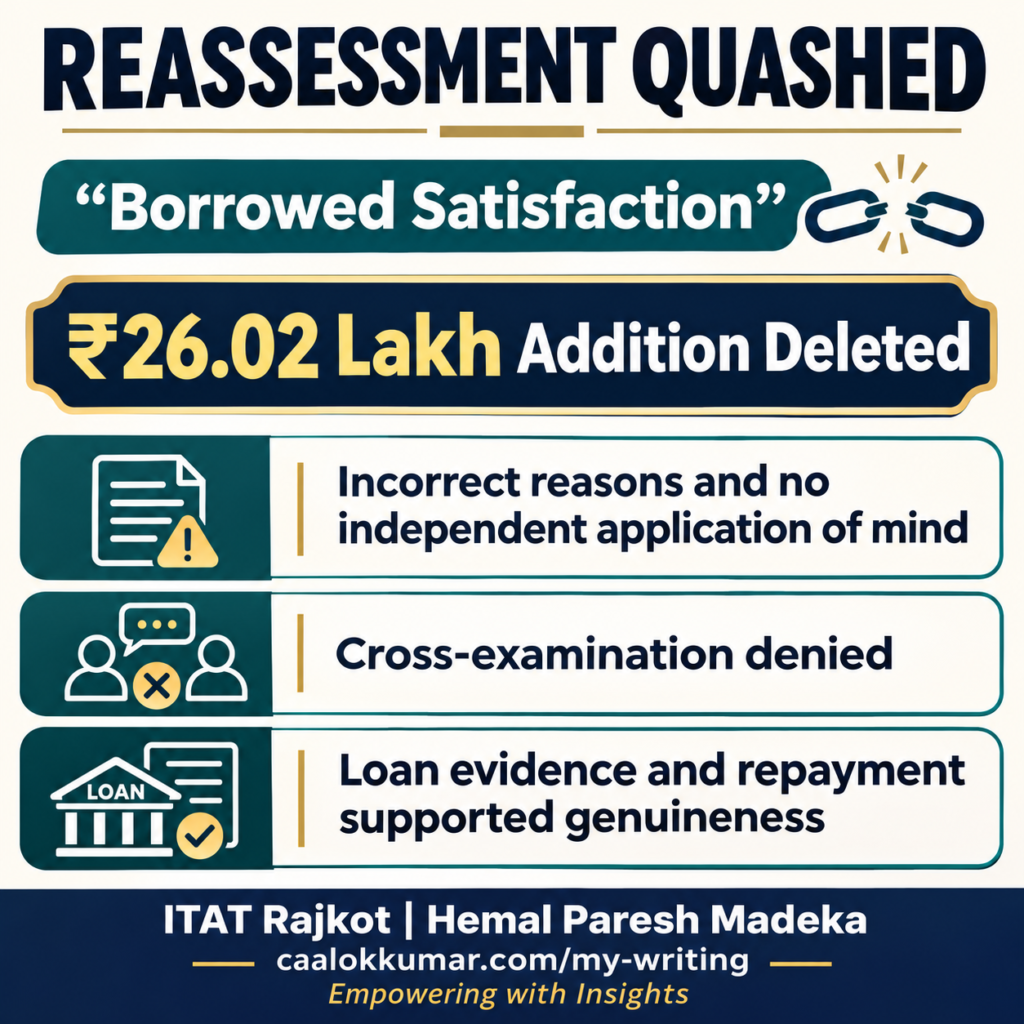
A reassessment cannot be opened merely by reproducing investigation information without independently examining whether the material actually establishes escapement of income. In *Hemal Paresh Madeka v. ACIT*, the ITAT Rajkot quashed a borrowed satisfaction reassessment and also deleted an addition of ₹26,02,186 relating to alleged accommodation-entry loans.
The Tribunal found problems at both levels: the jurisdictional reasons were based on incorrect premises and lacked independent application of mind, while the addition relied on third-party material without effective cross-examination despite documentary evidence supporting the loans. Taxpayers facing similar allegations may consider professional reassessment and tax litigation support.
Case at a Glance
| Case | Hemal Paresh Madeka v. ACIT, Circle-2(1), Rajkot |
| Forum | ITAT Rajkot |
| Appeal number | ITA No. 955/RJT/2026 |
| Order date | 19 October 2026 |
| Assessment year | AY 2020-21 |
| Disputed addition | ₹26,02,186 |
| Core issues | Borrowed satisfaction, factually incorrect reasons, lack of independent verification and denial of cross-examination |
| Outcome | Reassessment quashed and addition deleted |
Borrowed Satisfaction Reassessment Quashed : Background of the Case
The assessee filed the original return for AY 2020-21 on 8 January 2021, declaring total income of ₹62,19,410. Following search action against the Qutone Group and associated persons on 9 August 2022, the Assessing Officer alleged that the assessee had entered into accommodation-entry transactions involving Rajesh Janaklal Daftary and related persons or entities.
A notice under Section 148 was issued on 24 March 2024. The reassessment ultimately resulted in an addition of ₹26,02,186, comprising ₹10,39,973 relating to Bhoomi P. Vachhani and ₹15,62,213 relating to Rajesh J. Daftary. The CIT(A), NFAC, upheld the proceedings and addition.
Why the Reassessment Was Held Invalid
The Tribunal observed that the recorded reasons proceeded on borrowed satisfaction and factually incorrect assumptions. The Assessing Officer had not adequately verified the assessment record or independently connected the investigation material with taxable income escaping assessment.
The underlying transactions were already reflected in the books. Reassessment cannot be used merely to verify a recorded transaction or to conduct a fishing and roving inquiry. Relying on the Gujarat High Court decisions in *Vijay Ramanlal Sanghvi* and *Inductotherm (India) Pvt. Ltd.*, the Tribunal quashed the reopening.
Denial of Cross-Examination
The addition was also challenged because the Department relied on statements and material collected from third parties without giving an effective opportunity to cross-examine the persons concerned.
Where a statement is used as substantive adverse material, the taxpayer must receive a fair opportunity to test its credibility. This principle is supported by the Supreme Court rulings in *Andaman Timber Industries* and *Kishinchand Chellaram*. A generic investigation conclusion cannot replace evidence linking the taxpayer to the alleged accommodation entry.
Documentary Evidence Supporting the Loans
The assessee produced ledger accounts, PAN details, bank statements, confirmations and repayment particulars. The loans were recorded in the books and were repaid in the subsequent year.
The Tribunal also relied on *CIT v. Ayachi Chandrashekhar Narsangji*, where the Gujarat High Court considered the acceptance of repayment in a subsequent year relevant to the cash-credit issue. On the combined facts, the addition of ₹26,02,186 was deleted.
Practical Lessons for Reassessment Cases
- Obtain and examine the exact reasons or information forming the basis of reopening.
- Identify factual errors, mismatched names, duplicated amounts and transactions already disclosed in the books.
- Demand copies of third-party statements, digital extracts and material proposed to be used against the taxpayer.
- Request cross-examination specifically and explain why it is necessary.
- File a complete evidence trail including confirmations, PAN, bank statements, ITR acknowledgements, financial statements, utilisation and repayment proof.
- Address both jurisdiction and merits; success on one ground should not leave the other undefended.
Frequently Asked Questions
What is borrowed satisfaction? It describes reopening where the Assessing Officer merely adopts another authority’s conclusion without independently analysing the material and forming the statutory belief.
Does investigation information have no value? It may constitute relevant information, but the Assessing Officer must verify it and establish a rational link with the taxpayer and alleged escapement.
Is cross-examination required in every case? It becomes critical where a third-party statement is relied upon as substantive adverse evidence.
Does repayment automatically prove a loan is genuine? No. It is relevant evidence but must be examined with identity, creditworthiness, genuineness and the complete banking trail.
Read Also
- Third-Party Statement Insufficient Without Cross-Examination: ITAT Delhi
- Reopening under Sections 147 and 148: Supreme Court Analysis
- WhatsApp Chats and Section 69: Third-Party Evidence Explained
Disclaimer
This article is intended for general information and professional discussion. It does not constitute legal or tax advice. Applicability depends on the facts, procedural history and law governing each case. The signed judicial order, official circulars and statutory provisions should be examined before taking action.
#Reassessment #Section147 #BorrowedSatisfaction #CrossExamination #AccommodationEntry #ITATRajkot #TaxLitigation #NaturalJustice #IncomeTaxNotice #CAAlokKumar
Leave a Reply