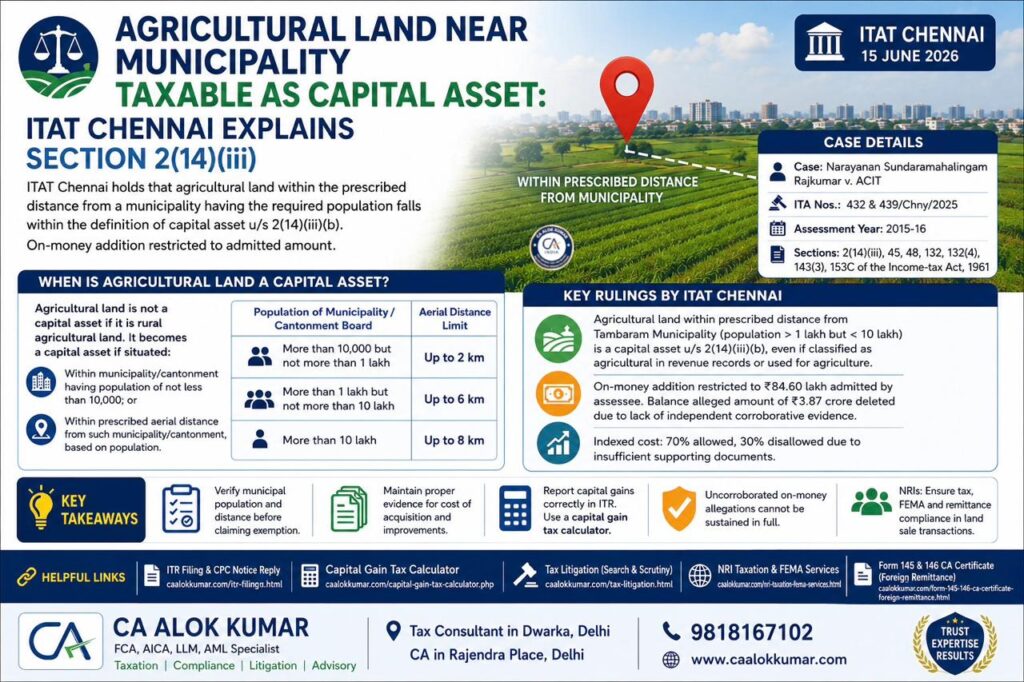
Agricultural Land Near Municipality Taxable as Capital Asset: ITAT Chennai Explains Section 2(14)(iii)
Introduction
Can gain from sale of agricultural land be treated as exempt merely because the land is recorded as agricultural land in revenue records? Agricultural Land is Taxable so How?
The Chennai Bench of the Income Tax Appellate Tribunal has answered this important issue in Narayanan Sundaramahalingam Rajkumar v. ACIT, ITA Nos. 432 & 439/Chny/2025, Assessment Year 2015-16, order dated 15 June 2026.
The Tribunal held that agricultural land situated within the prescribed distance from a municipality having the requisite population falls within the definition of capital asset under section 2(14)(iii)(b) of the Income-tax Act, 1961. Therefore, gains from sale of such land are taxable as capital gains, even if the land is agricultural in revenue records or agricultural activities were carried out.
This ruling is highly relevant for landowners, builders, real estate developers, NRIs, HUFs and taxpayers selling agricultural land near expanding urban or municipal areas. Before claiming exemption on sale of agricultural land, taxpayers should carefully examine the statutory distance and population criteria under section 2(14)(iii). For practical computation, taxpayers may also use a capital gain tax calculator before filing their income tax return.
Case Details
Case Name: Narayanan Sundaramahalingam Rajkumar v. ACIT
Court / Tribunal: ITAT Chennai, “A” Bench
Appeal Numbers: ITA Nos. 432 & 439/Chny/2025
Assessment Year: 2015-16
Order Date: 15 June 2026
Key Sections: Sections 2(14)(iii), 45, 48, 132, 132(4), 143(3), 153C of the Income-tax Act, 1961
Background of the Case
The assessee was engaged in construction and development activities. During the relevant assessment year, he sold land situated at Madambakkam Village, Tambaram Taluk.
The case arose from search proceedings. The Department alleged that the assessee had received cash consideration over and above the registered sale consideration. The Assessing Officer treated the land as a capital asset and taxed the gain under the head “Capital Gains”.
The assessee contended that the land was agricultural land and therefore not a capital asset under section 2(14). He relied on revenue records and claimed that the land was agricultural in nature.
The case involved two major questions:
- Whether the agricultural land was outside the definition of capital asset.
- Whether the alleged cash consideration could be added in full merely on the basis of search statements and third-party electronic records.
Taxpayers facing similar assessments should avoid casual replies and should obtain proper guidance for income tax scrutiny and search assessment, especially where land sale, cash allegation, or capital gains computation is involved.
Legal Position Under Section 2(14)(iii)
Section 2(14) defines “capital asset”. Agricultural land in India is generally excluded from the definition of capital asset only if it satisfies the conditions for rural agricultural land.
Broadly, agricultural land becomes a capital asset if it is situated:
- within the jurisdiction of a municipality or cantonment board having population of not less than 10,000; or
- within the prescribed aerial distance from such municipality or cantonment board, depending on population.
The distance criteria are:
| Population of Municipality / Cantonment Board | Aerial Distance Limit |
|---|---|
| More than 10,000 but not more than 1 lakh | Up to 2 km |
| More than 1 lakh but not more than 10 lakh | Up to 6 km |
| More than 10 lakh | Up to 8 km |
Therefore, the decisive test is not only whether the land is agricultural in revenue records. The land must also fall outside the municipal and aerial-distance limits prescribed under section 2(14)(iii).
For quick reference on section mapping and statutory provisions, readers may also refer to the Income Tax Act 2025 section finder.
Tribunal’s Finding on Agricultural Land
In this case, the Assessing Officer found that the land was situated within the prescribed distance from Tambaram Municipality. The population of Tambaram Municipality, as per Census 2011, was more than 1 lakh but less than 10 lakh.
Accordingly, agricultural land situated within 6 km aerial distance from the municipality would fall within the definition of capital asset under section 2(14)(iii)(b).
The Tribunal noted that the assessee did not produce any alternative survey report, municipal record, geographical study or other evidence to show that the land was beyond the statutory distance. The assessee mainly relied on agricultural classification and revenue records.
The ITAT held that even if the land was agricultural in character and even if agricultural activities were carried out, the statutory fiction under section 2(14)(iii)(b) would still apply once the land was situated within the prescribed distance from a municipality having the required population.
Accordingly, the Tribunal upheld the finding that the land constituted a capital asset and the gains arising from transfer were taxable as capital gains.
Important Principle: Agricultural Use Alone Is Not Sufficient
This decision clarifies a common misconception.
Many taxpayers assume that if land is recorded as agricultural land in Patta, Chitta, Adangal or other revenue records, then gain on sale is automatically exempt from capital gains tax. This is not correct.
For income-tax purposes, the following questions must be checked:
- Is the land situated within municipal or cantonment limits?
- What is the population of the relevant municipality or cantonment board?
- What is the aerial distance from the municipal or cantonment limits?
- Is there reliable evidence to prove that the land is outside the prescribed distance?
- Was the capital gain properly reported in the income tax return?
Where the land is close to a city, municipality, notified area or urban expansion zone, proper verification becomes essential. Incorrect reporting may result in demand, penalty exposure, or reassessment proceedings. In such cases, taxpayers should ensure proper ITR filing and capital gains reporting.
On-Money Addition: Tribunal Restricted Addition to Admitted Amount
The second important issue was alleged cash consideration.
The Revenue alleged that the assessee had received cash consideration of ₹4.72 crore over and above the registered sale consideration. The Department relied on search statements, third-party records and electronic material.
However, during assessment proceedings and cross-examination, the assessee admitted receipt of only ₹84.60 lakh in cash.
The Tribunal held that the admitted cash amount of ₹84.60 lakh could be added as part of sale consideration. However, the balance alleged amount of ₹3.87 crore could not be sustained merely on the basis of search statements and third-party electronic records without independent corroborative evidence.
The Tribunal observed that the Revenue did not bring sufficient evidence to prove actual receipt of the full alleged amount by the assessee. There was no adequate evidence of corresponding cash movement, utilisation, investment, asset acquisition or expenditure by the assessee to support the larger addition.
Accordingly, the ITAT deleted the balance addition and restricted the addition to the amount admitted by the assessee.
This part of the ruling is important for taxpayers facing additions based on loose papers, third-party data, digital records or search statements. If a tax demand has already been raised on such basis, taxpayers should take timely advice for income tax demand notice response instead of submitting a casual portal reply.
Search Statements Are Important, But Not Always Conclusive
The ruling also reiterates that statements recorded during search proceedings may be relevant evidence, but they are not always conclusive by themselves.
Where the assessee disputes the quantum of alleged cash receipt, the Department must support the addition with credible corroborative evidence. A third-party statement or electronic record may justify further inquiry, but a large addition must be backed by reliable material showing that the assessee actually received the amount.
For taxpayers, this also means that statements during search proceedings should be handled carefully. Any admission made without proper understanding of facts may create serious tax exposure. Where proceedings are conducted through the faceless mechanism, proper drafting and document submission become even more important. Taxpayers may seek professional assistance for faceless assessment matters to avoid avoidable additions.
Indexed Cost: 70% Allowed, 30% Disallowed
The assessee had claimed indexed cost of acquisition / improvement. The lower authorities disallowed the claim due to lack of complete supporting documents.
The Tribunal accepted that the assessee could not fully substantiate the entire indexed cost claim. However, it also held that it would be unrealistic to presume that no expenditure had been incurred at all in relation to the property.
Taking a reasonable view, the Tribunal directed the Assessing Officer to allow 70% of the indexed cost claimed and sustain disallowance of 30%.
This finding is practical and balanced. It recognises that capital gains should be computed on real gains, but taxpayers must still maintain proper evidence for cost of acquisition, improvement, development, conversion, levelling, boundary, legal expenses and other related expenditure.
Practical Lessons for Taxpayers
1. Do not rely only on revenue records
Agricultural classification in land records is relevant, but it is not conclusive for capital gains exemption. The section 2(14)(iii) municipal-distance test must be independently verified.
2. Obtain proper distance evidence
Before claiming exemption, taxpayers should keep:
- municipal boundary map;
- distance certificate, where available;
- surveyor’s report;
- Google map / GIS support, wherever appropriate;
- land revenue records;
- proof of agricultural use;
- sale deed and purchase deed;
- cost and improvement records.
3. Report capital gains correctly in ITR
Incorrect classification of urban agricultural land as exempt may lead to scrutiny, reassessment, demand and interest. Proper reporting is essential while filing ITR. Taxpayers located in Delhi NCR may also consider professional support for ITR filing in Dwarka Delhi.
4. Preserve cost records
Indexed cost claims should be supported by bills, vouchers, bank payments, contractor details, development records and other supporting evidence. Without documents, only estimated relief may be allowed.
5. Contest uncorroborated on-money additions carefully
If the Department alleges cash consideration, the taxpayer should examine whether the allegation is supported by independent evidence. Additions based only on third-party statements or electronic records may be challengeable, depending on facts.
6. NRIs should be more careful in land sale cases
In NRI land sale matters, tax deduction, capital gains computation, repatriation, FEMA compliance and remittance documentation require careful handling. NRIs selling property in India should examine NRI taxation and FEMA services, especially where sale proceeds are to be remitted outside India. Where foreign remittance certification is required, professional assistance may be needed for Form 145 and 146 CA certificate for foreign remittance.
Professional Analysis
The ITAT Chennai ruling strikes a balanced approach.
On the first issue, the Tribunal strictly applied section 2(14)(iii)(b). Once the land was found to be within the prescribed distance from Tambaram Municipality and the population condition was satisfied, the agricultural nature of the land did not save it from being treated as a capital asset.
On the second issue, the Tribunal protected the assessee from an excessive on-money addition where the Department could not prove actual receipt of the full alleged amount. The admitted amount was sustained, but the uncorroborated balance addition was deleted.
On the third issue, the Tribunal adopted a fair estimate by allowing 70% of the indexed cost claim and sustaining 30% disallowance due to lack of complete documentation.
The ruling is particularly important because many agricultural lands near cities continue to appear as agricultural in revenue records, but for income-tax purposes they may still become urban agricultural lands and therefore capital assets.
Conclusion
The decision in Narayanan Sundaramahalingam Rajkumar v. ACIT gives three clear messages:
- Agricultural land within the prescribed municipal distance may be taxable as a capital asset under section 2(14)(iii)(b).
- On-money addition cannot be sustained in full unless supported by independent and credible corroborative evidence.
- Indexed cost claims should be properly documented; otherwise, only reasonable estimated relief may be allowed.
Taxpayers selling agricultural land near municipal or urban areas should verify the statutory distance, population criteria, land records, cost documents and capital gains computation before filing the return or responding to income-tax notices.
For professional assistance in capital gains reporting, scrutiny notices, search assessment matters and land sale taxation, you may consult a tax consultant in Dwarka or a CA in Rajendra Place Delhi.
Leave a Reply