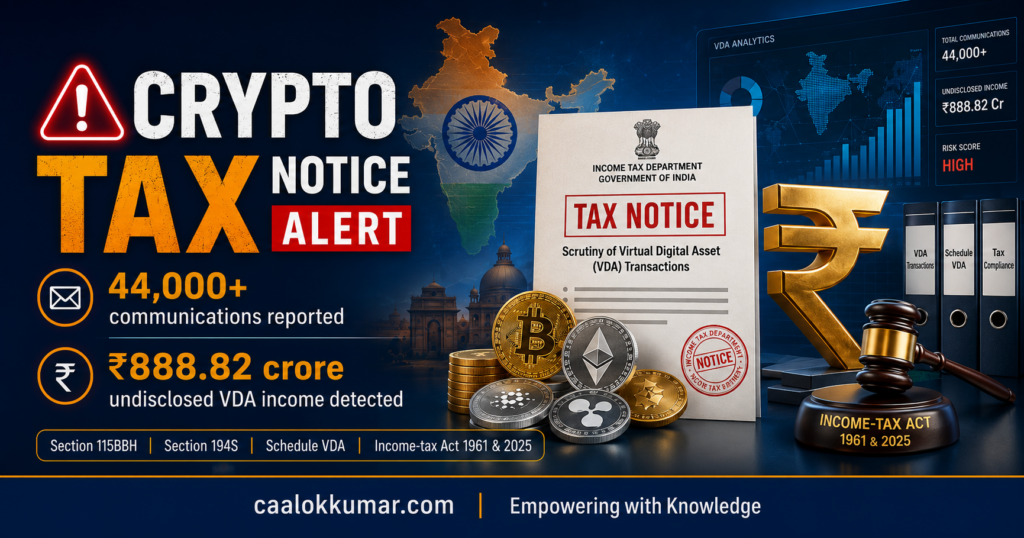
Crypto investors, traders and even occasional users must take this compliance and crypto tax notice alert seriously.
National business publications have reported that the Income Tax Department issued more than 44,000 tax notices or compliance communications to persons who traded in cryptocurrencies but did not appropriately disclose the transactions or related income in their Income Tax Returns.
More importantly, an official Ministry of Finance reply placed before the Lok Sabha confirms that search and survey actions resulted in detection of ₹888.82 crore of undisclosed income relating to Virtual Digital Asset transactions. The Government has also confirmed substantial non-compliance with the one per cent TDS requirement on crypto transactions. (Business Today)
Government figures reveal the scale of crypto-tax monitoring
In its official reply, the Ministry of Finance disclosed the following information:
| Particulars | Amount/details |
| Undisclosed income detected through VDA-related searches and surveys | ₹888.82 crore |
| Crypto exchanges surveyed under section 133A | 3 exchanges |
| Non-compliance with section 194S detected | ₹39.80 crore |
| Undisclosed income detected in those exchange surveys | ₹125.79 crore |
| TDS collected during FY 2022-23 | ₹221.27 crore |
| TDS collected during FY 2023-24 | ₹362.70 crore |
| TDS collected during FY 2024-25 | ₹511.83 crore |
The substantial increase in TDS collections demonstrates the growing volume of reportable crypto transactions and the expanding information trail available to the Department. (Digital Sansad)
Why crypto transactions are no longer invisible
A common misconception is that transactions executed through a crypto exchange, foreign platform, decentralised wallet or peer-to-peer arrangement cannot be tracked by Indian tax authorities.
That assumption is increasingly unsafe.
The Government has confirmed that:
- domestic as well as offshore Virtual Asset Service Providers serving Indian users are required to register with the Financial Intelligence Unit–India under the Prevention of Money Laundering Act, 2002;
- section 194S creates a one per cent TDS trail for VDA transfers;
- search and survey powers are being used against exchanges and other entities;
- exchange records, TDS statements, bank transactions, AIS information and return disclosures can be compared electronically; and
- certain offshore exchanges serving Indian users have also been observed to be non-compliant with Indian TDS provisions. (Digital Sansad)
Business Today reported that the Department uses Project Insight, internal analytics and information obtained from crypto exchanges to compare reported transactions with Income Tax Returns. (Business Today)
Under the Income-tax Act, 2025, this information framework has been further strengthened through a specific obligation under section 509 requiring prescribed reporting entities to furnish information concerning crypto-asset transactions. Failure by a reporting entity to furnish the prescribed statement can attract a daily penalty under section 446. (Etds)
The Income Tax Department has also operationalised Form 142, a quarterly statement for specified VDA exchanges containing details of relevant transactions and tax deposited under the new Act. (Income Tax Department)
The practical message is clear: crypto may be decentralised, but its tax information trail is becoming increasingly centralised.
Crypto taxation under the Income-tax Act, 1961
The special VDA taxation regime was introduced by the Finance Act, 2022.
1. Definition of Virtual Digital Asset — section 2(47A)
Section 2(47A) covers, among other things:
- cryptocurrencies and cryptographic tokens;
- digital representations of value that can be electronically transferred, stored or traded;
- notified non-fungible tokens; and
- any other digital asset notified by the Central Government.
The definition is sufficiently broad to cover Bitcoin, Ethereum, stablecoins, tokens and several other blockchain-based assets. (Etds)
2. Thirty per cent tax under section 115BBH
Section 115BBH provides that income from the transfer of a VDA is taxable “at the rate of thirty per cent”.
The effective liability is ordinarily:
- 30% income tax;
- applicable surcharge; and
- 4% health and education cess.
Without surcharge, the effective rate is ordinarily 31.20%. (Etds)
Restrictions under section 115BBH
While calculating taxable VDA income:
- only the cost of acquisition is permitted;
- no deduction for other expenditure or allowance is ordinarily available;
- loss from one VDA transfer cannot be adjusted against other income;
- VDA loss cannot be carried forward; and
- normal long-term capital-gain concessions are not available for transactions covered by section 115BBH.
Section 115BBH expressly provides that no expenditure deduction is available “other than cost of acquisition” and prohibits set-off and carry-forward of VDA losses. (Etds)
Example
A taxpayer earns:
- profit on Bitcoin: ₹4,00,000;
- loss on Ethereum: ₹2,50,000.
The conservative statutory computation is:
- taxable Bitcoin income: ₹4,00,000;
- Ethereum loss: not adjustable;
- taxable amount under section 115BBH: ₹4,00,000.
This differs substantially from the normal rules applicable to shares and other capital assets.
3. One per cent TDS under section 194S
Section 194S requires deduction of tax at 1% of the consideration, not one per cent of the profit.
TDS may apply even where:
- the seller ultimately suffers a loss;
- one cryptocurrency is exchanged for another;
- consideration is wholly or partly in kind;
- the transaction is conducted through an exchange;
- the parties transact directly through an OTC or P2P arrangement; or
- an offshore platform is involved and the income is chargeable to tax in India.
The threshold is:
- ₹50,000 where payment is made by a specified individual or HUF; and
- ₹10,000 in other cases.
A specified person broadly includes an individual or HUF without business or professional income, or whose preceding-year business turnover or professional receipts do not exceed the prescribed limits. (Etds)
TDS does not replace the 30% tax
The one per cent TDS is only a tax credit and information-reporting mechanism. The taxpayer must still calculate actual taxable income under section 115BBH and claim the corresponding TDS credit in the return.
This is why a transaction appearing in Form 26AS or AIS without corresponding Schedule VDA disclosure can become an immediate compliance trigger.
Taxpayers requiring assistance with deduction, deposit or reconciliation may refer to TDS filing and TDS notice services.
4. Schedule VDA must be completed transaction-wise
The Income Tax Department’s official ITR guidance requires VDA income to be disclosed transaction-wise in Schedule VDA of the applicable return, including ITR-2 or ITR-3, depending upon the facts and the head under which the income is offered. (Income Tax Department)
Merely reporting:
- total withdrawals from an exchange;
- net annual profit;
- bank credits;
- TDS appearing in Form 26AS; or
- closing crypto holdings
may not satisfy the transaction-wise reporting requirement.
Each taxable transfer should ordinarily be reconciled by recording:
- date of acquisition;
- date of transfer;
- name and quantity of the VDA;
- INR value of consideration;
- eligible cost of acquisition;
- income chargeable under section 115BBH; and
- TDS deducted under section 194S.
Professional assistance for return preparation, Schedule VDA disclosure and reconciliation is available through ITR filing and CPC notice reply services.
Corresponding provisions under the Income-tax Act, 2025
The Income-tax Act, 2025 came into force from 1 April 2026. The Income Tax portal clarifies that the 1961 Act continues to govern dues relating to periods up to FY 2025-26, while the 2025 Act applies for Tax Year 2026-27 onwards, subject to the repeal and savings provisions. (Income Tax Department)
The principal provisions may be compared as follows:
| Subject | Income-tax Act, 1961 | Income-tax Act, 2025 |
| Definition of VDA | Section 2(47A) | Section 2(111) |
| Tax on VDA transfer income | Section 115BBH | Section 194(1), Table, Sl. No. 4 |
| Rate of tax | 30% | 30% |
| Permitted deduction | Cost of acquisition only | Cost of acquisition only |
| Set-off of VDA loss | Not permitted | Not permitted |
| Carry-forward of VDA loss | Not permitted | Not permitted |
| TDS on VDA transfer | Section 194S | Section 393(1), Table, Sl. No. 8(vi) |
| TDS rate | 1% of consideration | 1% of consideration |
| TDS threshold exemption | ₹50,000/₹10,000 | Section 393(4), Table, Sl. No. 12: ₹50,000/₹10,000 |
| Updated return | Section 139(8A) | Section 263(6) |
| Under-reporting/misreporting penalty | Section 270A | Section 439 |
| Search | Section 132 | Section 247 |
| Survey | Section 133A | Section 253 |
| Crypto transaction reporting | Exchange/TDS and prescribed reporting framework | Specific obligation under section 509 |
The Income-tax Act 2025 Section Finder may be used to locate and compare the renumbered provisions.
Wider definition under section 2(111) of the 2025 Act
Section 2(111) retains the VDA definition and separately includes a crypto-asset as a digital representation of value relying on a cryptographically secured distributed ledger or similar technology for validating and securing transactions. (Etds)
The separate reference to crypto-assets supports a more structured reporting and information-exchange framework under the new legislation.
Section 194 of the 2025 Act retains the strict tax treatment
Section 194(1), Table Sl. No. 4, taxes income from transfer of a VDA at 30%.
It also expressly provides that:
- expenditure other than cost of acquisition is not deductible;
- VDA loss cannot be set off against other income; and
- such loss cannot be carried forward to succeeding tax years. (Etds)
Thus, the new Act has simplified and renumbered the provisions but has not relaxed the substantive tax burden on crypto income.
Section 393 retains one per cent TDS
Under section 393(1), Table Sl. No. 8(vi), tax must be deducted at one per cent from consideration for transfer of a VDA. The ₹50,000 and ₹10,000 threshold exemptions are provided under section 393(4), Table Sl. No. 12. (Etds)
Transactions that taxpayers frequently fail to report
A taxable VDA event is not restricted to conversion of crypto into Indian rupees.
Subject to the facts, taxable transfers can include:
- selling cryptocurrency for INR or foreign currency;
- exchanging Bitcoin for Ethereum;
- converting tokens into stablecoins;
- using cryptocurrency to purchase goods or services;
- transferring a token for consideration;
- disposal through an overseas exchange;
- P2P sale;
- redemption, relinquishment or extinguishment of rights in a VDA; and
- settlement of a liability through cryptocurrency.
A transfer between two wallets beneficially owned by the same taxpayer should not, by itself, generate income. However, the taxpayer must be able to establish common ownership through wallet addresses, transaction hashes and supporting records. Otherwise, an outward transfer may be mistaken for a sale or unexplained disposal.
What may trigger a crypto income-tax notice?
1. TDS is visible, but Schedule VDA is blank
Where section 194S TDS appears in AIS or Form 26AS but no VDA transaction is disclosed in the return, the mismatch is readily identifiable.
2. Exchange records exceed reported turnover
A taxpayer may report only the net amount withdrawn from the exchange, whereas the exchange statement may show hundreds of purchase, sale and swap transactions.
3. Only profitable withdrawals are reported
Tax is determined with reference to taxable transfers and not merely the amount transferred to a bank account.
4. Crypto-to-crypto swaps are omitted
A swap can involve a transfer of one VDA followed by acquisition of another. Absence of INR settlement does not automatically make the transaction tax-free.
5. Cost of acquisition is unsupported
The Department may seek proof of purchase price, source of funds, exchange statements, bank records and wallet history.
6. Gross traded value is confused with actual investment
Repeated buying and selling can produce very high cumulative turnover even where the taxpayer introduced only a much smaller amount of capital. Proper reconciliation is essential to prevent the gross traded value from being treated as unexplained investment or expenditure.
7. Transactions through foreign exchanges are not disclosed
The official Lok Sabha reply states that FIU registration and tax-compliance requirements also extend to offshore platforms catering to Indian users. (Digital Sansad)
8. P2P or OTC TDS was not deducted
In a direct transaction, the buyer may be responsible for deduction and deposit of TDS under section 194S or section 393, as applicable.
9. Bank deposits do not match declared income
Large deposits from exchanges or P2P counterparties without a complete transaction trail can result in questions regarding the source and taxability of funds.
Possible consequences of non-disclosure
Tax, interest and reassessment
Failure to disclose taxable VDA income can result in:
- assessment or reassessment of omitted income;
- demand for tax at the applicable special rate;
- interest for short payment or deferment of tax;
- denial of unsupported cost;
- inquiry into the source of crypto purchases;
- treatment of unexplained investment or expenditure under the relevant provisions; and
- separate consequences for failure to deduct or deposit TDS.
A taxpayer receiving a communication, assessment notice or demand should obtain a structured income tax demand notice response rather than submitting an unverified explanation.
Penalty for under-reporting or misreporting
Under section 270A of the 1961 Act:
- under-reporting may attract penalty equal to 50% of the tax payable on under-reported income; and
- misreporting may attract penalty equal to 200% of the tax payable on misreported income. (Etds)
Section 439 of the Income-tax Act, 2025 substantially retains the same framework:
- 50% of tax on under-reported income; and
- 200% of tax where the under-reporting results from misreporting, including suppression of facts or failure to record investments or receipts. (Etds)
Penalty is not automatic in every case. The nature of the default, disclosure made by the taxpayer, bona fide explanation, supporting evidence and wording of the notice remain important.
TDS-related consequences
Failure to deduct, deposit or report TDS may result in:
- assessee-in-default proceedings;
- interest;
- late-filing fees;
- penalty; and
- prosecution in serious cases.
The applicable consequences depend upon whether the taxpayer, exchange, broker or another person was responsible for deduction. (Etds)
Important Indian tribunal decisions on cryptocurrency income
1. Raunaq Prakash Jain v. ITO
ITA No. 01/Jodh/2024, ITAT Jodhpur, order dated 28 November 2024
The taxpayer had acquired Bitcoin during FY 2015-16 and sold it during FY 2020-21.
The Tribunal held that:
- Bitcoin was “property” and therefore a capital asset under section 2(14);
- the gain arising before introduction of the special VDA regime was taxable as long-term capital gain and not income from other sources; and
- deduction under section 54F was consequently allowable, subject to the facts.
The Tribunal specifically noted that section 115BBH applies from AY 2023-24 onwards. Therefore, this ruling is highly relevant for pre-VDA-regime transactions, but it should not be applied mechanically to transfers governed by section 115BBH. (Indian Kanoon)
Key takeaway
The year of transaction is crucial. A favourable decision concerning a transaction before the special VDA regime may not reduce the 30% liability for subsequent years.
2. Sunil Kumar Nayak v. Circle (International Taxation)
ITA No. 148/JP/2024, ITAT Jaipur, order dated 25 June 2024
The Assessing Officer treated the cumulative crypto trading amount as unexplained investment because complete exchange records were unavailable. The exchange had closed following a cyberattack, and the taxpayer subsequently obtained further records.
The Tribunal:
- admitted the significance of the subsequently obtained evidence;
- restored the matter to the Assessing Officer for fresh verification; and
- expressly refrained from deciding the merits.
The case highlights why bank statements, exchange ledgers, emails, wallet records and transaction-wise reconciliations must be preserved. (Indian Kanoon)
Key takeaway
Gross traded value and actual capital introduced may be materially different, but the distinction must be established through reliable evidence.
3. Muhammed Arif Shaikh v. Income Tax Department
ITA No. 1806/Ahd/2025, ITAT Ahmedabad, order dated 25 February 2026
An addition under section 69C was made towards the alleged unexplained source of cryptocurrency purchases.
The Tribunal observed that:
- the same assessment unit had accepted the taxpayer’s approach for the preceding assessment year;
- the Department had not provided adequate transaction particulars such as the name of the cryptocurrency, broker, dates, quantity and amounts; and
- inconsistent treatment was adopted in the two years.
The section 69C addition was consequently deleted. (Indian Kanoon)
Key takeaway
An addition cannot rest merely on a general allegation. Nevertheless, the taxpayer must provide a credible transaction trail and source-of-funds reconciliation.
Caution on reliance upon these decisions
All three decisions substantially concern periods preceding the special taxation regime under section 115BBH.
They help in matters involving:
- classification of pre-2022 crypto income;
- unexplained investment or expenditure;
- gross turnover versus actual investment;
- evidentiary requirements; and
- consistency in assessment.
They do not override the express 30% tax, deduction restrictions and loss-set-off prohibition applicable to current VDA transfers.
What should a taxpayer do after receiving a crypto notice?
Step 1: Verify the communication
Confirm that the communication appears in the registered account on the Income Tax portal and verify its Document Identification Number. Do not respond through links contained in suspicious emails or messages.
Step 2: Identify the exact proceeding
Determine whether it is:
- an e-campaign or compliance nudge;
- an e-verification communication;
- a request for information;
- a scrutiny notice;
- a defective-return notice;
- a reassessment communication;
- a penalty notice; or
- a demand arising from an assessment or intimation.
A compliance email and a statutory assessment notice require different responses.
Step 3: Preserve the response deadline
Do not allow the deadline to expire while collecting records. Where additional time is genuinely required, seek it through the prescribed portal process.
Step 4: Download all available information
Collect:
- AIS and TIS;
- Form 26AS;
- exchange-wise ledgers;
- annual profit-and-loss reports;
- order and trade history;
- wallet addresses and transaction hashes;
- bank and credit-card statements;
- P2P payment records;
- proof of cost of acquisition;
- TDS certificates and challans; and
- earlier return acknowledgements and computations.
Step 5: Prepare a transaction-wise reconciliation
The reconciliation should distinguish:
- purchases;
- taxable sales;
- crypto-to-crypto swaps;
- own-wallet transfers;
- deposits and withdrawals;
- rewards, airdrops or staking receipts;
- VDA received as consideration;
- opening and closing holdings; and
- TDS deducted or deductible.
Step 6: Recompute the correct income
Do not assume that the exchange’s “profit” figure is automatically the taxable figure. The computation must be tested against section 115BBH or section 194 of the 2025 Act.
Step 7: Examine return-correction options
Depending upon the relevant year and procedural stage, the taxpayer may consider:
- revised return, where the statutory time remains available;
- ITR-U updated return filing, subject to section 139(8A) or section 263(6), time limits and restrictions;
- response through the compliance portal;
- submission during assessment or reassessment; or
- appeal and income tax litigation, where an unsustainable addition has already been made.
Under section 263(6) of the 2025 Act, an updated return may generally be furnished within the prescribed 48-month period, but its availability is subject to statutory exclusions and the status of proceedings. (Etds)
Step 8: Submit a factual, evidence-based reply
A reply should not merely state that the taxpayer was unaware of the law. It should establish:
- the nature of every transaction;
- the correct taxable amount;
- reasons for any mismatch;
- the source of investment;
- supporting documentary evidence;
- tax and TDS already paid; and
- corrective action voluntarily taken.
Assistance with online proceedings can be obtained through faceless assessment representation.
Preventive checklist for crypto investors
Before filing the return, taxpayers should verify that:
- every exchange account has been considered;
- foreign and Indian exchanges have both been included;
- crypto-to-crypto swaps have not been omitted;
- own-wallet transfers have been separately identified;
- Schedule VDA is transaction-wise;
- cost of acquisition is supported;
- section 194S or section 393 TDS is reconciled;
- AIS and Form 26AS agree with the return;
- losses have not been wrongly adjusted or carried forward;
- bank credits have been explained; and
- transaction records are preserved even where an exchange has closed.
Frequently Asked Questions
Is one per cent TDS the complete tax on cryptocurrency?
No. TDS is deducted from consideration and is only a credit against the final tax liability. Income from transfer of a VDA is separately taxable at 30%, plus applicable surcharge and cess.
Can a loss from one cryptocurrency be adjusted against profit from another?
The special VDA provisions prohibit set-off of a loss from transfer of a VDA against income computed under another provision and prohibit carry-forward. Taxpayers should not apply normal capital-loss rules to VDA losses.
Is exchanging Bitcoin for another cryptocurrency taxable?
Yes, a crypto-to-crypto swap can constitute a transfer. The fact that no rupees are received does not, by itself, make the transaction non-taxable.
Is moving crypto from an exchange to my personal wallet taxable?
A transfer between wallets beneficially owned by the same person should ordinarily not result in income. However, common ownership and the complete transaction trail must be established.
Can an updated return be filed after discovering omitted crypto income?
An updated return may be available under section 139(8A) of the 1961 Act or section 263(6) of the 2025 Act, subject to time limits, additional tax, statutory restrictions and the status of assessment, search, survey or other proceedings.
Can foreign crypto-exchange transactions be detected?
Foreign-platform usage should not be assumed to be invisible. The Government has stated that FIU registration requirements extend to offshore platforms serving Indian users, and section 194S can apply where the income is chargeable in India. International information-reporting arrangements are also expanding.
Does payment of 30% tax make cryptocurrency legally regulated?
No. Taxation of income does not by itself amount to regulatory approval or recognition of cryptocurrency as legal tender. Taxation, PMLA compliance and financial regulation operate in different legal fields.
Final alert for taxpayers
The Government’s own figures confirm that cryptocurrency taxation has moved from a new reporting requirement to an active enforcement area.
The combination of:
- section 194S TDS;
- Schedule VDA;
- AIS and Form 26AS;
- exchange statements;
- FIU-IND reporting;
- section 509 crypto-asset information statements;
- bank records;
- search and survey powers; and
- electronic data analytics
makes non-disclosure increasingly detectable.
The safest course is to voluntarily reconcile the records, correctly compute VDA income and take lawful corrective action before a mismatch develops into tax demand, penalty or litigation.
For professional assistance with crypto-income reconciliation, ITR filing in Dwarka and Delhi, notice replies, updated returns or faceless proceedings, taxpayers may schedule a consultation.
Important source-verification note
The figure of over 44,000 notices has been reported by Business Today, The Financial Express and other national business publications as information given to Parliament. However, the particular official Lok Sabha reply located and examined by us—Unstarred Question No. 1194 dated 8 December 2025—does not itself mention the number 44,000.
The official reply independently and conclusively confirms the figures relating to ₹888.82 crore of undisclosed VDA income, TDS collections, surveys against crypto exchanges and enforcement under sections 132, 133A and 194S. Therefore, the number 44,000 is described in this article as “reported”, while the remaining Government figures are directly verified from the official parliamentary document. (Business Today)
This article is intended for general professional and educational information. Crypto and VDA taxation depends upon the transaction date, nature of receipt, residential status, source of funds, applicable tax year and procedural stage. Taxpayers should obtain transaction-specific advice before filing a return or responding to an Income Tax notice.
Stay compliant with Crypto Tax India, VDA Income Tax, Schedule VDA filing, Section 115BBH, Section 194S TDS, Income-tax Act 2025 and professional crypto tax notice reply services. #CryptoTaxNotice #VDATax #CryptocurrencyTaxIndia #Section115BBH #Section194S #ScheduleVDA #IncomeTaxAct2025 #IncomeTaxNotice Tax on VDA, Income Tax on Bitcoin Crypto Tax Notice reply Bitcoin Tax Notice Reply Bitcoin Tax Filing , Crptocurrency ITR Filing, Crypto Income Tax Filing
Leave a Reply