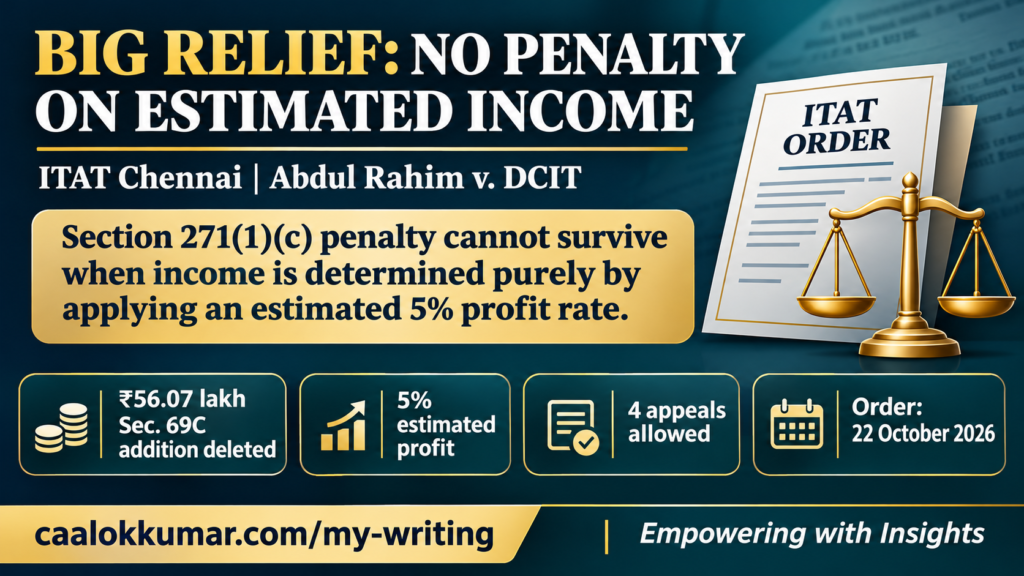
No Penalty on Estimated Income: ITAT Chennai Grants Major Relief
Can penalty be imposed merely because taxable income is ultimately determined by estimation? The Chennai Bench of the Income Tax Appellate Tribunal has answered this important question in favour of the taxpayer. In Mr. Abdul Rahim v. DCIT, the Tribunal deleted the penalty on estimated income after the underlying addition under Section 69C had been removed and the business income was recomputed by applying a 5% estimated profit rate.
The ruling reinforces a settled but often overlooked principle: an estimate may determine taxable income, but it does not by itself prove concealment of income or furnishing of inaccurate particulars. Penalty proceedings require their own statutory foundation and cannot automatically follow every assessment addition.
Case at a Glance
Case: Mr. Abdul Rahim v. Deputy Commissioner of Income Tax, Central Circle-1(4), Chennai
Forum: Income Tax Appellate Tribunal, Chennai Bench
Appeals: ITA Nos. 1739, 1740, 1741 and 1742/Chny/2026
Assessment years: 2010-11, 2012-13, 2014-15 and 2015-16
Order date: 22 October 2026
Key provisions: Sections 69C and 271(1)(c) of the Income-tax Act, 1961
Result: All four appeals allowed; penalties on estimated income and relevant house-property additions deleted
Background of the Dispute
The assessee carried on the business of trading in Basmati rice through M/s Excellent Food Products and was also associated with M/s A.R. Rahaman Biryani restaurant. Search proceedings were conducted on 24 August 2015 in connection with the SS Hyderabad Biryani Private Limited group.
During assessment, the Assessing Officer made an addition of ₹56,07,751 under Section 69C as alleged unexplained expenditure. In the earlier quantum appeal, however, the Tribunal deleted the Section 69C addition and directed the Assessing Officer to determine business income by applying a 5% profit rate to the figures quantified by the Assessing Officer.
The Assessing Officer thereafter imposed penalty under Section 271(1)(c) on the income computed through this estimation exercise. The Commissioner of Income Tax (Appeals) upheld the penalties, after which the assessee approached the ITAT in four appeals.
Why the ITAT Deleted the Penalty
The Tribunal observed that the original Section 69C addition had already been deleted in the quantum proceedings. What survived was not a finding of a precisely identified concealed amount, but an income computation based on an estimated profit percentage.
The ITAT held that penalty on estimated income was not sustainable because an addition made purely through estimation does not, without more, conclusively establish either of the two statutory defaults under Section 271(1)(c):
- concealment of particulars of income; or
- furnishing of inaccurate particulars of income.
The Revenue did not bring any new facts or evidence to distinguish the judicial authorities relied upon by the assessee. The Tribunal therefore followed the established principle that an estimated addition cannot automatically attract concealment penalty.
Estimation and Concealment Are Legally Different
Assessment proceedings and penalty proceedings serve different purposes. In an assessment, the tax authority may estimate income where exact profits cannot be reliably determined from the available material. Penalty, however, is not a routine mathematical consequence of that estimate.
For a valid penalty under Section 271(1)(c), the Revenue must establish that the taxpayer concealed income or furnished inaccurate particulars. A difference between the taxpayer’s declared figure and an estimated figure adopted by the Assessing Officer may justify tax computation in an appropriate case, but the difference alone does not establish culpable conduct.
This distinction is especially important in cases involving estimated gross profit, rejection of books, best-judgment assessments, alleged unexplained expenditure or an ad hoc disallowance. The factual basis, nature of disclosure, explanation offered and evidence on record remain decisive.
Effect of Deletion of the Section 69C Addition
Section 69C permits taxation of unexplained expenditure where a taxpayer cannot satisfactorily explain the source of that expenditure. Here, the substantive addition of ₹56,07,751 under Section 69C did not survive the quantum appeal.
Once the original foundation was deleted and replaced by a 5% profit estimate, the penalty could not continue as though the Section 69C finding remained intact. The penalty order had to be tested against the income that actually survived the appellate process and the evidence supporting any alleged concealment.
Penalty Relating to House Property Income
For the appeals involving income from house property, the ITAT also followed coordinate-bench decisions in Joseph Abraham Peter Joseph, R.R. Industries Ltd., Martin Rajadurai and Winners India Land Promoters. Those decisions had accepted the legal position in favour of the taxpayer, relying among other authorities on the Madras High Court decision in Babuji Jacob v. ITO.
Accordingly, the Assessing Officer was directed to delete the penalty relating to house property income in the relevant assessment years as well.
Judicial Principles Applied
The Tribunal considered authorities including CIT v. Reliance Petroproducts (P.) Ltd., where the Supreme Court explained that making an unsustainable claim does not by itself amount to furnishing inaccurate particulars; CIT v. P. Rojes, where the Madras High Court dealt with penalty arising from estimated income; PCIT v. Elcon Pipe and Fittings (P.) Ltd., concerning penalty on additions sustained through estimation; and Babuji Jacob v. ITO, relied upon for the house-property penalty issue.
The common thread is clear: penalty provisions must be applied strictly, and the statutory conditions for penalty must be independently satisfied.
Important Context for Current Proceedings
The appeals concerned assessment years governed by Section 271(1)(c) of the Income-tax Act, 1961. For later years, under-reporting and misreporting penalties are principally governed by Section 270A of the 1961 Act. The Income-tax Act, 2025, effective from 1 April 2026, contains renumbered penalty provisions.
Therefore, the ruling should not be read as a blanket proposition that every estimated addition is immune from penalty under every provision. Its persuasive value lies in the requirement that a penalty must rest on proved statutory ingredients, not merely on the fact that income has been estimated.
Practical Takeaways for Taxpayers and Professionals
- Review whether the penalty order merely reproduces the assessment order without an independent finding.
- Identify whether the surviving addition is purely estimated or supported by specific evidence of concealed income.
- Check whether the quantum addition has been deleted, reduced or substituted by an estimated profit rate in appeal.
- Ensure that the return, financial statements, books and submissions consistently disclose the primary facts.
- Challenge vague penalty notices and orders that do not clearly identify the statutory charge.
- File a rectification, appeal or stay application within the prescribed limitation period where demand remains outstanding.
- Preserve the quantum appellate order because it may materially affect pending penalty proceedings.
Taxpayers handling scrutiny, penalty or appellate proceedings may consider professional tax litigation and ITAT representation. Where a notice or penalty order has already been received, timely income-tax notice resolution and consultation is critical. If the penalty has created an outstanding demand, the income-tax demand notice response should be coordinated with the appeal and stay strategy.
What This Ruling Does—and Does Not—Mean
The decision is a strong authority against mechanically imposing penalty on income determined only through estimation. It does not prevent penalty where the Revenue has direct evidence of concealed receipts, fabricated records, false entries or a demonstrably inaccurate claim supported by incorrect facts.
Each case must therefore be assessed on its own record. The key question is not merely whether the final addition is estimated, but whether the evidence independently establishes the specific statutory default alleged in the penalty notice.
Conclusion
The ITAT Chennai ruling provides meaningful relief by reaffirming that penalty on estimated income cannot be imposed as an automatic consequence of assessment. After the ₹56.07 lakh Section 69C addition was deleted and income was determined by applying a 5% profit rate, the essential basis for concealment penalty was absent.
For taxpayers and advisers, the practical lesson is straightforward: always separate the quantum dispute from the penalty dispute. Examine what addition actually survives, what evidence supports the penalty and whether the statutory charge has been independently proved.
Read Also
- Borrowed Satisfaction Reassessment Quashed; ₹26.02 Lakh Loan Addition Deleted
- Big Relief in Stay of Income Tax Demand: Allahabad High Court on 20% Pre-Deposit
- Third-Party Statement Insufficient Without Cross-Examination
- Read the tribunal order
Disclaimer
This article is intended solely for general information and professional education. It is not legal or tax advice and should not be relied upon as a substitute for advice based on the facts, applicable assessment year and current law. Judicial decisions may be appealed, distinguished or affected by subsequent amendments.
#IncomeTax #ITAT #TaxPenalty #Section2711c #Section69C #EstimatedIncome #TaxLitigation #IncomeTaxAppeal #CharteredAccountant #CaseLawUpdate
Leave a Reply