Form 146 User Manual 2026: Foreign Remittance Rules Explained
Updated: 25 August 2026
Form 146 User Manual 2026: Why This Official Update Matters
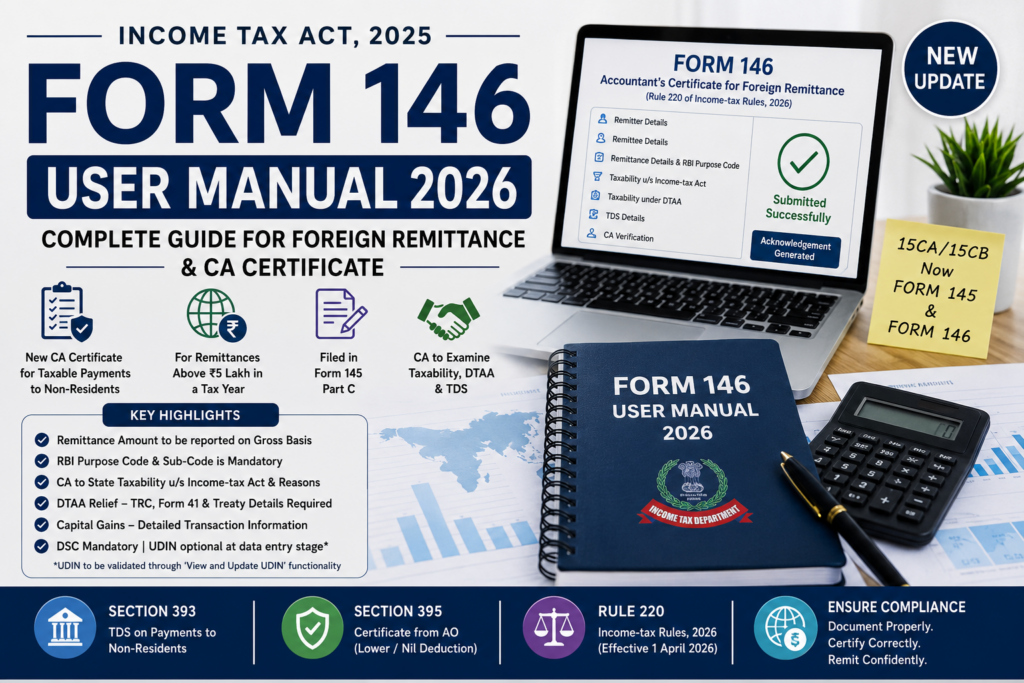
The Income Tax Department has now published a detailed Form 146 User Manual, giving taxpayers, businesses and Chartered Accountants a practical roadmap for certifying taxable foreign remittances under the Income-tax Act, 2025.
Form 146 is the new Accountant’s Certificate corresponding to the earlier Form 15CB. For remittances made on or after 1 April 2026, the procedural framework has moved to Form 145 and Form 146 under the Income-tax Rules, 2026. The new Rules came into force from 1 April 2026.
The update is important because Form 146 is no longer something businesses or NRIs should view merely as a “certificate required by the bank”.
The official Form 146 filing process itself requires examination of:
the remitter → overseas recipient → nature of payment → RBI purpose code → Indian taxability → DTAA position → TDS → Chartered Accountant verification.
That means a foreign remittance now creates a much more structured and searchable compliance trail.
Taxpayers who require professional assistance can refer to our dedicated Form 145 and Form 146 – CA Certificate for Foreign Remittance service covering taxability review, Section 393 TDS, DTAA analysis and remittance documentation.
What Is Form 146?
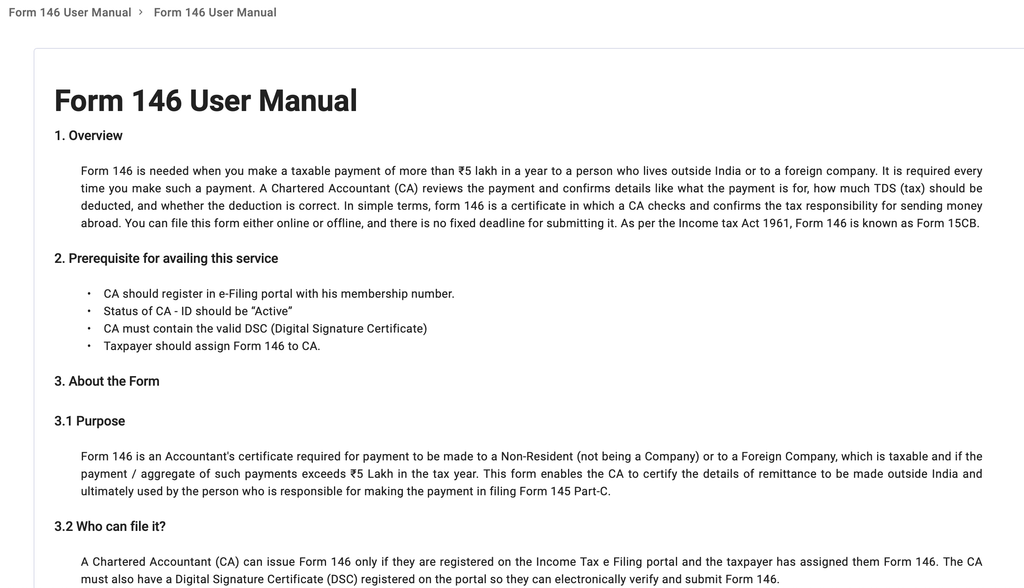
Form 146 is an Accountant’s Certificate for payment to a non-resident or foreign company.
According to the Income Tax Department’s official FAQ, Form 146 is required for filing Part C of Form 145 where:
- the payment is chargeable to tax in India;
- the payment or aggregate of such payments exceeds ₹5 lakh during the tax year; and
- the taxpayer has not obtained the relevant certificate from the Assessing Officer under Section 395(1) or Section 395(2).
The Department describes Form 146 as a tax-determination certificate in which the Chartered Accountant examines the remittance with reference to domestic taxability and the applicable Double Taxation Avoidance Agreement (DTAA).
In simple terms:
Form 146 is not merely proof that tax has been deducted. It records why the remittance is taxable or non-taxable, which tax provision applies, whether DTAA relief is available and what TDS treatment has been adopted.
Form 15CA and Form 15CB Have Changed to Form 145 and Form 146
For remittances made on or after 1 April 2026, taxpayers should use the forms prescribed under the Income-tax Act, 2025 and Income-tax Rules, 2026.
| Earlier framework | New framework |
|---|---|
| Form 15CA | Form 145 |
| Form 15CB | Form 146 |
| Section 195 – TDS on non-resident payments | Section 393 |
| Section 197 – lower/nil deduction | Section 395 |
| Rule 37BB | Rule 220 |
The CBDT transition FAQs expressly confirm that Forms 145 and 146 are to be used for remittances made on or after 1 April 2026, while broadly retaining the earlier compliance structure.
For a broader comparison of the old and new forms, readers may also refer to our internal guide on Income-tax Act 2025 Forms Mapping – Old Forms vs New Forms.
When Is Form 146 Required?
The easiest way to understand the requirement is to first identify which part of Form 145 applies.
Form 145 – Four-Part Structure
| Situation | Form 145 Part | Form 146 required? |
|---|---|---|
| Taxable remittance and aggregate does not exceed ₹5 lakh | Part A | No |
| Taxable remittance above ₹5 lakh with AO certificate u/s 395(1)/(2) | Part B | No |
| Taxable remittance above ₹5 lakh with CA certificate | Part C | Yes |
| Remittance not chargeable to tax, other than Rule 220(3) exempt payments | Part D | No |
The official Form 145 User Manual confirms this four-part structure. It also explains that where Part C applies, information from the filed Form 146 is pulled into Form 145 through the Form 146 acknowledgement number.
Important point
A foreign remittance exceeding ₹5 lakh does not automatically mean that Form 146 is required.
The first question is:
Is the payment chargeable to tax in India?
Only after determining taxability should the taxpayer decide whether Part A, B, C or D of Form 145 applies.
Form 146 User Manual: The Seven Panels Explained
The official Form 146 User Manual divides the form into seven panels.
1. Particulars of the Remitter
This captures details of the Indian person or entity making the payment.
2. Particulars of the Remittee
The overseas recipient’s information has to be correctly reported.
3. Particulars of the Remittance
This includes the amount, banking information, authorised dealer details and RBI purpose code.
4. Taxability Under the Income-tax Act
The Chartered Accountant must examine whether the transaction is taxable in India without first considering treaty relief.
5. Taxability Under DTAA
If treaty relief is available, the transaction must separately be analysed under the applicable DTAA.
6. Details of Tax Deducted at Source
The TDS treatment, applicable basis and date of deduction are reported.
7. Verification
The Chartered Accountant verifies and electronically signs the Form.
This structure makes one thing clear:
Domestic tax law analysis and DTAA analysis are two separate steps.
A taxpayer should not simply apply a treaty rate without first determining the position under the Income-tax Act.
7 Important Points from the New Form 146 User Manual
1. Remittance Amount Must Be Reported Before TDS
The Form 146 User Manual specifically states that the remittance amount should be entered before deduction of TDS, i.e. on a gross basis.
For example:
Invoice amount: ₹10,00,000
TDS: ₹1,00,000
Net amount paid abroad: ₹9,00,000
The relevant remittance amount for Form 146 reporting would ordinarily be the gross amount of ₹10,00,000, subject to the facts of the transaction.
This makes reconciliation between the invoice, books of account, TDS working and bank documents particularly important.
2. RBI Purpose Code and Sub-Code Must Match the Actual Payment
The official manual requires reporting of the RBI Purpose Code and Sub-Code from the RBI-prescribed list.
This may appear procedural, but it can become important during subsequent verification.
Consider the following mismatch:
Agreement: Software licence
Invoice: Technical support
Books: Consultancy expense
RBI purpose code: Other business services
Form 146: Royalty not taxable
Even where the underlying payment is genuine, inconsistent characterisation can invite questions.
The agreement, invoice, accounting treatment, tax analysis and banking purpose should therefore tell one coherent story.
3. CA Must Specifically Determine Whether the Transaction Is Taxable in India
One of the most significant fields in Form 146 asks the Chartered Accountant to state whether the transaction is taxable in India.
Where the answer is “Yes”, particulars such as the relevant section, taxable amount and rate of tax are required.
Where the answer is “No”, the CA is expected to provide the reason for non-taxability.
This is a crucial compliance point.
A foreign invoice does not automatically become non-taxable merely because the recipient is located outside India.
Depending upon the facts, payments for:
- software;
- consultancy;
- technical services;
- professional services;
- royalty;
- commission;
- cloud services;
- subscription charges;
- marketing services;
- reimbursement;
- freight; or
- cross-border management services
may require detailed examination under the Income-tax Act and the relevant treaty.
4. DTAA Benefit Requires Separate Treaty Analysis
Where DTAA relief is claimed, Form 146 requires treaty-specific information, including the nature of payment, treaty particulars, Tax Residency Certificate information, taxable income and tax amount.
The official Form 146 FAQ further lists Form 41 and Tax Residency Certificate (TRC) among the documents relevant where DTAA benefit is claimed.
For NRIs and businesses dealing with cross-border income, our NRI Taxation, DTAA and FEMA Services page covers treaty relief, foreign tax matters, NRO repatriation and related cross-border compliance.
Practical approach
Before claiming DTAA relief, check:
Recipient’s tax residence → TRC → prescribed additional information/Form 41 where applicable → nature of payment → relevant DTAA Article → Permanent Establishment exposure → domestic tax position → treaty rate.
A treaty rate should be the result of tax analysis, not merely the rate mentioned by the overseas vendor.
5. Capital Gain Remittances Require Detailed Transaction Data
The Form 146 User Manual contains a specific field asking whether the remittance relates to capital gains.
If the answer is yes, details such as:
- classification of capital gain;
- sale consideration;
- date of purchase;
- cost of purchase; and
- amount of capital gain
have to be provided.
This is highly relevant for:
NRI sale of property in India, sale of shares or securities, business exits and subsequent repatriation of proceeds.
For NRI property transactions, readers may also refer to our detailed guide on TDS and Form 145/146 where property is purchased from an NRI seller.
6. Form 146 Has to Be Assigned to a Chartered Accountant
The taxpayer cannot simply fill Form 146 himself.
The taxpayer must first add a Chartered Accountant on the e-Filing portal and assign Form 146 to that CA.
The Chartered Accountant must:
- be registered on the e-Filing portal;
- have an active CA profile;
- have a registered Digital Signature Certificate; and
- have Form 146 assigned by the taxpayer.
The CA then files the form electronically or through the prescribed offline utility.
7. DSC Is Required – and UDIN Has an Important Operational Nuance
The Income Tax Department confirms that Form 146 can be e-verified through Digital Signature Certificate (DSC) only.
UDIN deserves separate attention.
The official FAQ explains that the Unique Document Identification Number (UDIN) helps authenticate the CA certificate through integration with ICAI.
However, the latest Form 146 User Manual presently states that the UDIN field in the Form itself is optional at the data-entry stage. It further instructs the CA to validate UDIN through the “View and Update UDIN” functionality after filing.
Therefore, it is safer to describe the present position as:
UDIN authentication forms part of the Form 146 verification framework, although the current portal manual describes the UDIN field itself as optional while filling the Form.
Professionals should follow the live e-Filing portal and ICAI UDIN requirements applicable on the actual filing date.
Can Form 146 Be Filed More Than Once in a Year?
Yes.
There is no annual numerical limit on the number of Forms 146 that may be filed.
The Income Tax Department describes Form 146 as an event-based form, meaning that it is required before each remittance that independently satisfies the conditions prescribed under Rule 220.
This point is particularly important for businesses making multiple payments to overseas suppliers during a tax year.
Is There a Due Date for Form 146?
There is no separately prescribed calendar due date.
However, Form 146 must be filed before Form 145 Part C is filed, and Form 145 itself is required before the corresponding foreign remittance.
Accordingly, Form 146 is best viewed as a transaction-linked pre-remittance compliance, rather than a monthly or quarterly return.
Can Form 146 Be Revised After Filing?
This is another important practical point.
According to the Department’s FAQ:
- a filed Form 146 cannot be edited or modified;
- it may ordinarily be withdrawn within 7 days of submission;
- once it has been used for filing Form 145 Part C, it becomes “Consumed”; and
- if Form 145 Part C is withdrawn, the corresponding Form 146 is also updated appropriately.
This is why the transaction should be checked carefully before certification.
Errors in beneficiary details, remittance amount, treaty position or tax rate should not be treated casually.
What Documents Should Be Ready Before Form 146 Certification?
The official FAQ refers to invoices, agreements/contracts, remitter and remittee particulars, banking information and DTAA-related documents.
In practical terms, the documentation file should normally include, as relevant:
| Document / Information | Why it matters |
|---|---|
| Agreement / engagement letter / purchase order | Establishes actual nature of transaction |
| Invoice | Confirms amount and commercial description |
| Remittee details | Identifies overseas beneficiary |
| Bank and AD details | Supports remittance processing |
| RBI purpose code | Links banking purpose with transaction |
| TRC | Supports DTAA residence claim |
| Form 41 / treaty documentation | Supports treaty benefit, where applicable |
| Taxability working | Explains domestic-law position |
| DTAA working | Explains treaty treatment |
| TDS computation | Supports Section 393 compliance |
| Capital gain computation | Required for relevant remittances |
| Previous payments during tax year | Helps determine ₹5 lakh aggregate threshold |
| Form 146 acknowledgement | Required for Form 145 Part C |
Taxpayers requiring end-to-end assistance with Form 145/146, NRO remittance or foreign payment certification may refer to our Form 145/146 Foreign Remittance CA Certificate service.
Special Relevance for NRIs: NRO Repatriation and Property Sale Proceeds
The Form 146 framework is particularly important for NRIs who want to transfer eligible funds from India to:
- an NRE account;
- their overseas bank account; or
- another permitted foreign destination.
Typical sources may include:
property sale proceeds, rent, bank interest, fixed-deposit maturity, investments, inheritance or other tax-paid funds.
However, income-tax documentation is only one part of the process.
NRO repatriation can also involve:
FEMA conditions → source-of-funds documentation → tax payment evidence → Form 145/146 → Form A2 / bank documentation → Authorised Dealer verification.
Our dedicated NRI Taxation & FEMA Compliance and Fund Repatriation Services page covers NRI taxation, DTAA, NRO repatriation, property-sale issues and FEMA-related documentation.
NRIs seeking broader India tax support may also refer to NRI Tax Consultant – ITR, DTAA, FEMA and Form 145/146 Services.
Form 146 and Section 393 TDS: Do Not Start With the TDS Rate
One common mistake in foreign remittances is to begin by asking:
“What percentage of TDS should be deducted?”
The correct sequence is different.
Step 1 – Identify the nature of payment
Royalty? FTS? Professional fee? Commission? Business income? Capital gain? Reimbursement?
Step 2 – Determine chargeability under Indian tax law
Section 393 is the withholding provision, but taxability must be examined with reference to the charging and deemed-accrual provisions applicable to the transaction.
Step 3 – Examine DTAA
If treaty relief is available, determine the relevant Article and conditions.
Step 4 – Determine withholding rate
Only after the taxability analysis should the applicable TDS rate be determined.
Step 5 – Examine Section 395 route where relevant
Where an Assessing Officer’s certificate is obtained under Section 395(1) or 395(2), Form 145 Part B applies and Form 146 is not required.
This is particularly relevant in transactions where the gross remittance is significantly higher than the amount actually chargeable to tax.
Foreign Remittance Compliance Checklist
Before making a material overseas payment, ask the following questions:
- Is the recipient correctly identified?
- Does the agreement explain the payment?
- Does the invoice match the agreement?
- Is the payment chargeable to tax in India?
- Which Section 393 withholding position applies?
- Is DTAA relief available?
- Is the TRC available?
- Is Form 41 or other treaty documentation required?
- Has the ₹5 lakh annual threshold been checked?
- Does Form 145 Part A, B, C or D apply?
- Is an AO certificate under Section 395 preferable?
- Is Form 146 required?
- Does the RBI purpose code correctly describe the payment?
- Does the amount reconcile with the books and bank records?
- Has TDS been correctly deducted and deposited?
- Can the entire transaction be explained several years later during tax verification?
If the answer to the last question is uncertain, the documentation should be strengthened before remittance.
Why the New Form 146 Process Is More Important Than It Looks
The most significant feature of the new framework is not simply the renumbering of Form 15CB to Form 146.
It is the structured digital linkage created between the commercial transaction and its tax treatment.
The compliance trail can now broadly read:
Agreement → Invoice → Remittee → RBI Purpose Code → Indian Taxability → DTAA → TDS → Form 146 → Form 145 → Bank Remittance
When each part says the same thing, the remittance is easier to defend.
When different documents describe the same payment differently, the risk of queries increases.
That is why businesses making regular payments abroad should make foreign remittance tax review part of their internal payment process rather than obtaining a CA certificate only after the bank places the transaction on hold.
Frequently Asked Questions on Form 146
Is Form 146 the same as old Form 15CB?
Yes. Form 146 is the corresponding Accountant’s Certificate under the Income-tax Rules, 2026 for remittances governed by the new framework from 1 April 2026.
Is Form 146 required for every payment above ₹5 lakh?
No. The payment must also be chargeable to tax, and the applicable Form 145 pathway must be determined. If an AO certificate under Section 395 has been obtained, Part B rather than Part C applies.
Who can file Form 146?
A Chartered Accountant registered on the Income Tax e-Filing portal, having a valid DSC and to whom the taxpayer has assigned the Form.
Is DSC compulsory?
Yes. The official FAQ states that Form 146 is e-verified through the Chartered Accountant’s registered DSC.
Is UDIN mandatory in the Form 146 field?
The current User Manual says the UDIN field is presently optional while filling the Form, but also provides a separate UDIN validation process after filing. The Department’s FAQ highlights UDIN as the authentication mechanism. Taxpayers and CAs should therefore follow the live portal procedure applicable on the filing date.
Can Form 146 be modified after filing?
No. The Department says it cannot be edited after submission, although withdrawal is permitted within the prescribed conditions and time.
Is there a fixed due date?
There is no specific calendar due date, but Form 146 must precede Form 145 Part C and the remittance.
Conclusion: Form 146 Is a Tax Determination Exercise, Not Just a Bank Formality
The Form 146 User Manual 2026 makes the Department’s expectations much clearer.
A Chartered Accountant certifying a foreign remittance is expected to understand:
what the payment represents, whether it is taxable in India, what DTAA relief is available, whether TDS has been correctly determined and whether the banking and tax documentation are consistent.
For taxpayers, the practical lesson is equally important:
Do not arrange the tax documentation after deciding to remit the money. Determine the tax position before initiating the remittance.
For businesses making overseas vendor payments, NRIs repatriating Indian funds, property sellers remitting sale proceeds or taxpayers claiming DTAA relief, a properly documented transaction can prevent unnecessary banking delays and substantially reduce future tax-compliance risk.
For professional assistance, explore:
Form 145 & Form 146 – CA Certificate for Foreign Remittance
NRI Taxation, FEMA Compliance & Fund Repatriation
NRI Tax Consultant – DTAA, Property Sale, FEMA & Repatriation
Official References
- Income Tax Department – Form 146 User Manual: Filing workflow, seven panels, gross remittance reporting, RBI purpose codes, taxability, DTAA, capital gains, DSC and UDIN process.
- Income Tax Department – Form 146 FAQs: ₹5 lakh threshold, Part C applicability, Section 395 certificate, documents, filing frequency, withdrawal and Section 463 consequences.
- Income-tax Rules, 2026 – CBDT Notification G.S.R. 198(E), dated 20 March 2026, effective 1 April 2026; Form 146 is prescribed under Rule 220.
- CBDT FAQs on transition from Income-tax Act, 1961 to Income-tax Act, 2025: Forms 145/146 applicable to remittances made on or after 1 April 2026.
Disclaimer: This article is for professional and educational information only. Foreign-remittance taxability depends upon the facts of each transaction, the applicable tax year, the Income-tax Act, DTAA, FEMA/RBI requirements and supporting documentation.
Leave a Reply