
₹1.29 Lakh Crore Foreign Remittances Under Income-Tax Lens: CBDT’s 2026 Verification Drive, Form 145/146 Risks & Action Plan – Read on Foreign Remittance Income Tax Scrutiny 2026
Updated: 23 August 2026
Foreign Remittances Are Now Under a Much Sharper Income-Tax Lens
A large foreign-remittance trail has brought cross-border payments into sharp focus.
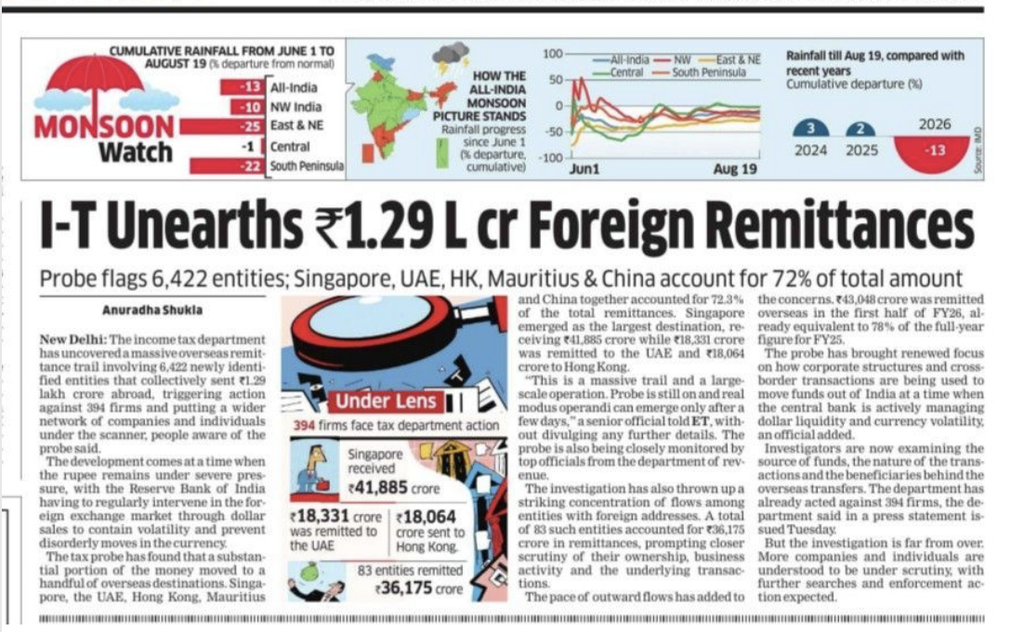
Recent reports state that the Income Tax Department has identified a foreign-remittance trail involving 6,422 entities and approximately ₹1.29 lakh crore, with Singapore, UAE, Hong Kong, Mauritius and China reportedly accounting for about 72.3% of the amount. Singapore alone reportedly received ₹41,885 crore, followed by UAE at ₹18,331 crore and Hong Kong at ₹18,064 crore.
But the more important development for taxpayers is not merely the size of these figures.
On 18 August 2026, the Income Tax Department launched a nationwide detailed verification exercise into suspicious foreign remittances. The CBDT statement confirms that the exercise presently covers approximately 394 entities, including 117 entities in land-border States, as well as 36 professionals connected with foreign-remittance certifications.
This is therefore not simply another news story about money moving abroad. It signals an important shift in how the Department is using data analytics, income-tax returns, turnover information, foreign-remittance declarations, banking data and professional certifications together to identify transactions requiring deeper verification.
For businesses, NRIs, importers, consultants, finance teams and Chartered Accountants, the practical question is:
If an old or proposed foreign remittance is picked up for verification tomorrow, can its commercial purpose, source of funds, tax treatment and supporting documentation be explained transaction by transaction?
That is now the real compliance test.
First, What Has CBDT Actually Confirmed?
It is important to separate an official tax verification from media estimates surrounding the investigation.
| Particular | Position |
|---|---|
| Nationwide foreign-remittance verification launched on 18 August 2026 | Confirmed by Income Tax Department/CBDT |
| Approximately 394 entities covered | Confirmed |
| 117 entities situated in land-border States | Confirmed |
| 36 professionals being covered | Confirmed |
| Entities with insignificant turnover/non-filers despite large outward remittances | Specifically highlighted by CBDT |
| Mismatch between stated business activity and remittance purpose | Specifically highlighted by CBDT |
| Large number of remittance certificates issued by a relatively small group of professionals | Highlighted by CBDT |
| ₹1.29 lakh crore remitted by 6,422 newly identified entities | Reported by media; not stated in the CBDT communication presently available |
| 72.3% reportedly going to Singapore, UAE, Hong Kong, Mauritius and China | Media-reported data |
This distinction matters. A verification exercise is not a finding of tax evasion, and a foreign remittance to Singapore, UAE, Hong Kong, Mauritius or any other jurisdiction does not become suspicious merely because of the destination country.
What matters is whether the transaction is genuine, commercially explainable, correctly taxed and properly documented.
What Triggered the Income Tax Department’s Foreign Remittance Verification?
According to the CBDT statement, the Department initially obtained intelligence while investigating a network involving fictitious charitable trusts and accommodation entries. Further data analysis of outward foreign remittances reportedly revealed entities that had sent substantial foreign exchange abroad during the preceding three years despite showing little business activity or, in some cases, not filing income-tax returns.
The Department has specifically referred to situations where:
the amount remitted was disproportionate to the turnover reported in the income-tax return; the stated nature of business did not reasonably correspond with payments described as freight, software imports or consultancy; some entities could not be found operating from their declared addresses; overseas recipients appeared concentrated among a limited group; and a large number of remittance certificates had been issued by a relatively small number of professionals.
That tells us something important about the Department’s approach.
The Department is no longer looking at Form 145 or Form 146 in isolation.
It can potentially compare the remittance with:
ITR → turnover → books → TDS → bank transaction → RBI purpose code → foreign recipient → invoice/agreement → Form 145 → Form 146 → authorised-dealer reporting.
The Income Tax Department’s own explanatory note for Form 145 states that the form is integrated with its ITBA system for risk profiling, analytics and backend verification and can be cross-verified with Forms 144, 146 and 147.
That is perhaps the most important takeaway from the entire development.
Form 15CA/15CB Have Changed: Use Form 145 and Form 146 After 1 April 2026
There is another important compliance issue which several news reports still describe using the older terminology of Form 15CA and Form 15CB.
For remittances made on or after 1 April 2026, the Income-tax Act, 2025 and Income-tax Rules, 2026 apply to the procedural filing, and the relevant forms are now:
| Earlier framework | Current framework from 1 April 2026 |
|---|---|
| Form 15CA | Form 145 |
| Form 15CB | Form 146 |
| Section 195 | Section 393 |
| Section 197 | Section 395 |
| Rule 37BB | Rule 220 |
The Income Tax Department has expressly clarified that Form 145 and Form 146 must be used for remittances made on or after 1 April 2026. The basic compliance structure remains substantially similar, but the form and statutory references have changed.
Businesses and individuals dealing with overseas payments can refer to our detailed Form 145 and Form 146 – CA Certificate for Foreign Remittance service for the present filing framework, DTAA review, TDS determination and remittance documentation.
For readers still working with the old form numbers, our Income-tax Act 2025 Forms Mapping guide also explains the transition from Forms 15CA/15CB to Forms 145/146.
When Is Form 146 Actually Required?
The current Income Tax Department FAQ gives a fairly clear rule.
Form 146 is the Accountant’s tax-determination certificate required where the payment to a non-resident or foreign company is chargeable to tax and the aggregate taxable remittance exceeds ₹5 lakh during the tax year, unless the remitter has obtained the relevant Assessing Officer certificate under Section 395(1) or 395(2).
A Chartered Accountant issuing Form 146 is expected to examine the taxability of the remittance with reference to:
Sections 5 and 9 of the Income-tax Act, 2025, Section 393 withholding provisions, the applicable DTAA, and the supporting facts and documentation.
The Income Tax Department lists documents such as invoices, agreements or contracts, remitter/remittee details, bank particulars and, where DTAA benefit is claimed, Form 41 and the Tax Residency Certificate (TRC).
This is why treating Form 146 as a routine “bank certificate” is becoming increasingly risky.
Form 145 Is Also Not Required in Every Foreign Remittance
Another common misconception is that every payment outside India automatically needs Form 145.
Rule 220 and the official Form 145 guidance provide exceptions. For example, the Department’s FAQ states that Form 145 is not required for specified cases such as certain individual remittances not requiring prior RBI approval under the Liberalised Remittance Scheme, remittances by an IFSC unit, and remittances falling within specified RBI purpose codes.
Accordingly, the correct sequence should be:
Determine the nature of payment → determine chargeability to tax → check Rule 220 → determine the correct part of Form 145 → decide whether Form 146 or an AO certificate is required → deduct/deposit TDS where applicable → complete remittance.
Starting with “the bank has asked for Form 146, so please issue it” is not a safe tax-analysis process.
Why Form 146 Has Become Central to the 2026 Investigation
CBDT has specifically observed that a large number of the earlier Form 15CB certificates were issued by a comparatively small group of professionals.
Its statement goes further and emphasises that Accountants issuing Form 15CB/Form 146 are expected to exercise due care, diligence and professional judgment and properly examine the underlying transactions and relevant facts before certification.
Under the current Income-tax Act, 2025, furnishing inaccurate information in Form 146 can also expose the Accountant to a penalty of up to ₹10,000 for each such certificate under Section 463. The Income Tax Department expressly mentions this consequence in its official Form 146 FAQ.
The lesson is not that every CA must conduct a forensic investigation into every foreign vendor.
The lesson is that a documented professional judgment is becoming essential.
A certification file should be capable of showing why the nature of payment was accepted, how taxability was determined, what DTAA article was relied upon, which documents were examined, why the applicable rate was selected and whether the information in the certificate reconciles with the books and remittance documents.
Foreign Remittance Risk Test: Would Your Transaction Survive Verification?
Use the following as an internal compliance test. This is a practical risk-review tool, not a CBDT scoring model.
| Question | Lower Risk Indicator | Higher Risk Indicator |
|---|---|---|
| Does the remittance broadly fit the payer’s turnover and financial capacity? | Yes | Very large remittance despite negligible turnover |
| Does the payment match the actual business activity? | Clearly connected | Generic/unrelated purpose |
| Can the foreign recipient be independently identified? | Established vendor/group entity | Unclear entity/address/ownership |
| Is there a proper agreement, invoice or commercial document? | Complete and specific | Generic invoice/no agreement |
| Is evidence of service, software, goods, freight or other deliverable available? | Yes | No supporting evidence |
| Is the RBI purpose code appropriate? | Matches underlying transaction | Selected merely for convenience |
| Has Indian taxability been examined? | Written analysis available | Assumed “foreign payment = no TDS” |
| If DTAA benefit is claimed, are TRC/Form 41 and other relevant declarations available? | Complete | Missing/inconsistent |
| Do Form 145/146, books, TDS records and bank remittance agree? | Fully reconciled | Amount/nature/date mismatch |
| Can source of funds be explained? | Clear banking/books trail | Unexplained routing/funding |
| Are repeated payments going to the same or connected overseas entities? | Commercial basis documented | Pattern unexplained |
| Does the CA file contain transaction-specific working papers? | Yes | Certificate based only on client request |
If several answers fall in the last column, a pre-emptive foreign-remittance compliance review may be much cheaper than reconstructing the transaction after an Income Tax Department query.
A Practical Action Plan for Businesses Making Foreign Payments
Businesses need not stop genuine overseas transactions because of the verification drive. They should instead strengthen the transaction file before money leaves India.
| Stage | What should be done |
|---|---|
| Before entering transaction | Verify overseas counterparty, commercial purpose and contract |
| Before remittance | Determine taxability under domestic law and DTAA |
| TDS stage | Determine applicable Section 393 deduction and rate |
| Treaty claim | Obtain TRC, Form 41 and supporting declarations/documents, where applicable |
| Form compliance | Determine correct Part of Form 145 and need for Form 146/AO certificate |
| Bank processing | Match invoice, A2/remittance request, RBI purpose code and beneficiary |
| Accounting | Ensure ledger classification matches stated remittance purpose |
| TDS reporting | Reconcile payment with applicable non-resident TDS statement/Form 144 |
| Year-end | Cross-check remittance with financial statements, ITR and tax records |
| Record retention | Preserve the complete transaction and tax-position working paper |
The biggest risk is usually not that money was sent abroad.
It is the absence of a coherent documentary story explaining why it was sent, to whom, for what, from which source and after applying which tax position.
Received an Income-Tax Query About Foreign Remittance? Do Not Send a Generic Reply
A foreign-remittance verification should ideally be answered transaction-wise, rather than by uploading hundreds of pages without reconciliation.
For each remittance, prepare one master working sheet containing:
date of remittance; amount and currency; beneficiary name and country; relationship with beneficiary; nature of payment; RBI purpose code; agreement/PO/invoice; evidence of service or supply; ledger account; source of funds; chargeability under the Income-tax Act; applicable DTAA article; TRC/Form 41; TDS rate and challan; Form 145 ARN; Form 146 ARN and UDIN where applicable; bank debit/A2 records; and reconciliation with ITR/financial statements.
Where the Department has raised a specific mismatch, answer that mismatch first. Do not create fresh inconsistencies by giving broader explanations that are unsupported by records.
For cases already selected for verification, scrutiny or reassessment, professional support for Income Tax Scrutiny and risk-based assessment matters and, where proceedings become contentious, Income Tax Litigation and notice representation may help ensure that factual reconciliation and legal submissions are dealt with separately and systematically.
Special Concern for Importers and Service-Paying Businesses
The CBDT’s reference to payments described as freight, software imports and consultancy services deserves particular attention.
A narration such as “consultancy fee” or “software payment” is not itself a tax conclusion.
For example, depending upon the facts, a cross-border software or service payment may require examining whether it constitutes royalty, fees for technical services, business income, reimbursement or another category under domestic law and the applicable DTAA.
The same is true of freight, commission, marketing, subscription, cloud services, professional fees and inter-company payments.
Therefore, businesses should avoid adopting a TDS position merely from the invoice description.
The agreement, actual rights/services, place of performance, permanent-establishment position, treaty article and supporting facts should drive the tax analysis.
What About NRIs Sending or Repatriating Their Own Money?
The present investigation should not be confused with an allegation that ordinary NRI repatriations or genuine individual overseas transfers are suspicious.
An NRI transferring eligible funds from an NRO account, remitting property-sale proceeds, inheritance, investments or other legitimate money may have an entirely valid transaction. But the source and tax history of those funds must still be properly established where applicable.
Depending upon the transaction, documentation may include the original source of funds, property documents, capital-gain computation, tax-payment evidence, bank statements, TDS records and Form 145/146 documentation.
For such cases, the dedicated NRI tax, DTAA, foreign remittance and repatriation advisory service covers the tax and documentation aspects of NRI remittance transactions.
The key distinction is simple:
Sending money abroad is not the problem. Sending money abroad without being able to establish its source, purpose and tax treatment can become a problem.
A ₹1.29 Lakh Crore Headline Does Not Mean ₹1.29 Lakh Crore of Tax Evasion
This distinction deserves emphasis.
The reported ₹1.29 lakh crore represents the foreign-remittance trail being examined, based on media reports. It should not be equated with concealed income, tax evasion, FEMA violation or proceeds of crime unless and until facts in individual cases establish such a conclusion.
Likewise:
A remittance to Singapore or UAE is not inherently suspicious. A high-value remittance is not automatically unlawful. A low-turnover entity may have a legitimate source of funds that can be demonstrated. A professional issuing Form 146 is not automatically liable merely because a transaction is subsequently investigated.
The purpose of verification is precisely to determine whether the apparent mismatch has a legitimate explanation.
That is why evidence and reconciliation matter more than assumptions.
The Bigger Message: Foreign Remittance Data Is Becoming a Connected Compliance Trail
The Income Tax Department’s current Form 145 documentation itself explains that foreign-remittance information feeds into backend risk profiling and can be cross-verified against other tax forms.
A modern cross-border payment therefore leaves several connected data points:
PAN → ITR → books of account → TDS → Form 144 → Form 145 → Form 146 → UDIN → bank → authorised dealer → beneficiary → RBI purpose code.
Where these data points tell the same story, verification becomes easier.
Where they tell different stories, the transaction may attract questions.
For businesses undertaking regular cross-border payments, therefore, foreign remittance compliance should now become part of the internal tax-control framework rather than a last-minute certificate obtained when the bank asks for it.
Frequently Asked Questions
Is every foreign remittance now under Income Tax investigation?
No. CBDT has launched a targeted verification exercise based on data analytics and intelligence. The fact that an individual or business legitimately sends money overseas does not by itself make the transaction suspicious.
Has Form 15CB been abolished?
For procedural compliance relating to remittances made on or after 1 April 2026, old Form 15CB has been replaced by Form 146 under the Income-tax Rules, 2026. Form 15CA corresponds to new Form 145.
Is Form 146 required for every foreign remittance above ₹5 lakh?
No. The official guidance says Form 146 applies where the payment is chargeable to tax, the specified ₹5 lakh threshold is exceeded and the relevant AO certificate under Section 395 has not been obtained. The nature and taxability of the transaction therefore have to be examined first.
Can DTAA benefit be claimed while making a foreign payment?
Yes, where legally available. The applicable DTAA, residential status of the recipient, TRC, Form 41 and transaction facts must be examined. The Income Tax Department specifically lists Form 41 and TRC among the documents relevant where DTAA benefit is claimed in Form 146.
Can a CA be penalised for an incorrect Form 146?
Section 463 of the Income-tax Act, 2025 provides for a penalty of up to ₹10,000 for each certificate containing inaccurate information, according to the Income Tax Department’s Form 146 FAQ.
What should I do if large foreign remittances were made in earlier years?
Do not revise or alter records merely because of the present news. Instead, conduct a transaction-wise retrospective review: reconcile the books, bank records, invoices, agreements, taxability, TDS, DTAA documents and Forms 15CA/15CB or 145/146 applicable to the relevant period. Any actual lapse should then be evaluated under the law applicable to that period.
Conclusion: Do Not Fear Genuine Remittances—Prepare to Explain Them
CBDT’s 2026 foreign-remittance verification drive carries a clear message for taxpayers and professionals.
Cross-border payments are increasingly being tested through connected data rather than individual forms.
A genuine transaction backed by a clear business purpose, identifiable beneficiary, proper source of funds, correct TDS/DTAA analysis and consistent documentation should be capable of explanation.
The vulnerable transaction is the one where the invoice says one thing, the books say another, the RBI purpose code says something else and the tax certificate cannot explain the difference.
For businesses, NRIs and professionals, therefore, the right response to the present development is not panic. It is a Foreign Remittance Compliance Health Check.
For proposed or completed cross-border transactions, assistance can be taken for Form 145/Form 146 certification and foreign-remittance tax compliance, NRI taxation and repatriation advisory, or Income Tax scrutiny and notice representation depending upon the nature of the matter.
Official References & Further Reading
Income Tax Department – Form 145 guidance: Explains Form 145, Rule 220, exemptions, parts of the form and backend verification. Official Form 145 Guidance – Income Tax Department
Income Tax Department – Form 146 FAQ: Covers applicability, ₹5 lakh threshold, Sections 5 and 9, DTAA documentation, UDIN and Section 463 consequences. Official Form 146 FAQ – Income Tax Department
Income Tax Department – transition guidance: Confirms use of Forms 145 and 146 for remittances on or after 1 April 2026. Income Tax Forms & Transition FAQs
CBDT verification announcement: The 18 August 2026 statement, reported from the official CBDT communication, covers approximately 394 entities, 117 entities in land-border States and 36 professionals.
Disclaimer: This article is intended for general professional and educational information. Taxability of an overseas payment depends upon the facts, applicable tax year, domestic law, DTAA and supporting documentation. Verification or investigation by a tax authority should not by itself be treated as a finding of wrongdoing.
[…] We recently discussed this separately in our article on Foreign Remittance Income Tax Scrutiny 2026. […]