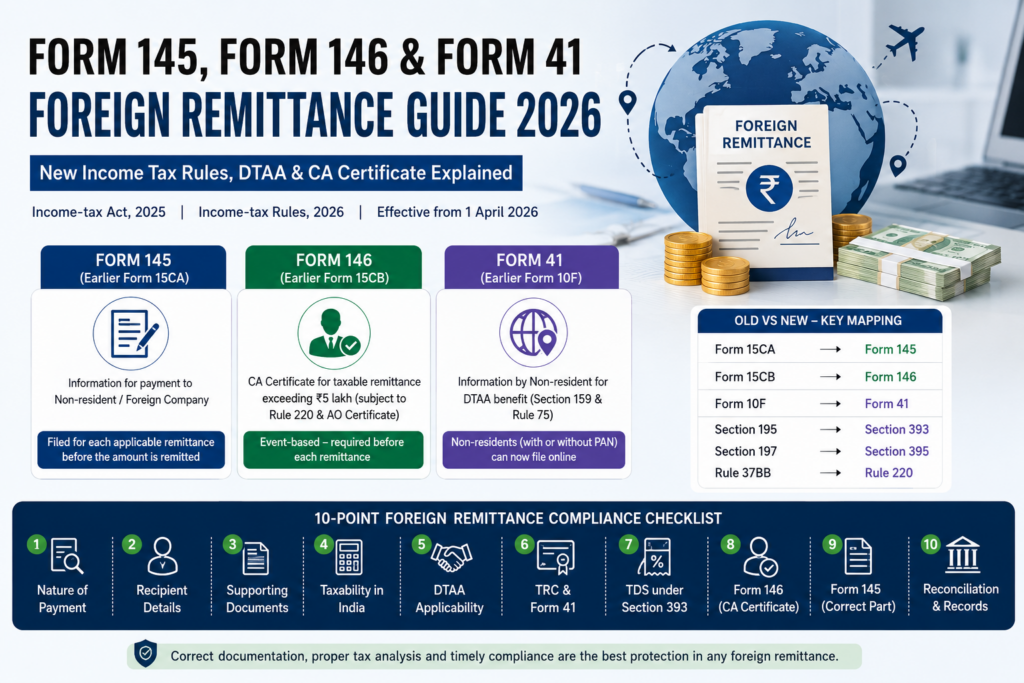
Form 145-146 & Form 41: Foreign Remittance Guide 2026
Foreign Remittance Rules Have Changed: Do Not Keep Using the Old Form Numbers
If you are making a payment outside India, repatriating NRO funds, paying a foreign consultant, remitting property-sale proceeds or claiming a DTAA benefit, there is an important procedural change to understand.
From 1 April 2026, the Income-tax Act, 2025 and Income-tax Rules, 2026 have introduced new form numbers for several familiar international-tax compliances.
The important mapping is:
| Earlier Form / Provision | From 1 April 2026 | Purpose |
|---|---|---|
| Form 15CA | Form 145 | Information for payment to non-resident/foreign company |
| Form 15CB | Form 146 | Chartered Accountant’s certificate |
| Form 10F | Form 41 | Information furnished by non-resident for DTAA purposes |
| Section 195 | Section 393 | TDS on payment to non-resident |
| Section 197 | Section 395 | Certificate for lower/nil deduction |
| Rule 37BB | Rule 220 | Foreign-remittance reporting framework |
CBDT has specifically clarified that for remittances made on or after 1 April 2026, Forms 145 and 146 under the Income-tax Rules, 2026 are to be used. The underlying compliance principle broadly continues, but taxpayers, banks and professionals now need to use the new statutory framework. (incometax.gov.in)
For a wider comparison of old and new forms, see our detailed guide on Income Tax Act 2025 Forms Mapping.
What Is Form 145?
Form 145 is the new equivalent of old Form 15CA.
It is the information statement furnished by a person responsible for making a payment to:
- a non-resident, other than a company; or
- a foreign company.
The Income Tax Department’s official Form 145 User Manual states that Form 145 is filed for each applicable remittance before the amount is remitted. (incometax.gov.in)
This point is important.
Form 145 is not simply an annual declaration. It creates a transaction-specific foreign-remittance reporting trail.
Depending upon the amount and taxability, the taxpayer has to select the appropriate part of Form 145.
Form 145 Has Four Parts — Which One Applies?
The new Form 145 retains the familiar four-part structure, but it is important to select the correct part.
Part A — Taxable Remittance Up to ₹5 Lakh
Part A applies where the remittance is taxable under the Income-tax Act and the amount or aggregate of such remittances does not exceed ₹5 lakh during the tax year.
A Form 146 CA certificate is generally not required for this part.
Part B — More Than ₹5 Lakh With AO Certificate
Part B applies where:
- the remittance is taxable;
- aggregate applicable remittance exceeds ₹5 lakh; and
- a certificate under Section 395(1) or Section 395(2) has been obtained from the Assessing Officer.
An important simplification under the new framework is that where the taxpayer already has the relevant AO certificate and files Part B, a separate Part C/CA certificate is not required. CBDT has expressly highlighted this as removal of duplication under the new system. (incometax.gov.in)
Part C — More Than ₹5 Lakh With Form 146
Part C applies where:
- the remittance is taxable;
- aggregate applicable remittance exceeds ₹5 lakh; and
- a Chartered Accountant has issued Form 146.
The CA must first file Form 146.
The taxpayer then enters the Form 146 acknowledgement number in Form 145 Part C. Relevant information from Form 146 is pre-filled into Form 145 for verification by the taxpayer. (incometax.gov.in)
Part D — Remittance Not Taxable in India
Part D applies where the remittance is not chargeable to tax under the Income-tax Act, subject to the exclusions prescribed under Rule 220(3).
This is an important distinction because:
Not taxable does not automatically mean no foreign-remittance compliance whatsoever.
The nature of payment and Rule 220 must first be examined.
What Is Form 146?
Form 146 is the new Form 15CB.
It is an Accountant’s Certificate relating to payment to a non-resident or foreign company.
According to the Income Tax Department, Form 146 is required where the payment is taxable and the payment or aggregate of applicable payments exceeds ₹5 lakh during the tax year, subject to the Form 145 framework and cases where the appropriate AO certificate has been obtained. (incometax.gov.in)
For professional assistance, taxpayers and businesses can refer to our dedicated Form 145 & Form 146 – CA Certificate for Foreign Remittance service.
Form 146 Is Not Merely a Certificate Requested by the Bank
This is perhaps the most important practical point.
The official Form 146 User Manual shows that the CA has to deal with seven separate areas:
- Particulars of the remitter;
- Particulars of the foreign recipient;
- Particulars of the remittance;
- Taxability under the Income-tax Act without considering DTAA;
- Taxability under the applicable DTAA;
- Tax deducted at source; and
- Verification by the Chartered Accountant. (incometax.gov.in)
Therefore, the correct approach is not:
“Bank wants Form 146 → ask CA to issue certificate → remit money.”
The proper approach is:
Understand transaction → determine taxability → examine DTAA → determine TDS → verify documentation → select Form 145 Part → prepare Form 146 where required → remit.
What Documents Should Be Checked Before Form 146?
The Income Tax Department’s official Form 146 FAQ specifically refers to documents including:
- invoice;
- agreement or contract;
- remitter details;
- foreign recipient/remittee details;
- remittance particulars;
- bank details;
- applicable AO certificate, where relevant;
- Form 41; and
- Tax Residency Certificate (TRC) where DTAA benefit is claimed. (incometaxindia.gov.in)
Depending upon the transaction, additional documents may also be necessary.
For example, an NRI repatriating property-sale proceeds may need the purchase deed, sale deed, capital-gain computation, TDS evidence, ITR, bank statements and proof establishing the source of funds.
Important New Development: Form 41 Has Replaced Form 10F
This is particularly relevant for international taxation and DTAA claims.
Under the new Income-tax framework:
Old Form 10F → New Form 41
The Income Tax Department has now issued a detailed Form 41 User Manual and made the form available on the e-Filing portal.
Form 41 is prescribed for furnishing information required from a non-resident in connection with treaty relief under Section 159 read with Rule 75 of the Income-tax Rules, 2026. (incometax.gov.in)
This matters directly to Form 146 because the Department’s own Form 146 FAQ lists Form 41 and the Tax Residency Certificate among the relevant documents where DTAA benefit is being claimed. (incometaxindia.gov.in)
No PAN in India? Non-Residents Can Still File Form 41
This is one of the most useful practical features of the new system.
The official Form 41 User Manual provides that a non-resident who does not hold PAN and is not required to obtain PAN can use a separate login created for the Non-Resident Taxpayer category.
The non-resident will require, among other things:
- foreign Tax Identification Number;
- prescribed residence certificate/documentation; and
- registration under the applicable non-resident login mechanism.
PAN-based users may verify the form through the applicable EVC/DSC mechanism, whereas an eligible non-resident using the NR-ID login can verify through OTP sent to the registered email and mobile number. (incometax.gov.in)
This makes DTAA documentation more workable for genuine overseas recipients who do not otherwise need an Indian PAN.
Form 41 + TRC: Why Both Matter for DTAA
A common mistake in cross-border payments is to assume that merely obtaining a Tax Residency Certificate (TRC)settles the DTAA documentation.
That is not always sufficient.
Where the prescribed information is not fully contained in the TRC, the relevant additional information is furnished through Form 41, subject to the requirements of Section 159(8) and Rule 75.
Therefore, before granting a treaty-based withholding position in Form 146, the remitter and CA should check:
TRC → Form 41 → treaty country → nature of income → beneficial treaty Article → PE/fixed-base implications where relevant → applicable tax rate → TDS under Section 393.
For NRI and cross-border tax matters, our NRI Tax & DTAA Advisory service covers DTAA, NRO repatriation and related international-tax compliance.
Example: Indian Company Paying Foreign Consultant
Suppose an Indian company proposes to remit ₹12 lakh to a Singapore-based consultant.
The company should not simply conclude:
“The consultant is outside India, so there is no TDS.”
Instead, the transaction should be examined in sequence.
Step 1: What is the real nature of service?
Examine the agreement, invoice and actual scope of work.
Step 2: Is the income chargeable to tax in India?
Examine the relevant provisions of the Income-tax Act, including the source rules applicable to the payment.
Step 3: Does DTAA change the tax position?
Examine the India-Singapore DTAA and the relevant treaty Article.
Step 4: Are TRC and Form 41 available?
If treaty benefit is being claimed, ensure the prescribed documentation is complete.
Step 5: What TDS is required under Section 393?
Determine the withholding obligation and rate.
Step 6: Which Form 145 Part applies?
If the remittance is taxable, exceeds the prescribed ₹5 lakh threshold and no Section 395 AO certificate is being relied upon, Form 146 followed by Form 145 Part C may be applicable.
This analysis should happen before remittance, not after the bank raises a query.
Special Rule for Transactions Straddling 1 April 2026
There is an important transition issue.
Suppose an expense or liability accrued in February 2026, but payment is actually remitted in April 2026.
Which Act applies?
CBDT has specifically clarified:
- the procedural requirement follows the law applicable on the date of remittance—therefore Forms 145/146 under the Income-tax Act, 2025 apply to a remittance made after 1 April 2026; but
- the taxability of the underlying income is determined under the Act applicable to the year in which that income accrued. (incometax.gov.in)
This distinction is particularly important during FY 2026-27 because businesses may still be settling liabilities originating before the new Act became effective.
Form 146 Is Event-Based — Not a Once-a-Year Certificate
Another useful clarification from the Income Tax Department concerns frequency.
There is no annual limit on the number of Form 146 certificates.
The Department describes Form 146 as an event-based form, which is required before each remittance satisfying the conditions of Rule 220. (incometaxindia.gov.in)
Similarly, Form 145 is filed for each applicable remittance. (incometax.gov.in)
So, if a business makes several independent taxable overseas payments, one Form 146 obtained earlier in the year should not automatically be assumed to cover all later remittances.
Form 145/146 Compliance Is Becoming More Important After CBDT’s Foreign Remittance Scrutiny
The significance of these forms has increased further because the Income Tax Department is now paying closer attention to foreign-remittance data and inconsistencies between the nature of business, turnover, remittance purpose and supporting documentation.
We recently discussed this separately in our article on Foreign Remittance Income Tax Scrutiny 2026.
The practical lesson is straightforward:
Form 145 and Form 146 should agree with the commercial and financial records underlying the transaction.
Ideally, the following should tell one consistent story:
Agreement → Invoice → Books of Account → RBI Purpose Code → Bank Remittance → Taxability Analysis → DTAA → TRC/Form 41 → TDS → Form 146 → Form 145
A mismatch at one stage does not automatically establish wrongdoing, but it can create questions that require explanation.
10-Point Foreign Remittance Compliance Checklist
Before making a material overseas payment, check:
| Check | Question |
|---|---|
| 1. Nature | What exactly is being paid for? |
| 2. Recipient | Who is the beneficial recipient? |
| 3. Documentation | Are invoice and agreement available? |
| 4. Taxability | Is the amount chargeable to tax in India? |
| 5. DTAA | Does a treaty provide relief? |
| 6. TRC/Form 41 | Is treaty documentation complete? |
| 7. TDS | Has Section 393 withholding been correctly determined? |
| 8. Form 146 | Is CA certification required? |
| 9. Form 145 | Which Part of Form 145 applies? |
| 10. Reconciliation | Do books, bank, RBI purpose code, TDS and forms agree? |
If these ten questions can be answered with supporting evidence, the remittance file is substantially better prepared for future verification.
NRI Repatriation: Form 145/146 Is Only One Part of the Process
For NRIs, foreign remittance frequently arises while:
- transferring funds from NRO to an overseas account;
- repatriating property-sale proceeds;
- remitting inherited money;
- transferring investment proceeds; or
- remitting accumulated income from India.
In these cases, obtaining Form 145/146 should not be treated as the entire exercise.
The source of funds and Indian tax compliance may also need to be demonstrated.
For example, property-sale proceeds may require examination of:
sale deed + original acquisition documents + capital-gain computation + NRI TDS + Form 26AS/AIS + tax payment/return + bank trail + Form 145/146 + FEMA/bank documentation.
Where the underlying transaction involves sale of Indian property by an NRI, our detailed guide on NRI Property Sale – TDS, Form 144 and Form 145/146 explains the related compliance framework.
What If Form 145/146 Is Filed Incorrectly?
Foreign-remittance forms should not be prepared from assumptions or merely from the description appearing on an invoice.
An incorrect classification can potentially affect:
- withholding tax;
- treaty benefit;
- reporting of the remittance;
- consistency with banking records;
- future assessment or verification; and
- professional certification.
Where a substantial historical foreign-remittance mismatch is identified, the first step should normally be a transaction-wise reconciliation rather than sending an unstructured explanation to the Department.
If the transaction has already resulted in an income-tax inquiry, professional assistance for Income Tax Scrutiny and Assessment matters may be considered.
Frequently Asked Questions
1. Is Form 15CA still applicable after 1 April 2026?
For remittances made on or after 1 April 2026, the corresponding prescribed form under the Income-tax Act, 2025 framework is Form 145. CBDT’s transition FAQ specifically confirms the use of Forms 145 and 146 for such remittances. (incometaxindia.gov.in)
2. What is the new Form 15CB?
Form 146 is the corresponding Accountant’s Certificate under the new framework. (incometax.gov.in)
3. Is Form 146 compulsory for every foreign remittance above ₹5 lakh?
No. The ₹5 lakh amount alone should not be used as the test. Taxability, Rule 220, the applicable part of Form 145 and whether an AO certificate under Section 395 has been obtained must also be considered. (incometax.gov.in)
4. What is the new Form 10F?
Form 41 corresponds to the earlier Form 10F framework and is used for prescribed information relating to DTAA claims by non-residents under Section 159 and Rule 75. (incometax.gov.in)
5. Can a foreign company without Indian PAN file Form 41?
The Income Tax Department’s User Manual provides a separate Non-Resident Taxpayer login for a non-resident not holding PAN and not required to obtain one. The prescribed registration and identification requirements still have to be satisfied. (incometax.gov.in)
6. Is TRC enough to claim DTAA benefit?
The applicable documentation should be examined case by case. The Income Tax Department specifically lists Form 41 and TRC among the documents relevant to Form 146 where DTAA benefit is claimed. (incometaxindia.gov.in)
7. Does Form 146 have to be filed before Form 145?
Where Part C of Form 145 applies, yes. The CA files Form 146 first and its acknowledgement number is then used for filing Form 145 Part C. (incometax.gov.in)
8. Can one Form 146 cover all remittances during the year?
Not automatically. The Department describes Form 146 as an event-based form required before each remittance satisfying Rule 220 conditions. (incometaxindia.gov.in)
Practical Takeaway
The change from 15CA/15CB/10F to Forms 145/146/41 is more than a change in numbering.
The new framework connects three important questions:
Is the foreign payment taxable in India?
If DTAA relief is claimed, is the treaty documentation complete?
Does the tax position match what is being reported to the Income Tax Department and the authorised dealer bank?
For businesses, NRIs and professionals, the safest approach is therefore to complete the taxability and DTAA review before making the remittance.
Remember the sequence:
Foreign Payment → Taxability → Section 393 TDS → DTAA → TRC + Form 41 → Form 146, where applicable → Form 145 → Bank Remittance
For assistance with cross-border payments, NRO repatriation, DTAA analysis and CA certification, refer to our Form 145 & Form 146 – CA Certificate for Foreign Remittance service.
Official References
The article is based principally on the following current official material:
- Form 145 User Manual – Income Tax Department — filing requirement, four-part structure and Part C linkage with Form 146. (incometax.gov.in)
- Form 146 User Manual – Income Tax Department — applicability, CA filing and seven-panel taxability/DTAA structure. (incometax.gov.in)
- Form 146 FAQs – Income Tax Department — filing frequency, documentation, TRC and Form 41 requirements. (incometaxindia.gov.in)
- Form 41 User Manual – Income Tax Department — Section 159/Rule 75 compliance and filing by non-residents, including eligible taxpayers without PAN. (incometax.gov.in)
- CBDT Transition FAQs – Income Tax Act 2025 — confirms Forms 145/146 from 1 April 2026 and explains transitional remittances. (incometaxindia.gov.in)
Disclaimer: This article is intended for general educational and professional information. Taxability of a foreign remittance depends upon the nature of payment, residential status, source rules, applicable DTAA, documentation and facts of the particular transaction. Professional advice should be obtained before acting on a material cross-border payment.
[…] detailed guide explains the Form 145 and Form 146 foreign-remittance rules, DTAA review and CA certification. (CA Alok […]