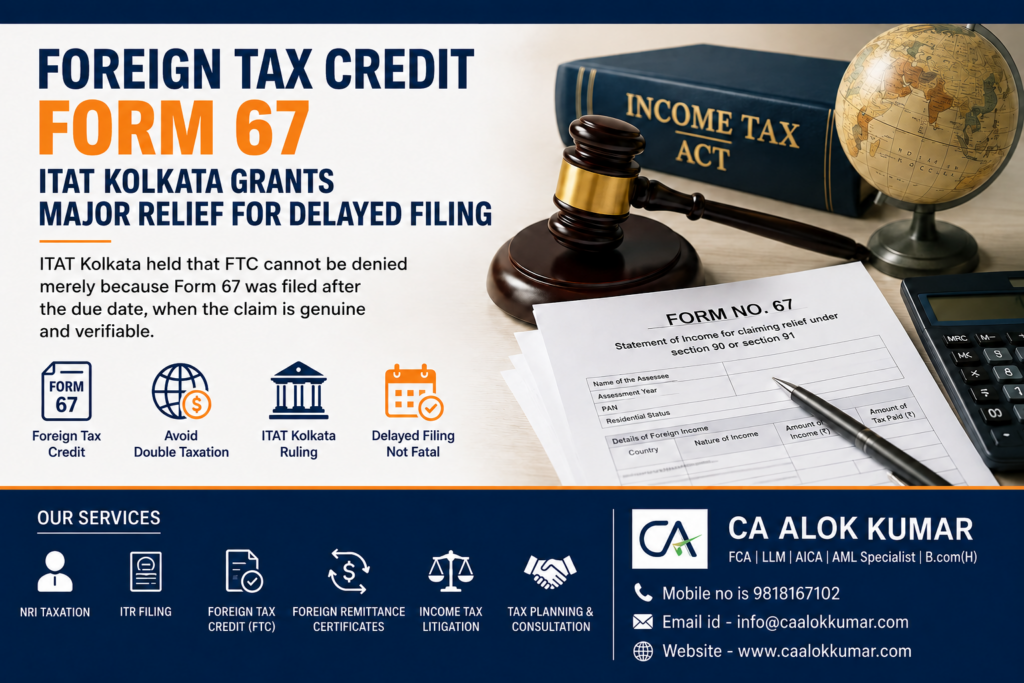
Foreign Tax Credit Form 67 compliance is a crucial issue for Indian resident taxpayers who earn income outside India and pay tax in another country. Foreign salary, overseas dividends, foreign consultancy income, ESOPs, RSUs, rental income from abroad, and other foreign-source receipts may result in the same income being taxed twice — once outside India and again in India.
The Income-tax Act provides relief through foreign tax credit, commonly known as FTC. However, this relief is generally linked with filing Form No. 67 under Rule 128 of the Income-tax Rules. In practice, many genuine taxpayers face denial of foreign tax credit only because Form 67 was filed late.
The recent ITAT Kolkata ruling in Neeta Makkar v. DCIT gives important relief to such taxpayers. The Tribunal held that foreign tax credit of ₹8,81,398 could not be denied merely because Form No. 67 was filed after the due date, when the foreign tax credit claim was otherwise genuine and verifiable.
For taxpayers, NRIs, returning Indians, globally mobile employees, consultants and professionals, this ruling is significant. It confirms that a procedural delay should not defeat a substantive right to avoid double taxation.
For professional assistance with foreign income, NRI taxation, DTAA position, Form 67 reporting and return filing, you may consult an experienced NRI tax consultant in Dwarka Delhi or a qualified tax consultant in Dwarka.
Table of Contents
- Case summary of Neeta Makkar v. DCIT
- What was the dispute before ITAT Kolkata?
- ITAT Kolkata ruling on delayed Form 67
- What is Form 67?
- Who is required to file Form 67?
- Due date and filing requirement of Form 67
- Is delayed Form 67 fatal to FTC claim?
- Practical impact for taxpayers with foreign income
- Compliance checklist for Foreign Tax Credit Form 67
- FAQs on Foreign Tax Credit Form 67
Case Summary of Neeta Makkar v. DCIT
In Neeta Makkar v. DCIT, the assessee filed her return of income for Assessment Year 2017-18 declaring total income of ₹83,88,210. The returned income was accepted in assessment. However, the Assessing Officer denied the foreign tax credit of ₹8,81,398 claimed under Section 90 of the Income-tax Act.
The reason for denial was not that foreign income was undisclosed. It was also not that foreign tax had not been paid. The denial was made solely because Form No. 67 had been filed after the due date for filing the return.
The Commissioner (Appeals) upheld the denial on the ground that Form 67 was filed late. The assessee then approached the ITAT Kolkata.
The Tribunal allowed the appeal and held that the foreign tax credit claim could not be rejected merely because Form 67 was filed belatedly. This makes the ruling highly relevant for taxpayers who have genuine foreign tax credit claims but face procedural objections during processing, assessment or appeal.
What Was the Dispute Before ITAT Kolkata?
The core dispute was simple but important:
Can foreign tax credit be denied only because Form 67 was filed late?
The assessee’s position was that Form 67 is a procedural requirement. If the foreign income has been offered to tax in India and foreign tax has actually been paid or deducted abroad, then the substantive relief under Section 90 should not be denied merely due to delay in filing the prescribed form.
The Revenue’s view was that Form 67 had to be filed within the prescribed timeline and non-compliance justified denial of FTC.
The ITAT Kolkata accepted the taxpayer’s position and treated the delayed filing of Form 67 as a procedural lapse in the facts of the case.
Foreign Tax Credit Form 67: ITAT Kolkata’s Key Finding
The ITAT Kolkata held that the denial of FTC merely due to late filing of Form 67 was not sustainable. The Tribunal followed the judicial approach that procedural requirements should not override substantive relief where the claim is otherwise genuine, verifiable and supported by tax records.
This ruling is important because foreign tax credit is not an ordinary deduction. It is a mechanism to prevent double taxation. When the same income is taxed in a foreign country and again in India, FTC gives credit for foreign tax paid, subject to the provisions of the Act, applicable tax treaty and Rule 128.
The decision in Neeta Makkar v. DCIT therefore strengthens the taxpayer’s case where the only defect is delayed filing of Form 67 and there is no dispute about the genuineness of the foreign tax credit claim.
However, taxpayers should not treat this ruling as a reason to ignore timelines. The safest approach remains timely filing of Foreign Tax Credit Form 67 along with accurate disclosure in the income tax return.
For accurate reporting of foreign income and FTC in the income tax return, taxpayers may seek assistance for ITR filing in Dwarka Delhi.
What Is Form 67?
Form 67 is the prescribed form for claiming foreign tax credit in India. It is filed by a resident assessee who wants to claim credit of foreign tax paid or deducted outside India on income that is also offered to tax in India.
In simple terms, Form 67 acts as a bridge between three important items:
- foreign income earned by the taxpayer;
- foreign tax paid or deducted in another country; and
- foreign tax credit claimed in the Indian income tax return.
The form generally requires details of the foreign country, foreign income, foreign tax paid, relevant tax treaty relief, and computation of credit claimed in India.
Foreign Tax Credit Form 67 becomes relevant in cases such as:
- salary earned outside India by a resident taxpayer;
- foreign dividend income;
- ESOP or RSU income from overseas employer or parent company;
- foreign consultancy or professional income;
- foreign pension;
- foreign rental income;
- overseas capital gains;
- taxes withheld abroad on foreign income;
- income of returning NRIs who become resident in India.
Where foreign remittance, DTAA analysis or tax certification is also involved, a taxpayer may separately require professional support for CA certificate for remittance of funds outside India or Form 145 and 146 CA certificate for foreign remittance, depending on the applicable law, transaction and year.
Who Is Required to File Form 67?
Form 67 is generally relevant for a resident taxpayer claiming foreign tax credit. It may apply to individuals, HUFs, firms, companies or other assessees, depending on the facts.
A typical taxpayer requiring Form 67 may be:
- an Indian resident employee who worked abroad during the year;
- a returning NRI who became resident in India;
- an Indian resident receiving foreign dividends;
- a consultant receiving foreign professional income;
- a person receiving foreign pension;
- an employee receiving ESOPs or RSUs taxed overseas;
- a resident taxpayer having tax deducted in the USA, UK, UAE, Singapore, Canada, Australia or any other foreign jurisdiction.
For NRIs, RNOR taxpayers and returning Indians, the first step is to determine residential status correctly. Residential status affects whether foreign income is taxable in India and whether FTC reporting is required. A wrong residential-status position may result in defective reporting, double taxation, notice, demand or refund blockage.
A taxpayer with foreign income should therefore not look at Form 67 in isolation. It should be reviewed together with residential status, DTAA position, Schedule FSI, Schedule TR, Schedule FA, AIS/TIS, Form 26AS and the applicable ITR form.
A qualified Chartered Accountant in Dwarka can help verify the correct tax treatment before filing or revising the return.
Due Date and Filing Requirement of Form 67
For current compliance, Form 67 is filed electronically on the income tax e-filing portal. It is required to be filed before claiming foreign tax credit in the return.
The present official Form 67 guidance states that where the return is filed under Section 139(1) or Section 139(4), Form 67 should be filed on or before the end of the relevant assessment year. For an updated return under Section 139(8A), Form 67 should be filed on or before the date of furnishing the updated return.
For older assessment years, including Assessment Year 2017-18 involved in Neeta Makkar v. DCIT, the earlier due-date framework caused frequent disputes because Form 67 was expected to be filed within a stricter timeline. Many genuine taxpayers filed the return and disclosed foreign income but missed or delayed Form 67 due to lack of awareness or technical reasons.
The Neeta Makkar ruling is therefore particularly useful where:
- foreign income was duly offered to tax in India;
- foreign tax was actually paid or deducted abroad;
- Form 67 was eventually filed;
- the FTC claim is supported by documents;
- the denial is only due to delay in Form 67 filing.
Is Delayed Form 67 Fatal to Foreign Tax Credit Claim?
The ITAT Kolkata ruling indicates that delayed Form 67 filing is not automatically fatal to the FTC claim.
This is because Form 67 is procedural in nature. It facilitates verification of foreign tax credit, but it should not normally destroy the substantive benefit if the taxpayer is otherwise eligible.
The distinction between procedural compliance and substantive entitlement is important. A procedural form helps the tax department verify the claim. A substantive right arises from the law and, where applicable, the Double Taxation Avoidance Agreement. If the foreign tax has been paid and the same income is taxable in India, denial of FTC only on a technical delay may result in unfair double taxation.
That said, taxpayers should not become careless. Litigation relief depends on facts. A delayed Form 67 case is stronger when the taxpayer can prove:
- foreign income was reported in the return;
- foreign tax was paid or deducted;
- Form 67 was filed, though belatedly;
- documents were available for verification;
- there was no attempt to conceal income;
- the FTC claim was correctly computed;
- the claim was made under the relevant treaty or statutory provision.
If a notice, demand or mismatch has already arisen due to denial of FTC, early professional review is advisable. Taxpayers in Delhi NCR may consult a tax consultant in Dwarka or a CA in Rajendra Place Delhi for case-specific representation.
Practical Impact of Neeta Makkar v. DCIT
The Neeta Makkar decision is helpful for taxpayers because it supports the principle that genuine FTC should not be denied solely on procedural delay.
1. Relief from double taxation
The ruling protects taxpayers from being taxed twice on the same foreign income where foreign tax was already paid and the claim is otherwise lawful.
2. Useful precedent for appeals and rectification
Where FTC has been denied in intimation, assessment or appeal only due to belated Form 67, the taxpayer may examine available remedies such as rectification, appeal or revision, depending on the stage and facts.
3. Stronger position for foreign-income taxpayers
Employees, consultants, NRIs returning to India, global mobility professionals and investors with foreign income may rely on the judicial trend that procedural delay should not override a genuine claim.
4. Reminder to maintain documentation
The ruling gives relief, but it also highlights the need for proper documentation. Taxpayers should keep foreign tax payment proof, salary slips, overseas tax returns, withholding certificates, employer statements, bank statements and computation workings.
5. Better ITR planning
Foreign tax credit is not a last-minute entry in the return. It requires coordination between foreign income disclosure, Indian tax computation, DTAA relief, Form 67, Schedule FSI, Schedule TR and foreign asset reporting where applicable.
Compliance Checklist for Foreign Tax Credit Form 67
Before claiming FTC, taxpayers should verify the following points:
1. Confirm residential status
Foreign income taxation depends heavily on whether the taxpayer is resident, non-resident or resident but not ordinarily resident. A returning Indian should review RNOR status carefully.
2. Identify foreign income correctly
Classify foreign income under the correct head of income, such as salary, house property, capital gains, business or profession, or income from other sources.
3. Check whether income is taxable in India
Foreign income should be examined under the Income-tax Act and the applicable DTAA, where relevant.
4. Verify foreign tax paid or deducted
Foreign tax credit can be claimed only where tax has been paid or deducted in the foreign country or specified territory and the income is offered to tax in India.
5. Prepare Form 67 carefully
Foreign Tax Credit Form 67 should match the ITR schedules and supporting documents. Any mismatch may lead to denial, defective return, adjustment, notice or demand.
6. File Form 67 within the prescribed timeline
Even though courts and tribunals have granted relief in genuine delayed filing cases, timely filing is always safer and avoids unnecessary litigation.
7. Complete Schedule FSI and Schedule TR
In the ITR, foreign-source income and tax relief must be correctly reported in the relevant schedules. Form 67 alone is not enough if the ITR schedules are incomplete.
8. Review foreign asset reporting
Resident taxpayers may also have to report foreign assets, foreign bank accounts, foreign equity, ESOPs, RSUs or financial interest in Schedule FA, where applicable.
9. Reconcile AIS, TIS and Form 26AS
For proper return filing and refund processing, taxpayers should review AIS/TIS, Form 26AS, foreign withholding documents and tax paid details.
10. Seek professional review before filing
FTC errors can create avoidable demand, refund delay and litigation. For complex cases, CA-assisted ITR filing in Dwarka Delhi can help ensure correct compliance.
Form 67 and Foreign Remittance: Avoid Confusion
Form 67 should not be confused with forms used for foreign remittance from India.
Form 67 is for claiming foreign tax credit in the Indian income tax return. On the other hand, Form 15CA/15CB or the applicable remittance-related forms are generally connected with remittance of funds outside India and tax deduction compliance on payments to non-residents.
For example:
- Form 67 relates to foreign tax credit.
- Form 15CA/15CB relates to foreign remittance compliance under the existing framework.
- Form 145/146, where applicable under the new framework, may be relevant for foreign remittance certification and reporting.
Therefore, a taxpayer earning foreign income may require Form 67 for FTC, while a person remitting money outside India may require separate remittance compliance. In cross-border cases, both issues may arise together, but they serve different legal purposes.
For remittance-related assistance, taxpayers may review services for CA certificate for remittance of funds outside Indiaand Form 145 and 146 CA certificate for foreign remittance.
Important Note for Taxpayers
If your foreign tax credit has been denied because Form 67 was filed late, do not ignore the demand or intimation. The first step is to review the return, Form 67 filing status, foreign tax documents and the order or intimation issued by the department.
A professional review can help identify whether rectification, appeal, revised filing, updated return or other remedy is suitable in your case.
CA Alok Kumar provides professional assistance for foreign income reporting, NRI taxation, ITR filing, tax notices, foreign remittance certificates and income tax representation through offices in Dwarka and Rajendra Place, Delhi.
You may connect with a Chartered Accountant in Dwarka, consult a tax consultant in Dwarka, or visit a CA in Rajendra Place Delhi for case-specific assistance.
Key Takeaway
The ruling in Neeta Makkar v. DCIT is a taxpayer-friendly decision on Foreign Tax Credit Form 67. It confirms that FTC should not be denied merely because Form 67 was filed late, where the underlying foreign tax credit claim is genuine and verifiable.
However, taxpayers should still file Form 67 on time. The ruling should be treated as a protective precedent for genuine cases, not as a substitute for proper compliance.
If you have foreign income, foreign tax paid, NRI tax issues, ESOPs, RSUs, overseas salary, foreign dividend income or a pending FTC denial, proper review before filing or responding to the department can prevent avoidable tax demand and litigation.
FAQs on Foreign Tax Credit Form 67
1. What is Foreign Tax Credit Form 67?
Foreign Tax Credit Form 67 is the prescribed form for claiming credit of foreign tax paid or deducted outside India on income that is offered to tax in India.
2. Who should file Form 67?
A resident taxpayer claiming foreign tax credit should file Form 67. It is commonly relevant for taxpayers having foreign salary, foreign dividends, ESOPs, RSUs, overseas consultancy income, foreign pension or other foreign-source income.
3. Can FTC be denied only because Form 67 was filed late?
In Neeta Makkar v. DCIT, the ITAT Kolkata held that FTC could not be denied merely because Form 67 was filed after the due date, where the claim was otherwise genuine.
4. Does this mean Form 67 due date can be ignored?
No. Taxpayers should file Form 67 within the prescribed timeline. The ruling helps genuine cases where the delay has already occurred, but timely compliance remains the best approach.
5. Is a CA certificate mandatory for Form 67?
A CA certificate is not mandatory for filing Form 67. However, professional review is advisable where foreign income, DTAA, FTC computation, Schedule FSI, Schedule TR or Schedule FA reporting is involved.
6. What documents are needed for foreign tax credit?
Common documents include foreign tax withholding certificate, overseas tax return, salary certificate, dividend statement, tax payment proof, employer certificate, foreign bank statement, Form 67 computation and relevant ITR schedules.
7. What should I do if my FTC is denied?
You should review the intimation or order, verify Form 67 filing status, reconcile the ITR schedules and examine whether rectification, appeal or other remedy is available.
8. Is Form 67 the same as Form 15CA/15CB?
No. Form 67 is for foreign tax credit. Form 15CA/15CB relates to foreign remittance compliance. These are different forms with different purposes.
9. Can NRIs claim foreign tax credit in India?
An NRI is generally taxed in India based on Indian income. However, if the person becomes resident or RNOR, foreign income and FTC issues may arise depending on the facts. Residential status must be determined first.
10. Why is professional help useful in Form 67 cases?
Foreign tax credit cases involve residential status, DTAA provisions, foreign tax documents, ITR schedules and procedural timelines. A small error may lead to denial of credit, demand or refund delay.
Leave a Reply