7 November 2026 | RBI & FEMA Updates | Foreign Remittance Compliance
RBI Form A2 Update 2026 – RBI A.P. (DIR Series) Circular No. 23, RBI/2026-27/279, dated 1 October 2026; RBI Circular No. 12 dated 3 July 2024; Income Tax Department guidance on Forms 145/146.
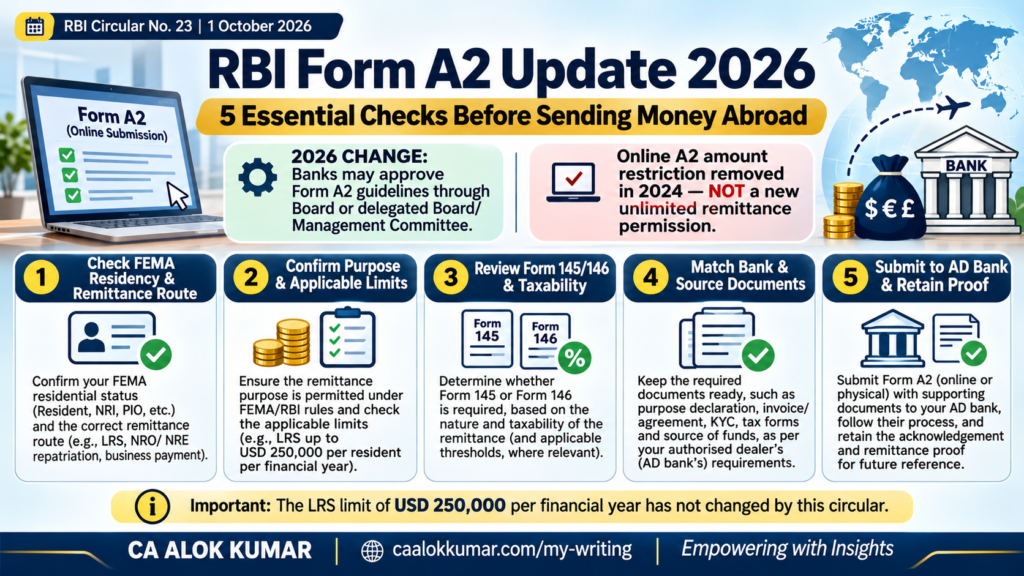
The RBI Form A2 Update 2026 is important for anyone sending money outside India, but its actual effect is narrower than many headlines suggest. Through A.P. (DIR Series) Circular No. 23 dated 1 October 2026, the Reserve Bank of India has permitted authorised dealers to obtain approval of their Form A2 operating guidelines from the Board or a duly delegated Board Committee or Management Committee.
The circular does not increase the Liberalised Remittance Scheme (LRS) limit, make all outward remittances unrestricted, or waive income-tax documents. It changes who may approve a bank’s internal remittance procedures. For residents, NRIs and businesses, correct FEMA classification, bank documentation and tax reporting remain essential.
What exactly changed in RBI Form A2 in October 2026?
RBI Circular RBI/2026-27/279, A.P. (DIR Series) Circular No. 23, dated 1 October 2026, refers to paragraph 3 of its earlier Circular No. 12 dated 3 July 2024. The earlier circular required authorised dealers to prepare appropriate internal guidelines, approved by their Board, for outward remittances using online or physical Form A2 and related documents.
Under the October 2026 amendment, those guidelines may be approved by the Board or a Board Committee / Management Committee to which the Board has delegated the required powers. All other instructions in the July 2024 circular remain unchanged. The direction cites sections 10(4) and 11(1) of the Foreign Exchange Management Act, 1999.
Practical effect: banks have additional flexibility in their internal governance and approvals. Customers should still follow the authorised dealer’s applicable submission process and supply supporting evidence.
Online Form A2: did RBI remove the amount limit in 2026?
No. The restriction attached specifically to the online mode of Form A2 submission was removed in July 2024. RBI’s 2024–25 Annual Report confirms that authorised dealers could facilitate relevant remittances using online or physical Form A2 irrespective of transaction value, subject to FEMA and the bank’s checks. The October 2026 circular changes only the approval authority for related internal guidelines.
Removing a form-submission cap is not the same as removing restrictions on the underlying foreign exchange transaction. An individual remittance may still be subject to LRS limits, purpose restrictions, regulatory approvals, KYC, source-of-funds verification and tax compliance.
RBI Annual Report — 2024–25 explanation of online Form A2 reform
What is Form A2 used for?
Form A2 is an authorised-dealer declaration/documentation instrument used for relevant outward foreign exchange remittances. The bank may seek the remitter and beneficiary details, foreign currency, amount, remittance purpose, appropriate purpose code, declarations and transaction evidence.
Section 10(5) of FEMA provides for reasonable information and declarations enabling authorised persons to satisfy themselves that the transaction does not contravene the law. The documents vary: an overseas education payment, a foreign vendor invoice and repatriation of NRO balances are not identical transactions.
Form A2 versus Form 145 and Form 146 — do not confuse them
Form A2 is connected with RBI/FEMA and the authorised dealer’s foreign exchange documentation. Forms 145 and 146 are income-tax information and certification forms under the Income-tax Act, 2025 and Rule 220 of the Income-tax Rules, 2026, applicable from 1 April 2026. They replaced the earlier Forms 15CA and 15CB.
Form 145 has Parts A, B, C and D, depending on taxability, annual aggregate and available certificates; Form 146 is the accountant’s certificate where the Part C route applies. Not every remittance requires both forms. Exempt transactions under Rule 220(3) and non-taxable remittances require a different analysis from taxable remittances exceeding the prescribed threshold.
For transaction-specific guidance on Form 145 and Form 146 CA certification for foreign remittance, review the underlying taxability, applicable TDS and documents before filing.
Income Tax Department — FAQs covering Form 145/146 transition and parts
Five essential checks before sending money abroad
1. Identify FEMA residential status and the correct remittance route
Confirm whether the remitter is a resident individual, NRI/person resident outside India or business entity under FEMA. Do not assume FEMA residential status automatically equals income-tax residential status. Resident individuals may use LRS for eligible transactions; NRI repatriation from NRO accounts and company outward payments are governed by different provisions.
For NRO and other eligible balances, review NRI repatriation services and supporting source-of-funds records.
2. Confirm the payment purpose, purpose code and applicable limits
Verify the exact beneficiary, purpose and RBI classification. The usual LRS framework permits resident individuals up to USD 250,000 per financial year for eligible remittances, subject to the scheme’s conditions and exceptions. The October 2026 circular does not change this threshold. Purpose-specific requirements and approvals may still apply.
3. Determine taxability, TDS/TCS and Forms 145/146 applicability
Examine whether the foreign recipient is receiving income chargeable to tax in India, whether withholding applies, whether a tax treaty is relevant and which reporting part or exemption applies under Rule 220. LRS-related tax collection at source, where applicable, is a separate issue. A transfer value exceeding ₹5 lakh does not automatically mean Form 146 is mandatory irrespective of taxability or exemptions.
For Delhi NCR clients, see Form 145/146 CA certificate services in Delhi. Businesses can also review foreign exchange services.
4. Reconcile the bank documents and source of funds
Ensure that names, purpose code, amount, currency, beneficiary information and tax declarations agree across records. Depending on the transaction, the bank may require an invoice, service agreement, fee letter, bank statement, property sale deed, inheritance or gift evidence, capital-gains calculation, TDS challans or tax-residency documents. Ask for documents relevant to the actual case rather than a generic exhaustive checklist.
5. Follow the authorised dealer’s submission process and retain proof
Confirm whether the particular bank accepts online Form A2, a physical form or an integrated digital instruction. Provide the requested records, complete the applicable tax reporting before remittance and retain submitted forms, acknowledgements and transfer advice. Processing timelines depend on the bank’s review; the RBI circular does not promise immediate remittance approval.
How the update affects common foreign remittance cases
Resident individual paying university fees abroad
Check the educational purpose, LRS eligibility, invoices or admission letters, required bank documentation and applicable TCS position. The payment does not automatically require a CA certificate merely because funds are being sent overseas.
NRI repatriating Indian property sale proceeds
Check the relevant FEMA repatriation route, NRO account source trail, sale deed, capital-gains tax compliance, TDS credits and bank documentation. Online Form A2 availability does not independently establish that the underlying funds are repatriable.
Read more about NRI taxation services and NRI taxation and FEMA guidance.
Indian business paying an overseas service provider
Examine the agreement and services, taxability in India, withholding under the Income-tax Act, treaty documentation and the permitted FEMA route. A correct purpose classification and consistent bank and tax forms can reduce queries.
Frequently asked questions on RBI Form A2 Update 2026
What was the key change in RBI Circular No. 23 dated 1 October 2026?
Authorised dealers may approve relevant Form A2 internal guidelines through their Board or a properly delegated Board Committee or Management Committee.
Does the update permit unlimited outward foreign remittance?
No. The earlier online submission cap was removed in July 2024; the underlying FEMA conditions, purposes and transaction limits continue.
Has the USD 250,000 LRS limit increased?
No. The October 2026 Form A2 circular does not amend the LRS ceiling.
Are Forms 145 and 146 compulsory for every remittance?
No. Their applicability depends on taxability, Rule 220 conditions, thresholds, the relevant part of Form 145 and any exemptions.
Can NRIs use LRS for NRO repatriation?
LRS is designed for resident individuals. NRI repatriation follows the relevant FEMA rules and bank documentation.
Can Form A2 be submitted online?
RBI permits authorised dealers to facilitate eligible outward remittances through online or physical Form A2, subject to applicable requirements and each dealer’s systems.
Conclusion: a governance simplification, not a remittance-limit increase
RBI Form A2 Update 2026 provides flexibility to authorised dealers in approving their internal Form A2 procedures. The underlying regulatory questions remain: Is the remittance permitted, is the purpose correctly classified, are the source documents satisfactory and have the applicable tax reporting and withholding obligations been met?
For tailored remittance documentation, Form 145/146 filing and CA certification can be reviewed alongside bank and FEMA requirements.
Official sources and legal references
RBI Circular No. 23 of 1 October 2026
RBI Annual Report discussion of July 2024 Form A2 reform
Income Tax Department — Forms 145 and 146 FAQ
Legal basis: Foreign Exchange Management Act, 1999, sections 10(4), 10(5), 11(1); Income-tax Rules, 2026, Rule 220; relevant RBI directions and AD-bank procedures. This article is informational and case-specific advice may be required.
Leave a Reply