Judicial Update | 2 November 2026 | GST Litigation
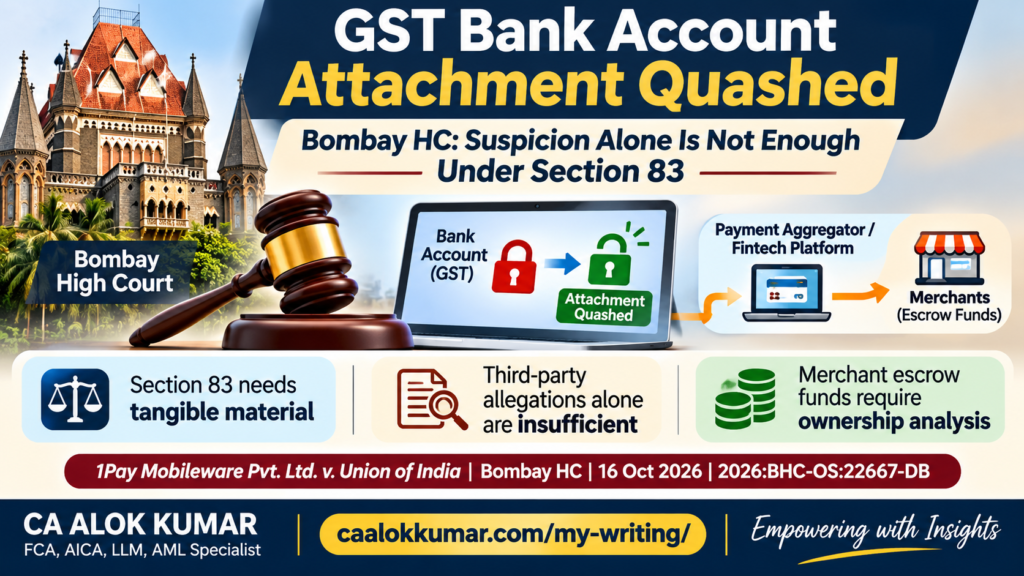
In 1Pay Mobileware Private Limited v. Union of India & Others, the Bombay High Court quashed provisional attachment orders affecting a payment aggregator’s bank accounts. The Court examined the extraordinary power under Section 83 of the CGST Act, 2017 and found that the statutory conditions for freezing the accounts had not been demonstrated through cogent, credible material.
The judgment does not grant automatic immunity to payment aggregators. It requires tax authorities to establish the statutory basis for the attachment and consider whether the money targeted is the person’s own property or is held for third-party merchants.
Case at a glance
| Particular | Details |
| Case | 1Pay Mobileware Private Limited v. Union of India & Others |
| Court | Bombay High Court, Division Bench |
| Decision | 16 October 2026 |
| Writ petition | 4586 of 2026 |
| Neutral citation | 2026:BHC-OS:22667-DB |
| Bench | M. S. Karnik and Sandesh D. Patil, JJ. |
| Key law | CGST Act Section 83; Section 122(1A); CGST Rule 159 |
| Result | Impugned provisional attachment orders set aside |
What led to the GST bank account attachment?
The petitioner was an RBI-authorised payment aggregator handling customer receipts and merchant settlements. During an investigation into alleged online-gaming-related GST evasion, the Directorate General of GST Intelligence (DGGI) suspected that certain merchant entities had routed transactions through the platform. Authorities provisionally froze accounts, including a settlement escrow account, using the powers under Section 83.
The petitioner maintained that allegations against merchants could not, without more, establish its own liability or justify freezing merchant settlement funds. The Court considered the attachment orders, the available material, and the statutory conditions for invoking Section 83.
Five important findings from the Bombay High Court
1. Provisional attachment is a drastic power
Section 83 is a protective, not punitive, measure. It cannot be used merely because an investigation is underway or attachment seems expedient. The Commissioner must form an opinion, based on relevant material, that attachment is necessary to protect government revenue.
2. Mere suspicion cannot replace tangible material
The Court noted the absence of adequately identified specific transactions and an explanation connecting the petitioner to the alleged evasion. General suspicions about merchants were insufficient to establish the statutory foundation for attaching the petitioner’s bank accounts.
3. The intermediary’s role must be examined independently
The use of a payment gateway by allegedly defaulting merchants does not automatically mean the aggregator falls within Section 122(1A) or that its property is liable to attachment. A reasoned analysis of the intermediary’s own role and the applicable statutory ingredients is necessary.
4. Escrow balances require an ownership analysis
The Court distinguished the payment aggregator’s beneficial property from amounts held in settlement accounts for merchants and other beneficiaries. The legal character of the funds matters: operating an account is not necessarily equivalent to owning all funds held in it.
5. Later explanations cannot repair a defective statutory order
An affidavit or litigation submission cannot substitute for the legally required formation of opinion at the time the attachment decision is made. On the facts, the Court quashed the impugned orders.
Section 83 of the CGST Act: statutory conditions
Section 83(1) authorises provisional attachment after the initiation of prescribed proceedings under Chapters XII, XIV or XV, where the Commissioner considers it necessary to protect the interest of government revenue. The provision concerns property, including bank accounts, belonging to the taxable person or a person specified in Section 122(1A). Under Section 83(2), such provisional attachment ordinarily ceases after one year from the order date.
- Identify the relevant pending proceeding and the person covered by Section 83.
- Establish credible material and a reasoned necessity to protect revenue.
- Demonstrate that the targeted property belongs to a person within the statutory provision.
- Follow the procedure and safeguards in Rule 159 of the CGST Rules.
Supreme Court guidance: Radha Krishan Industries
The Bombay High Court’s approach aligns with Radha Krishan Industries v. State of Himachal Pradesh, (2021) 6 SCC 771. The Supreme Court treated provisional attachment as an extraordinary power, requiring tangible material, a live link to revenue-protection necessity, and careful application of mind. A freeze should not become a routine substitute for assessment or recovery.
How to challenge a GST bank account freeze
Rule 159 provides a procedure for provisional attachment through FORM GST DRC-22 and objections through FORM GST DRC-22A. Where the authority is satisfied that release is justified, FORM GST DRC-23 may be issued. The appropriate remedy and timelines should be assessed from the actual order and facts of the case.
- Obtain the signed DRC-22, bank correspondence and subsequent continuation orders.
- Review the underlying proceedings, reasons and material relied upon.
- Reconcile account balances and document any third-party or escrow ownership.
- Prepare a supported objection under Rule 159(5); consider judicial review where warranted.
- Preserve evidence of business disruption, merchant settlement obligations and the company’s own GST compliance.
For assistance with GST notice reply and demand defence, review the relevant statutory order and supporting records before choosing a remedy.
Businesses handling complex DGGI notices may also consult GST investigation and notice support for a structured compliance review.
Practical implications for fintechs and other businesses
The ruling is especially relevant to payment aggregators, marketplaces and businesses that handle third-party settlement funds. It is not a categorical prohibition against bank attachment. Authorities retain lawful powers when the precise statutory ingredients are met, and taxpayers must demonstrate their position with records rather than relying on the label “escrow” alone.
Companies should maintain clear contracts, merchant ledgers, settlement reconciliations, RBI-mandated escrow records where applicable, and tax compliance documents. For broader assistance, see GST compliance services and GST advisory and filing services.
Frequently asked questions
Can GST authorities freeze bank accounts under Section 83?
Yes, but only where the statutory prerequisites, property nexus and prescribed procedure are satisfied.
Does a payment aggregator automatically become liable for a merchant’s GST evasion?
No. The facts and legal requirements, including Section 122(1A) where invoked, must independently support such a conclusion.
Can merchant escrow balances be attached as the aggregator’s property?
The ownership and trust/settlement arrangement must be examined. In this case, the Court found the third-party nature of relevant funds material.
Which GST form is used to object to attachment?
FORM GST DRC-22A under Rule 159(5), as applicable.
What is the duration of a Section 83 attachment?
Section 83(2) provides that provisional attachment ceases after one year from the date of the order.
Does this ruling stop genuine GST investigations?
No. The judgment addresses the legality of the particular attachment orders, not every underlying merchant investigation.
Conclusion
The Bombay High Court has reinforced a central safeguard of GST administration: a serious power such as bank account attachment requires more than suspicion. Tangible material, an applicable statutory basis, a considered opinion and proper identification of the attached property are indispensable. The judgment is particularly useful where third-party payment flows have been confused with the intermediary’s own assets.
Sources and legal references
• Bombay High Court judgment text (Indian Kanoon mirror)
• CGST Act and Rules (CBIC official portal)
• Supreme Court — Radha Krishan Industries judgment
Disclaimer: Educational legal commentary. Facts and legal remedies depend upon the relevant order, current statute and judicial precedents.
Leave a Reply