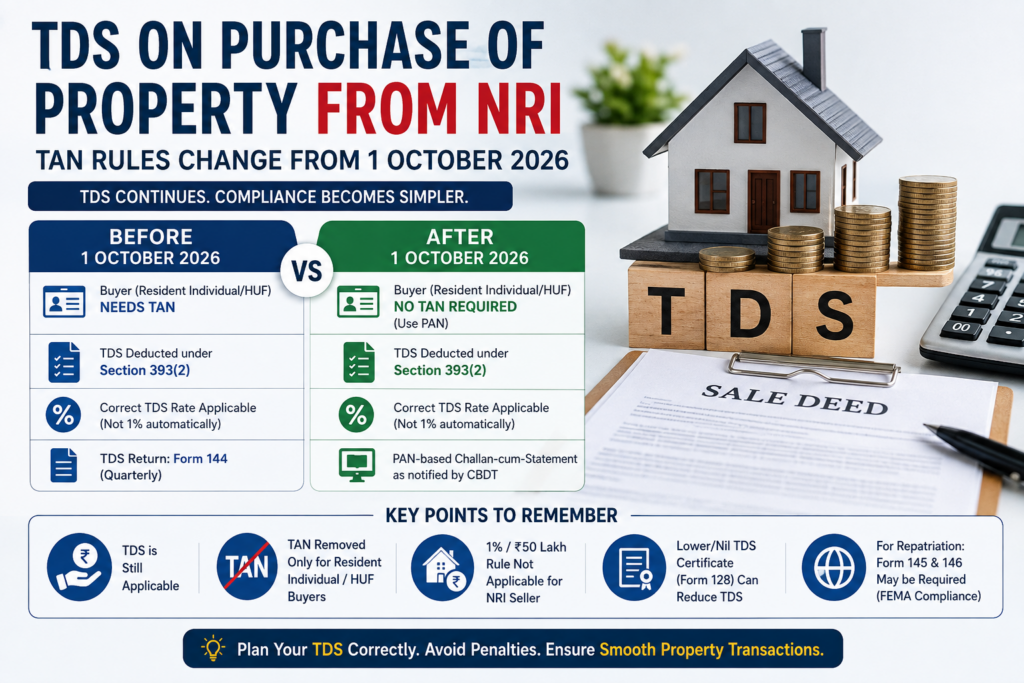
TDS on Purchase of Property from NRI is one of the most misunderstood property-tax compliances in India. A buyer may assume that the normal 1% property TDS rule applies, make payment and proceed with registration. But if the seller is a non-resident, the TDS rules are very different.
A major compliance change is now approaching:
1 October 2026
Up to 30 September 2026, a resident individual or HUF buying immovable property from a non-resident seller generally requires TAN for TDS compliance. From 1 October 2026, such eligible buyers will no longer be required to obtain TAN and will be able to use a PAN-based mechanism.
The change has been enacted through the Finance Act, 2026 by amending Section 397 of the Income-tax Act, 2025. Readers can verify the amended statutory provision directly from the Income-tax Act, 2025 as amended by Finance Act, 2026.
CBDT has also specifically clarified the change, its scope and its effective date of 1 October 2026 in its official Budget 2026 FAQ on TAN requirement for NRI property transactions.
But there is one point every buyer should understand:
TAN is being removed. TDS is not.
The TDS obligation on purchase of property from an NRI continues. The amendment primarily simplifies the compliance mechanism for eligible resident individual/HUF buyers.
For a broader understanding of the present process, you may also read our earlier detailed guide on Buying Property from an NRI in India – Form 144, TAN and Form 145/146 Explained.
TDS on Purchase of Property from NRI: What Changes From 1 October 2026?
| Particular | Up to 30 September 2026 | From 1 October 2026 |
|---|---|---|
| Seller | Non-resident | Non-resident |
| Buyer covered by relaxation | Resident Individual/HUF | Resident Individual/HUF |
| TAN required | Yes | No |
| PAN required | Yes | Yes |
| TDS liability | Continues | Continues |
| Normal 1% resident-property TDS rule | Not automatically applicable | Not automatically applicable |
| ₹50 lakh resident-property threshold | Not applicable in the same manner | Same |
| Lower TDS mechanism | Available | Available |
| Governing non-resident provision | Section 393(2) | Section 393(2) |
| Buyer identification | TAN | PAN-based mechanism |
| Reporting | Existing non-resident mechanism | PAN-based challan-cum-statement as notified |
The amendment is therefore primarily a compliance simplification and should not be mistaken for a reduction or abolition of TDS.
Rule 1: TAN Is Still Required Until 30 September 2026
The most important immediate rule is simple:
Buying property from an NRI before 1 October 2026? Do not assume TAN has already been abolished.
Section 397 of the Income-tax Act, 2025 generally requires persons deducting or collecting tax to obtain a Tax Deduction and Collection Account Number — TAN, unless a specific exemption applies.
The Finance Act, 2026 has now introduced such an exemption for a resident individual or HUF purchasing immovable property from a non-resident, but the amendment becomes effective only from:
1 October 2026
CBDT’s official Budget FAQ confirms that under the present provision, a resident individual/HUF buyer purchasing property from a non-resident is required to obtain TAN. It further confirms that the relaxation begins from 1 October 2026.
Therefore, transactions involving payment or TDS obligations arising up to 30 September 2026 should continue to be handled under the existing TAN-based framework.
For end-to-end buyer-side compliance including TAN, TDS deposit, Form 144 and TDS reconciliation, see our TDS Filing – Form 138, Form 140 & Form 144 services.
Rule 2: From 1 October 2026, Eligible Buyers Can Use PAN Instead of TAN
From 1 October 2026, compliance becomes substantially easier for specified buyers.
The amended Section 397 specifically exempts a:
- resident individual; or
- resident Hindu Undivided Family (HUF)
from obtaining TAN where tax has to be deducted on consideration for transfer of immovable property to a non-resident under Section 393(2).
The buyer will instead:
- use his or her PAN;
- quote the NRI seller’s PAN;
- deduct applicable TDS; and
- report the deduction through the prescribed PAN-based challan-cum-statement mechanism.
CBDT describes this as a compliance simplification intended to make the process broadly similar from the buyer’s perspective whether the property seller is resident or non-resident.
But the TAN exemption does not apply to every buyer
The statutory relaxation specifically refers to a resident individual or HUF.
Therefore, where the purchaser is a:
- company;
- LLP;
- partnership firm;
- trust;
- association; or
- other entity,
the buyer should not automatically assume that the new TAN exemption applies.
This is why the frequently used statement—
“TAN has been abolished for NRI property purchases”
—is too broad.
A more accurate statement is:
From 1 October 2026, a resident individual/HUF buying immovable property from a non-resident will not be required to obtain TAN for that specified transaction.
Rule 3: No TAN Does Not Mean No TDS
This is perhaps the most important takeaway from the amendment.
TDS on Purchase of Property from NRI continues even after 1 October 2026.
Only the requirement for the specified buyer to obtain a separate TAN is being removed.
The substantive non-resident withholding provisions continue under Section 393(2) of the Income-tax Act, 2025, which broadly takes over the role played by Section 195 under the Income-tax Act, 1961.
If you are dealing with old and new section numbers, use our free Income-tax Act 1961 ↔ 2025 Section Finder to identify the corresponding provision.
The amendment does not by itself:
- abolish TDS;
- make the TDS rate 1%;
- introduce a ₹50 lakh exemption for NRI seller transactions;
- change the NRI seller’s capital-gains tax liability;
- abolish lower TDS certificates; or
- change FEMA rules for subsequent repatriation.
Rule 4: Do Not Apply the Normal 1% Property TDS Rule to an NRI Seller
This is one of the most common and potentially expensive mistakes in property transactions.
Most property buyers know the simplified TDS mechanism for qualifying property purchases from a resident seller and therefore remember:
1% TDS and ₹50 lakh.
Those figures should not automatically be carried over to an NRI seller transaction.
Where the seller is non-resident, the payment falls under the non-resident withholding framework.
For professional assistance in determining whether the resident-property or NRI-property TDS mechanism applies, see our dedicated TDS on Sale of Property – Resident & NRI service page.
First determine the seller’s residential status
Before calculating TDS, the buyer should establish whether the seller is resident or non-resident for Indian income-tax purposes.
Do not decide residential status merely from:
- citizenship;
- OCI status;
- foreign passport;
- NRE/NRO account;
- overseas address; or
- the seller casually referring to himself or herself as an NRI.
Residential status must be determined under the Income-tax law for the relevant tax year.
This single determination can change the TDS provision, procedure, rate analysis and reporting requirement.
Rule 5: Do Not Assume a ₹50 Lakh Exemption for an NRI Property Seller
Another common misconception is:
“The property value is below ₹50 lakh, therefore no TDS is required.”
That conclusion should not be imported from the resident-property provision into an NRI transaction.
The non-resident withholding framework does not provide the same ₹50 lakh property-value exemption available under the specified resident-seller property TDS provision.
Therefore, an NRI property transaction may require TDS even where the consideration is:
- ₹45 lakh;
- ₹35 lakh; or
- lower.
This becomes particularly relevant in cases involving:
- smaller residential flats;
- jointly owned property;
- inherited property;
- old properties with a low historical acquisition cost;
- plots of land; and
- multiple NRI sellers.
Rule 6: Determine the Correct TDS — Do Not Arbitrarily Deduct 1%
The amount of tax ultimately payable by an NRI seller depends on the nature and amount of taxable income.
For immovable property, the first issue is normally the holding period.
Long-Term Capital Gain
Immovable property held for more than 24 months is generally treated as a long-term capital asset.
For qualifying transfers on or after 23 July 2024, long-term capital gains are generally subject to the applicable statutory rate of 12.5%, together with applicable surcharge and Health & Education Cess, subject to the governing provisions and facts of the case.
Short-Term Capital Gain
Where the property is held for 24 months or less, the gain is generally short-term and taxable at the applicable rates.
However:
Capital-gains tax of the seller and TDS obligation of the buyer are related but should not be treated as mechanically identical computations.
A buyer should not simply ask the seller to calculate the “profit” and independently decide to deduct tax only on that amount.
Where the taxable component of a payment is substantially lower than the gross consideration, the Income-tax law provides formal mechanisms for lower deduction or determination of the appropriate taxable portion.
Rule 7: Lower TDS Certificate Can Prevent Excessive Deduction
This is often the most important planning opportunity for an NRI seller.
Suppose an NRI sells property for ₹1.50 crore, but after considering acquisition cost, improvement expenditure and available exemptions, the actual taxable capital gain is substantially lower.
Without proper planning, a large amount can remain blocked as TDS until the NRI:
- files the income-tax return;
- claims the credit; and
- waits for the refund.
A better option may be to examine a lower or nil TDS certificate before substantial payment or registration takes place.
For specialised assistance covering NRI property sale, lower TDS, capital gains, DTAA, FEMA and repatriation, see our NRI Taxation & FEMA Services.
Form 128 — Lower or Nil TDS Certificate
Under the Income-tax Rules, 2026, Form 128 is used for applying for a certificate for lower or nil deduction under Section 395(1).
It replaces the earlier Form 13 mechanism.
The Income Tax Department confirms that Form 128 can be used by resident as well as non-resident applicants seeking deduction at a lower or nil rate.
You can also review the official Income Tax Department guidance on Form 128.
A lower TDS application may be particularly relevant where the NRI seller has:
- substantial acquisition cost;
- eligible improvement expenditure;
- capital losses;
- qualifying reinvestment;
- eligible capital-gains exemption; or
- other factors materially reducing the expected final tax liability.
Form 129 — Buyer-Side Determination of Taxable Amount
The Income-tax Rules, 2026 also provide Form 129, corresponding to the earlier Form 15E mechanism.
Form 129 allows the payer, in appropriate cases, to approach the Assessing Officer for determination of the amount chargeable to tax in a payment being made to a non-resident.
The Income Tax Department specifically explains that this mechanism can help avoid excessive withholding where the entire payment may not be taxable in India or a lower rate may apply.
See the official guidance on Form 129 for payments to non-residents.
Practical point
Do not start lower-TDS planning after the entire sale consideration has already been paid.
The issue should preferably be reviewed before the payment schedule is finalised and before substantial consideration is released.
Which TDS Return Applies to an NRI Property Transaction?
For relevant non-salary payments to non-residents under the Income-tax Act, 2025, the quarterly TDS statement is:
Form 144
Form 144 replaces the earlier Form 27Q under the Income-tax Act, 1961 framework.
CBDT’s transition guidance confirms that Form 144 is the non-resident TDS return under the new Income-tax Act framework.
For Form 144 filing, challan reconciliation, corrections and TDS certificates, see our dedicated Form 144 – NRI/Non-Resident TDS Filing service.
The quarterly filing cycle is generally:
| Quarter | Period | TDS Statement Due Date |
|---|---|---|
| Q1 | April–June | 31 July |
| Q2 | July–September | 31 October |
| Q3 | October–December | 31 January |
| Q4 | January–March | 31 May |
The Income Tax Department’s transition FAQ specifically confirms 31 October 2026 as the due date for the July–September 2026 quarter under the new forms.
Important: Do Not Use the Existing Form 141 for an NRI Seller
This is an important practical issue.
The Income Tax Department currently describes Form 141 as the unified challan-cum-statement for specified PAN-based deductions under Section 393(1).
The existing Form 141 replaces the earlier:
- Form 26QB;
- Form 26QC;
- Form 26QD; and
- Form 26QE
for the relevant resident transactions.
Most importantly, the Income Tax Department’s current FAQ expressly states:
Form 141 cannot be filed where the deductee is a non-resident.
The existing form applies only to resident deductees.
Readers can verify this directly from the Income Tax Department’s official Form 141 FAQ.
Therefore, a buyer should not presently use Form 141 merely because the transaction relates to immovable property when the seller is non-resident.
What Filing Mechanism Will Apply From 1 October 2026?
CBDT’s Budget 2026 FAQ states that after the TAN relaxation becomes effective, the eligible resident individual/HUF buyer will deduct tax using PAN and report the transaction through a:
PAN-based challan-cum-statement “as may be notified”.
That wording is important.
The substantive amendment has already been enacted.
However, the final operational mechanism must also be reflected in the applicable notification and e-filing portal functionality.
Therefore, taxpayers completing an NRI property transaction on or after 1 October 2026 should check the exact filing mechanism available on the Income Tax portal at that time.
Do not automatically assume that the presently available Form 141 will apply.
CBDT may extend, modify or prescribe the relevant PAN-based mechanism specifically for these transactions.
Can an NRI Sell Property Before 1 October 2026 If the Buyer Has No TAN?
Recent headlines have suggested that an NRI “cannot sell” property before 1 October 2026 unless the buyer has TAN.
That description needs some legal precision.
The Income-tax Act creates the relevant TDS and TAN compliance obligation on the buyer. It does not simply provide that the property sale itself becomes void merely because TAN has not been obtained.
However, failure to complete the correct TDS compliance can create serious practical problems, including:
- incorrect or non-deposit of TDS;
- interest and other consequences;
- defective TDS reporting;
- tax-credit mismatch for the NRI seller;
- difficulty obtaining/reconciling certificates; and
- practical complications around completion of the transaction.
Therefore, the sensible approach remains:
For an NRI property transaction involving payment before 1 October 2026, complete the required TAN and TDS compliance before releasing consideration.
Property Agreement in September, Registration in October: Which Rule Applies?
This issue is likely to become particularly important during September–October 2026.
Consider:
15 September 2026 – Agreement executed
20 September 2026 – Advance paid
5 October 2026 – Balance consideration paid
7 October 2026 – Sale deed registered
It would be unsafe to assume that the entire transaction automatically falls under the new PAN-based system merely because registration occurs after 1 October.
TDS obligations need to be examined with reference to the applicable statutory payment/credit event, rather than only the date of registration.
Therefore, transactions straddling 30 September and 1 October should be reviewed payment-wise.
For transactions involving such timing issues, our TDS on Sale of Property – Resident & NRI advisory service covers the applicable TDS mechanism, deduction, reporting and reconciliation.
NRI Seller Should Plan Capital Gains Before the Payment Schedule
TDS planning should not be separated from the NRI seller’s capital-gains computation.
Before deciding the appropriate withholding strategy, review:
Acquisition Cost
Purchase deed, builder agreement, registration costs and other qualifying acquisition expenses should be identified.
Improvement Expenditure
Eligible capital improvements should be supported with invoices, payment records and other evidence.
Holding Period
Determine whether the property gives rise to long-term or short-term capital gain.
Available Capital-Gains Exemptions
Relevant reinvestment exemptions should be examined before deciding whether a lower TDS application is worthwhile.
For help identifying the corresponding provisions under the Income-tax Act, 2025, use our Income-tax Act 2025 Section Finder.
Lower TDS
Once estimated taxable income is reasonably established, consider whether Form 128 or another determination mechanism should be used before payment.
NRI Property Sale and Repatriation Are Two Separate Compliance Stages
For many NRI sellers, completing the sale is only the first part of the transaction.
The second question is:
How can the property sale proceeds be repatriated outside India?
This requires a separate review of FEMA, banking and income-tax remittance requirements.
The first stage is:
Property Sale → Capital Gains → Buyer-Side TDS
The second stage is:
NRO/NRE Account → FEMA Compliance → Bank Documentation → Foreign Remittance
Under the Income-tax Rules, 2026:
Form 15CA has been replaced by Form 145
and
Form 15CB has been replaced by Form 146.
For professional assistance with repatriation of NRI property sale proceeds, taxability review, CA certification and bank documentation, see our dedicated Form 145 & Form 146 – CA Certificate for Foreign Remittance service.
For broader NRO/NRE, FEMA and NRI tax planning, see NRI Taxation & FEMA Services.
An NRI seller may also need to file the appropriate Indian income-tax return to report the capital gain and reconcile TDS. Our NRI ITR Filing service covers Indian-source income, capital gains, TDS credit and related disclosures.
Practical Checklist for Buying Property from an NRI Before 1 October 2026
Before making substantial payment:
- Confirm the seller’s residential status under Indian income-tax law.
- Obtain and verify the seller’s PAN.
- Review the agreement and payment schedule.
- Compute the estimated capital gain.
- Determine whether the gain is long-term or short-term.
- Examine available capital-gains exemptions.
- Evaluate a Form 128 lower/nil TDS certificate.
- Consider Form 129 where payer-side determination is appropriate.
- Ensure the buyer obtains TAN where required up to 30 September 2026.
- Determine the correct TDS before releasing consideration.
- Deposit the tax within the prescribed period.
- Complete the applicable Form 144 non-resident TDS reporting.
- Verify that the seller receives the correct TDS credit.
- Preserve challans, certificates and supporting documentation.
- If funds are to be sent abroad, separately plan Form 145/Form 146 and FEMA repatriation compliance.
Frequently Asked Questions on TDS on Purchase of Property from NRI
Is TAN required for TDS on purchase of property from NRI in September 2026?
Yes, generally for a resident individual/HUF buyer under the existing mechanism.
The new TAN exemption becomes effective only from 1 October 2026. CBDT has expressly confirmed this effective date.
Is TAN required for NRI property purchase after 1 October 2026?
A resident individual or HUF covered by amended Section 397 will not be required to obtain TAN for deduction of tax on consideration for purchase of immovable property from a non-resident.
The prescribed PAN-based mechanism will apply.
Does TDS on NRI property become 1% from 1 October 2026?
No.
The amendment simplifies TAN and reporting compliance. It does not convert an NRI property transaction into the resident-seller 1% TDS mechanism.
Is the ₹50 lakh TDS threshold applicable when buying property from an NRI?
The ₹50 lakh threshold available under the specified resident-property TDS provision should not be automatically applied to payment made to a non-resident seller.
Can an NRI seller obtain a lower TDS certificate?
Yes.
An eligible NRI seller can examine an application for lower or nil TDS under Section 395 using Form 128.
This may materially reduce unnecessary withholding where the expected actual tax liability is lower.
Which TDS return applies to payments made to an NRI?
Under the Income-tax Act, 2025 framework, Form 144 is the relevant quarterly TDS statement for applicable non-resident payments and replaces old Form 27Q.
Can Form 141 presently be used when the property seller is an NRI?
No.
The Income Tax Department’s current Form 141 guidance specifically states that the form applies only to resident deductees and is not applicable where the deductee is non-resident.
What if advance is paid in September but registration takes place in October?
The answer can depend upon the timing of the payment/credit event giving rise to the TDS obligation.
Transactions crossing 30 September–1 October 2026 should therefore be reviewed payment-wise rather than merely on the final registration date.
Can an NRI repatriate Indian property sale proceeds abroad?
Yes, subject to applicable tax, FEMA and authorised-dealer-bank requirements.
Depending upon the facts, the seller may require appropriate tax-payment evidence and Form 145/Form 146 foreign remittance documentation before repatriating funds.
Final Takeaway: TAN Ends From 1 October 2026 — NRI Property TDS Continues
The change from 1 October 2026 is a welcome compliance simplification.
A resident individual/HUF buying immovable property from an NRI will no longer need TAN for the specified transaction and can use the prescribed PAN-based mechanism.
But buyers and NRI sellers should remember:
TDS continues.
The normal 1% resident-property rule should not automatically be applied.
The ₹50 lakh resident-property threshold should not automatically be applied.
Lower TDS planning may significantly reduce unnecessary withholding.
Form 144 remains relevant under the current non-resident TDS framework.
The presently available Form 141 cannot be used where the deductee is non-resident.
The new PAN-based compliance system takes effect from 1 October 2026 for the specified resident individual/HUF buyer.
And where the NRI intends to transfer the property proceeds abroad, property TDS, capital gains, lower TDS and FEMA/Form 145/Form 146 repatriation should ideally be planned together from the beginning.
For end-to-end professional support, see our NRI Taxation, Property Sale, TDS, Capital Gains & FEMA Services.
Official References
- Income-tax Act, 2025 as amended by Finance Act, 2026 – Section 397
- CBDT Budget 2026 FAQ – TAN exemption for NRI property transactions
- Income Tax Department – Form 128 Lower/Nil TDS Guidance
- Income Tax Department – Form 129 Non-Resident Payment Determination
- CBDT Transition FAQ – Form 144 replacing Form 27Q
- Income Tax Department – Form 141 FAQ
- Income-tax Rules 2026 – Forms Guidance
Disclaimer: This article is intended for general professional information and should not be treated as transaction-specific tax, FEMA or legal advice. NRI property transactions can differ based on residential status, buyer status, ownership structure, payment dates, capital-gains computation, exemptions, lower-deduction certificate and repatriation requirements.
Leave a Reply