By CA Alok Kumar | Updated 21 November 2026
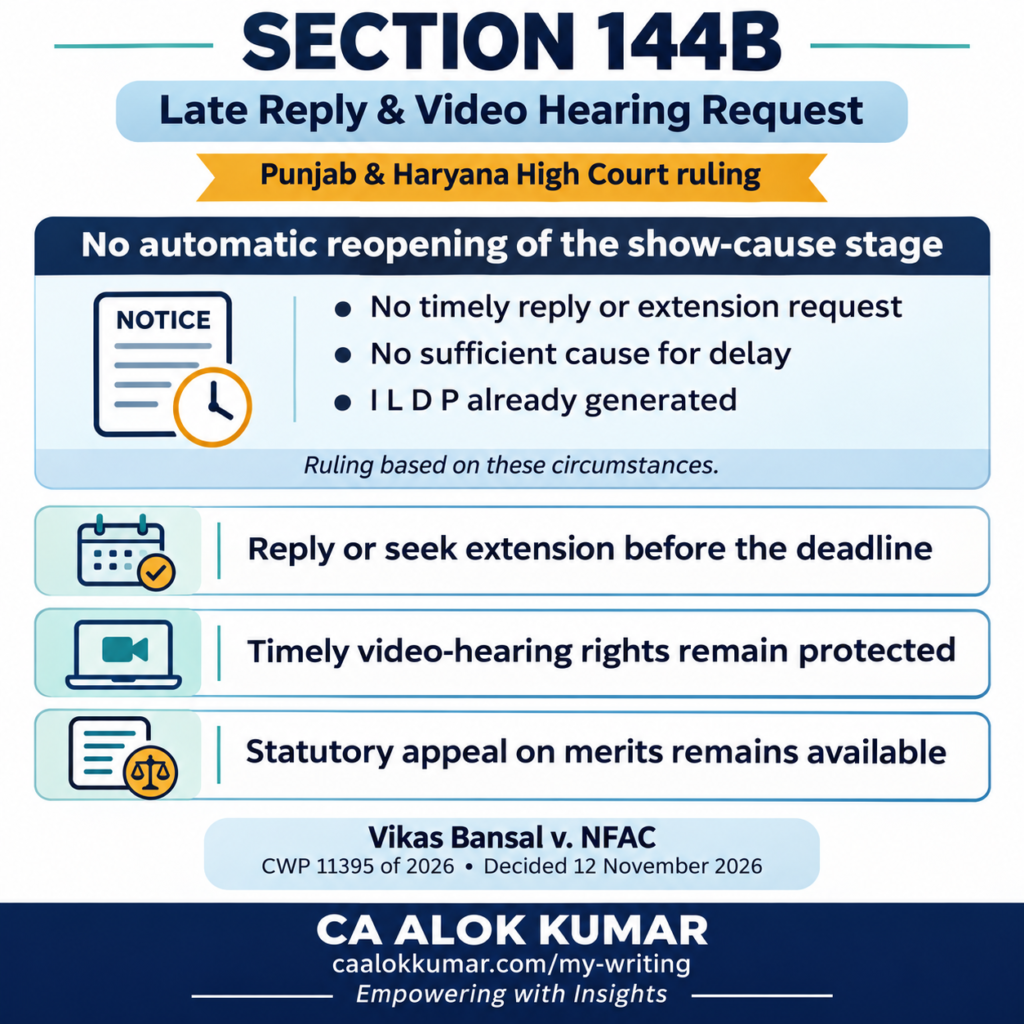
A late reply under Section 144B may not require the assessment authority to reopen a completed show-cause stage. In Vikas Bansal v. National Faceless Assessment Centre, the Punjab and Haryana High Court rejected a natural justice challenge where the taxpayer missed the notice deadline, sought no timely extension and failed to establish sufficient cause for the delay. [1, paragraphs 26–30]
The ruling is a practical reminder for taxpayers handling a faceless assessment under Section 144B: file the reply, seek an extension or request the video hearing within the permitted process. A submission made before the final digital signature is not necessarily a timely submission.
Case citation and result
Vikas Bansal v. National Faceless Assessment Centre
CWP No. 11395 of 2026 (O&M), Punjab and Haryana High Court
Decided on 12 November 2026; uploaded on 13 November 2026
Bench: Justice Deepak Sibal and Justice Sunish Bindlish
Assessment year: 2024–25
The writ petition was dismissed. The challenge to the assessment and consequential demand failed, while the taxpayer remained free to pursue a statutory appeal on the additions. The Court’s natural justice findings were not to influence the appellate decision on merits. [1, paragraphs 29–30]
What happened in the faceless assessment
The assessment was made under Section 143(3), following the faceless procedure in Section 144B of the Income-tax Act, 1961. The central chronology was as follows. [1, paragraphs 2 and 19]
| Date and time | Event |
|---|---|
| 24 February 2026 | Show-cause notice proposed adverse variations |
| 1 March 2026 at 5:40 PM | Deadline for response and the video-hearing request; no reply, request or extension application was made within time |
| 13 March 2026 | Income or Loss Determination Proposal, or ILDP, approved and generated |
| 16 March 2026 | Taxpayer requested video conferencing after the ILDP stage |
| 17 March 2026 at about 4:52 PM | Detailed reply and supporting documents uploaded |
| 17 March 2026 at about 5:54 PM | Final digital authentication of the assessment order |
The taxpayer argued that the reply preceded authentication and should therefore have been considered. The Court held that this timing did not undo the earlier failure to act within the show-cause deadline.
How Section 144B structures the opportunity to respond
The relevant provisions form a sequence:
- Section 144B(1)(xii)(b): a show-cause notice is required where prejudicial variations are proposed.
- Section 144B(1)(xiii): the taxpayer responds by the specified date and time, or within time extended on application.
- Section 144B(1)(xiv): NFAC communicates non-response within the permitted time to the assessment unit.
- Section 144B(1)(xv): the assessment unit prepares the ILDP after the response or the non-response intimation, considering relevant material on record.
- Section 144B(6)(vii) and (viii): the taxpayer can request an oral hearing, with the hearing conducted through video conferencing or video telephony as prescribed. [2]
These are provisions of the Income-tax Act, 1961, applied in this AY 2024–25 case. The article’s section references should be read in that context.
Section 144B Late Reply: Why the High Court rejected the late video hearing plea
No timely reply or extension application
The taxpayer said that the email containing the notice had escaped his attention. The Court found the explanation unsupported and insufficient. It also noted his participation in the assessment, including a reply submitted on 23 February 2026, just before the show-cause notice. [1, paragraph 25]
For a taxpayer who genuinely needs more time, the practical step is to apply before the deadline, explaining the reason and requesting a specific additional period. Merely planning to respond later creates no extension.
The show cause stage had already closed
By 13 March, the ILDP had been generated after non-response. The subsequent preparation, review and approval of the draft order formed the onward assessment process. On these facts, the authority was not obliged to reopen the completed stage for the late communications. [1, paragraphs 19–22]
This is why the judgment should not be reduced to a headline claiming that every late reply can always be ignored. The Court examined the expired deadline, absence of extension, stage of the proceedings and lack of sufficient cause together.
Uploading before digital authentication was not enough
The reply was uploaded approximately an hour before final authentication. About two weeks also remained before the limitation date recorded in the case. Neither circumstance gave the taxpayer an enforceable right to restart the earlier procedural stage. [1, paragraphs 19–20 and 27]
Businesses and individuals seeking income tax notice reply assistance should therefore share the notice and deadline immediately, rather than waiting until the assessment order is about to be issued.
Timely video hearing requests remain important
The Court recognised the mandatory hearing requirement under Section 144B(6)(viii) when a request is made within the prescribed process. The ruling does not create a general discretion to refuse a timely, valid request.
It distinguished Arihant Roller Flour Mills v. NFAC, CWP No. 7239 of 2023, and Suvidhi Udyog Pvt. Ltd. v. NFAC, CWP No. 8976 of 2022, because those cases involved timely hearing requests that remained unattended. It also distinguished Champion Exim Company v. Union of India, (2025) 175 taxmann.com 1006 (Gujarat), involving notice sent to an email address other than the registered one. [1, paragraphs 23–24]
The Court also held that the Department’s explanation of the procedural sequence did not constitute impermissible supplementation of the order’s reasons under Mohinder Singh Gill v. Chief Election Commissioner, (1978) 1 SCC 405. [1, paragraph 20]
Does Section 144B guarantee a fixed response period
The Court found no fixed statutory number of days in the relevant show-cause and hearing provisions. It explained that the Board-approved SOP of 3 August 2022 ordinarily contemplated seven days, with curtailment having regard to assessment limitation. The deadline must nevertheless be reasonable and realistically capable of compliance. [1, paragraphs 12–14]
Accordingly, the judgment does not validate every short deadline. A dispute over inadequate time, defective service, a timely extension request or a documented technical failure requires examination on its own facts.
Does a digital signature date mismatch invalidate the order
The order bore the date 16 March 2026, while digital authentication occurred on 17 March 2026. The Court treated this minor, explainable variance as insufficient to invalidate the order in the absence of demonstrated prejudice. Generation, approval and authentication were sequential steps in the system. [1, paragraph 27]
This finding is confined to the discrepancy examined. It is not a ruling that every authentication, service or limitation defect is harmless. Review the actual order, signature, service record and prejudice before choosing a ground of challenge.
What remedies remained available to the taxpayer
Appeal against the additions
The Court preserved the appeal remedy under Section 246A. The merits of the additions were left for the appellate authority. A taxpayer assessing CIT(A) appeal and tax litigation options should prepare the factual reconciliation and supporting evidence alongside the legal grounds.
Condonation of appeal delay
Under Section 249(3), delay can be condoned on sufficient cause. The Court said that bona fide time spent pursuing the writ petition could be considered. It did not itself condone the appeal delay. For an assessment appeal, Section 249(2)(b) ordinarily measures the 30-day period from service of the related demand notice, subject to the applicable provisions. [1, paragraph 29; 3]
Additional evidence and separate penalty proceedings
The judgment left additional evidence subject to Rule 46A of the Income-tax Rules, 1962. Admission was not automatic. A properly supported application must explain why the evidence was not produced earlier and how the rule’s conditions are satisfied.
The taxpayer could also respond separately to the notices under Section 274 read with Section 271AAC(1). The Court did not decide that a penalty was payable merely because the assessment challenge failed. [1, paragraphs 22 and 28–30]
For the consequential demand, obtain a separate review of the computation and appropriate income tax demand notice response.
Practical checklist for taxpayers and accounting teams
1. Record the exact cutoff. Capture both the date and time, assign a responsible person and set an internal deadline earlier than the portal cutoff.
2. Monitor the portal and registered email. Do not rely exclusively on a forwarded email from the client.
3. Respond to each proposed variation. Use an issue-wise reply with indexed documents and reconciliation workings.
4. Seek additional time early. Explain the actual difficulty, identify pending evidence and request a realistic period. Track whether the request is granted.
5. Request VC separately where required. Do not assume that a sentence in the written reply substitutes for the designated portal request.
6. Retain submission proof. Save acknowledgments, uploaded files, transaction IDs and relevant error screenshots.
7. If a deadline is missed, act immediately. Submit the explanation and evidence through available channels, document the reason and obtain advice on the remaining remedies. Acceptance cannot be presumed.
The Department’s e-Proceedings user manual explains the Seek/View Adjournment and Seek Video Conferencing facilities. Retain the transaction ID and check the status after submission. [4]
Frequently asked questions
Can a late reply under Section 144B always be ignored
No universal rule follows from this case. The adverse result concerned no timely response or extension, closure of the show-cause stage and absence of sufficient cause.
Can a timely video hearing request be refused because the assessment is faceless
Faceless proceedings do not remove the statutory hearing protection. The judgment recognised the duty to grant a hearing on a request made within the prescribed process.
Does a reply filed before the final digital signature have to be considered
Not automatically. In Vikas Bansal, the reply preceded authentication but followed the deadline and closure of the relevant stage.
Did the High Court approve the additions on their merits
No. The merits remained open for statutory appeal, uninfluenced by the Court’s natural justice findings.
Key takeaway
Protect the hearing opportunity before the show-cause deadline expires. The Vikas Bansal ruling makes a timely reply, a reasoned extension application and a properly recorded VC request central to managing a faceless assessment. If an order has already been passed, assess the appeal, evidence and penalty issues separately.
CA Alok Kumar
FCA, LLM, AICA, AML Specialist, B.Com(H)
caalokkumar.com/my-writing — Empowering with Insights
Sources and legal references
[1] Vikas Bansal v. NFAC, CWP No. 11395 of 2026 (O&M), decided 12 November 2026, particularly paragraphs 12–14, 19–30. Judgment text verified against the 30-page copy; court-record retrieval can be made through the Punjab and Haryana High Court portal using the case number and decision date.
[2] Income Tax Department — Section 144B, Income-tax Act, 1961, particularly subsections (1)(xii)–(xv) and (6)(vii)–(viii).
[3] Income Tax Department — Section 249, and official Form 35 FAQs.
[4] Income Tax Department — e-Proceedings user manual, particularly the adjournment and video-conferencing instructions.
Case-specific advice should address the relevant assessment year, applicable law, complete notice history and documentary record.
Leave a Reply