By CA Alok Kumar | Updated 22 November 2026
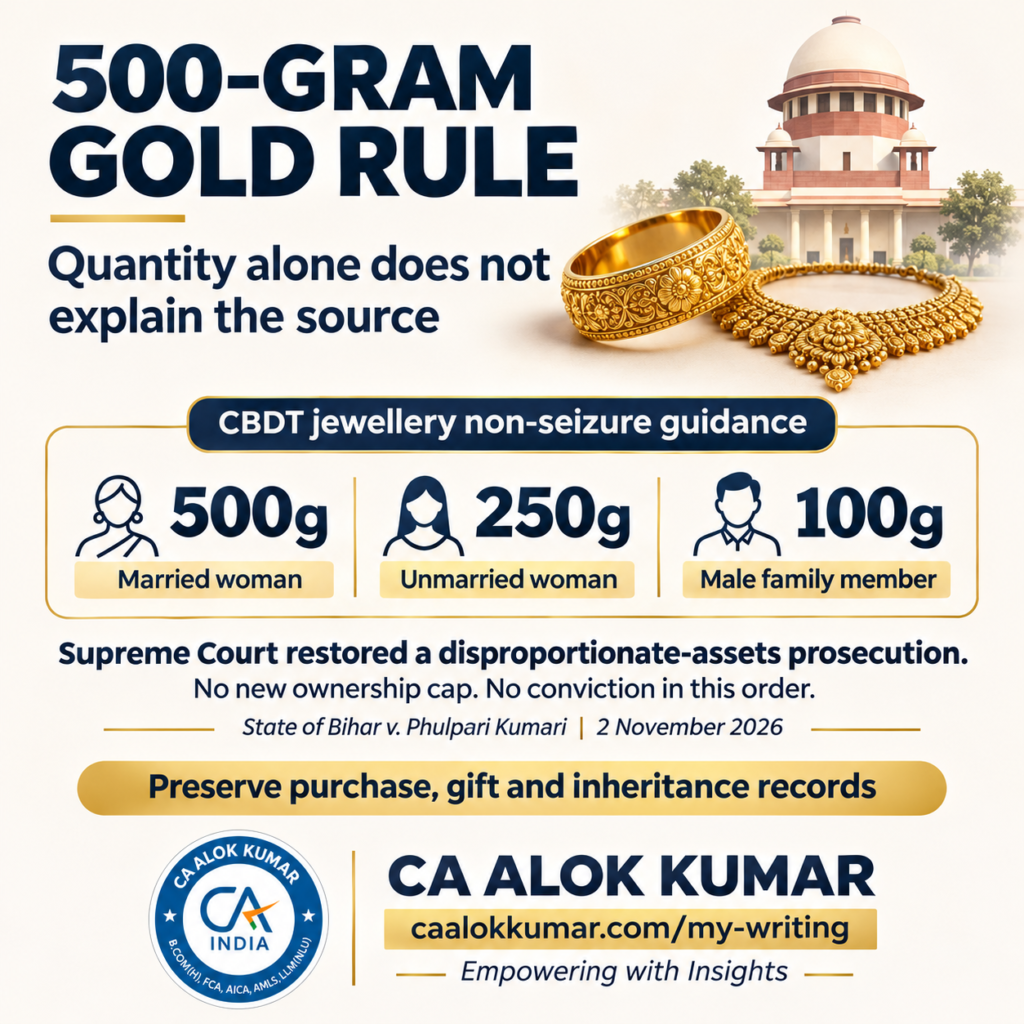
Gold jewellery within the familiar 500-gram limit does not, by that fact alone, explain how it was acquired. In State of Bihar v. Phulpari Kumari, decided on 2 November 2026, the Supreme Court rejected the use of CBDT jewellery quantities as a standalone reason to stop a disproportionate-assets prosecution against a public servant. It restored the criminal proceedings without deciding guilt. [1, paragraphs 9–12]
The ruling has prompted concern among families holding wedding or inherited jewellery. Its actual scope matters: the Court did not introduce a new gold ownership ceiling or cancel CBDT Instruction No. 1916. For taxpayers seeking income tax dispute assistance, the practical lesson is to preserve a credible explanation of ownership and acquisition rather than rely only on weight.
The case and the legal issue
Case: State of Bihar v. Phulpari Kumari
Court: Supreme Court of India
Case number: Criminal Appeal No. 5212 of 2026, arising from SLP (Criminal) No. 15711 of 2026
Decision: 2 November 2026
Bench: Justice K.V. Viswanathan and Justice Arun Palli
Provisions involved: Section 13(1)(e) read with Section 13(2) of the Prevention of Corruption Act, 1988, as applicable to the prosecution. [1]
The question was whether jewellery falling within quantities mentioned in CBDT instructions and a Finance Ministry press release could, without an explanation of its acquisition, justify quashing proceedings alleging assets disproportionate to known income.
This was a criminal vigilance case. It was not an appeal against an income-tax addition on household jewellery.
Facts and history at each stage
The Patna High Court recorded that Phulpari Kumari had been posted as Child Development Project Officer, Patna. An earlier vigilance trap case, P.S. Case No. 54 of 2013, led to a house search on 17 August 2013. The authorities inventoried articles and documents concerning bank investments. A separate disproportionate-assets case followed in 2015. These were allegations and procedural developments, not findings of guilt in the Supreme Court order. [2, paragraph 3]
| Date and stage | What happened |
|---|---|
| 17 August 2013 — search | The High Court recorded a search in the earlier vigilance matter. The daughter was unmarried on that date. |
| 11 May 2015 — FIR | Vigilance P.S. Case No. 37 of 2015 was registered against the respondent and her husband alleging disproportionate assets. |
| 29 July 2020 — chargesheet | After sanction, a chargesheet was filed only against the respondent, according to the Supreme Court. |
| 28 January 2021 — Special Judge | The Special Judge, Vigilance, Patna, took cognizance in Special Case No. 20 of 2015. Cognizance allowed the criminal case to move forward; it was not a conviction. |
| 2021 — High Court challenge | The respondent filed Criminal Miscellaneous No. 56839 of 2021 seeking to quash the cognizance order. |
| 14 May 2026 — Patna High Court | The High Court accepted the jewellery-limit argument and quashed cognizance insofar as the respondent was concerned. |
| 2 November 2026 — Supreme Court | The Court allowed Bihar’s appeal, set aside the High Court order and restored the cognizance order. Proceedings were to resume from that stage. |
Sources: Supreme Court order, paragraphs 3–6 and 10–12; High Court judgment, paragraphs 2–7. [1–2]
Why the quantity of jewellery mattered
The High Court recorded 646.400 grams of gold jewellery. The respondent said it belonged to her, her unmarried daughter and other family members. It also recorded a difference of ₹12,71,693 between total income and expenditure during the check period. That figure should not be presented as a final Supreme Court finding of unexplained wealth. [2, paragraph 3]
The defence relied on 500 grams for a married woman and 250 grams for an unmarried woman. Treating the combined 750 grams as sufficient protection, the High Court held that the vigilance authorities had erred in dealing with the jewellery and calculating disproportionate assets.
Bihar argued that tax search guidance could not supply the missing explanation in an anti-corruption prosecution. The Supreme Court accepted that objection. [1, paragraphs 5–9]
What the Supreme Court finally held
The Court held that merely referring to circulars or press releases permitting specified gold holdings does not account for the assets in a disproportionate-assets prosecution. An accused called upon to answer the allegations must address acquisition and known sources of income. [1, paragraph 9]
Its operative directions were:
- Set aside the Patna High Court order dated 14 May 2026.
- Restore the Special Judge’s cognizance order dated 28 January 2021.
- Permit Special Case No. 20 of 2015 to proceed from that stage.
- Preserve the respondent’s right to pursue legally available proceedings before the Trial Court, which must decide them uninfluenced by observations in either order. [1, paragraphs 10–12]
The Supreme Court did not convict the respondent, finally classify the jewellery as illegally acquired, or determine an income-tax liability. The verified outcome is restoration of proceedings, not a final trial verdict.
What the 500 gram gold rule actually means
The expression “500 gram gold rule” usually refers to CBDT Instruction No. 1916 dated 11 May 1994, concerning seizure of jewellery during income-tax searches.
The Income Tax Department’s Manual of Office Procedure reproduces the instruction. For persons not assessed to wealth-tax, it specifies these quantities of gold jewellery and ornaments that need not be seized: [3, paragraph 22.2]
| Family member | Quantity under the non-seizure guidance |
|---|---|
| Married woman | 500 grams |
| Unmarried woman | 250 grams |
| Male family member | 100 grams |
The instruction also permits an authorised officer to exclude a larger quantity from seizure after considering family status, community customs and other circumstances. It requires a detailed inventory for assessment purposes. Its separate references to wealth-tax returns reflect the historical framework in which it was issued.
The Finance Ministry clarification of 1 December 2016 confirms that jewellery within these quantities will not be seized even where it initially appears inconsistent with income records. It also states that explained jewellery holdings, including inheritance, have no quantity ceiling under the income-tax position it clarifies. [4]
These quantities concern gold jewellery and ornaments. Do not automatically extend them to gold bars, bullion or coins.
Ownership seizure and source are separate questions
Three questions need separate answers:
1. Can the jewellery be owned? The 500-gram figure is not a general maximum ownership limit.
2. Should it be seized during an income-tax search? The CBDT instruction guides that decision.
3. Has its acquisition been satisfactorily explained? This depends on the applicable law, facts and evidence.
For example, a married woman holding 700 grams acquired through documented purchases and inheritance is not automatically holding illegal gold because she exceeds 500 grams. Equally, 400 grams does not establish a lawful source merely because it falls below that figure.
This explains why adding up family quantities cannot, by itself, defeat a disproportionate-assets prosecution.
Does the ruling automatically make household gold taxable
No. The Supreme Court decided the circular argument in a Prevention of Corruption Act prosecution. It did not order automatic tax additions for jewellery below or above the CBDT quantities.
There is also relevant income-tax jurisprudence. In CIT v. Ratanlal Vyaparilal Jain, (2011) 339 ITR 351 (Gujarat), decided on 19 July 2010, the High Court recognised customary family jewellery and accepted a presumption concerning the quantities in the instruction unless the Revenue showed contrary material. [5, paragraph 10]
The Phulpari Kumari order does not discuss that decision. It should therefore not be described as expressly overruling it or as resolving every household jewellery assessment. Taxpayers must consider the facts, contrary evidence and applicable precedents.
For current tax law, Section 104 of the Income-tax Act, 2025 addresses unexplained assets and expressly includes jewellery and bullion. Subject to its conditions, an absent or unsatisfactory explanation of acquisition can lead to deemed income. Earlier tax years and proceedings can remain governed by the Income-tax Act, 1961 under Section 536, including its savings provisions. The applicable year and law must be identified before advising on an addition. [6]
Impact on families salaried people professionals and businesses
The following are practical implications of the source-documentation issue. They are not new obligations imposed on every household by this criminal order.
Ordinary families and inherited jewellery
Families should identify who owns each item and how it came into the family. Wedding jewellery, gifts, inheritance and accumulated savings require explanations appropriate to their history.
A missing decades-old bill is not, by itself, proof of wrongdoing. A credible account supported by available records is more useful than an unsupported statement that all gold below 500 grams is exempt. Families with substantial inherited assets can include jewellery records in their family wealth and succession planning.
Salaried employees and pensioners
Retain purchase invoices and corresponding bank or card payments. Salary records, tax returns and savings history may help show capacity to purchase, but an income-tax return alone does not identify the source of each ornament.
Where jewellery was bought gradually, prepare a realistic chronology. Avoid explaining an old purchase using income earned only much later.
Doctors lawyers consultants and other professionals
Connect personal purchases with legitimate professional earnings, drawings and savings. Where books are maintained, reconcile relevant withdrawals and bank payments. Keep personal jewellery separate from professional assets and expenses.
Regular accounting and financial reconciliation can help identify inconsistencies before a notice requires an explanation.
Business owners and jewellers
Distinguish personal jewellery from business stock, customer goods, company assets and partners’ or directors’ property. Reconcile purchases, stock movements, exchanges and personal drawings.
A large business turnover is not the proprietor’s available personal income. The explanation should address profits, withdrawals, financing and actual acquisition. Jewellers should not assume that household non-seizure quantities explain stock discrepancies.
Public servants
This category faces the ruling’s direct legal consequence: CBDT quantities alone cannot stop a disproportionate-assets prosecution.
Maintain acquisition and funding records and check applicable service rules concerning asset returns, gifts, permissions or reporting. Those requirements depend on the employment rules; the Supreme Court order does not replace them.
Precautions that can help explain jewellery
These are recommended recordkeeping steps, not a mandatory new gold register prescribed by the judgment.
1. Prepare an owner-wise inventory. Record description, photograph, approximate acquisition date, gross weight, net gold weight where available, purity and location. Distinguish ownership from access to a shared locker.
2. Preserve purchase and payment records together. Keep invoices with bank, card or other payment evidence. A bill identifies a purchase; the funding record helps explain its source.
3. Record genuine gifts when they occur. Note the donor, relationship, occasion, item and date. Retain available confirmations and supporting records. Gift tax treatment is a separate question and should be checked under the applicable law.
4. Document inheritance. Preserve available wills, estate inventories, family settlement records, old photographs, earlier valuations and records linking the jewellery to the previous owner.
5. Keep exchange and remaking records. Record the old gold surrendered, additional gold purchased, deductions and making charges. This helps reconcile an old item with its replacement.
6. Use valuations for their proper purpose. A valuation can describe an item, weight, purity and value. It does not independently establish the historic purchase date or lawful source. Where estate documentation involves asset valuation services, obtain the appropriate specialist’s report.
7. Check applicable disclosures. Review the relevant return form, asset schedule, accounts and service declarations where applicable. This ruling does not require every individual to file a fresh gold declaration.
8. Respond with an indexed explanation. If a notice questions jewellery, match each allegation with ownership, acquisition and source evidence. Income tax notice response assistance should address the facts and legal basis within the deadline.
For families seeking income tax scrutiny and notice support, a coherent explanation with corroboration is preferable to a response consisting only of the CBDT weight table.
Inherited gold without bills
Start with what can honestly be established: the earlier owner, family relationship, occasion or approximate period of transfer, and available records. Mark uncertain dates or weights as estimates rather than inventing precision.
Old photographs, insurance schedules, estate records and earlier declarations may support possession and history, although their evidentiary value depends on the facts. A present-day confirmation should carry its actual date and explain the historical event it records.
Do not create backdated invoices or artificial gift documents. The absence of a purchase bill should be addressed through genuine evidence and the relevant legal principles.
Frequently asked questions
Can a married woman own more than 500 grams of gold jewellery
Yes. The CBDT quantity is not a general ownership ceiling. Explained acquisition and the applicable law remain relevant. [3–4]
Has the Supreme Court withdrawn CBDT Instruction 1916
The order does not withdraw or invalidate the instruction. It rejects reliance on the instruction alone to explain assets in the disproportionate-assets prosecution. [1]
Is jewellery below the stated quantities automatically tax exempt
The quantities are not a blanket statutory tax exemption. They guide non-seizure, while the assessment of source must consider the law, facts and relevant judicial precedents.
Does a gold valuation certificate prove the source
It can help identify and value jewellery. It cannot by itself establish who funded the purchase or how an inherited item was acquired.
Does keeping jewellery in a bank locker remove the need for source evidence
Locker storage does not itself explain acquisition. Keep ownership and source records for jewellery stored at home or in a locker.
Was Phulpari Kumari convicted by this Supreme Court order
No. The Court restored cognizance and allowed the criminal proceedings to continue, preserving her other legally available remedies before the Trial Court. [1]
Practical action for jewellery owners
Keep a reasonable owner-wise inventory and preserve the evidence that actually exists. Explain substantial purchases through their funding, and inherited or gifted jewellery through its genuine history. Seek advice where quantities, ownership or records do not reconcile.
The Supreme Court’s decision makes a specific point: CBDT jewellery quantities do not, on their own, answer allegations of disproportionate assets. For ordinary taxpayers, careful records and fact-specific advice remain the sensible response.
CA Alok Kumar
FCA, LLM, AICA, AML Specialist, B.Com (H)
Senior Partner — S.K. Mehta & Co., Chartered Accountants
caalokkumar.com/my-writing — Empowering with Insights
Sources and legal references
[1] Supreme Court official order — State of Bihar v Phulpari Kumari, Criminal Appeal No. 5212 of 2026, 2 November 2026; paragraphs 3–12.
[2] Patna High Court judgment — Phulpari Kumari v State of Bihar Through Vigilance, Criminal Miscellaneous No. 56839 of 2021, 14 May 2026; paragraphs 2–7. Court text reproduced by Indian Kanoon.
[3] Income Tax Department Manual of Office Procedure Volume III, printed page 60, paragraph 22.2, reproducing CBDT Instruction No. 1916 dated 11 May 1994; paragraph 23 separately addresses bullion and coins.
[4] Ministry of Finance clarification on gold jewellery holdings, Press Information Bureau, 1 December 2016.
[5] CIT v Ratanlal Vyaparilal Jain — Gujarat High Court judgment, Tax Appeal Nos. 661 and 662 of 2009, 19 July 2010, (2011) 339 ITR 351; paragraph 10. Court-copy PDF hosted by TaxGuru.
[6] Income-tax Act 2025 as amended by Finance Act 2026 — official text, Sections 1(3), 104 and 536, particularly Section 536(2)(c) and (j).
Leave a Reply