By CA Alok Kumar | Updated 23 November 2026
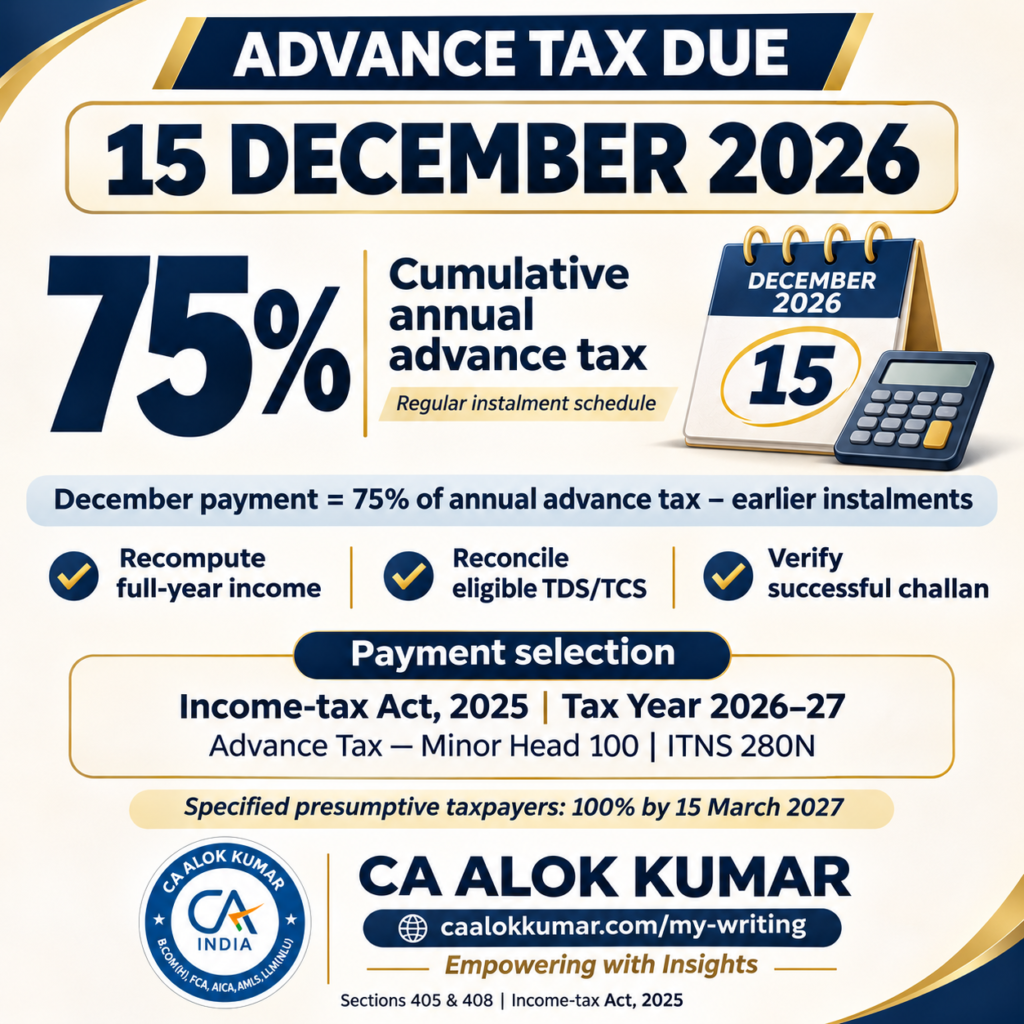
The advance tax due date of 15 December 2026 is approaching. Taxpayers covered by the regular four-instalment schedule must ensure that their cumulative advance-tax payments reach at least 75% of the estimated annual advance-tax liability, after eligible TDS/TCS adjustments. Earlier instalments are deducted when calculating the amount to pay now. This is the third instalment for Tax Year 2026–27, governed by Section 408 of the Income-tax Act, 2025. [1]
A reliable advance tax payment starts with an updated annual income estimate and ends with a verified challan. Repeating the September payment without reviewing profits, capital gains, interest income and tax deducted at source can leave a shortfall.
For the December payment, two checks are essential: calculate the correct amount and select the correct Act, tax year and payment category on the Income Tax Department portal.
Advance tax due dates for Tax Year 2026–27
Under Section 408(1), the regular schedule is cumulative. The percentages below are not separate quarterly tax rates. [1]
| Due date | Cumulative advance tax required |
|---|---|
| 15 June 2026 | At least 15% |
| 15 September 2026 | At least 45% |
| 15 December 2026 | At least 75% |
| 15 March 2027 | 100% |
December amount payable = 75% of the revised annual advance-tax liability minus advance tax already paid for the same tax year.
The payment cannot be less than zero. If earlier valid payments already cover the revised cumulative requirement, no further December instalment arises on that estimate. Keep the supporting computation and reassess the position for March.
Section 408(2) provides a different schedule for specified eligible presumptive taxpayers, explained below. The statutory December deadline remains the planning date; an extension should be relied upon only when supported by an applicable official order.
Advance Tax Due on 15 December 2026: Which Income Tax Act and year apply
Income earned during 1 April 2026 to 31 March 2027 falls within Tax Year 2026–27 under the Income-tax Act, 2025. The Department confirms that advance tax for this period is paid under the new Act. [2]
Tax Year 2026–27 is not the same payment period as Assessment Year 2026–27. The latter relates to the earlier year under the Income-tax Act, 1961. Selecting AY 2026–27 under the old Act for the current December instalment can allocate the payment to the wrong period.
For this instalment, the portal selection should be Income Tax Act, 2025 → Tax Year 2026–27 → Advance Tax. [2–3]
Who must pay advance tax
Section 404 requires advance tax where the tax payable for the year, computed under the advance-tax provisions, is ₹10,000 or more. This is a tax-liability threshold, not a threshold of salary, income, turnover or bank receipts. Sections 403–405 determine the obligation and computation. [1]
The requirement can apply to individuals, HUFs, firms, LLPs, companies and other taxpayers. Relevant situations include:
- Salary accompanied by rental income, investment income or capital gains not fully covered by TDS.
- Professional or freelance income where TDS is lower than the final tax liability.
- Business profits, including profits that have increased since September.
- Taxable gains on shares, mutual funds, property or other assets.
- NRI income taxable in India, subject to the applicable tax and withholding position.
Having TDS deducted does not automatically eliminate advance tax. Compare eligible deductions and collections against the full-year tax computation.
Advance tax for salaried employees and senior citizens
Salaried employees
A salaried employee may have no separate advance-tax payment when employer TDS sufficiently covers the complete liability. A review is still needed where there is more than one employer, taxable investment income, rent, capital gains or an under-deduction.
For example, employer TDS may adequately cover salary while leaving tax on a property sale unpaid. Include that transaction when reviewing the December instalment.
Resident senior citizens
Section 403(3) exempts an individual resident in India who is aged 60 years or more at any time during the tax year and has no income chargeable under business or profession from advance tax. [1]
The exemption is not available merely because a person is a pensioner or a senior citizen. Residency and the absence of business or professional income both matter. A non-resident senior citizen cannot assume this particular exemption applies.
An exempt resident senior citizen can still have a final income-tax liability; exemption from advance tax does not exempt the underlying income.
How to calculate the December advance tax instalment
Section 405 expresses the computation as A = B − C, where A is advance tax, B is income-tax on the relevant estimated income at the rates in force, and C is the qualifying amount deductible or collectible at source, subject to the statutory conditions. Section 406(2) permits revision of the estimate for remaining instalments. [1]
Use the following working process:
1. Estimate income for the entire tax year. Start with April-to-date actuals and forecast income up to 31 March 2027. December tax is not calculated only on October–December income.
2. Make tax adjustments. Consider allowable expenses, depreciation, deductions, eligible losses and relevant restrictions. Accounting profit and taxable income can differ.
3. Apply the correct rates. Check the applicable regime, special-rate income, rebate eligibility, surcharge and cess. Companies and other entities should also review minimum-tax provisions where relevant.
4. Reconcile eligible TDS/TCS. Match the income included in the estimate with withholding records. Do not claim a deduction simply because the payer should have deducted tax but did not do so on income already paid or credited.
5. Compute the annual advance-tax liability. Apply Section 405 and review any relevant relief or tax credit with its legal conditions.
6. Calculate the December top-up. Take 75% of the revised annual advance-tax liability and deduct valid advance-tax payments already made for Tax Year 2026–27.
Do not deduct earlier instalments twice: TDS/TCS reduces the annual advance-tax computation, while earlier advance-tax payments reduce the cumulative amount still payable.
For assistance with advance tax computation and payment, maintain a working showing income estimates, tax adjustments, withholding and each challan separately.
Worked example of advance tax calculation
Assume a taxpayer follows the regular schedule, the following figures represent a valid revised estimate, and there are no additional reliefs or special circumstances.
| Particulars | Amount |
|---|---|
| Estimated annual income-tax including applicable surcharge and cess | ₹8,00,000 |
| Less qualifying TDS/TCS | ₹2,00,000 |
| Estimated annual advance-tax liability | ₹6,00,000 |
| Cumulative requirement by 15 December at 75% | ₹4,50,000 |
| Less valid advance tax paid earlier in the same tax year | ₹2,70,000 |
| Additional advance tax payable by 15 December 2026 | ₹1,80,000 |
The December payment is ₹1,80,000 in this example. It is not 75% of ₹8,00,000 followed by a deduction of the entire ₹2,00,000 TDS amount.
An upward revision of annual profits may make the December top-up larger than 30% of the earlier estimate. Conversely, a supported downward revision can reduce the amount payable.
Presumptive taxpayers and the March exception
Under Section 408(2), a taxpayer declaring profits under Section 58(2), Table serial number 1 or 3, must pay the whole advance-tax liability by 15 March 2027 for this tax year. These are the specified eligible presumptive business and professional categories, familiar under the former Sections 44AD and 44ADA. [1]
Such taxpayers are not required to follow the regular June–September–December instalment schedule. However, verify actual eligibility and the scheme being used. The single-instalment rule should not be assumed to cover every presumptive provision, transporter or business.
A December review remains useful for estimating the March payment and arranging funds.
Advance tax on capital gains and unexpected income
Taxable capital gains can create a liability even where salary or business income has already been covered. Review realised transactions, relevant exemptions, available losses and the tax withheld. A deduction based on sale consideration may not equal the final tax on the gain.
Section 425(4) provides conditional relief from deferment interest for specified income that was underestimated or not estimated, including capital gains, specified winnings, business or professional income arising for the first time, and qualifying dividend income. It requires full payment of the tax attributable to that income in the remaining instalments, if any, or by 31 March of the tax year. [1]
For example, a taxable gain first arising after 15 December should be considered for the remaining instalment. The relief is not a general exemption from tax or permission to postpone all capital-gains tax until return filing. Check the income category, timing and payment conditions.
Interest for late or insufficient advance tax
Searches for “234B of Income Tax Act” and “234C of Income Tax Act” remain common. For current Tax Year 2026–27, the corresponding provisions are Sections 424 and 425 of the Income-tax Act, 2025. The old sections remain relevant to periods governed by the 1961 Act. [1–2]
Section 425 on deferment of instalments
For a regular taxpayer, the December entry in Section 425(1) prescribes 3% interest on the relevant shortfall against the 75% cumulative requirement, subject to the section’s conditions and reliefs. The statutory calculation uses tax due on returned income, so a reasonable-looking interim estimate does not guarantee that interest will be nil. [1]
If the relevant December shortfall is ₹50,000 and no relief applies, illustrative December deferment interest is ₹50,000 × 3% = ₹1,500. This excludes any separate shortfall for earlier instalments or other interest.
The limited June and September tolerances in Section 425(2) do not create a similar December tolerance. Paying the balance in March does not automatically erase earlier deferment interest.
Section 424 on annual shortfall
Section 424 generally applies where a liable taxpayer pays no advance tax or pays less than 90% of assessed tax. It prescribes simple interest at 1% per month or part of a month, beginning from 1 April following the tax year, subject to the detailed computation and payment adjustments. [1]
The 90% figure is an interest threshold. It does not replace the requirement to pay 100% under the March instalment schedule.
Section 408(3) treats advance tax paid by 31 March as advance tax for that financial year. This does not make 31 March a substitute for the prescribed instalment dates.
Online advance tax payment process
Use the official Income Tax Department e-Filing portal and its e-Pay Tax service. Current Department guidance identifies ITNS 280N for income-tax and corporation-tax payments under the 2025 Act. [3]
1. Open e-Pay Tax, using the appropriate pre-login or post-login process.
2. Select Income Tax Act, 2025 and Tax Year 2026–27.
3. Choose the applicable income-tax or corporation-tax category and Advance Tax — Minor Head 100.
4. Enter the approved amount and review the payment particulars.
5. Complete payment through an available authorised banking mode.
6. Download the successful challan receipt and retain it with the computation.
For taxpayers searching for “Challan 280” or “ITNS 280 payment”, the important current distinction is ITNS 280N for the new Act, as against ITNS 280 for applicable old-Act payments. A saved or generated challan reference does not establish that payment has succeeded. [3–4]
Payment controls before and after the bank transaction
A short review can prevent a correct computation from being paid under the wrong particulars.
- PAN and taxpayer: Confirm the name and PAN before authorising payment.
- Act and year: Verify the 2025 Act and Tax Year 2026–27.
- Payment type: Select Advance Tax, not self-assessment tax or an outstanding demand.
- Tax category: Check the appropriate company or non-company category.
- Amount and credits: Reconcile prior challans and avoid counting another year’s payment.
- Bank completion: Allow time for authorisation and processing. Check the final status rather than relying only on a bank debit or generated reference.
- Receipt and follow-up: Save the challan, payment date and identifying particulars. Review Payment History and reconcile the available tax-credit records.
- Independent review: For a business or professional office, have the computation and payment particulars checked by a second person before release.
If the bank account is debited but the portal status is pending, investigate the transaction and bank reference before making a duplicate payment.
Documents to keep ready before 15 December
Collect year-to-date accounts or income summaries, salary and projected TDS details, bank interest statements, rental records, capital-gains reports, relevant TDS/TCS evidence and earlier advance-tax challans.
For companies and professional practices, prepare a forecast through March, identify unusual gains or expenditure and reconcile accounts before approving the instalment. Good accounting and financial reconciliation supports a more defensible estimate.
Do not wait for every income item to appear in an information statement. Keep source records for taxable transactions already known to you.
Frequently asked questions
What is the advance tax due date in December 2026
The regular third instalment is due on or before 15 December 2026. Cumulative advance-tax payments must reach at least 75% of the relevant annual liability. [1]
Do I pay 75% again in December
No. Deduct valid advance tax already paid for the same tax year from the revised 75% cumulative requirement.
Is advance tax required if my tax payable is exactly ₹10,000
Yes, subject to the applicable exemptions. Section 404 uses ₹10,000 or more. [1]
Can I pay advance tax without filing an income tax return first
Yes. Advance tax is paid during the tax year on estimated income. It is a tax payment, not the annual return filing.
Are all senior citizens exempt from advance tax
No. Section 403(3) requires Indian residency, age 60 or more during the tax year and no business or professional income. [1]
Is the December instalment compulsory under the specified presumptive schemes
The eligible categories identified in Section 408(2) have a single payment deadline of 15 March. Verify eligibility before applying that exception.
Which year should I select for the December 2026 payment
For income of April 2026–March 2027, select the Income Tax Act, 2025 and Tax Year 2026–27, rather than AY 2026–27 under the old Act. [2–3]
Prepare the December instalment now
Update the annual computation, establish the eligible withholding credits and deduct earlier advance-tax payments. Complete the approved payment with enough time to verify the receipt before 15 December 2026.
For online advance tax payment assistance, seek a review of both the calculation and the payment particulars. Keeping the computation and successful challan together will also help with the March instalment and eventual return reconciliation.
CA Alok Kumar
FCA, LLM, AICA, AML Specialist, B.Com (H)
Senior Partner — S.K. Mehta & Co., Chartered Accountants
caalokkumar.com/my-writing — Empowering with Insights
Official sources
[1] Income-tax Act 2025 as amended by Finance Act 2026: Sections 403–406, 408, 424 and 425. Sections 408(1) and (2) govern instalment dates and the specified presumptive exception.
[2] Income Tax Department FAQs on tax payments under the new Act: questions 14–22 on advance tax, interest and the transition between Acts.
[3] Income Tax Department manual for challan creation through PAN login: Act selection, Tax Year, ITNS 280N, Minor Head 100 and payment receipts.
[4] Income Tax Department general payment FAQs: applicable Act, Tax Year and generated-challan versus Payment History status.
Leave a Reply