FAST-DS Supplementary FAQs Explained — 43 Essential Answers Before Filing
By CA Alok Kumar Nandan | Updated 20 November 2026
The FAST-DS supplementary FAQs answer an important question: how should taxpayers correct foreign-asset and foreign-income omissions without misclassifying their case, overstating the value, or missing a filing requirement?
CBDT’s supplementary document continues the earlier guidance through FAQs 51–93. It addresses joint bank accounts, assets acquired during RNOR years, the single ₹1 lakh fee, valuation, Form 1 corrections and pending Black Money Act proceedings. This guide explains all 43 answers in plain English, with practical examples and links to tools that help readers organise their facts.
Start with our FAST-DS 2026 complete guide if you need the wider scheme background. If an advisory prompted your review, first read what the Income Tax FAST-DS email means.
The key distinction: an asset missing from Schedule FA is not automatically an asset bought with undisclosed income. Establish residential status, the source of investment and earlier return disclosures before choosing a category.
FAST-DS supplementary FAQs at a glance
The scheme operates under Chapter IV, Sections 130–144 of the Finance Act, 2026, read with the FAST-DS Rules, 2026 notified through Notification No. 114/2026, G.S.R. 732(E), dated 14 August 2026. The supplementary FAQs are explanatory guidance; they do not replace the Act or Rules.
| Item | Position to check |
|---|---|
| Declaration | One consolidated Form 1 |
| Valuation date | 31 March 2026 |
| Form 1 deadline | 31 December 2026, subject to any subsequent official amendment |
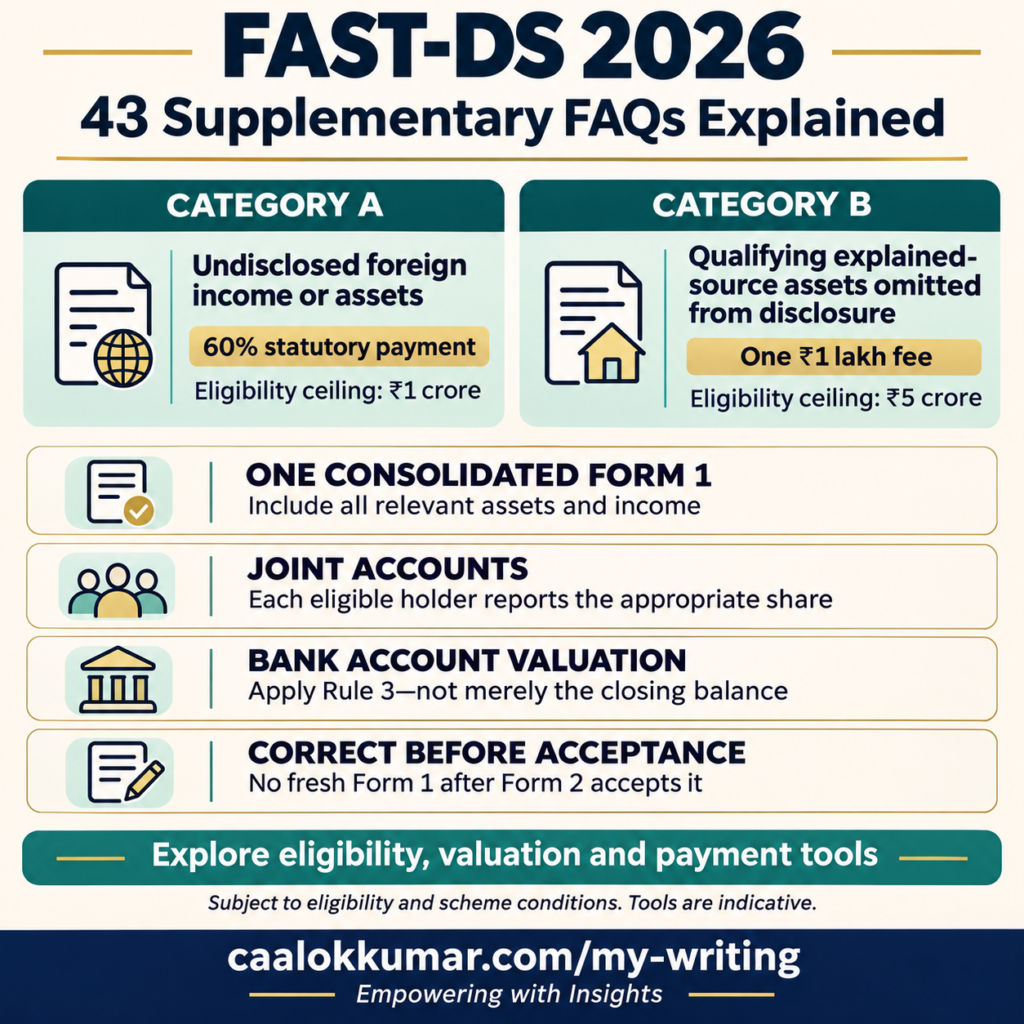
| Category A | Qualifying undisclosed foreign income or assets; 30% tax plus 30% additional amount; ₹1 crore ceiling |
| Category B | Qualifying explained-source assets omitted from required disclosure; single ₹1 lakh fee; ₹5 crore ceiling |
| Corrections | Fresh filing can replace Form 1 before Form 2 accepts it |
| Protection | Limited to qualifying declared items and completion of scheme requirements |
The ₹1 crore and ₹5 crore figures are eligibility limits, not amounts deductible from a larger disclosure. Neither category should be chosen merely because it produces the smaller payment.
Try it: use the FAST-DS category and eligibility finder to organise your initial assessment. Its result is preliminary and depends on complete, correct inputs.
Use the right tool while reading
Use the tools below for preliminary calculations and to organise your facts. Check the results against supporting documents and the official rules before filing.
| Your question | Relevant tool |
|---|---|
| Which route might apply | Category and eligibility finder |
| Was I ROR, RNOR or non-resident | Residential status checker |
| What may be payable | FAST-DS amount calculator |
| Which valuation rule applies | Foreign-asset valuation method finder |
| How indexed cost converts into INR | Indexed cost and rupee-value calculator |
| How joint holders share the value | Joint holding allocation calculator |
| How a bank account is valued | Foreign bank account value calculator |
| When payment may fall due | Payment timeline and interest calculator |
Have an advisory but do not know where to start? The FAST-DS email response checker helps structure that first review. None of these tools submits a statutory declaration or replaces documentary verification.
What must be declared and how currency is converted
FAQ 51 — Must foreign income already taxed in India be declared again
Not simply because other income was omitted. Category A concerns the qualifying income or assets not offered to tax. For example, if foreign rent was correctly taxed but interest and dividends were missed, review the omitted streams separately. Do not automatically include the already-taxed rent again.
FAQ 52 — Must assets already shown in Schedule FA be repeated
The FAQ allows Category B disclosure of the qualifying asset that was omitted. If two of three explained-source assets were properly reported, identify the gap in the third rather than treating the entire portfolio as unreported. Keep an asset-wise comparison with earlier returns.
FAQ 53 — Does another omitted income item destroy protection for what was declared
The FAQ says the declaration remains valid for the qualifying income or assets actually declared, subject to timely payment. An omitted item receives no automatic immunity. This is a limit on protection, not a recommendation to make an incomplete declaration.
FAQ 54 — What if another asset is discovered after the declaration
For Category B too, protection attaches to the qualifying assets included in the declaration. It does not extend automatically to another asset later discovered. Read this with FAQs 84–86: a later discovery does not create an unrestricted right to file another Form 1 or bypass the prescribed ceiling.
FAQ 55 — Which USD to INR rate applies
The supplementary document specifies ₹94.6543 per US dollar, using the reference rate of 30 March 2026 because no reference rate was published on 31 March 2026. This is the scheme’s valuation conversion clarification, not a universal exchange rate for historical income-tax computations.
Use the indexed cost and currency conversion tool for a working estimate. For other currencies, follow Rule 3(4); do not assume every currency can be converted using an arbitrary commercial rate.
Joint accounts and company signing authority
FAQ 56 — Does each joint holder have a separate reporting obligation
Yes, the FAQ explains that each joint holder has an interest requiring examination under Sections 42 and 43 of the Black Money Act, 2015. Compliance is individual. One holder’s return disclosure does not necessarily satisfy another holder’s obligation.
FAQ 57 — What if only the husband funded and disclosed a joint account
The wife cannot disregard her position merely because her husband supplied all the funds. The FAQ treats a named joint holder as falling within the relevant description and permits scheme relief subject to eligibility. Account funding and reporting responsibility must be examined separately.
FAQ 58 — How is a joint account valued and allocated
First value the account under Rule 3(1)(e). Then allocate it using definite, ascertainable ownership shares; where such shares are absent, divide equally.
Example: a ₹30 lakh asset held in the documented ratio 3:3:4 produces shares of ₹9 lakh, ₹9 lakh and ₹12 lakh. With no ascertainable shares, three holders receive ₹10 lakh each. Evidence must support an unequal allocation.
Try the joint holding share and ceiling calculator. For a bank account, establish the prescribed whole-account value first; do not split a closing balance and assume the exercise is complete.
FAQ 59 — How does the Category B ceiling apply to joint holders
Each declarant tests the aggregate value in his or her own Form 1. The appropriately allocated share of the joint asset counts towards that individual’s ceiling, together with other relevant declared assets.
FAQ 60 — Does signing authority over a company account always require Category B filing
The FAQ calls for an examination of ownership or beneficial ownership, beneficiary status and foreign-source income under the stated BMA provisions. A director or employee should not assume either that signing authority always means personal ownership or that a company account can never create a reporting issue. Review the mandate and the person’s actual interest; also check the applicable ITR instructions separately.
FAQ 61 — What value applies where the signatory satisfies those conditions
The FAQ directs use of Rule 3(1)(e). A nominal figure cannot be substituted merely because the person signs on behalf of a company. Determine whether the FAQ 60 conditions apply before calculating any personal declaration value.
Residential status and completed proceedings
FAQ 62 — Can someone who is now non-resident declare an earlier omission
Yes, where the relevant statutory conditions are met. The example concerns an account that should have been disclosed during earlier resident years, although the taxpayer is now non-resident. Present status does not erase a past disclosure obligation.
FAQ 63 — What about assets acquired while RNOR and omitted after becoming ROR
The FAQ permits qualifying assets under Category B where they were acquired during RNOR status but not disclosed after the taxpayer became ROR. It points to Part B clause 2(A)(i)(3) and the applicable RNOR option in clause 2(A)(iii)(3) of Form 1.
Pause and check: prepare a year-by-year status chart using travel and residential records. The ROR RNOR and non-resident status checker is a useful starting point; legal status is not decided by the account’s location or an NRI label in a bank profile.
FAQ 64 — Does a pending appeal undo the completed BMA assessment exclusion
No. The FAQ excludes the relevant asset or income where the BMA assessment has already concluded, even if an appeal is pending. Proceedings started but not completed are treated differently. Obtain the actual order and its date before deciding eligibility.
FAQ 65 — What if BMA penalty proceedings have concluded
The FAQ says the scheme does not reopen concluded penalty proceedings for the relevant item, including the stated Section 42 or 43 penalty situation. It distinguishes pending assessment or penalty notices from completed proceedings. A notice alone and a final order should never be treated as the same event.
FAQ 66 — How does the scheme payment compare with BMA exposure
The document illustrates Category A at 60%, compared with BMA tax of 30% and penalty of 90%. For Category B it contrasts the single ₹1 lakh fee with the reporting-penalty exposure described in the FAQ. Actual BMA liability depends on the applicable provision, year, threshold and facts; the comparison is not an automatic penalty demand in every case.
The FAST-DS amount payable calculator can support budgeting after category and value are verified. Scheme tax and fees are statutory payments, not professional charges.
Small accounts and the correct disclosure category
FAQ 67 — Is FAST-DS needed for a small explained-source bank account
The FAQ addresses foreign bank accounts within the stated ₹20 lakh aggregate-balance protection and distinguishes explained deposits from undisclosed income or unaccounted deposits. It says scheme disclosure is not needed in the explained-source circumstances described, while untaxed or unaccounted amounts need separate attention.
Do not read this as a blanket exemption from Schedule FA or income tax. Check the version of the law applicable to each default year, aggregation conditions and the precise protection being claimed, especially for older years. The ₹20 lakh discussion is not a substitute for testing FAST-DS valuation and eligibility.
FAQ 68 — Can a revised return sometimes be sufficient
Yes. The document’s example concerns a returning resident with an overseas account funded from post-tax deposits during non-resident years, followed by an omission of the account and relevant interest after becoming resident. For that example, it says a revised AY 2026-27 return by 31 March 2027, reporting both, would constitute sufficient BMA compliance.
This is not a general cure for every earlier-year omission. Confirm that revision is legally available, includes the necessary information and matches the facts of the example. The scheme deadline and revised-return deadline are separate.
FAQ 69 — Must a Category A asset also be declared in Category B
No. The FAQ says the same asset need not be declared again under Category B once validly disclosed under Category A with the required payment. Avoid duplicating an asset merely because it also missed Schedule FA.
FAQ 70 — What if an asset has both taxed and undisclosed funding
The FAQ says it cannot be declared under Category B because undisclosed income is embedded in it. Category A may apply if eligible. Do not assume that splitting the purchase price allows the same asset to be divided between categories without authority.
FAQ 71 — Can both categories appear in one Form 1
Yes. Different qualifying items can fall in different categories within a single consolidated declaration. Classify each item on its own funding and disclosure history, then test the prescribed limits.
FAQ 72 — Is income counted again when used to buy an asset
Rule 3(3), as explained in the FAQ, prevents double counting of the source income and its application towards an asset. The prescribed adjustment needs a funding trail linking the receipt and investment. It does not mean every deposit can be deducted merely because it is described as tax-paid.
FAQ 73 — How are fractional shares reported
Use the exact fractional quantity in Schedule A5. The FAQ prescribes multiplication by the average of the relevant quoted high and low on the valuation date, followed by conversion into INR. For example, 0.45 shares should not be rounded to zero or one. Retain the broker record and pricing evidence.
Scrutiny and confidentiality
FAQ 74 — Does FAST-DS prevent every scrutiny proceeding
No blanket bar is stated. The FAQ distinguishes the electronic scheme process from risk-based scrutiny. Qualifying declared amounts receive the prescribed treatment subject to compliance, and a pending assessment must take the declaration into account. Do not describe the scheme as immunity from all future enquiries.
FAQ 75 — Are declarations confidential
The FAQ describes confidentiality comparable to a return of income, referring to Section 138 of the Income-tax Act, 1961 as incorporated through the BMA. This is statutory confidentiality, subject to the legal framework, not an unconditional guarantee against every authorised disclosure.
The 20 percent valuation tolerance
FAQ 76 — What does the tolerance protect
It addresses qualifying valuation differences where an asset is declared on a recognised valuer’s report as at 31 March 2026. If the later authority’s value exceeds the declared value by no more than 20%, the FAQ explains that the declaration is not invalidated merely for that difference.
Example: a report-supported value of ₹50 lakh and a later value of ₹58 lakh differ by 16%. A value of ₹65 lakh differs by 30% and falls outside that tolerance. The rule is not permission to intentionally understate an asset.
FAQ 77 — Does the tolerance apply to bank accounts
No. The FAQ treats bank-account valuation as an arithmetical exercise rather than subjective valuation. Missing statements and omitted deposits cannot be excused through a 20% margin.
FAQ 78 — Does it apply to immovable property
Yes, where a qualifying valuation report is used and the stated conditions are met. Keep the report, valuation date, assumptions and supporting documents with the declaration records.
FAQ 79 — What if the permitted indexed-cost method is used
The FAQ says that where the rules adopt indexed acquisition cost as deemed FMV because no valuation is carried out, that figure cannot later be replaced by a higher open-market valuation. This is distinct from the report-based tolerance route. Use the foreign-asset valuation method finder to identify the relevant rule before choosing a calculation method.
Gifts loans and the single Category B fee
FAQ 80 — What cost applies to gifted or inherited foreign assets
The FAQ adopts the donor’s or previous owner’s acquisition cost; its illustration uses the donor’s acquisition year for indexation. A gift’s cost is not automatically nil simply because the recipient paid nothing. Obtain the original purchase documents, gift or succession evidence and funding history. Use the gift and inherited-asset indexed-cost calculator only after selecting the appropriate method.
FAQ 81 — Is an overseas unsecured loan receivable a foreign asset
The FAQ treats debt receivable from a non-resident as a foreign financial asset capable of declaration, subject to the scheme. Category selection still depends on the source and facts. Preserve the agreement, remittance evidence, borrower details, repayments and outstanding entitlement.
FAQ 82 — Is ₹1 lakh charged for each asset
No. Category B uses one flat ₹1 lakh fee for all qualifying declared assets within the aggregate ₹5 crore ceiling. It is not a per-account, per-country or per-property charge.
FAQ 83 — Is ₹1 lakh charged for every omitted year
No. The FAQ extends the single fee across qualifying assets and years, subject to the aggregate limit. Reconcile annual omissions without multiplying the statutory scheme fee by the number of years.
Consolidated filing corrections and refiling
FAQ 84 — Can several independent Form 1 declarations be filed
The FAQ requires one consolidated Form 1. Repeat the relevant schedules where needed for multiple assets or income items. Before Form 2 accepts it, a fresh filing replaces the earlier declaration. After acceptance through Form 2, another Form 1 is not permitted, even for an inadvertently omitted item.
FAQ 85 — Can a rejected Form 1 be filed afresh
Yes. The FAQ permits a fresh filing after rejection. Check the rejection reason, correct the defect and observe the applicable filing window; rejection does not create a new statutory deadline.
FAQ 86 — Can an incorrectly filed Form 1 be revised
The FAQ permits a fresh Form 1 before Form 2 accepts the declaration. This is not an unlimited post-acceptance amendment facility. Review all schedules together so that a corrective filing does not accidentally leave out information already supplied.
Before you file: use our FAST-DS eligibility and document review form to share your facts and available records. This is our client-information form, not the Government’s Form 1, and submitting it does not itself make a statutory declaration.
Foreign tax credit search cases and pending assessments
FAQ 87 — Can DTAA or foreign tax credit reduce Category A payment
No. The FAQ says such benefits belong to the relevant income-tax return framework and are not available within FAST-DS. Do not deduct foreign withholding automatically from the scheme liability. Where another lawful compliance route is available, compare its consequences separately.
FAQ 88 — Does a search or survey automatically block FAST-DS
No. The FAQ distinguishes an Income-tax Act search or survey from specific scheme exclusions, including relevant completed BMA assessments and PMLA circumstances. The underlying statute must be checked carefully; do not treat a search as automatic disqualification or as automatic eligibility.
FAQ 89 — What if a BMA assessment concludes before scheme payment
The FAQ explains that a qualifying declaration filed while the relevant assessment was pending remains valid despite later completion. Share Forms 1 and 2 with the AO promptly. Where payment is made before assessment concludes, communicate it in time. If an addition is made while payment remains pending, the FAQ contemplates appropriate rectification after timely payment and submission of Form 4.
Its example uses a December 2026 declaration, a January 2027 Form 2 and payment extending into the permitted interest period. These are example dates, not one deadline applicable to every declarant.
Use the FAST-DS payment timeline and interest calculator as a reminder aid. Verify both order and receipt dates against the Rules, especially if they fall in different months. Do not rely solely on a tool with a single order-date input.
Entities grievances and older assets
FAQ 90 — Can entities and legal heirs use the scheme
Yes, subject to the statutory conditions. The FAQ includes qualifying HUFs, companies, firms, LLPs, AOPs and trusts, and permits a legal representative to act for a deceased person. Confirm residency, authority, taxpayer identity and eligibility before filing.
FAQ 91 — What if Form 2 contains an apparent error
An electronic representation or grievance may be made to the designated Systems authority. However, a grievance does not stay or extend the payment deadline. Track the complaint and payment obligation separately, and obtain advice before deciding how to respond to a disputed computation.
FAQ 92 — How does the indexed-cost route treat assets acquired before April 2001
Where the specified method applies and no valuation as at 31 March 2026 is carried out, the FAQ uses the higher of actual cost or FMV on 1 April 2001 as the foreign-currency base cost. It then indexes that cost and converts the resulting value into INR under the prescribed rule.
The supplied supplementary document illustrates CII 100 for FY 2001-02 and CII 380 for FY 2025-26. Check the applicable official index and method before signing off the computation; do not copy an illustration into every asset’s working without checking its assumptions.
FAQ 93 — Must the same asset be entered once for every default year
No. Report the asset once in the consolidated Form 1, with the earliest relevant acquisition year and prescribed valuation-date amount. Keep a separate year-wise record of past omissions; do not create duplicate asset entries for the same holding merely because several returns omitted it.
Why a foreign bank closing balance can give the wrong answer
The bank-account rule is particularly important. Rule 3(1)(e) refers to deposits from account opening to the valuation date, subject to its specified exclusions. A current balance, a peak balance and a cumulative-deposit figure answer different questions.
Build a deposit ledger, identify qualifying recycled withdrawals, reconcile transfers and separately examine Rule 3(3) adjustments. A deposit funded from disclosed income does not automatically disappear from the asset-valuation calculation merely because it is not fresh taxable income.
Use the foreign bank account valuation calculator to structure that working. A calculator cannot recognise a transfer or funding source that the statements do not establish.
A practical sequence before submitting Form 1
- Reconcile the advisory. Compare AIS foreign information with your own records. Start with the FAST-DS advisory email explanation if needed.
- Establish residential status. Work year by year using passports, travel records and the applicable law.
- Prepare one asset inventory. Include ownership shares, acquisition dates, gifts, loans and holdings disposed of during the relevant history where the Rules require review.
- Separate asset reporting from income tax. Identify which receipts were taxable in India and what was already reported or taxed.
- Select and document valuation methods. Reconcile bank deposits, broker quantities and property evidence before testing the ceilings.
- Check proceedings and exclusions. Obtain the actual BMA notices, assessment orders and penalty orders.
- Review Form 1 as a whole. Check every schedule before acceptance through Form 2 limits refiling.
- Track payment and follow-up forms. Keep the order, receipt date, challans, Form 3 and Form 4 together.
Self-check: Can you explain every significant deposit? Is each joint holder’s share supported? Does your chosen category match the source of funds? If not, resolve those points before relying on a calculator result.
Get a case specific FAST-DS review
The right outcome is not always a scheme payment. It may involve confirming that disclosure was already complete, considering an available revised return, or preparing an eligible Category A or B declaration. The answer depends on your facts.
You can share foreign-asset details and documents for a FAST-DS review. The intake helps organise information for professional review; it does not file a return, pay statutory amounts or guarantee immunity. Never send passwords or OTPs.
Read also
- FAST-DS 2026 guide with eligibility and valuation tools
- Received the FAST-DS email and unsure what to do
- FAST-DS advisory email and Form 1 preparation guide
- Foreign Assets Disclosure Scheme 2026 introductory article
Conclusion
The FAST-DS supplementary FAQs clarify that protection is item-specific, Category B has a single fee across qualifying assets and years, and a complete Form 1 matters because acceptance restricts further filing. Residential history and prescribed valuation can change the result materially.
Use the tools to organise your review, support the figures with records, and complete the legal and documentary checks before submission. A reasonable estimate is useful for planning; the declaration needs verified facts.
Official references
- CBDT supplementary FAST-DS FAQs covering Q51 to Q93
- Finance Act 2026 including Chapter IV
- Income Tax Department FAST-DS payment guidance
Disclaimer: This article simplifies the supplementary FAQs for general information and reflects the material reviewed on 20 November 2026. The Act, Rules, official forms and applicable amendments prevail. Reporting obligations, eligibility, thresholds, valuation, return-revision options and payment dates require case-specific examination. Website tools provide indicative assistance and do not constitute a government determination or professional opinion. Statutory scheme payments are separate from professional fees.
#FASTDS #FASTDS2026 #ForeignAssets #ScheduleFA #CBDT #BlackMoneyAct #ForeignIncome #NRITaxation #TaxCompliance
Leave a Reply