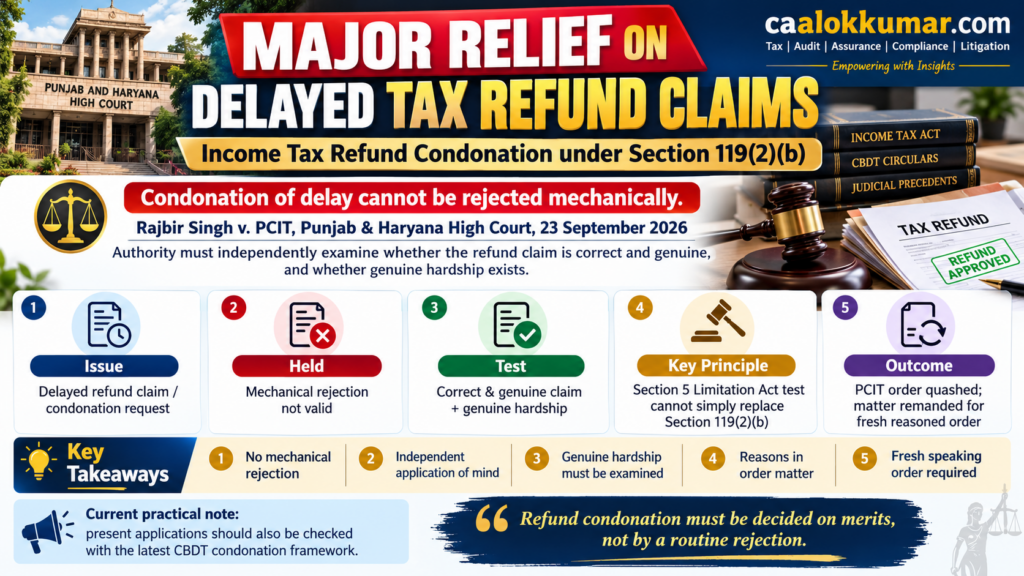
Income Tax Refund Condonation: Major Relief for Delayed Refund Claims under Section 119(2)(b)
Missed claiming an income tax refund because the original or revised ITR filing deadline had already expired? Have you filed Income Tax Refund Condonation request U/s 119(2)(b)?
The refund may not necessarily be lost.
The Punjab & Haryana High Court has delivered an important ruling on income tax refund condonation under Section 119(2)(b), holding that a delayed refund claim cannot be rejected mechanically without examining the taxpayer’s individual case.
In Rajbir Singh v. Principal Commissioner of Income Tax, Panchkula & Ors., CWP No. 18800 of 2023 (O&M), decided on 23 September 2026 along with connected petitions, the High Court quashed the rejection of a condonation application and directed the Principal Commissioner of Income Tax to reconsider the matter through a reasoned order.
The judgment is particularly useful for taxpayers who discover an old or missed income tax refund after the normal time available for filing or revising their return has expired.
However, taxpayers should also note an important current-law update: the Rajbir Singh case was governed by CBDT Circular No. 9/2015, whereas applications filed from 1 October 2024 onwards are governed by CBDT Circular No. 11/2024, which introduced a revised framework and a five-year outer time limit.
What Is Income Tax Refund Condonation?
Normally, an income tax refund is claimed through a valid return of income filed within the prescribed statutory time.
But what happens where:
- excess TDS has already been deducted;
- advance tax or self-assessment tax has been paid in excess;
- a legitimate exemption was missed;
- the taxpayer relied on an incorrect Form 16;
- an ITR was not filed within time;
- a refund claim was inadvertently omitted; or
- a subsequent judicial decision establishes that tax was paid unnecessarily?
In appropriate cases, Section 119(2)(b) of the Income-tax Act, 1961 provides a special remedy.
The provision enables the prescribed Income Tax Authority to admit a belated application or claim for refund or other relief where the statutory conditions are satisfied.
Therefore, expiry of the normal ITR or revised-return deadline does not automatically mean that every genuine refund is permanently lost.
Taxpayers can also use the Income-tax Act 1961–2025 Section Finder to check the corresponding provisions while dealing with proceedings relating to different tax years.
Rajbir Singh v. PCIT: Case at a Glance
Case: Rajbir Singh v. Principal Commissioner of Income Tax, Panchkula & Ors.
Court: Punjab & Haryana High Court
Case No.: CWP No. 18800 of 2023 (O&M) with connected petitions
Decision: 23 September 2026
Relevant Assessment Year: AY 2017-18
Provision involved: Section 119(2)(b), Income-tax Act, 1961
Circular considered: CBDT Circular No. 9/2015 dated 9 June 2015
Issue: Condonation of delay for making a belated income tax refund claim
Result: PCIT’s rejection order quashed; application remanded for fresh consideration through a reasoned order.
How Did the Refund Dispute Arise?
Rajbir Singh was a former employee of HMT Limited’s Tractor Division at Pinjore.
Following serious financial difficulties, the Tractor Division was proposed to be closed and the petitioner opted for a Voluntary Retirement Scheme in 2016.
He received approximately:
₹29,14,500 under the VRS
In the Form 16 issued by HMT:
- ₹5 lakh was treated as exempt under Section 10(10C); and
- the remaining ₹24,14,500 was treated as taxable.
The employee relied upon this Form 16 while filing his return for AY 2017-18 on 3 August 2017.
The return was processed and accepted.
Later Judicial Relief Changed the Position
Subsequently, similarly situated HMT employees succeeded in appellate proceedings.
In their cases, relief was granted by treating the relevant amount under Section 10(10B) rather than restricting exemption to ₹5 lakh under Section 10(10C).
These developments created a potential tax refund for other similarly situated employees who had originally filed their returns based upon the treatment adopted by HMT in Form 16.
Rajbir Singh therefore sought to revise his tax position.
Refund Claim of ₹7.19 Lakh
After becoming aware of the favourable decision in the case of another similarly situated employee, Rajbir Singh approached the Principal Commissioner of Income Tax on 10 August 2020.
He sought condonation of delay under Section 119(2)(b) so that a revised return could be filed and the additional exemption claimed.
The consequential refund was approximately:
₹7,19,819
The PCIT, however, rejected his application on 19 January 2022.
The taxpayer challenged the rejection before the Punjab & Haryana High Court.
Why Did the PCIT Reject the Condonation Application?
The PCIT substantially relied upon the fact that the favourable appellate order involving another HMT employee had not been accepted by the Income Tax Department on merits.
The Department had, however, not challenged that decision further because of the applicable monetary limits for filing departmental appeals.
The PCIT also concluded that genuine hardship had not been established.
The High Court found that this approach did not sufficiently address the statutory requirements applicable to the petitioner’s claim.
High Court: Refund Claim Must Be Examined Independently
The High Court held that the competent authority was required to independently examine whether the refund claimed by the taxpayer was correct and genuine.
Merely stating that the Department did not accept a favourable appellate decision in another employee’s case was not enough.
The taxpayer’s own refund claim had to be considered on its merits.
Therefore, a Section 119(2)(b) condonation application cannot be rejected mechanically merely by relying on reports of subordinate authorities or by making general observations.
There must be an actual application of mind to the taxpayer’s claim.
Genuine Hardship Must Also Be Examined Properly
Another important issue was genuine hardship.
The PCIT had effectively concluded that no case of hardship was made out.
The High Court held that such a conclusion required proper examination of the taxpayer’s individual circumstances.
Relevant factors included:
- loss of employment;
- closure of the HMT Tractor Division;
- circumstances in which VRS was accepted;
- amount of refund involved;
- financial consequences for the taxpayer; and
- relief already granted to similarly situated employees.
A statutory authority cannot merely use the expression “no genuine hardship” without demonstrating how the conclusion was reached.
Important Principle: Condonation Cannot Be Rejected Mechanically
The judgment therefore reinforces a broader rule:
A competent income-tax authority dealing with a delayed refund claim must apply its mind to the statutory conditions and the individual facts of the taxpayer’s case.
A standard rejection order without examining the substance of the refund claim and hardship may therefore be vulnerable to challenge.
Can the Limitation Act’s “Sufficient Cause” Test Be Applied?
The Revenue subsequently argued before the High Court that the taxpayer had failed to sufficiently explain the delay.
The High Court did not accept that argument in the manner in which it was advanced.
The Court distinguished proceedings under Section 119(2)(b) from an ordinary application under Section 5 of the Limitation Act, 1963.
The classic Section 5 inquiry revolves around whether the applicant has shown “sufficient cause” for delay.
The statutory framework applicable to Rajbir Singh’s application under Section 119(2)(b), read with CBDT Circular No. 9/2015, required consideration particularly of:
- correctness and genuineness of the claim; and
- genuine hardship.
Therefore, the Section 5 Limitation Act test could not simply be transplanted as an independent substitute for the criteria governing Section 119(2)(b).
But There Is an Important Current-Law Update
Taxpayers should be careful not to apply the Rajbir Singh judgment without considering the current CBDT framework.
Rajbir Singh’s application was filed in 2020 and rejected in 2022.
Therefore, the High Court examined it under the CBDT framework then applicable, principally Circular No. 9/2015.
For present-day applications, however, there has been an important change.
CBDT Circular No. 11/2024 – Current Rule for Delayed Refund Claims
CBDT issued Circular No. 11/2024 dated 1 October 2024, superseding the previous instructions governing condonation applications under Section 119(2)(b).
The current Circular is highly important for anyone seeking an income tax refund after the due date.
Current Five-Year Time Limit
For applications filed on or after 1 October 2024, no condonation application for a refund/loss claim can ordinarily be entertained beyond:
five years from the end of the relevant assessment year.
This is a significant change from the earlier six-year period under Circular No. 9/2015.
Therefore, an old refund claim should be examined without unnecessary delay.
Current Test Includes “Reasonable Cause” and Genuine Hardship
Circular No. 11/2024 also provides that while considering a Section 119(2)(b) application, the authority must ensure that:
- the assessee was prevented by reasonable cause from filing the return within the due date; and
- the case involves genuine hardship on merits.
Accordingly, the Rajbir Singh judgment remains important for the principle against mechanical rejection and requirement of proper application of mind.
However, taxpayers filing applications today should prepare their case according to the current Circular No. 11/2024, rather than merely reproducing the wording of the superseded Circular No. 9/2015.
Who Can Approve a Section 119(2)(b) Refund Claim?
Under the present CBDT framework, jurisdiction depends upon the amount involved.
Broadly:
Refund/loss claim up to ₹1 crore:
Principal Commissioner / Commissioner of Income Tax
Above ₹1 crore and up to ₹3 crore:
Chief Commissioner of Income Tax
Above ₹3 crore:
Principal Chief Commissioner of Income Tax
Therefore, the application should be addressed to the competent authority having jurisdiction under the current circular.
Can an Old Income Tax Refund Still Be Claimed?
Potentially, yes—subject to the applicable statutory requirements and time limit.
A taxpayer should therefore examine Section 119(2)(b) where:
Excess TDS Was Deducted
For example, an employer, bank, purchaser or other deductor may have deducted more tax than was ultimately payable.
ITR Was Not Filed
A taxpayer may have income below the taxable threshold but significant TDS appearing in Form 26AS/AIS.
Deduction or Exemption Was Missed
A legitimate exemption or deduction may not have been claimed in the original return.
Wrong Form 16 Was Relied Upon
An employer’s tax treatment may subsequently turn out to be incorrect.
Judicial Decision Subsequently Clarifies the Law
A later court or appellate ruling may establish eligibility for a tax exemption or refund.
Refund Was Omitted from the Original Return
A taxpayer may have inadvertently missed TDS credit, advance tax or another legitimate claim.
Each case, however, has to satisfy the statutory and CBDT conditions.
Missed Refund: Section 119(2)(b) vs ITR-U
This distinction is extremely important.
Many taxpayers assume that an Updated Return or ITR-U can solve every old-return problem.
That is not correct.
An ITR-U is fundamentally intended to permit taxpayers to disclose omitted income and correct certain earlier tax positions. It generally cannot be used to reduce the taxpayer’s tax liability or create/increase a refund.
Therefore, a taxpayer who has missed an income tax refund should not automatically file an ITR-U.
Depending upon the facts, a Section 119(2)(b) condonation application followed by the permitted return mechanismmay instead be the appropriate route.
For a detailed explanation of updated returns, see our guide on ITR-U Filing and Updated Return under Section 139(8A).
How Is ITR Filed After Condonation Is Approved?
The Income Tax Department now provides a specific filing mechanism after approval of condonation.
Where the competent authority approves the request under Section 119(2)(b), the taxpayer may file the relevant return through the prescribed ITR after condonation mechanism on the Income Tax e-Filing portal.
The portal presently identifies such filing under Section 139(9A) after condonation of delay under Section 119(2)(b).
This makes the process materially different from simply filing a normal belated return or ITR-U.
What Should a Strong Income Tax Refund Condonation Application Contain?
A Section 119(2)(b) application should not be treated as a routine letter asking the Department to excuse the delay.
It should be prepared almost like a short legal representation.
1. Explain the Refund Clearly
State:
- relevant assessment year;
- return already filed, if any;
- income originally reported;
- tax deducted or paid;
- refund originally claimed;
- additional refund now claimed; and
- how the refund has been calculated.
2. Establish That the Refund Is Genuine
Supporting records may include:
- Form 16;
- Form 16A;
- Form 26AS;
- AIS/TIS;
- TDS certificates;
- salary records;
- bank statements;
- challans;
- computation of income;
- earlier ITR;
- assessment/intimation;
- appellate order; and
- other supporting documents.
3. Explain the Reasonable Cause for Delay
Under the current CBDT Circular, this is particularly important.
The taxpayer should clearly explain what prevented the return or refund claim from being made within the normal period.
Examples can include reliance upon employer records, genuine lack of knowledge of a tax entitlement, subsequent judicial developments, medical or other serious circumstances, or other case-specific reasons.
The explanation should be factual and supported wherever possible.
4. Establish Genuine Hardship
The application should separately explain why rejection of a genuine refund claim would create hardship.
This requirement should not be dealt with through a generic one-line statement.
5. Refer to Relevant Judicial Decisions
Where the claim is supported by a High Court, Supreme Court or Tribunal decision, that precedent should be properly incorporated.
For complex disputes and appellate matters, taxpayers may also refer to the tax litigation and representation resources available through CA Alok Kumar – Income Tax and Litigation Services.
6. Check the Five-Year Deadline First
Before preparing the application, calculate whether the claim falls within the current five-year outer limit applicable under Circular No. 11/2024.
This should be one of the first checks because an otherwise strong refund claim can face a fundamental limitation problem.
Department Cannot Add New Reasons Later
Rajbir Singh also reiterates an important administrative-law principle.
The original PCIT order had not rejected the condonation application on the specific ground that the petitioner had inadequately explained the delay.
That justification was sought to be advanced subsequently before the High Court.
The Court relied upon the Supreme Court’s landmark decision in:
Mohinder Singh Gill v. Chief Election Commissioner, (1978) 1 SCC 405
for the principle that the validity of an administrative or statutory order must ordinarily be judged on the reasons contained in the order itself.
An authority cannot normally repair an otherwise defective order by supplying entirely new reasons later in court.
High Court Quashes PCIT’s Order
The Punjab & Haryana High Court ultimately allowed the writ petitions and set aside the impugned rejection orders.
The PCIT was directed to reconsider the Section 119(2)(b) applications:
- independently;
- after giving an opportunity of hearing;
- after examining the material on record; and
- through a reasoned order.
The fresh decision was directed to be taken within three months from receipt of the High Court’s order.
Did the High Court Direct Payment of the Refund?
No.
This is an important limitation of the judgment.
The High Court did not itself direct the Income Tax Department to pay Rajbir Singh the refund of ₹7.19 lakh.
Nor did it finally determine his entitlement to exemption under Section 10(10B).
Instead, the Court:
quashed the defective condonation order and directed the PCIT to reconsider the claim properly.
The substantive tax exemption and refund entitlement remained open for fresh consideration.
Therefore, the case should not be presented as an automatic refund ruling.
Rajbir Singh Judgment: Key Takeaways
1. Condonation Applications Cannot Be Rejected Mechanically
The competent authority must actually examine the taxpayer’s circumstances.
2. Genuine Hardship Requires Real Consideration
A standard statement that “no hardship is established” may not be sufficient.
3. Refund Claims Must Be Examined on Their Own Merits
A taxpayer’s claim cannot simply be rejected because the Department disagrees with a favourable decision obtained by another taxpayer.
4. Reasons in the Original Order Matter
The Department cannot ordinarily defend an order later on completely new grounds not recorded in it.
5. Rajbir Singh Concerned the Older Circular
The judgment dealt with Circular No. 9/2015 because of the dates involved.
6. Current Applications Are Governed by Circular No. 11/2024
For applications filed from 1 October 2024, taxpayers must consider:
reasonable cause + genuine hardship + current five-year limitation.
7. Section 119(2)(b) Can Be More Relevant Than ITR-U for Refund Claims
Where the objective is to create or enhance a refund, taxpayers should carefully examine the condonation route rather than assuming that an updated return will solve the issue.
Practical Example
Suppose a salaried taxpayer had ₹1.80 lakh TDS deducted in an earlier year but did not file an ITR because his taxable income was actually below the applicable limit.
Several years later, he discovers through Form 26AS or AIS that substantial tax remains refundable.
A normal belated return may no longer be possible.
An ITR-U may also be inappropriate because it cannot ordinarily be used to create an additional refund.
In such circumstances, subject to the applicable five-year period and other conditions, the taxpayer should examine whether a Section 119(2)(b) income tax refund condonation application is available.
Income Tax Refund Condonation Checklist
Before filing an application, check:
- Is there a genuine refund?
- What assessment year does it relate to?
- Is the application within the five-year period?
- Why was the return/refund not claimed within time?
- Is there reasonable cause?
- What genuine hardship would arise?
- Is the tax payment visible in Form 26AS/AIS?
- Are supporting documents available?
- Which authority has jurisdiction based on the refund amount?
- Does a favourable judicial precedent support the claim?
- Is ITR-U unavailable because the proposed return would result in or increase a refund?
Where the issue involves the interaction between old and new provisions, our Income-tax Act Section Finder may also be used for reference.
Frequently Asked Questions
Can I claim an income tax refund after the ITR due date has expired?
Potentially yes. Depending upon the facts, the applicable assessment year and statutory limitation, Section 119(2)(b) may permit a belated refund claim after condonation.
What is Section 119(2)(b)?
Section 119(2)(b) empowers the CBDT and authorised income-tax authorities to admit certain belated claims for exemption, deduction, refund or other relief subject to the prescribed conditions.
What is the time limit for an income tax refund condonation request?
Under the current CBDT Circular No. 11/2024, applications filed on or after 1 October 2024 are ordinarily subject to an outer limit of five years from the end of the relevant assessment year, subject to specified exceptions.
Can I use ITR-U to claim a missed refund?
Generally, an updated return cannot be filed where it would reduce the tax liability or result in/increase a refund. In appropriate cases, the Section 119(2)(b) route should instead be examined.
For more information, see ITR-U Filing & Updated Return Services.
Is condonation automatically granted if the refund is genuine?
No. The taxpayer must satisfy the applicable statutory and CBDT requirements. Under the current framework, reasonable cause and genuine hardship are important considerations.
What happens after the condonation request is approved?
The taxpayer can proceed with the permitted return filing mechanism in accordance with the Income Tax Department’s prescribed procedure for filing after condonation.
Conclusion
The Punjab & Haryana High Court’s ruling in Rajbir Singh v. Principal Commissioner of Income Tax provides significant guidance for taxpayers seeking income tax refund condonation under Section 119(2)(b).
The larger principle is clear:
A delayed refund claim should not be rejected through a mechanical or pre-determined approach.
The competent authority must examine the relevant statutory requirements, the taxpayer’s circumstances and the merits of the claim and pass a reasoned order.
At the same time, taxpayers filing condonation applications today must distinguish the law applicable in Rajbir Singh from the current CBDT Circular No. 11/2024.
For current applications, the key considerations include:
Five-year limitation + reasonable cause + genuine hardship + substantiated refund claim.
Therefore, anyone who discovers an old or missed income tax refund should examine the available remedy promptly rather than assuming that expiry of the ordinary ITR filing deadline necessarily means the refund is permanently lost.
For related guidance, refer to:
ITR-U Filing & Updated Return under Section 139(8A)
Income-tax Act 1961 ↔ 2025 Section Finder
Tax Consultant & Income Tax Representation
Case Citation
Rajbir Singh v. Principal Commissioner of Income Tax, Panchkula & Ors.
CWP No. 18800 of 2023 (O&M) with connected petitions
Punjab & Haryana High Court
Decision dated 23 September 2026
Important Legal References
Section 119(2)(b), Income-tax Act, 1961
CBDT Circular No. 9/2015 dated 9 June 2015 – applicable framework considered in Rajbir Singh.
CBDT Circular No. 11/2024 dated 1 October 2024 – current comprehensive framework for condonation applications filed from 1 October 2024.
Section 139(9A), Income-tax Act, 1961 – filing of return after condonation.
Mohinder Singh Gill v. Chief Election Commissioner, (1978) 1 SCC 405.
Disclaimer: This article is intended for general information and professional awareness. Eligibility for condonation, refund or other tax relief depends upon the relevant assessment year, statutory provisions, CBDT circulars, limitation period and facts of each case. Professional advice should be obtained before filing a condonation or refund claim.
Leave a Reply