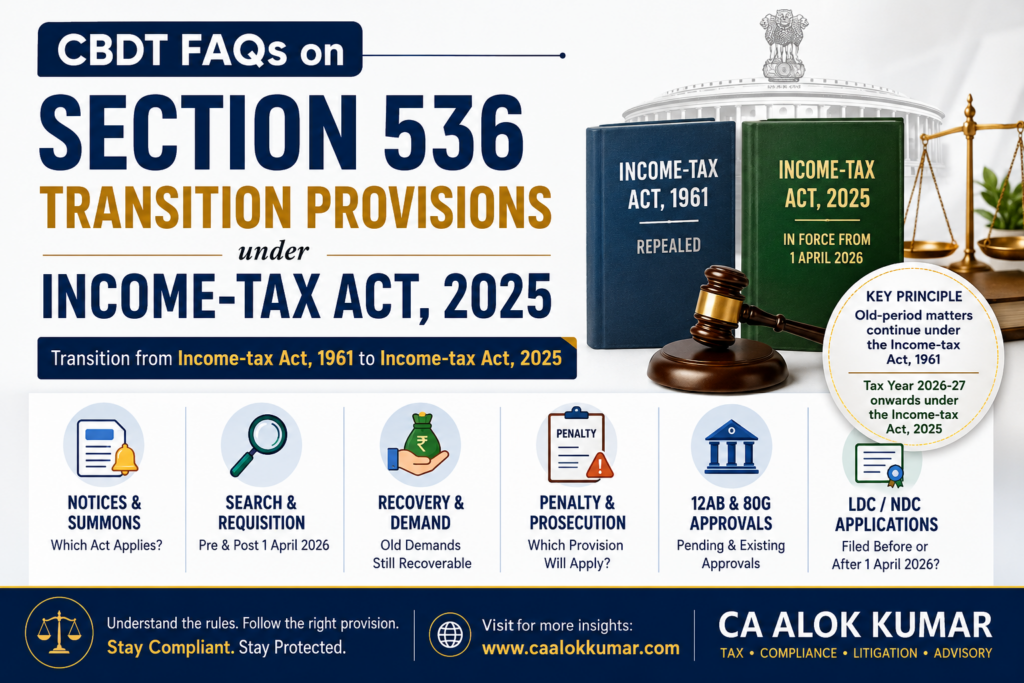
The Central Board of Direct Taxes has issued important clarificatory FAQs on the transition provisions under Section 536 of the Income-tax Act, 2025, dealing with the repeal of the Income-tax Act, 1961 and the continuation of pending or old-period proceedings.
The FAQs are important for taxpayers, Chartered Accountants, tax professionals, companies, trusts, NRIs and businesses because the Income-tax Act, 2025 has come into force from 1 April 2026, but many assessments, notices, searches, recovery proceedings, penalty matters and applications may still relate to earlier years.
In simple words, the key question is:
Which law will apply after 1 April 2026 — the Income-tax Act, 1961 or the Income-tax Act, 2025?
CBDT has now clarified this issue through 23 FAQs covering summons, notices, search proceedings, jurisdiction transfer, provisional attachment, recovery, penalties, prosecution, charitable registrations, 12AB/80G approvals and lower deduction or no deduction certificate applications.
For professionals and taxpayers dealing with pending income-tax proceedings, this clarification should be read carefully along with the relevant provisions of the new law. You may also use our Income Tax Act 2025 Section Finder for section-wise comparison and mapping.
Background: Why Section 536 is Important
Section 536 of the Income-tax Act, 2025 deals with Repeals and Savings. This provision ensures that the repeal of the Income-tax Act, 1961 does not automatically cancel or disturb actions already taken, pending proceedings, existing rights, liabilities, approvals, demands or proceedings relating to earlier years.
This is practically important because income-tax proceedings often continue for several years. For example:
- assessment or reassessment may relate to an earlier assessment year;
- search proceedings may have been initiated before 1 April 2026;
- penalty or recovery may relate to a demand created under the Income-tax Act, 1961;
- 12AB or 80G applications may have been filed before 31 March 2026 but may still be pending;
- lower deduction certificate applications may have been filed before the new Act came into force.
Without proper transition rules, there could be confusion regarding the authority, section, procedure and validity of notices or orders.
CBDT’s FAQs provide practical guidance on how such matters should be handled.
Core Principle of Section 536
The central principle clarified by CBDT is this:
For proceedings relating to tax years beginning before 1 April 2026, the provisions and procedure of the repealed Income-tax Act, 1961 may continue to apply.
At the same time, for matters relating to Tax Year 2026-27 onwards, the provisions of the Income-tax Act, 2025 will generally apply.
Therefore, the relevant factor is not merely the date on which the notice or summons is issued. The more important factor is:
Which period or tax year does the matter relate to?
This distinction is important while responding to income-tax notices, summons, assessment proceedings, search matters and recovery proceedings. Taxpayers facing notices should take proper professional advice before filing replies, especially in cases involving old assessment years, reassessment or pending litigation. Our Income Tax Demand Notice Response service may be useful where tax demand or portal response issues are involved.
1. Summons and Notices: Whether 1961 Act or 2025 Act Applies
CBDT has clarified that a summons is also a notice for the purpose of Section 536(2)(c) of the Income-tax Act, 2025.
Where a summons relates only to a period prior to 1 April 2026, powers under Section 131 of the Income-tax Act, 1961may be used. This may include matters arising from TEP, STR, CRS, FATCA or assessment-related information.
However, where a TEP or STR does not clearly relate to a period prior to 1 April 2026, or where the period cannot be specifically identified, CBDT has clarified that it would be appropriate to use powers under Section 246 of the Income-tax Act, 2025 for issuing summons.
At the same time, if the resulting proceedings relate to Tax Year 2025-26 or earlier, such proceedings have to be initiated under the Income-tax Act, 1961 by virtue of Section 536(2)(c).
Practical takeaway
Taxpayers should carefully check:
- date of summons or notice;
- tax year or assessment year involved;
- section mentioned in the notice;
- whether the matter relates to pre-1 April 2026 period;
- whether the authority has invoked the correct provision.
This will be particularly important in cases involving old-year information, reassessment, TEP, STR, CRS, FATCA or third-party reporting. For detailed representation in such matters, taxpayers may consider professional support for Income Tax Litigation and Faceless Assessment.
2. Assessment Proceedings for Tax Year 2026-27 Onwards
CBDT has clarified that where assessment proceedings pertain to Tax Year 2026-27 onwards, summons should be issued using powers under Section 246 of the Income-tax Act, 2025.
This means that the new Act becomes directly relevant for proceedings relating to the new tax year beginning from 1 April 2026.
Example
If an assessment proceeding relates to Tax Year 2026-27, the summons or proceedings will generally be under the Income-tax Act, 2025.
But if the proceeding relates to Tax Year 2025-26 or earlier, the old Act may continue to apply because of the saving provision under Section 536.
3. Issuance of Notice Itself Creates a Proceeding
CBDT has also clarified an important procedural point: issuance of any notice results in a proceeding within the meaning of Section 536(2)(c).
Therefore, where a summons is issued on or after 1 April 2026 but relates only to a period prior to 1 April 2026, it is covered by Section 536(2)(c), and summons under Section 131(1) or Section 131(1A) of the Income-tax Act, 1961 may be issued read with Section 536(2)(c) of the Income-tax Act, 2025.
This clarification will be useful in disputes where taxpayers may question whether the department has issued notice under the correct provision after repeal of the 1961 Act.
4. Search, Requisition and Post-Search Proceedings
CBDT has given separate clarification for search and requisition cases.
Where a search under Section 132 or requisition under Section 132A was initiated prior to 1 April 2026, the provisions of the repealed Income-tax Act, 1961 will continue to apply to connected proceedings.
This means that for searches initiated before 1 April 2026, the department may continue to use powers under Section 131(1) of the Income-tax Act, 1961 for post-search inquiries and assessment.
However, where search or requisition is initiated on or after 1 April 2026, the relevant powers under the Income-tax Act, 2025 will apply.
Practical takeaway for search cases
The date of initiation of search or requisition is crucial.
- Search before 1 April 2026: Income-tax Act, 1961 continues for connected proceedings.
- Search on or after 1 April 2026: Income-tax Act, 2025 applies.
This will be highly relevant in search assessments, block assessment matters and related filings. For such cases, taxpayers may refer to professional support for ITR-B Filing, especially where block assessment filing requirements are involved.
5. Power to Call for Information
CBDT has clarified that the same principle applicable to summons will also apply to the power to call for information.
This means that the use of Section 133(6) of the Income-tax Act, 1961 or Section 252 of the Income-tax Act, 2025 will depend on the period or tax year to which the matter relates.
Practical implication
Where information is called for in relation to a period before 1 April 2026, the old Act may apply. Where the matter relates to Tax Year 2026-27 onwards, the new Act will apply.
Taxpayers should not ignore such notices. They should preserve records, reconcile data and file replies within time.
6. Jurisdiction Transfer and PAN Migration
CBDT has clarified that transfer of jurisdiction is not related to a particular assessment year or tax year. Once jurisdiction is transferred, all matters relating to all years stand transferred to the new Assessing Officer.
Where notices under Section 127(2) of the Income-tax Act, 1961 were already issued before 1 April 2026, the transfer order can be passed under Section 127 of the Income-tax Act, 1961 read with the relevant saving provisions under Section 536 of the Income-tax Act, 2025.
However, where transfer of jurisdiction or PAN migration is initiated on or after 1 April 2026, the case can be transferred by passing the final order under Section 243 of the Income-tax Act, 2025.
Practical takeaway
Taxpayers should carefully check whether jurisdiction transfer was initiated before or after 1 April 2026. This may affect the section under which transfer is made, but once jurisdiction is transferred, the new Assessing Officer will handle all years.
7. Provisional Attachment
CBDT has clarified that provisional attachment is done during the course of assessment.
Therefore:
- if assessment relates to a tax year prior to 1 April 2026, provisional attachment may be made under Section 281B of the Income-tax Act, 1961;
- in other cases, provisional attachment may be made under Section 500 of the Income-tax Act, 2025.
Why this matters
Provisional attachment can have serious consequences because it may affect bank accounts, assets or business operations. Taxpayers should immediately seek professional advice if they receive any provisional attachment order or related communication.
8. Recovery by Tax Recovery Officer
CBDT has clarified that recovery of any demand relating to a period prior to 1 April 2026 can be made under the Income-tax Act, 1961 in accordance with Section 536(2)(c), as well as under the Income-tax Act, 2025 as per Section 536(2)(i).
In other words, recovery of old-period demand is enabled under both Acts.
Practical takeaway
This is a significant clarification. Taxpayers should not assume that recovery of old demand becomes invalid merely because the Income-tax Act, 1961 has been repealed.
If any outstanding demand is visible on the income-tax portal, taxpayers should verify:
- assessment year;
- nature of demand;
- intimation or order creating demand;
- rectification status;
- appeal status;
- stay petition, if any;
- whether the demand is correct or disputed.
For demand-related issues, professional assistance may be taken for Income Tax Demand Notice Response.
9. Director’s Liability in Private Company Tax Demands
CBDT has clarified that where an irrecoverable demand of a private company pertains to a particular period, and a person was director of the company during that period, such person may be jointly and severally liable for the demand.
The liability has to be fastened under:
- Section 179 of the Income-tax Act, 1961, where the demand relates to the period governed by the 1961 Act;
- Section 323 of the Income-tax Act, 2025, where the demand relates to the period governed by the new Act.
Practical takeaway for directors
Directors of private companies should not ignore old company tax demands. Even if they are no longer associated with the company, liability may arise if they were directors during the relevant period and statutory conditions are satisfied.
10. Penalty for Default in Payment of Tax Demand
CBDT has clarified that penalty for default in payment of tax arrears will be levied under:
- Section 221 of the Income-tax Act, 1961, where demand relates to a period prior to 1 April 2026;
- Section 412 of the Income-tax Act, 2025, where demand relates to the period on or after 1 April 2026.
Practical takeaway
Taxpayers should not delay action on outstanding tax demands. If a demand is incorrect, it should be disputed properly. If appeal is pending, stay application or appropriate representation should be considered.
Casual responses on the portal may create avoidable complications. Proper documentation and timely representation are important.
11. Tax Clearance Certificate
CBDT has clarified the treatment of Tax Clearance Certificate applications.
If the application for TCC is received before 1 April 2026, the certificate may be issued under Section 230 of the Income-tax Act, 1961 or Section 420 of the Income-tax Act, 2025, depending on whether the certificate applies up to 31 March 2026 or after that period.
However, where the application is received on or after 1 April 2026, TCC will be issued under Section 420 of the Income-tax Act, 2025.
This clarification may be relevant for persons leaving India, certain foreign travel cases and specified tax clearance situations.
NRIs and internationally mobile taxpayers may also refer to our NRI Taxation & FEMA Services page for related advisory.
12. Prosecution under Income-tax Act, 1961 or Income-tax Act, 2025
For prosecution matters, CBDT has clarified that the first step is to identify the section under which the default has taken place.
If the default has taken place under the Income-tax Act, 1961, prosecution will be launched under the relevant prosecution provision of the 1961 Act. If the default has taken place under the Income-tax Act, 2025, prosecution will be launched under the relevant prosecution provision of the 2025 Act.
Examples clarified by CBDT
CBDT has explained that:
- if default took place under Section 281B of the Income-tax Act, 1961, prosecution may be launched under Section 276 of the 1961 Act;
- if default took place under Section 132(3) of the Income-tax Act, 1961, prosecution may be launched under Section 275A of the 1961 Act;
- if default took place under the relevant provision of the Income-tax Act, 2025, prosecution will be under the corresponding provision of the 2025 Act.
Practical takeaway
In prosecution matters, the default provision and the relevant period must be examined carefully. Taxpayers should not respond without proper legal and factual review.
13. Retention of Books of Account
CBDT has clarified that retention of books of account will depend on the section under which the action has taken place.
For example:
- if search action is initiated under Section 132 of the Income-tax Act, 1961, retention of books will be under Section 132(8) of the 1961 Act;
- if search is initiated under Section 247 of the Income-tax Act, 2025, retention will be under Section 251(3) of the 2025 Act;
- if survey is conducted under Section 133A of the Income-tax Act, 1961, impounding will be under Section 133A(3)(ia);
- if survey is conducted under Section 253 of the Income-tax Act, 2025, impounding will be under Section 253(5)(c).
This clarification is important for taxpayers facing survey, search, assessment or information-gathering proceedings.
14. Pending Applications Seeking Benefits under the Income-tax Act, 1961
CBDT has clarified that applications filed on or before 31 March 2026 seeking benefits under provisions such as Sections 10(46), 10(46A), 80E, 80C(2), 80G(2), 11(1)(c), etc., of the Income-tax Act, 1961 may be disposed of by applying Section 536(2)(c) or Section 536(2)(e) of the Income-tax Act, 2025, read with the corresponding provisions of the Income-tax Act, 1961.
Practical takeaway
Pending applications do not become invalid merely because the 1961 Act has been repealed. The saving provisions allow continuation and disposal of such applications.
This is especially useful for institutions, funds, trusts, educational bodies, notified entities and charitable organisations.
15. Pending 12AB and 80G Applications
CBDT has given specific clarification on registration or approval applications under Section 12AB or Section 80G of the Income-tax Act, 1961.
Where an application was filed on or before 31 March 2026 and was pending as on 1 April 2026, and approval is sought from Tax Year 2025-26 onwards, the proceedings may continue under the Income-tax Act, 1961 by virtue of Sections 536(2)(c) and 536(2)(e).
CBDT has also clarified that any registration or approval already granted under the Income-tax Act, 1961 remains valid and protected under Section 536(2)(j) of the Income-tax Act, 2025.
Applications for Tax Year 2026-27 onwards
Where an application under Section 12AB or Section 80G was filed on or before 31 March 2026 but remains pending as on 1 April 2026, and approval is sought from Tax Year 2026-27 onwards, it may be administratively treated as filed under the corresponding provisions of the Income-tax Act, 2025.
Practical takeaway for trusts and NGOs
Trusts and charitable institutions should check:
- date of application;
- section under which application was filed;
- period from which approval is sought;
- whether approval relates to Tax Year 2025-26 or Tax Year 2026-27 onwards;
- validity of earlier registration or approval.
This clarification provides continuity and avoids uncertainty for charitable registrations and donation approvals.
16. Lower Deduction Certificate and No Deduction Certificate Applications
CBDT has also clarified the position regarding Lower Deduction Certificate and No Deduction Certificate applications.
Applications filed and disposed of on or before 31 March 2026
Where LDC/NDC applications were filed and disposed of on or before 31 March 2026, certificates already issued are protected under Section 536(2)(b) read with Section 536(2)(j) of the Income-tax Act, 2025.
Applications filed before 31 March 2026 but pending as on 1 April 2026
Where an application under Section 197 of the Income-tax Act, 1961 was filed on or before 31 March 2026 and remains pending as on 1 April 2026, and approval is sought for Tax Year 2026-27 onwards, it may be administratively treated as filed under the corresponding provisions of the Income-tax Act, 2025.
Applications filed on or after 1 April 2026
Applications filed on or after 1 April 2026 will be dealt with entirely under the Income-tax Act, 2025.
This is highly relevant for businesses, contractors, professionals, exporters, NRIs and persons requiring lower or nil deduction certificates. For TDS-related compliance, you may refer to our TDS Services page.
17. Impact on ITR Filing and Pending Tax Matters
Although the CBDT FAQs mainly deal with transition provisions, taxpayers should also evaluate their pending income-tax matters carefully.
Common situations where these FAQs may become relevant include:
- pending assessment for earlier years;
- reassessment notice relating to old years;
- rectification application pending before the department;
- appeal pending before CIT(A), NFAC or ITAT;
- old tax demand visible on the income-tax portal;
- search or survey initiated before 1 April 2026;
- pending TDS lower deduction certificate application;
- pending 12AB or 80G registration;
- private company tax demand and director liability;
- penalty or prosecution for default relating to earlier years.
Taxpayers should ensure that their return filings, reconciliations and replies are consistent with the correct legal provisions. For return filing and CPC notice support, you may refer to our ITR Filing service page. Taxpayers requiring updated return support may also refer to our ITR-U Updated Return Filing page.
18. Practical Compliance Checklist for Taxpayers
Taxpayers receiving any notice, summons, recovery communication or tax demand after 1 April 2026 should follow this checklist:
- Identify the relevant tax year or assessment year.
This is the most important step. - Check whether the matter relates to pre-1 April 2026 period.
If yes, the Income-tax Act, 1961 may still apply through Section 536. - Verify the section quoted in the notice.
Incorrect section may require legal review. - Check whether the proceeding was already pending before 1 April 2026.
Pending proceedings are generally saved. - Review the nature of proceeding.
Assessment, reassessment, rectification, penalty, recovery, appeal, prosecution and search proceedings may have different implications. - Preserve all records.
Bank statements, books of account, ITRs, Form 26AS, AIS/TIS, notices, orders and appeal documents should be preserved. - Do not ignore old tax demands.
Recovery may still continue despite repeal of the 1961 Act. - File replies within due date.
Delay may result in adverse order, penalty or recovery action. - Take professional advice in disputed matters.
Transition provisions can be technical and fact-specific.
For local assistance, taxpayers may also connect with a Tax Consultant in Dwarka or refer to our CA in Dwarka page.
19. Key Takeaways from CBDT FAQs
The CBDT FAQs provide much-needed clarity on the working of Section 536 of the Income-tax Act, 2025. The key takeaways are:
- Summons is treated as notice for Section 536 purposes.
- Proceedings relating to periods prior to 1 April 2026 may continue under the Income-tax Act, 1961.
- Proceedings for Tax Year 2026-27 onwards will generally be under the Income-tax Act, 2025.
- Search initiated before 1 April 2026 will continue under the old Act for connected proceedings.
- Search initiated on or after 1 April 2026 will be governed by the new Act.
- Recovery of old tax demand can continue.
- Penalty for old-period tax demand may be under Section 221 of the 1961 Act.
- Director liability will depend on the period to which company demand relates.
- Existing 12AB and 80G approvals remain protected.
- Pending 12AB/80G and LDC/NDC applications will be handled based on the relevant tax year and filing date.
FAQs on Section 536 Transition Provisions
1. What is Section 536 of the Income-tax Act, 2025?
Section 536 deals with repeals and savings. It explains how pending proceedings, old liabilities, notices, applications and actions under the Income-tax Act, 1961 will be treated after the Income-tax Act, 2025 comes into force.
2. Does repeal of the Income-tax Act, 1961 cancel old proceedings?
No. Pending proceedings and proceedings relating to periods before 1 April 2026 may continue under the Income-tax Act, 1961 through the saving provisions of Section 536.
3. Which Act applies to notices issued after 1 April 2026?
It depends on the period to which the notice relates. If the matter relates to Tax Year 2025-26 or earlier, the Income-tax Act, 1961 may continue to apply. If it relates to Tax Year 2026-27 onwards, the Income-tax Act, 2025 will generally apply.
4. What happens to search proceedings initiated before 1 April 2026?
Where search or requisition was initiated before 1 April 2026, connected proceedings will continue under the Income-tax Act, 1961.
5. What happens to 12AB and 80G approvals already granted?
CBDT has clarified that registration or approval granted under the Income-tax Act, 1961 remains valid and protected under Section 536(2)(j) of the Income-tax Act, 2025.
6. Are old income-tax demands still recoverable?
Yes. CBDT has clarified that recovery of demand relating to a period before 1 April 2026 is enabled under the relevant provisions of both Acts.
7. What happens to LDC/NDC applications filed before 31 March 2026?
If such applications were filed and disposed of before 31 March 2026, certificates issued are protected. If they were pending as on 1 April 2026 and relate to Tax Year 2026-27 onwards, they may be administratively treated under corresponding provisions of the Income-tax Act, 2025.
Conclusion
CBDT’s FAQs on Section 536 of the Income-tax Act, 2025 provide important guidance for managing the transition from the Income-tax Act, 1961 to the new law.
The broad rule is simple but important: old-period matters may continue under the old Act, while Tax Year 2026-27 onwards will generally be governed by the Income-tax Act, 2025.
However, the actual application may differ depending on the type of proceeding, date of initiation, relevant tax year, section invoked and nature of default. Taxpayers should carefully examine notices, summons, demand orders, recovery actions, penalty notices, search proceedings and pending applications before taking any action.
For assistance in income-tax notices, demand response, assessment proceedings, TDS matters, ITR filing, NRI taxation, tax litigation and Income-tax Act, 2025 transition-related advisory, you may contact CA Alok Kumar.
[…] amendment forms part of the wider transition from the Income-tax Act, 1961 to the Income-tax Act, 2025. Professionals should therefore read the revised rules together with the applicable transitional […]