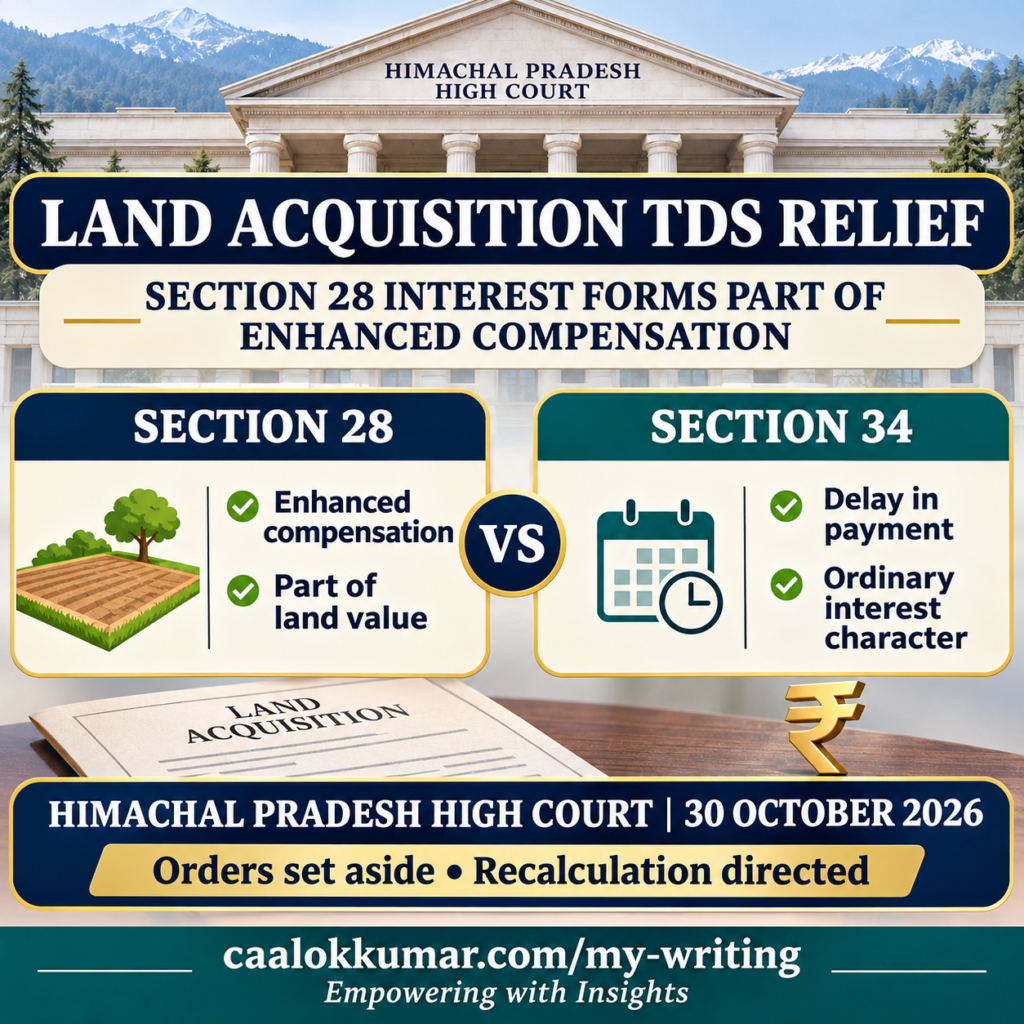
The Himachal Pradesh High Court has provided significant clarity on the treatment of Section 28 interest on land acquisition compensation. The Court held that interest awarded under Section 28 of the Land Acquisition Act, 1894 forms part of enhanced compensation and should not be mechanically treated as ordinary interest arising merely from delayed payment.
Following the Supreme Court decisions in Union of India v. Hari Singh and CIT v. Ghanshyam (HUF), the High Court set aside the impugned orders and remanded the matters to the District Judge, Chamba, for recalculation.
However, the judgment does not grant an automatic tax exemption or TDS refund to every landowner. The agricultural character of the acquired land, nature of the interest, applicable exemption and relevant Income-tax provisions must still be examined in each case.
Case at a Glance
| Particular | Details |
|---|---|
| Court | Himachal Pradesh High Court |
| Decision date | 30 October 2026 |
| Lead case | Bishamber v. General Manager, Ranjit Sagar (Thein Dam) Project and Others |
| Connected matters | CMPMO Nos. 397, 317, 319, 321, 512 and 513 of 2026 |
| Principal issue | TDS on enhanced land-acquisition compensation and Section 28 interest |
| Decision | Section 28 interest forms part of enhanced compensation; matters remanded for recalculation |
| Further direction | Parties directed to appear before the District Judge, Chamba, on 20 November 2026 |
The common question before the Court concerned deduction of income tax from enhanced compensation awarded under the Land Acquisition Act. The parties agreed that the dispute was covered by the Supreme Court decision in Union of India v. Hari Singh, (2018) 15 SCC 201.
What Is Interest Under Section 28
Section 28 of the Land Acquisition Act, 1894 empowers a court to award interest when it enhances the compensation originally determined by the Land Acquisition Collector.
Such interest is connected with the excess amount awarded by the court. It represents an accretion to the value of the compensation and is therefore different from interest payable merely because payment was delayed.
The Supreme Court in CIT v. Ghanshyam (HUF) explained that:
- Section 28 interest relates to the excess compensation awarded by the court.
- It forms part of the enhanced value of the acquired land.
- Section 34 interest is payable for delay after compensation has been determined.
The Himachal Pradesh High Court applied this distinction while remanding the matters for recalculation.
Section 28 and Section 34 Interest: Key Difference
| Basis | Section 28 interest | Section 34 interest |
|---|---|---|
| Reason for payment | Enhancement of compensation by court | Delay in paying determined compensation |
| Character | Part of enhanced compensation | Interest for delayed payment |
| Award | Discretionary | Statutory consequence of delayed payment |
| Tax analysis | Examined with the underlying compensation | Generally examined separately as interest |
| TDS treatment | Cannot be mechanically treated as ordinary interest | Ordinary interest provisions may apply |
This classification is important because the taxability and TDS consequences can change depending upon whether the amount is part of compensation or merely interest for delayed payment.
What the Supreme Court Held in Hari Singh
In Union of India v. Hari Singh, the Supreme Court considered cases where TDS had already been deducted from land-acquisition compensation and deposited with the Income Tax Department.
The Supreme Court held that landowners claiming that the acquired property was agricultural land should approach the jurisdictional Assessing Officer through the appropriate return and refund process.
The Assessing Officer must then:
- Determine whether the acquired property was agricultural land.
- Examine the nature of the compensation and Section 28 interest.
- Apply the principles laid down in Ghanshyam (HUF).
- Grant a refund where the compensation was not chargeable to tax.
Accordingly, a Land Acquisition Collector or executing court does not finally determine the landowner’s income-tax liability. That determination ordinarily rests with the Income Tax Department through the assessment or refund mechanism.
What the Himachal Pradesh High Court Decided
The High Court held that the impugned calculations could not be sustained without applying the distinction recognised in Hari Singh and Ghanshyam (HUF).
It therefore:
- Set aside the challenged orders.
- Remanded the matters to the District Judge, Chamba.
- Directed recalculation in accordance with the Supreme Court ruling.
- Required the parties to appear on 20 November 2026.
- Disposed of the connected miscellaneous applications.
The Court did not make a final assessment of the income-tax liability of each landowner. Any claim that the acquired land was agricultural land, or that deducted tax must be refunded, remains subject to verification by the Assessing Officer.
TDS on Compulsory Acquisition Under the Income-tax Law
For periods governed by the Income-tax Act, 1961, Section 194LA provided for TDS on compensation or enhanced compensation arising from compulsory acquisition of non-agricultural immovable property.
The principal conditions included:
- TDS at 10%.
- Application to compulsory acquisition of non-agricultural immovable property.
- No TDS where annual payments did not exceed Rs 5 lakh.
- No TDS on awards or agreements exempt under Section 96 of the Right to Fair Compensation and Transparency in Land Acquisition, Rehabilitation and Resettlement Act, 2013.
The corresponding provision under the Income-tax Act, 2025 is contained in Section 393. The official provision continues the 10% rate and Rs 5 lakh threshold for qualifying compensation relating to compulsory acquisition of non-agricultural immovable property.
This treatment must not be confused with TDS on the sale of property, which deals with a voluntary transfer between a buyer and seller. Compulsory acquisition is governed by a separate TDS framework.
Current Tax Treatment of Interest on Compensation
| Tax treatment | Income-tax Act, 1961 | Income-tax Act, 2025 |
|---|---|---|
| Income from other sources | Section 56(2)(viii) | Section 92(2)(i) |
| 50% statutory deduction | Section 57(iv) | Section 93(1)(f) |
| Taxable in year of receipt | Section 145B(1) | Section 278(1) |
The Income Tax Department’s published guidance states that interest on compensation is generally taxable in the year of receipt with a 50% deduction. It further clarifies that where the underlying compensation is exempt, the related interest may also be exempt.
Therefore, the proper conclusion is not that every payment described as Section 28 interest is automatically tax-free. Instead:
- Section 28 interest cannot be mechanically classified as ordinary delay interest.
- The nature and taxability of the underlying compensation must be examined.
- Agricultural-land and statutory exemptions must be verified.
- The applicable Act and tax year must be identified.
What Should a Landowner Do If TDS Has Already Been Deducted
1. Obtain the complete award. Collect the original award, enhancement order and calculation sheet separately showing compensation, solatium, additional amount, Section 28 interest and Section 34 interest.
2. Confirm the character of the land. Preserve revenue records, cultivation evidence, khasra details, land-use records and documents establishing whether the property qualified as agricultural land.
3. Reconcile TDS with Form 26AS and AIS. Verify the amount deducted, assessment year, deductor’s TAN and the component against which TDS was reported.
4. File the appropriate income-tax return. Report the receipt under the correct tax treatment and claim the available exemption or refund with supporting documents.
5. Respond to mismatches or demands. Where an incorrect tax treatment results in an outstanding demand or refund adjustment, a properly documented response to an income-tax demand notice may be required.
6. Seek rectification or appellate remedy where necessary. If the TDS credit, exemption or classification is not correctly allowed, consider rectification, appeal or other remedies depending upon the order involved.
Special Considerations for NRIs
An NRI landowner receiving acquisition compensation in India should separately examine taxability of the compensation, availability of exemption, credit or refund of TDS, deposit of funds in the appropriate NRO account and documentation required for remitting the net funds outside India.
Where compensation or refund proceeds are subsequently remitted abroad, Form 145 and Form 146 foreign-remittance compliance may require a separate taxability review and bank-documentation process.
Similarly, where the compensation materially changes the individual’s financial position, it may need to be properly supported while preparing a CA-certified net worth certificate for banking, immigration, investment or regulatory purposes.
Practical Significance of the Judgment
- The description interest is not conclusive for income-tax purposes.
- Section 28 and Section 34 interest have materially different legal characteristics.
- TDS cannot be applied without examining whether the acquired land was agricultural land or the award was otherwise exempt.
- Where TDS has already been deposited, the refund claim must generally be pursued before the Assessing Officer with supporting evidence.
Frequently Asked Questions
Is Section 28 interest always exempt from income tax?
No. The judgment recognises Section 28 interest as part of enhanced compensation, but final taxability depends on the nature of the acquired land, statutory exemptions, applicable tax year and relevant Income-tax provisions.
Can TDS be deducted from compensation for agricultural land?
Section 194LA of the Income-tax Act, 1961, and the corresponding compulsory-acquisition entry under Section 393 of the Income-tax Act, 2025 exclude agricultural land as defined for this purpose. Supporting land records must establish the exemption.
What is the difference between Section 28 and Section 34 interest?
Section 28 interest relates to enhanced compensation awarded by a court. Section 34 interest compensates for delay in paying compensation already determined.
How can a landowner claim a refund of TDS?
The landowner should file the appropriate return, disclose the compensation correctly, claim TDS credit and submit evidence proving the agricultural or otherwise exempt character of the acquisition. The Assessing Officer must examine the claim.
Does this judgment automatically cancel TDS in every land-acquisition case?
No. The High Court remanded the matters for recalculation. It did not grant a universal exemption or direct automatic refunds in every case.
Does Section 28 here refer to the 2013 Land Acquisition Act?
No. The judgment concerns Section 28 of the Land Acquisition Act, 1894. Section 28 of the 2013 Act deals with a different subject.
Conclusion
The Himachal Pradesh High Court ruling is an important reminder that Section 28 interest on land acquisition compensation forms part of enhanced compensation, unlike Section 34 interest payable merely for delayed payment.
At the same time, landowners should avoid treating the ruling as an automatic exemption. A successful TDS refund claim requires careful verification of the land’s character, acquisition law, award components, applicable tax provisions and supporting documentary record.
Legal and Official References
- Bishamber v. General Manager, Ranjit Sagar (Thein Dam) Project and connected matters, CMPMO Nos. 397, 317, 319, 321, 512 and 513 of 2026, Himachal Pradesh High Court, decided 30 October 2026, neutral citation 2026:HHC:47873.
- Union of India v. Hari Singh and Others, (2018) 15 SCC 201.
- CIT, Faridabad v. Ghanshyam (HUF), (2009) 8 SCC 412.
- Income Tax Department – Section 194LA
- Income Tax Department – Section 56
- Income Tax Department – Section 57
- Income Tax Department – Section 145B
- Income Tax Department – Section 393 of the Income-tax Act, 2025
Disclaimer
This article is intended for general informational purposes and does not constitute legal or tax advice. Taxability and TDS consequences depend on the acquisition law, nature of land, wording of the award, year of receipt and facts of each case. Professional advice should be obtained before filing a return, claiming a refund or responding to an income-tax proceeding.
Leave a Reply