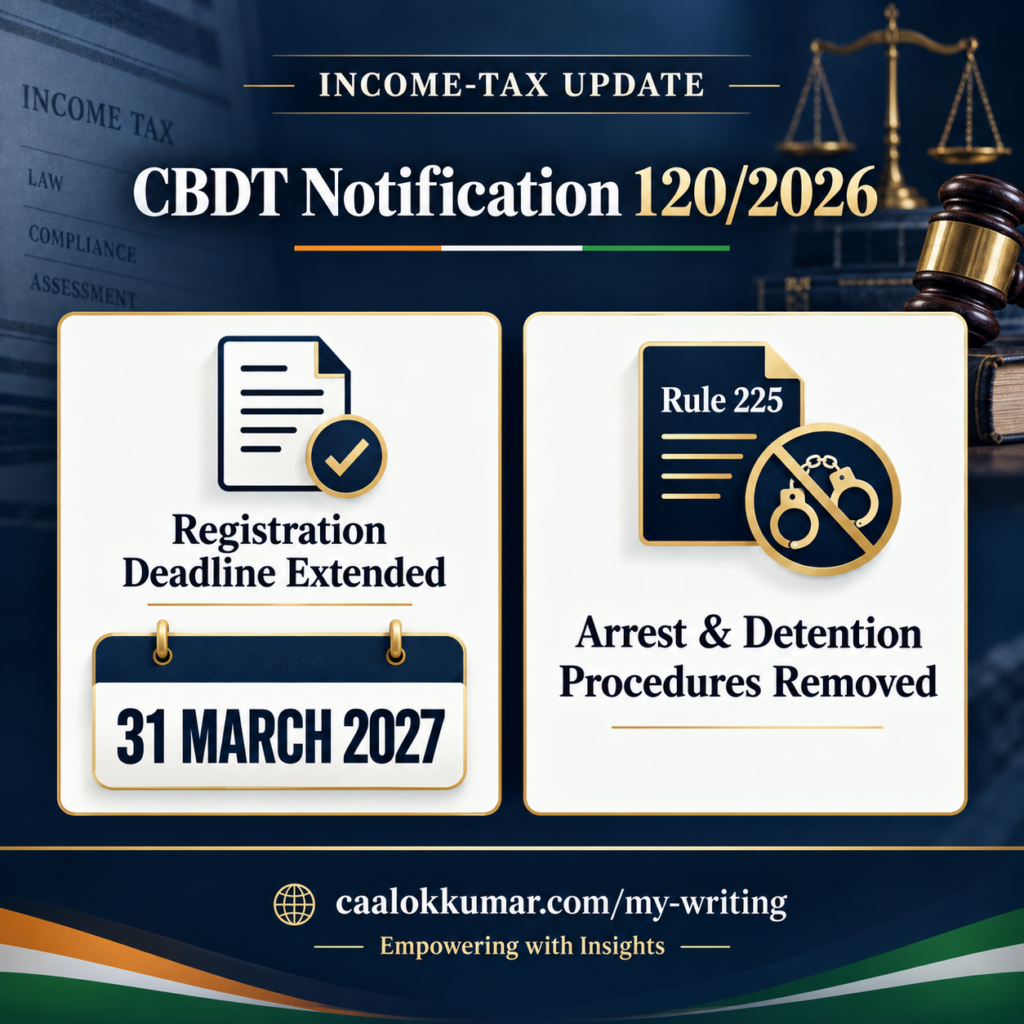
CBDT Notification 120/2026: Registration Deadline Extended to 31 March 2027
CBDT Notification 120/2026 has introduced important procedural changes under the Income-tax Rules, 2026. The notification extends the transitional registration deadline for eligible valuers and authorised income-tax practitioners from 30 September 2026 to 31 March 2027.
The notification also substitutes Form No. 169 and Form No. 171, expands the permitted mode of electronic communication under Rule 176 and removes specified arrest-and-detention procedures from Rule 225.
However, this is a limited amendment. It does not extend tax audit, income-tax return, TDS or other general compliance deadlines.
CBDT Notification 120/2026 at a Glance
| Particular | Details |
| Notification | Notification No. 120/2026 |
| Gazette number | G.S.R. 822(E) |
| Date of notification | 17 September 2026 |
| Name of amendment | Income-tax (Fourth Amendment) Rules, 2026 |
| Extended deadline | 31 March 2027 |
| Earlier deadline | 30 September 2026 |
| Relevant registration rules | Rules 246(4) and 256(4) |
| Revised forms | Form No. 169 and Form No. 171 |
| Other rules amended | Rules 160, 176 and 225 |
| Governing legislation | Income-tax Act, 2025 |
The amendment forms part of the wider transition from the Income-tax Act, 1961 to the Income-tax Act, 2025. Professionals should therefore read the revised rules together with the applicable transitional provisions.
What Has Changed Under CBDT Notification 120/2026?
The Income-tax (Fourth Amendment) Rules, 2026 make the following principal changes:
- The registration deadline under Rule 246(4) has been extended to 31 March 2027.
- The registration deadline under Rule 256(4) has also been extended to 31 March 2027.
- Form No. 169 for registration as a valuer has been replaced.
- Form No. 171 for registration as an authorised income-tax practitioner has been replaced.
- Rule 176 now permits authentication by electronic communication instead of restricting the provision to affixing a digital signature.
- Specified arrest-and-detention procedures have been removed from Rule 225.
- Certain technical references in Rules 160 and 225 have been corrected.
These changes affect professionals, departmental officers and compliance teams working under the Income-tax Act, 2025.
Registration Deadline Extended to 31 March 2027
Extension under Rule 246(4)
Rule 246 deals with the registration framework applicable to valuers. CBDT Notification 120/2026 replaces the earlier date of 30 September 2026 in Rule 246(4) with 31 March 2027.
Eligible valuers covered by this transitional provision therefore receive an additional six months to complete the prescribed registration process.
Extension under Rule 256(4)
A similar amendment has been made to Rule 256(4), which concerns the registration of authorised income-tax practitioners.
The applicable deadline under this sub-rule has also been shifted from 30 September 2026 to 31 March 2027.
The extension is not available for every tax compliance
The deadline extension is narrow and must not be treated as a general CBDT extension.
It applies only to the dates specifically prescribed under:
- Rule 246(4) for the relevant valuer registration;
- Rule 256(4) for the relevant authorised income-tax practitioner registration.
CBDT Notification 120/2026 does not amend the due date for:
- Tax audit reports;
- Income-tax returns;
- TDS or TCS statements;
- Advance tax;
- Form 145 or Form 146;
- Other statutory registrations or applications.
Taxpayers and professionals must continue to follow the independently applicable due dates for these compliances.
Revised Form No. 169 for Registration as a Valuer
Form No. 169 is the prescribed application for registration as a valuer under Section 514 of the Income-tax Act, 2025.
The substituted form seeks detailed information about the applicant, the proposed class of assets and the applicant’s professional eligibility.
Information required in Form No. 169
The revised Form No. 169 broadly requires:
- Full name of the applicant;
- Permanent Account Number;
- Complete address and contact details;
- Date of birth;
- Class of asset for which registration is sought;
- Educational qualifications;
- Previous employment details;
- Professional experience;
- Details of valuation work undertaken during the preceding three years;
- Existing registration under the Wealth-tax Act, 1957, if any;
- Disclosure of applicable disqualifications;
- Verification and professional declaration.
The applicant must also declare that valuations will be made impartially and that the applicant will not undertake the valuation of an asset in which the applicant has a direct or indirect interest.
Separate application for each asset class
A separate Form No. 169 must be filed for registration in each class of asset.
The prescribed asset classes include:
- Immovable property;
- Agricultural land;
- Specified plantations;
- Forests;
- Mines and quarries;
- Shares, securities and business assets;
- Plant and machinery;
- Jewellery;
- Works of art;
- Life interests and reversions;
- Other assets.
Professionals seeking registration for more than one asset class should therefore identify each eligible category and prepare separate applications.
Application fee for Form No. 169
Form No. 169 must ordinarily be accompanied by an application fee of ₹10,000.
No fee is required where the applicant is already registered as a valuer under the Wealth-tax Act, 1957 and falls within the stated exception.
Applicants claiming the exemption should keep a valid registration certificate ready for submission.
Revised Form No. 171 for Authorised Income-tax Practitioners
Form No. 171 is the application for registration as an authorised income-tax practitioner under Section 515 of the Income-tax Act, 2025.
The revised form seeks comprehensive personal and professional information from the applicant.
Important details required in Form No. 171
The substituted Form No. 171 requires information such as:
- Full name;
- Gender;
- PAN;
- Father’s or husband’s name, as applicable;
- Permanent and present residential addresses;
- Mobile number and email address;
- Principal place of profession in India;
- Details of partnership in any professional firm;
- Educational qualifications;
- Existing registration under the Income-tax Act, 1961;
- Other eligibility information;
- Details of statutory disqualification, if any.
The applicant must certify that he or she has been practising before income-tax authorities for at least one year and has not submitted another application for registration under the Income-tax Act, 2025 to a different authority.
Professionals should verify the revised form carefully instead of reusing an earlier draft or checklist.
Rule 176: Electronic Communication Replaces Narrow Digital-Signature Wording
CBDT Notification 120/2026 changes the language used in Rule 176(3)(a)(ii).
The earlier reference to authentication “by affixing digital signature” has been replaced with the broader expression “by way of an electronic communication.”
This is operationally significant because electronic communication is wider than one particular method of digital signing. It gives the procedural framework greater flexibility for electronic delivery and authentication.
Tax departments, professional firms and businesses should update their internal standard operating procedures wherever they reproduce the earlier wording.
The change also reflects the wider digital transition visible in areas such as the new forms introduced under the Income-tax Act, 2025.
Rule 225: What Has Changed in the Recovery Procedure?
Rule 225 deals with tax-recovery procedure. The Fourth Amendment Rules make several textual and structural changes to this rule.
CBDT Notification 120/2026:
- Omits clause (c) of sub-rule (4);
- Revises the language of sub-rule (19);
- Corrects a cross-reference in sub-rule (56);
- Omits sub-rules (75) to (83);
- Omits sub-rule (91);
- Removes the expression “except arrest and detention” from sub-rule (87).
The omitted sub-rules contained procedures associated with arrest and detention in the recovery framework.
Does this mean all arrest powers under income-tax law are abolished?
No such broad conclusion should be drawn from the notification alone.
The technically accurate position is that CBDT has removed specified arrest-and-detention procedures and related language from Rule 225. The notification itself does not declare that every statutory arrest power, recovery consequence or power available under another law has been abolished.
Any case involving coercive recovery should be examined with reference to:
- The amended Rule 225;
- The relevant provisions of the Income-tax Act, 2025;
- Other applicable recovery provisions;
- Transitional provisions;
- The facts and stage of the proceedings.
The amendment is therefore important, but the headline “arrest provisions removed” should be understood in the limited context of the specified Rule 225 procedures.
Technical Correction in Rule 160
The amendment also makes a limited drafting correction in Rule 160.
In sub-rules (3) and (4), an incorrect clause reference written as “(i)” has been replaced with “(a).”
Although this is primarily a technical correction, professionals maintaining rule-wise compliance notes should update their working copies to avoid quoting the earlier reference.
Effective Dates of the Fourth Amendment Rules
The different amendments do not all operate from the same date.
Amendments effective retrospectively from 1 April 2026
Rules 2 to 4 of the Fourth Amendment Rules are deemed to have come into force on 1 April 2026.
These cover the amendments to:
- Rule 160;
- Rule 176;
- Rule 225.
Accordingly, the corrections and procedural changes in these rules operate from the commencement of the Income-tax Rules, 2026.
Amendments effective from 17 September 2026
Rules 5 to 8 came into force on the date of publication in the Official Gazette, namely 17 September 2026.
These include:
- Extension under Rule 246(4);
- Extension under Rule 256(4);
- Substitution of Form No. 169;
- Substitution of Form No. 171.
Applications made after the notification should therefore be prepared using the substituted forms.
Who Is Affected by CBDT Notification 120/2026 ?
The notification is particularly relevant for:
- Valuers applying under Section 514;
- Authorised income-tax practitioners applying under Section 515;
- Professionals already registered under the Wealth-tax Act;
- Practitioners previously registered under the Income-tax Act, 1961;
- Chartered accountants and tax consultants assisting applicants;
- Departmental officers processing registrations;
- Businesses updating income-tax compliance systems;
- Legal and tax teams handling recovery proceedings.
Taxpayers facing assessment or recovery proceedings should also ensure that professional advice is based on the amended rules and current CBDT scrutiny and assessment guidelines.
Practical Action Points for Valuers and Tax Practitioners
1. Confirm whether Rule 246(4) or Rule 256(4) applies
The extension is linked to specific sub-rules. Applicants should first confirm whether their registration falls within the relevant transitional provision.
2. Use the substituted form
Valuers should use the revised Form No. 169, while eligible authorised income-tax practitioners should use the revised Form No. 171.
Using an old version may result in missing information, processing difficulties or a request for correction.
3. Collect supporting documents early
Applicants should prepare:
- PAN and identity details;
- Complete address particulars;
- Educational and professional certificates;
- Existing registration certificates;
- Experience documents;
- Details of professional practice;
- Information concerning any disqualification;
- Asset-class-specific documents for valuers.
4. Do not wait until 31 March 2027
Although the deadline has been extended, filing should not be postponed unnecessarily. Delayed filing can create practical problems if the portal, document upload or verification process requires correction.
5. Update office checklists and templates
Professional firms should revise:
- Registration checklists;
- Application templates;
- Client communications;
- Internal due-date calendars;
- Recovery-procedure notes;
- References to digital signatures;
- Form libraries and document masters.
6. Preserve acknowledgement and supporting records
A complete copy of the application, attachments, payment evidence and electronic acknowledgement should be retained.
Frequently Asked Questions
What is CBDT Notification 120/2026?
CBDT Notification 120/2026 notified the Income-tax (Fourth Amendment) Rules, 2026. It extends specified registration deadlines, substitutes Forms 169 and 171 and amends Rules 160, 176 and 225.
What is the new registration deadline?
The applicable deadline under Rules 246(4) and 256(4) has been extended from 30 September 2026 to 31 March 2027.
Does the extension apply to all valuers and tax professionals?
Not automatically. The extension applies to applicants covered by the specific transitional provisions in Rules 246(4) and 256(4). Eligibility should be checked before relying on the extended date.
Has the tax audit deadline also been extended?
No. CBDT Notification 120/2026 does not amend any tax audit deadline. It also does not provide a blanket extension for income-tax returns, TDS statements or other compliances.
What is Form No. 169?
Form No. 169 is the application for registration as a valuer under Section 514 of the Income-tax Act, 2025.
What is the application fee for Form No. 169?
The prescribed fee is ₹10,000. The fee is not required in the stated case of a valuer already registered under the Wealth-tax Act, 1957.
What is Form No. 171?
Form No. 171 is the application for registration as an authorised income-tax practitioner under Section 515 of the Income-tax Act, 2025.
Have arrest provisions been completely abolished?
CBDT has removed specified arrest-and-detention procedures and related language from Rule 225. It would be inaccurate to conclude from this notification alone that every arrest or coercive recovery power under all applicable laws has been abolished.
From which date are the amendments effective?
The amendments to Rules 160, 176 and 225 are deemed effective from 1 April 2026. The deadline extensions and substituted Forms 169 and 171 became effective on 17 September 2026.
Conclusion
CBDT Notification 120/2026 provides meaningful transitional relief to eligible valuers and authorised income-tax practitioners by extending the specified registration deadline to 31 March 2027.
At the same time, the Income-tax Fourth Amendment Rules, 2026 introduce important procedural changes concerning electronic communication, recovery proceedings and professional registration forms.
Affected professionals should determine their eligibility, use the substituted forms, update internal compliance systems and file their applications well before the revised deadline.
For case-specific assistance with registration, income-tax compliance or recovery proceedings, taxpayers and professionals may schedule a consultation with CA Alok Kumar.
Disclaimer: This article is intended for general information and professional awareness. The applicability of a rule, form or deadline depends on the facts of each case. Professional advice should be obtained before taking or postponing any statutory action.
Erstwhile Form 15CA / 15CB • Section 397(3)(d) • Rule 220 • TCS Budget 2026 Updated – Under the Income Tax Act 2025 (effective 1 April 2026), Form 15CA and 15CB have been replaced by Form 145 and Form 146. Whether you’re sending money abroad for education, medical treatment, property purchase, investment, or an NRI repatriating funds from your NRO account — CA Alok Kumar provides Form 145/146 filing in India, TCS advisory (Budget 2026 rates — 2% on education & medical), DTAA benefit optimization, Section 393 TDS compliance, and end-to-end support. Form 145 & 146 — CA Certificate for Foreign Remittance – https://caalokkumar.com/form-145-146-ca-certificate-foreign-remittance.html
Leave a Reply