CBDT Complete Scrutiny Guidelines FY 2026-27: Key Rules, Section 143(2) Notice and Taxpayer Action Plan
The Central Board of Direct Taxes has issued guidelines for compulsory selection of income tax returns for complete scrutiny during Financial Year 2026-27. These guidelines are important for taxpayers, professionals, businesses, charitable institutions, trusts, NRIs, companies, firms and individuals whose returns may fall under specific risk-based or information-based parameters.
Complete scrutiny is different from routine processing of Income Tax Return. In complete scrutiny assessment, the Income Tax Department examines the return in detail to verify the correctness of income, deductions, exemptions, losses, credits, tax liability and other disclosures. Therefore, taxpayers should ensure that their Income Tax Return is accurate, properly supported by documents and consistent with Form 26AS, AIS, TIS, books of accounts, GST data, TDS statements, bank statements and financial records.
Taxpayers who need professional support for ITR filing, ITR Filing in Dwarka Delhi, ITR Filing in Rajendra Place, ITR Filing near Karol Bagh or income tax notice response should review their records carefully before responding to any scrutiny notice.
Legal Background: Why These Guidelines Matter in 2026
The Income-tax Act, 2025 has come into force from 1 April 2026. However, section 536 of the Income-tax Act, 2025 contains transitional provisions for proceedings relating to earlier tax years. Therefore, assessment, reassessment, penalty, rectification, appeal and other proceedings relating to tax years beginning before 1 April 2026 may continue under the Income-tax Act, 1961, wherever applicable.
The CBDT guidelines for complete scrutiny during FY 2026-27 have been issued in this transitional legal framework. The notice for scrutiny assessment is generally served under section 143(2) of the Income-tax Act, 1961. For returns filed during FY 2025-26, the guideline mentions 30 June 2026 as the time limit for service of notice under section 143(2).
This makes it essential for taxpayers to regularly check their registered e-filing account, email and SMS alerts from the Income Tax Department.
CBDT Complete Scrutiny Guidelines for FY 2026-27: What Taxpayers Should Know
What is Complete Scrutiny Assessment?
Complete scrutiny assessment means a detailed verification of the entire return or material issues connected with the return. The Assessing Officer or the prescribed authority may examine:
- income disclosed under all heads;
- deductions, exemptions and claims made in the return;
- tax credits, TDS and TCS;
- capital gains and related exemptions;
- business income, expenses and audit report details;
- cash deposits, high-value transactions and investments;
- foreign assets, foreign income and NRI tax matters;
- trust or institution exemption claims;
- additions made in earlier years on recurring issues;
- information received from investigation, enforcement, intelligence or regulatory agencies.
A taxpayer selected for complete scrutiny should not treat the notice casually. Proper reconciliation, explanation and documentary evidence are critical.
CBDT Parameters for Compulsory Selection under Complete Scrutiny
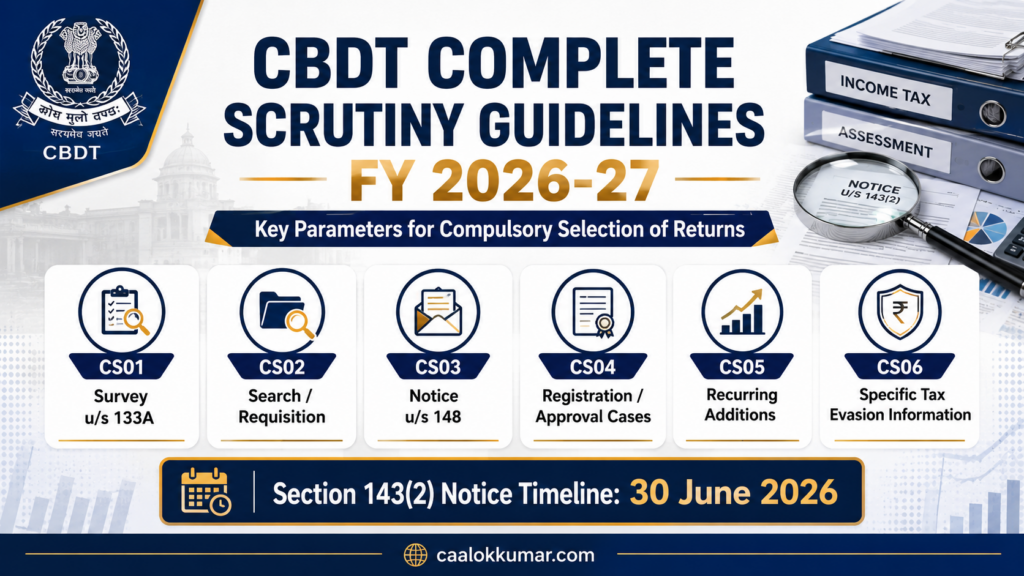
The guidelines prescribe six major parameters, commonly identified as CS01 to CS06.
CS01: Cases Related to Survey under Section 133A
Cases where survey under section 133A or 133A(2A) has been conducted on or after 1 April 2024 may be selected for compulsory scrutiny.
Such cases are selected based on information provided by the investigation wing and processed through the Directorate of Income Tax Systems, with necessary approval. Notice under section 143(2) may be served through the prescribed income tax authority or Assessing Officer.
Taxpayers covered under survey proceedings should maintain proper records, books of accounts, stock records, cash details, statements recorded during survey, reconciliation of impounded material and explanation of discrepancies, if any.
CS02: Search and Requisition Cases
Cases where search under section 132 or requisition under section 132A has been initiated or made on or after 1 April 2024 may be selected for complete scrutiny.
For searches or requisitions initiated on or after 1 September 2024, the return is to be selected for the relevant assessment year covered under section 158BA(6), wherever applicable.
In search and requisition matters, the taxpayer should carefully reconcile seized material, digital records, books of accounts, unexplained assets, cash, jewellery, investments and statements recorded during proceedings.
CS03: Cases Where Notice under Section 148 Has Been Issued
Reassessment cases where notice under section 148 has been issued may also be selected for complete scrutiny.
This category includes two broad situations:
First, cases where search and seizure action was initiated on or after 1 April 2021 but before 1 September 2024, or survey action was conducted on or after 1 April 2021.
Second, cases other than search, seizure or survey where notice under section 148 has been issued and the proceedings are required to be completed on or before 31 March 2027.
In such matters, the Jurisdictional Assessing Officer may be required to upload the underlying documents on the basis of which notice under section 148 was issued. In non-search and non-survey reassessment cases, the Directorate of Income Tax Systems may forward the cases to the National Faceless Assessment Centre, and notice under section 143(2) may be served through NaFAC where the return has been furnished.
Taxpayers who have received reassessment notices should take professional help for income tax notice response and income tax litigation support, especially where the matter involves unexplained deposits, property transactions, capital gains, high-value investments or mismatch in AIS/TIS.
CS04: Trusts, Institutions and Registration/Approval Related Cases
Cases relating to registration or approval under sections such as 12A, 12AB, 35(1)(ii), 35(1)(iia), 35(1)(iii), 10(23C)(iv), 10(23C)(v), 10(23C)(vi), 10(23C)(via) and similar provisions may be selected for complete scrutiny.
This applies where registration or approval has not been granted, or has been cancelled or withdrawn by the competent authority on or before 31 March 2025, and the assessee is still claiming exemption or deduction in ITR-7.
However, where the order of withdrawal, cancellation or rejection has been reversed or set aside in appellate proceedings, the case should not be selected under this parameter.
Charitable trusts, educational institutions, hospitals, religious institutions, scientific research institutions and other exempt entities should ensure that their registration status, Form 10B/10BB, donation records, application of income, accumulation, corpus funds and ITR-7 reporting are properly maintained.
CS05: Recurring Additions in Earlier Assessment Years
Cases may be selected for complete scrutiny where an addition was made in an earlier assessment year on a recurring issue of law, fact, or mixed question of law and fact.
The monetary threshold is:
- more than ₹50 lakh in eight metro charges: Ahmedabad, Bengaluru, Chennai, Delhi, Hyderabad, Kolkata, Mumbai and Pune;
- more than ₹20 lakh in other charges.
The earlier addition should either have become final because no further appeal was filed, or should have been upheld by appellate authorities in favour of the Revenue, even if further appeal of the assessee is pending.
This category may include recurring disallowances, unexplained credits, bogus purchases, business expense disallowances, capital gains disputes, transfer pricing issues and other recurring tax positions.
Taxpayers facing recurring disputes should maintain a year-wise assessment history, appeal status, evidence file, legal submissions and supporting judicial precedents.
CS06: Cases Based on Specific Information Regarding Tax Evasion
Cases may be selected where specific information pointing out tax evasion is provided by any law-enforcement agency, investigation wing, intelligence authority, regulatory authority or similar agency, and the return for the relevant assessment year has been furnished by the assessee.
However, the guideline clarifies that where a return has been furnished in response to notice under section 142(1), and such notice was issued only because of information contained in NMS Cycle, AIS statement, SFT information or CPC-TDS information from the Directorate of I&CI, such return will not automatically be taken up for compulsory scrutiny unless it independently falls under CS06.
This distinction is important. Every AIS/SFT mismatch may not automatically mean complete scrutiny, but where there is specific tax evasion information from an authorised agency, the risk of complete scrutiny becomes significant.
Role of NaFAC, JAO and Central Charges
The guideline also explains the procedural role of different authorities.
The National Faceless Assessment Centre may serve notice under section 143(2) in many cases. The Jurisdictional Assessing Officer may be required to upload the underlying documents or specific information on the basis of which the case has been selected. In International Taxation and Central Charges cases, selection may be handled by the respective charges with prior administrative approval, and communication to NaFAC for access or further action may not apply in the same manner.
This shows that even in the faceless assessment framework, proper documentary support and timely online compliance remain very important.
Time Limit for Section 143(2) Notice
For returns filed during FY 2025-26, the CBDT guideline mentions 30 June 2026 as the time limit for service of notice under section 143(2).
Taxpayers should carefully check whether the notice has been validly served within the prescribed limitation period. The date of service, DIN, section mentioned in the notice, assessment year, response deadline and portal availability should be verified immediately.
What Should Taxpayers Do After Receiving Complete Scrutiny Notice?
A taxpayer receiving notice under section 143(2) should follow a systematic approach:
- Download the notice from the income tax e-filing portal and verify DIN.
- Check assessment year, section, issue date, service date and response deadline.
- Identify whether the case falls under CS01, CS02, CS03, CS04, CS05 or CS06.
- Reconcile ITR with Form 26AS, AIS, TIS, bank statements, books of accounts and GST data.
- Prepare a structured reply with supporting documents.
- Avoid incomplete, casual or contradictory submissions.
- Maintain a document index and submit only relevant evidence.
- Track every submission acknowledgement on the income tax portal.
- Take professional advice in search, survey, reassessment, trust registration, high-value addition or tax evasion information cases.
For proper compliance, taxpayers may seek assistance from a qualified tax consultant in Dwarka, tax consultant in Rajendra Place, ITR filing consultant near Karol Bagh or professional team experienced in income tax scrutiny notice response.
Common Mistakes Taxpayers Should Avoid
Taxpayers should avoid these common mistakes during complete scrutiny:
- ignoring notice received on the income tax portal;
- filing reply without proper reconciliation;
- giving explanations not supported by documents;
- submitting excessive irrelevant documents;
- mismatch between books of accounts, GST returns and ITR;
- not explaining cash deposits, loans, gifts or capital introduction properly;
- claiming exemptions without legal eligibility;
- ignoring earlier assessment history in recurring addition cases;
- missing response deadlines in faceless assessment proceedings.
Why Proper ITR Filing Reduces Scrutiny Risk
A correctly prepared ITR is the first line of defence. Many scrutiny and reassessment issues arise due to mismatch in income reporting, wrong ITR form, missing capital gains details, incorrect TDS claim, non-reporting of foreign assets, incomplete business disclosure or incorrect exemption claim.
Therefore, professional ITR filing, ITR Filing in Dwarka Delhi, ITR Filing in Rajendra Place, ITR Filing near Karol Baghand income tax advisory can help taxpayers file accurate returns and respond effectively if selected for scrutiny.
Taxpayers with investments, capital gains, foreign remittances, NRI income, high-value transactions or significant wealth should also review their broader tax and financial planning. For personal finance review, investors may use the Wealth Score Calculator and explore disciplined investment planning through mutual fund investment advisory, subject to proper tax reporting.
FAQs on CBDT Complete Scrutiny Guidelines FY 2026-27
1. What is complete scrutiny in income tax?
Complete scrutiny is a detailed assessment where the Income Tax Department examines the return, income, deductions, exemptions, tax credits, books of accounts and supporting documents to verify correctness of the return.
2. What is notice under section 143(2)?
Notice under section 143(2) is issued when the return is selected for scrutiny assessment. It gives the taxpayer an opportunity to support the return filed and explain the claims made therein.
3. What is the time limit for section 143(2) notice for returns filed in FY 2025-26?
As per the CBDT guideline for FY 2026-27, the time limit for service of notice under section 143(2) for returns filed during FY 2025-26 is 30 June 2026.
4. Does AIS or SFT mismatch always lead to complete scrutiny?
No. The guideline clarifies that returns furnished in response to notice under section 142(1) based only on NMS/AIS/SFT/CPC-TDS information will not automatically be selected for compulsory scrutiny unless the case falls under specific tax evasion information under CS06.
5. Can charitable trusts be selected for complete scrutiny?
Yes. Trusts and institutions claiming exemption in ITR-7 may be selected where registration or approval has been refused, cancelled or withdrawn, subject to conditions mentioned in the guideline.
6. What should I do if I receive an income tax scrutiny notice?
You should verify the notice, check limitation, identify the scrutiny parameter, reconcile all records and file a clear reply with supporting documents. In complex matters, professional assistance is advisable.
Conclusion
The CBDT Complete Scrutiny Guidelines for FY 2026-27 show that the Income Tax Department is focusing on search, survey, reassessment, registration/approval disputes, recurring additions and specific tax evasion information. The process is increasingly data-driven, document-based and faceless.
Taxpayers should not wait until a scrutiny notice is received. Accurate ITR filing, proper documentation, AIS/TIS reconciliation, correct tax reporting and timely professional response are essential for smooth compliance.
For assistance in ITR filing in Dwarka, ITR Filing in Rajendra Place, ITR Filing near Karol Bagh, income tax scrutiny notice response and income tax litigation, taxpayers may consult CA Alok Kumar, Chartered Accountant, for professional guidance and legally sound compliance support.
Official References
- CBDT Guidelines for Compulsory Selection of Returns for Complete Scrutiny during FY 2026-27, F.No.225/56/2026/ITA-II dated 04.06.2026.
- Income Tax Department – Assessment.
- Income Tax Department – Limitation Periods.
- Income-tax Act, 2025 – Section 536.
- Income Tax Department – Faceless Scheme.
Disclaimer: This article is for general information and professional awareness. Taxpayers should seek case-specific advice before responding to any notice or assessment proceeding.
Leave a Reply