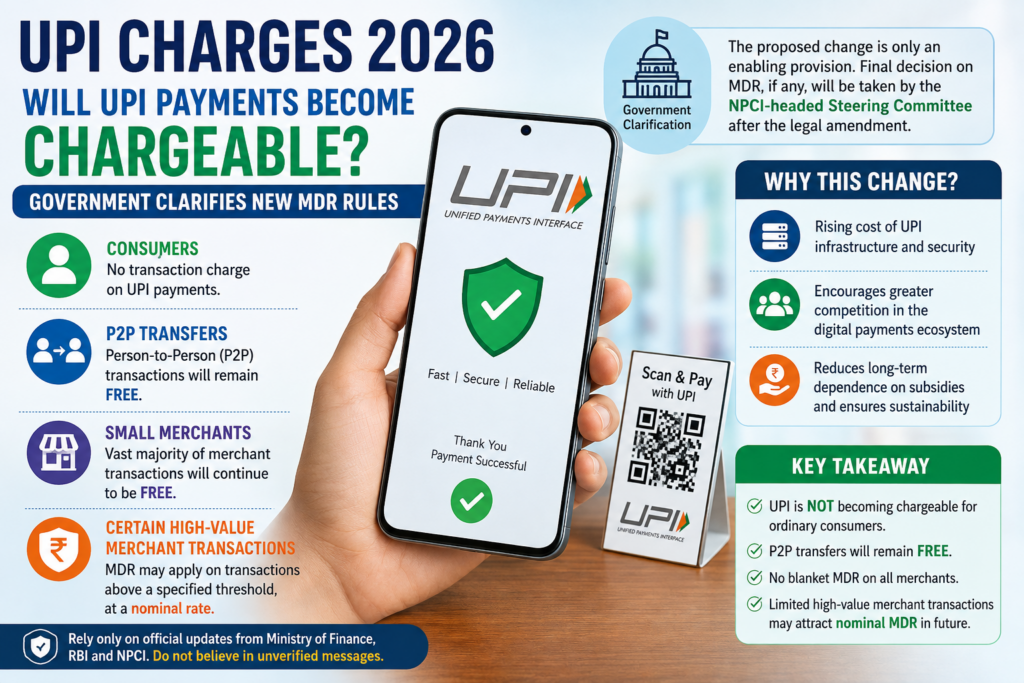
Update on UPI Charges – Will UPI Payments Become Chargeable? Government Clarifies New MDR Rules for Consumers and Merchants
Will Google Pay, PhonePe, Paytm, BHIM or other UPI payments soon start attracting transaction charges?
Following discussion around a proposed amendment to India’s payment law, concerns emerged that the era of completely free UPI transactions could be coming to an end.
The Ministry of Finance has now issued an important clarification dated 8 August 2026.
The answer for ordinary consumers is straightforward:
No transaction charge is proposed on consumers making UPI payments.
Person-to-Person or P2P UPI transfers will also continue to remain free.
However, the position for merchants may eventually become slightly different.
The Government has indicated that if Merchant Discount Rate or MDR is introduced in future, it could apply only to a limited category of merchant transactions above a specified threshold, and at a nominal rate.
Therefore, the important distinction is:
UPI is not becoming chargeable for ordinary consumers. The proposed change relates primarily to the possible future economics of certain merchant transactions.
The clarification was issued by the Ministry of Finance through the Press Information Bureau on 8 August 2026.
What Exactly Has the Government Clarified?
The Government has specifically stated the following:
| Type of UPI Transaction | Proposed Position |
| Consumer making UPI payment | No transaction charge |
| Person-to-Person (P2P) transfer | Free |
| Small/everyday merchant transactions | Vast majority expected to remain free |
| Certain merchant transactions above prescribed threshold | MDR may potentially apply |
| Rate of future MDR | Expected to be nominal |
| Blanket MDR on all merchants | Not proposed |
Therefore, headlines suggesting that all UPI transactions will now become chargeable would not correctly reflect the Government’s clarification.
The Ministry has expressly stated that even if MDR is introduced, the vast majority of merchant transactions are intended to remain free, and the levy would be threshold-based rather than a blanket charge.
What Is MDR on UPI?
MDR — Merchant Discount Rate — is a charge associated with processing a digital payment received by a merchant.
Traditionally, merchants accepting card payments may incur MDR or similar payment-processing costs.
UPI has followed a substantially different model.
Since 1 January 2020, MDR has not been charged on prescribed UPI and RuPay debit-card transactions under the existing statutory framework.
Parliamentary material relating to India’s digital-payment ecosystem also records that MDR was earlier reimbursed by the Government for specified transactions and that, from 1 January 2020, UPI and RuPay debit cards continued under the zero-MDR framework.
This zero-MDR approach played an important role in encouraging merchants—from major businesses to neighbourhood shops—to accept QR-code payments.
Is the Government Introducing MDR on Every UPI Payment?
No.
This is perhaps the most important part of the entire development.
The Government has not announced a blanket MDR on UPI transactions.
Instead, the proposed framework would enable an MDR to be considered for a limited set of merchant transactions exceeding a specified threshold.
That means a future framework could theoretically distinguish between, for example:
- ordinary low-value merchant transactions; and
- comparatively higher-value commercial transactions.
The actual transaction threshold and applicable MDR rate have not been specified in the PIB clarification.
Therefore, it would be premature to state that a particular transaction value—₹2,000, ₹5,000, ₹10,000 or any other amount—will definitely attract MDR.
The final position will depend upon the legal amendment and subsequent framework prescribed by the competent authorities.
What Is Changing in the Payment and Settlement Systems Act?
The proposed change relates to section 10A of the Payment and Settlement Systems Act, 2007.
According to the Ministry of Finance, the Taxation and Other Laws (Amendment) Bill, 2026 proposes to amend section 10A of the PSS Act.
The Government describes the amendment as an enabling provision.
That distinction matters.
An enabling provision does not itself mean that every UPI transaction automatically becomes chargeable from the day the law is amended.
According to the PIB clarification, after Parliament passes the proposed legislation, the “UPI and Services Steering Committee” headed by NPCI would decide on MDR, if any.
Therefore, there are effectively two separate stages:
Stage 1 – Legislative change
The statutory restriction needs to be modified so that an appropriate MDR framework can legally be considered.
Stage 2 – Operational decision
The relevant committee would subsequently determine whether MDR should actually be introduced and, if so, for which merchant transactions, threshold and rate.
This is an important difference between allowing the possibility of MDR and actually levying MDR.
Will Customers Be Charged for Paying a Shop Through UPI?
According to the Government’s current clarification:
No.
Consumers making UPI payments will not face transaction charges.
Therefore, if a consumer scans a merchant’s QR code and makes a payment, the Government’s stated policy is that the consumer should continue to make the payment without a UPI transaction fee.
If MDR is eventually introduced for a specified merchant category, it would be part of the merchant-side payment ecosystem rather than a direct UPI usage charge levied on the consumer under the announced framework.
Will Sending Money to Friends or Family Become Chargeable?
Again, no.
The Ministry of Finance has specifically clarified that all Person-to-Person (P2P) transactions will continue to remain free.
Examples include:
- sending money to a family member;
- transferring money to a friend;
- sharing expenses;
- making a personal transfer between individuals.
Thus, the proposed MDR discussion should not be confused with ordinary P2P UPI transfers.
What About Small Merchants and Local Shops?
The Government’s statement is particularly relevant to small businesses.
It says that the vast majority of merchant transactions will remain free, and any future MDR would apply only to a limited category of merchant transactions beyond a prescribed threshold.
This suggests that the framework is intended to protect routine and relatively small-value digital transactions from payment-processing costs.
However, merchants should wait for the final notification/framework before assuming whether they fall inside or outside any future threshold.
Businesses should also remember that the payment mechanism does not determine the taxability of the underlying transaction.
A sale received through UPI remains part of the merchant’s business receipts and should be appropriately recorded in books of account and reconciled with applicable income-tax return filing, GST and accounting records.
The question of MDR is therefore separate from the tax treatment of the underlying sale.
Why Does the Government Want the Power to Introduce MDR?
The Ministry has given three principal reasons.
1. Rising Cost of UPI Infrastructure
UPI transaction volumes have expanded substantially.
That requires continuous investment in:
- technology infrastructure;
- cybersecurity;
- system capacity;
- fraud prevention;
- reliability; and
- risk management.
The Government’s argument is that a payment system operating at such enormous scale requires a sustainable source of investment.
2. Greater Competition
A viable payment ecosystem also requires banks, payment-service providers and technology companies to continue investing in the network.
According to the Government, a sustainable economic model can encourage more participants and competition in digital payments.
3. Reducing Long-Term Dependence on Subsidies
The Government has historically supported the UPI ecosystem through incentive schemes.
Its current position is that reliance exclusively on subsidies may not be sufficient to support the next stage of UPI’s growth.
The proposed framework therefore seeks a balance between:
keeping UPI affordable and inclusive
and
making the ecosystem economically sustainable.
How Big Has UPI Become?
The scale explains why the debate over its funding model is important.
According to the Ministry of Finance, UPI processed approximately:
2,366 crore transactions in July 2026 alone
with a total value of approximately:
₹29.9 lakh crore.
The Government also states that UPI is currently live in 11 foreign countries, with additional countries expressing interest.
NPCI describes UPI as an instant payment system developed by the National Payments Corporation of India, an RBI-regulated entity.
The issue is therefore no longer simply whether QR-code payments should remain inexpensive.
The larger policy question is how India can maintain a payment infrastructure processing billions of transactions while continuing to invest in security, innovation and reliability.
Present Position vs Possible Future Position
This distinction will help taxpayers and businesses understand the development correctly.
| Issue | Position Now / Government Clarification |
| UPI charge on consumer | No |
| P2P UPI charge | No |
| Blanket MDR on merchants | No |
| MDR already applicable on all UPI merchant transactions | No |
| Future MDR legally possible | Proposed |
| MDR on limited high-value merchant transactions | May be introduced |
| Threshold announced | Not yet specified in PIB clarification |
| MDR rate announced | Not yet specified |
| Consumer transaction fee proposed | No |
This is why the development should be viewed as a change in the regulatory framework, rather than an announcement that every UPI payment will immediately become chargeable.
An Illustration
Suppose three transactions take place:
Transaction 1
Rahul sends ₹15,000 to his brother through UPI.
This is a P2P transaction.
Under the Government’s stated position, it continues to remain free.
Transaction 2
A customer pays ₹800 through UPI at a neighbourhood grocery store.
The Government says the vast majority of merchant transactions will continue to remain free.
Therefore, the proposed framework is intended to protect routine payments of this nature, subject of course to the final threshold/rules.
Transaction 3
A customer makes a substantial UPI payment to a large commercial establishment.
If a future MDR framework specifies a threshold and the transaction falls within the prescribed category, an MDR could potentially apply to the merchant.
However, the customer is still not proposed to be charged for making the UPI payment.
This illustration is only to explain the proposed policy structure. The actual threshold, merchant categories and MDR rates will depend upon the final regulatory framework.
Could Merchants Pass MDR Cost to Customers?
This will require careful attention once the final MDR framework is notified.
The Government’s present announcement states that consumers will not face transaction charges for making UPI payments.
Whether and how merchants account commercially for their own payment-processing expenses is a different matter and may depend upon the final regulatory terms, applicable consumer-protection requirements and contractual arrangements.
Accordingly, businesses should not presently begin adding an arbitrary “UPI charge” to customers merely because an enabling amendment has been proposed.
The actual rules should first be notified.
Accounting and Tax Treatment of MDR for Businesses
Although the final MDR framework is not yet available, if MDR is eventually charged to eligible merchants, businesses will need to account for it appropriately.
For example, if:
Gross customer payment: ₹1,00,000
MDR/payment processing deduction: ₹100
Net settlement by payment provider: ₹99,900
the business should ordinarily not treat ₹99,900 as the gross turnover merely because that is the amount received in the bank.
The gross sale/receipt remains relevant for accounting and taxation, while the payment-processing charge would ordinarily be separately accounted for as an expense, subject to the applicable tax and accounting treatment.
This distinction is important because digital settlement deductions can otherwise create discrepancies between:
- sales recorded in books;
- bank credits;
- GST turnover;
- income-tax turnover; and
- payment-gateway/UPI settlement reports.
Businesses should therefore ensure proper reconciliation as part of their accounting and tax-compliance process.
Does MDR Mean GST Will Be Charged on the UPI Payment?
These are two separate issues.
The underlying sale of goods or services may attract GST according to the applicable provisions and rates.
MDR, on the other hand, relates to the payment-processing ecosystem.
Therefore:
UPI payment ≠ separate tax on the consumer merely because digital payment is used.
Any GST implications associated with payment-processing services would need to be examined separately under the applicable GST provisions.
Merchants should therefore avoid mixing the concepts of GST on the underlying supply, payment-processing charges, and UPI MDR.
What Should Consumers Do?
For consumers, practically nothing changes at present.
You can continue using UPI for:
- merchant payments;
- P2P transfers;
- bills;
- online purchases; and
- routine digital transactions.
There is no Government announcement requiring consumers to pay a UPI transaction fee.
Consumers should also be cautious about messages claiming that every UPI payment will shortly attract charges.
The Ministry has specifically advised citizens to rely on official information from the Ministry of Finance, RBI and NPCI, rather than circulating unverified messages.
What Should Businesses and Merchants Do?
Businesses need not make any immediate accounting or pricing change merely on the basis of the enabling proposal.
However, merchants should monitor:
- passage and final wording of the legislative amendment;
- notification of any MDR framework;
- transaction threshold;
- merchant categories covered;
- MDR rate;
- treatment of small merchants;
- payment-service-provider settlement arrangements; and
- accounting and GST implications of any payment-processing charge.
For businesses with substantial digital receipts, reconciliation between UPI settlements, bank statements, books of account, GST returns and income-tax reporting should already form part of routine financial controls.
FAQs on UPI Charges 2026
Is UPI becoming chargeable in 2026?
Not for consumers. The Government has expressly said that consumers making UPI payments will not face transaction charges.
Will Google Pay or PhonePe charge me for sending money?
The Government has stated that Person-to-Person UPI transactions will remain free. The policy clarification applies to UPI transactions generally and is not limited to a particular UPI app.
Will shops have to pay MDR?
Not necessarily. If MDR is introduced, the Government says it will apply only to a limited set of merchant transactions above a prescribed threshold. The vast majority of merchant transactions are intended to remain free.
What will be the MDR rate?
No final rate has been announced in the PIB clarification. The Government has only stated that any MDR introduced would be nominal and considerably lower than debit- or credit-card MDR.
What is the UPI MDR transaction limit?
No final threshold has yet been specified in the Government clarification. Any figure being circulated should therefore be verified against the final notification/framework.
Has MDR already been imposed?
The PIB clarification does not announce immediate blanket imposition of MDR. It describes an enabling legislative proposal and says that the NPCI-headed steering committee will decide MDR, if any, after the legislative process.
Will small merchants be protected?
The Government has indicated that the vast majority of merchant transactions will remain free, suggesting that the proposed framework is intended to avoid blanket charges on routine merchant payments. The exact protection will depend on the final threshold and rules.
Final Takeaway
The latest UPI development should neither be ignored nor exaggerated.
UPI is not becoming chargeable for ordinary citizens.
The Government has unequivocally stated that:
Consumers will continue to make UPI payments without transaction charges.
P2P transfers will remain free.
There will be no blanket MDR on all merchants.
What is being proposed is a legal mechanism that could eventually permit a nominal, threshold-based MDR on a limited category of merchant UPI transactions.
The actual threshold, merchant categories and MDR rate will become clear only after the legislative and regulatory process is completed.
For consumers, therefore, UPI remains free.
For businesses, the development is worth monitoring because a future MDR framework could affect payment-processing costs, accounting and settlement reconciliation for certain merchant transactions.
Official Sources
Press Information Bureau, Ministry of Finance – “No Charges for UPI Users”, 8 August 2026
National Payments Corporation of India – Unified Payments Interface (UPI)
Payment and Settlement Systems Act, 2007
Readers should rely upon subsequent notifications and official communications from the Ministry of Finance, RBI and NPCI for implementation details.
Disclaimer: This article is for general information and educational purposes. The proposed MDR framework is evolving. Final legal and commercial implications will depend upon the enacted legislation, notifications and operational guidelines issued by the competent authorities.
Use Below Link for Relevant Income Tax related Services in India
- ITR Filing – https://caalokkumar.com/itr-filing.html
- Income Tax Demand Notice – https://caalokkumar.com/income-tax-demand-notice-response.html
- Faceless Assessment – https://caalokkumar.com/faceless-assessment.html
- Tax Litigation – https://caalokkumar.com/tax-litigation.html
- Capital Gain Tax Calculator – https://caalokkumar.com/capital-gain-tax-calculator.php
- Schedule Appointment – https://caalokkumar.com/schedule-appointment.html
Leave a Reply