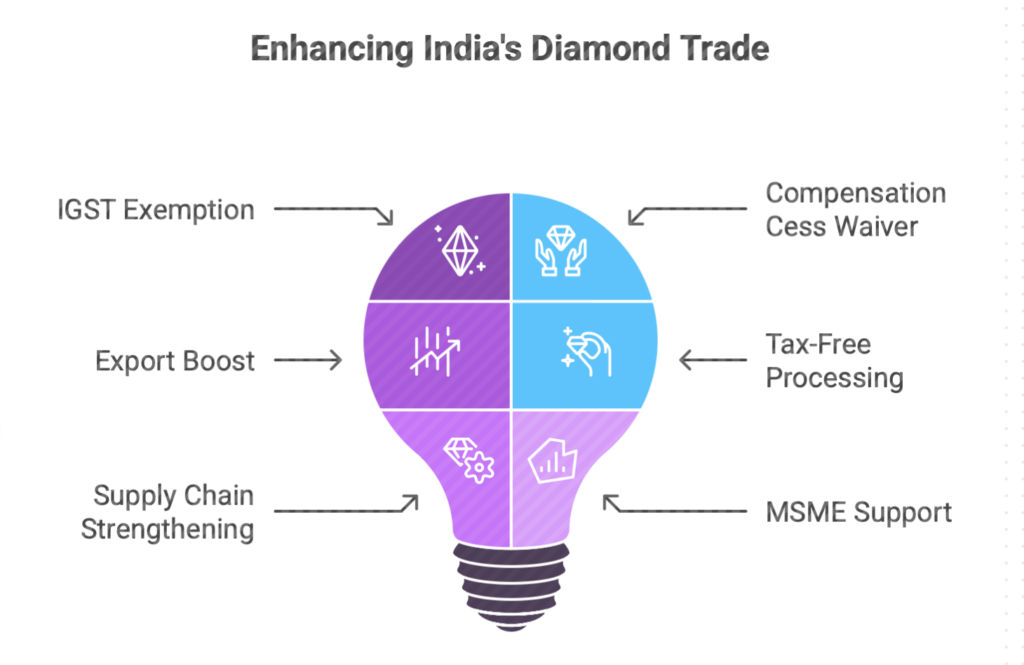
Government exempts diamond imports under the Diamond Imprest Authorisation (DIA) scheme from Integrated Tax and Compensation Cess
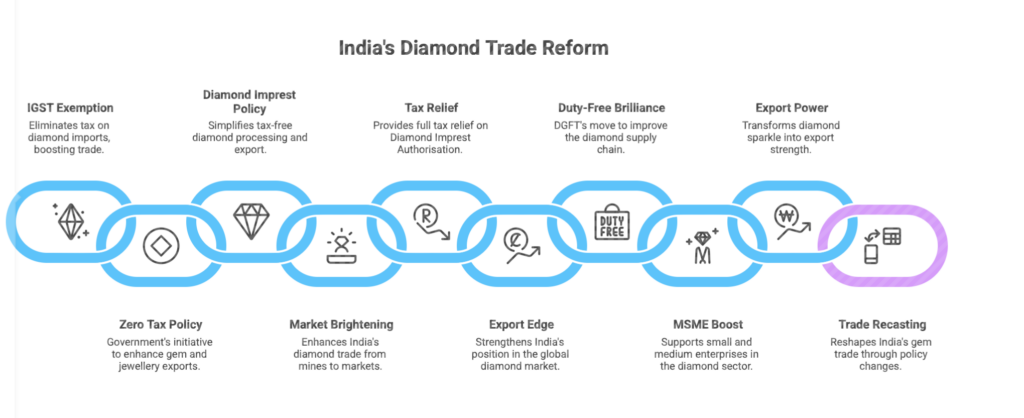
1 Background – integrated tax and compensation cess on imports
Under the Goods and Services Tax (GST) regime, imports of goods into India are treated as inter‑state supplies. Integrated GST (IGST) is levied on imports in addition to basic customs duty. Section 3(7) of the Customs Tariff Act, 1975 authorises the levy of IGST on imported goods at the rate applicable to similar goods supplied in India. The value for IGST calculation is the assessable value plus basic customs duty and social‑welfare cess; the tax is collected through customs using the procedures of the Customs Actgstcouncil.gov.in. GST compensation cess, introduced by the Goods and Services Tax (Compensation to States) Act, 2017, is levied under section 3(9) of the Customs Tariff Act on specified luxury or “sin” goods (such as large cars, tobacco and aerated drinks). The cess is calculated on the assessable value plus customs duty, and the revenue is used to compensate states for GST revenue shortfallsgstcouncil.gov.in. Businesses can generally claim credit of IGST and compensation cess paid on imports, but these levies raise working‑capital costs.
2 Overview of the Diamond Imprest Authorisation (DIA) scheme
2.1 Purpose and policy objectives
India’s gem and jewellery sector contributes significantly to exports and employment, yet faces competition from countries that mandate value addition within their borders. To retain India’s leadership in the diamond supply chain and reduce incentives for manufacturers to relocate overseas, the Department of Commerce introduced the Diamond Imprest Authorisation (DIA) scheme. Announced in Notification 53/2024‑25 (21 January 2025) and operational from 1 April 2025, the scheme allows duty‑free imports of natural cut and polished diamonds (including semi‑processed, half‑cut and broken diamonds) weighing no more than ¼ carat (25 cents) for subsequent export.The scheme aims to provide a level playing field for Indian exporters—especially micro, small and medium‑sized enterprises (MSMEs)—and prevent flight of investment to diamond‑mining countries that require in‑country cutting and polishing.
2.2 Eligibility and import limits
Only exporters with Two‑Star Export House status or above who have achieved at least US$ 15 million of cut‑and‑polished diamond exports in each of the previous three financial years are eligible to obtain DIA. The imports cannot exceed 5 % of the average export turnover of cut‑and‑polished diamonds during the preceding three years, subject to a cap of US$ 15 million.Importers must also have filed all GST and income‑tax returns for those years.
2.3 Value‑addition and export obligations
Holders of a DIA must fulfil an export obligation by exporting natural cut‑and‑polished diamonds with a minimum value‑addition of 10 %, realised in free foreign exchange, within six months of import. Exports must be channelled through Mumbai airport, and failure to meet the obligation attracts payment of duties plus interest. The scheme excludes lab‑grown diamonds. An application form ANF‑4J has been prescribed for DIA applicants; it captures details such as the importer’s IEC, export turnover, GST filings and supporting manufacturer information.
2.4 Earlier duty exemptions under the scheme
Before December 2025 the DIA scheme already granted exemption from several customs duties—basic customs duty, additional customs duty (countervailing duty), education cess, anti‑dumping duty, countervailing duty on subsidised articles, safeguard duty and transition product specific safeguard duty—for imports under the authorisation.However, importers still had to pay IGST (normally 18 %) and compensation cess, which locked up working capital until credits could be utilised.
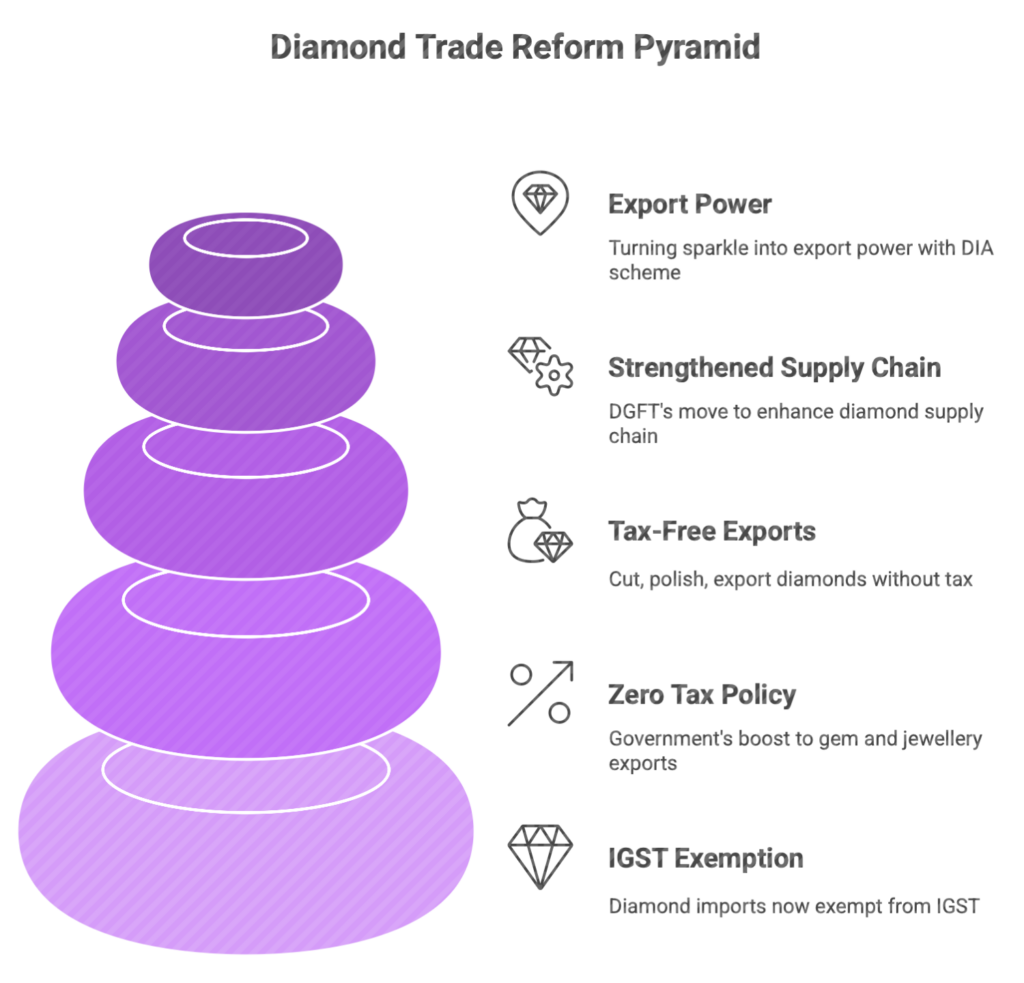
3 Notification 49/2025‑26—exemption from IGST and compensation cess
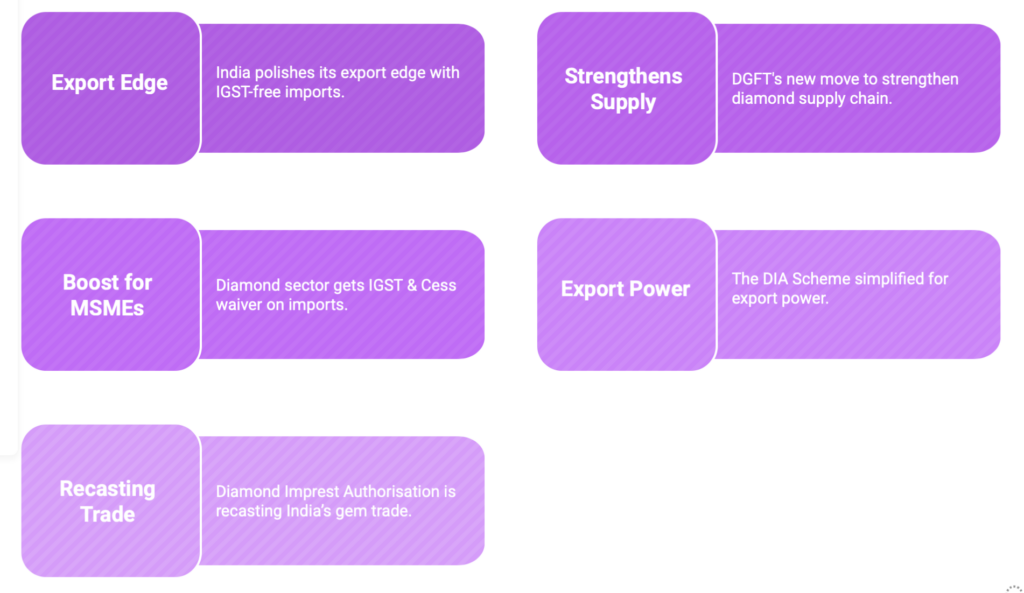
On 9 December 2025 the Directorate General of Foreign Trade (DGFT) issued Notification 49/2025‑26 amending paragraph 4.63 of the Foreign Trade Policy 2023 to further liberalise the DIA scheme. The notification states that imports under Diamond Imprest Authorisation are not only exempt from customs duties listed above but are also exempt from the whole of the Integrated Tax and the Compensation Cess leviable under sub‑sections (7) and (9) of section 3 of the Customs Tariff Act, 1975. The amendment clarifies that the exemption takes effect immediately and has been issued with the approval of the Minister of Commerce & Industry. The DGFT summarised the effect clearly: “The import under DIA shall also be exempted from payment of the Integrated Tax and Compensation Cess”.
3.1 Legislative basis for the exemption
Sections 3(7) and 3(9) of the Customs Tariff Act empower the government to levy IGST and compensation cess on imported goods. The DGFT derives authority to exempt these levies through section 25 of the Customs Act and sections 3 and 5 of the Foreign Trade (Development and Regulation) Act, 1992. By amending the Foreign Trade Policy, the notification aligns customs exemptions with tax policy while maintaining control under the actual‑user condition (imported diamonds must be used for manufacturing and export).
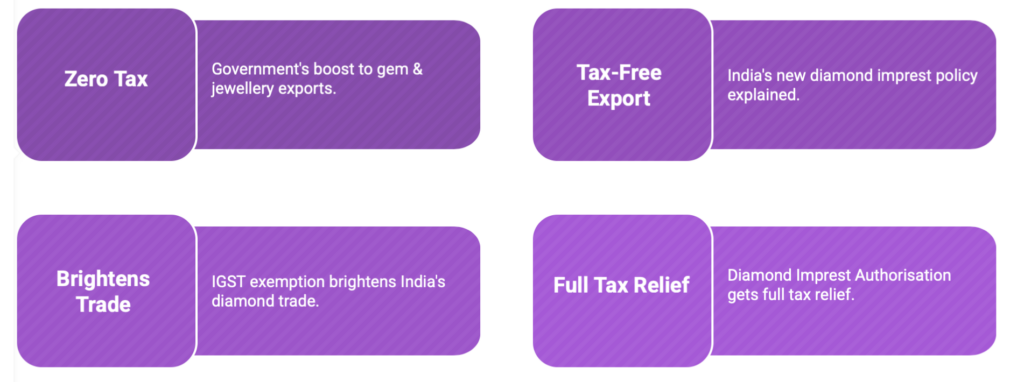
4 Why the exemption matters
4.1 Reduction of tax burden and working‑capital strain
Imported natural cut and polished diamonds up to 25 cents previously attracted 18 % IGST. The 56th GST Council meeting (September 2025) recommended that this IGST be reduced to nil for imports under the DIA scheme. The DGFT notification implemented this decision by exempting both IGST and compensation cess. Industry representatives noted that the exemption would ease working‑capital pressures for small and medium diamond processors who previously had to pay IGST upfront and claim credit later.
4.2 Support for exporters and MSMEs
The Gem & Jewellery Export Promotion Council (GJEPC) welcomed the reform. It observed that exempting natural cut and polished diamonds up to 25 cents from IGST will stimulate domestic demand, reduce costs, and provide a cushion to export supply chains facing global challenges. The Council emphasised that the benefits of lower taxes and reduced working‑capital blockage would be passed on to consumers, strengthening India’s competitiveness as a global hub for diamond processing and jewellery design. The reduction of GST on jewellery boxes from 12 % to 5 %—announced concurrently—also lowers packaging costs, further supporting exporters.
4.3 Preserving India’s position in the global diamond value chain
Several African diamond‑mining countries have adopted beneficiation policies requiring local cutting and polishing. The DIA scheme counters these policies by enabling Indian manufacturers to import small diamonds duty‑free, add value domestically and re‑export them. MSME exporters, who form a large part of the gem and jewellery sector, can import at least 5 % (up to 10 %) of their average export turnover under the Diamond Imprest Licence announced by the Commerce Minister in August 2024. The policy is expected to create jobs in diamond sorting and semi‑finished processing and deter flight of investment.
5 Practical considerations for DIA holders
- Application and monitoring: Exporters seeking a DIA must submit the ANF‑4J form through the DGFT online portal, providing details of past exports, GST returns and value‑addition plans. Regional licensing authorities monitor fulfilment of export obligation and value‑addition.
- Actual‑user condition: The imported diamonds must be used exclusively for manufacturing or processing and cannot be sold domestically. Failure to meet export obligation or diversion of goods results in demand for customs duty, IGST and cess with interest.
- Exclusion of lab‑grown diamonds: The scheme covers only natural diamonds; lab‑grown diamonds remain subject to normal import duties and taxes.
- Time‑bound exports: Exporters must complete exports with the prescribed value‑addition within six months; extensions may be granted on merit.
- Documentation: Careful record‑keeping is essential to avail exemption and later claim input‑tax credit (where applicable). Invoices must mention the DIA number and exports must be routed through Mumbai airport.
6 Conclusion
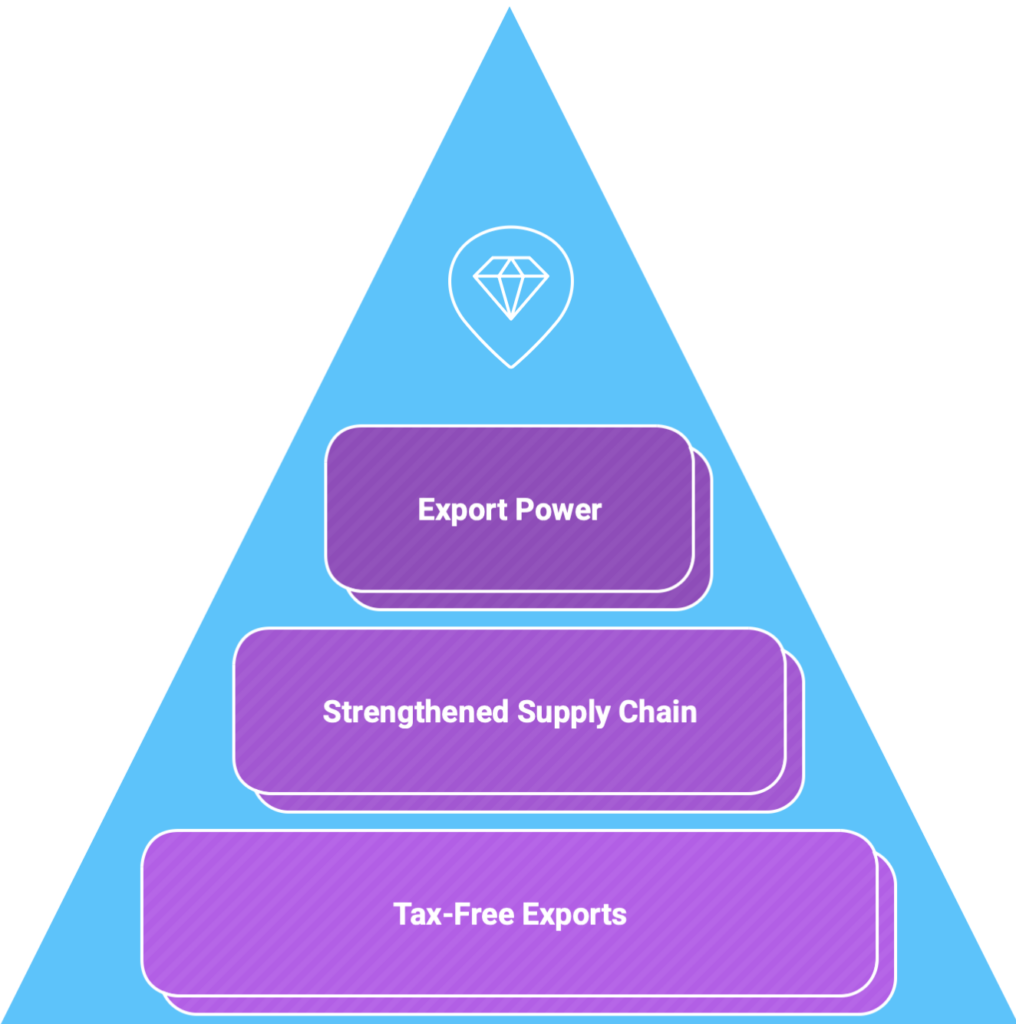
The exemption from IGST and compensation cess under the Diamond Imprest Authorisation scheme marks a significant policy shift. By removing the 18 % IGST and any applicable compensation cess on small, natural cut‑and‑polished diamonds imported for re‑export, the government addresses a long‑standing demand of the gem and jewellery sector. The reform reduces working‑capital blockage, enhances competitiveness for MSME exporters and aligns India’s trade policy with global trends of domestic value addition. Exporters should, however, comply strictly with eligibility conditions, value‑addition requirements and export obligations to retain the benefit of duty‑free imports.
Leave a Reply