From Mahatma to Mission: unpacking the VB‑G RAM G Act and its promise for rural India
Background and legislative context
The Mahatma Gandhi National Rural Employment Guarantee Act, 2005 (MGNREGA) has been India’s flagship rural social‑security law. It guaranteed every rural household at least 100 days of wage‑employment and was demand‑driven: funding allocations were based on actual demand for work and the Union government bore the entire wage bill, with states contributing to material and administrative costs. Over the last two decades MGNREGA provided a lifeline during droughts, economic slow‑downs and the COVID‑19 pandemic and bolstered grassroots democracy through Gram Panchayats’ planning of public works. However, audits revealed leakages, under‑utilisation of the 100‑day entitlement and delayed wage payments. In December 2025 the Government introduced the Viksit Bharat—Guarantee for Rozgar and Ajeevika Mission (Gramin) Act, 2025 (popularly called VB‑G RAM G). The Bill passed both houses of Parliament on 18 December 2025 and received presidential assent on 21 December 2025, formally replacing MGNREGA.
Key features of the VB‑G RAM G Act
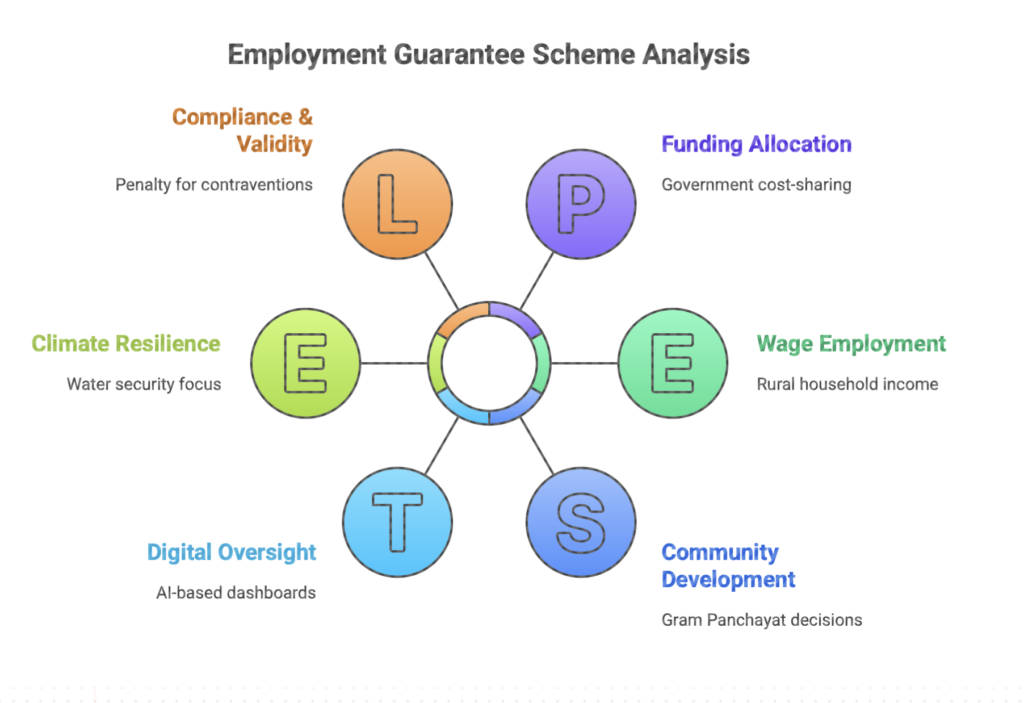
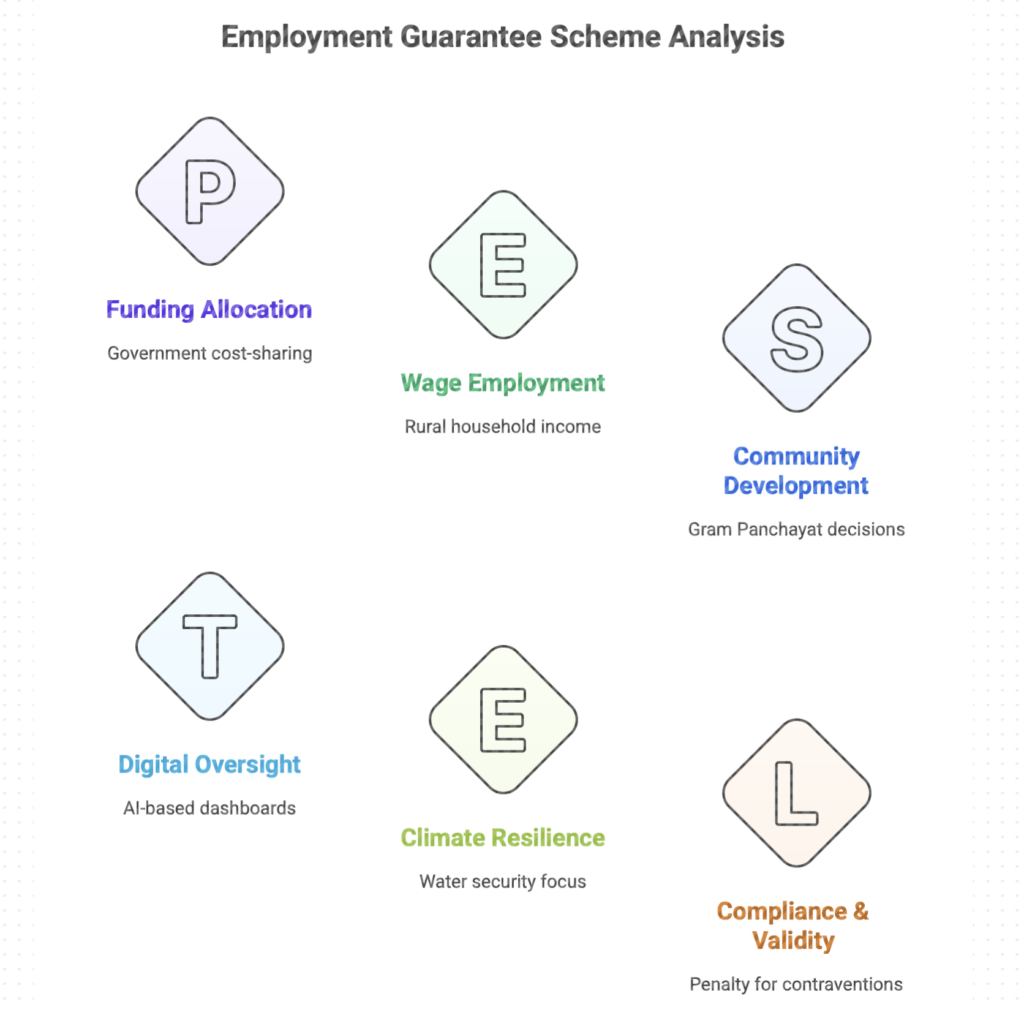
The Act’s stated goal is to align rural employment with the vision of Viksit Bharat @ 2047, emphasising empowerment, growth, convergence of public programmes and saturation of rural infrastructure. Its salient features include:
- Expanded employment guarantee – 125 days
Section 5(1) of the Act provides a statutory guarantee of not less than 125 days of wage employment per rural household per year. This is higher than the 100‑day guarantee under MGNREGA. - Normative funding and cost‑sharing
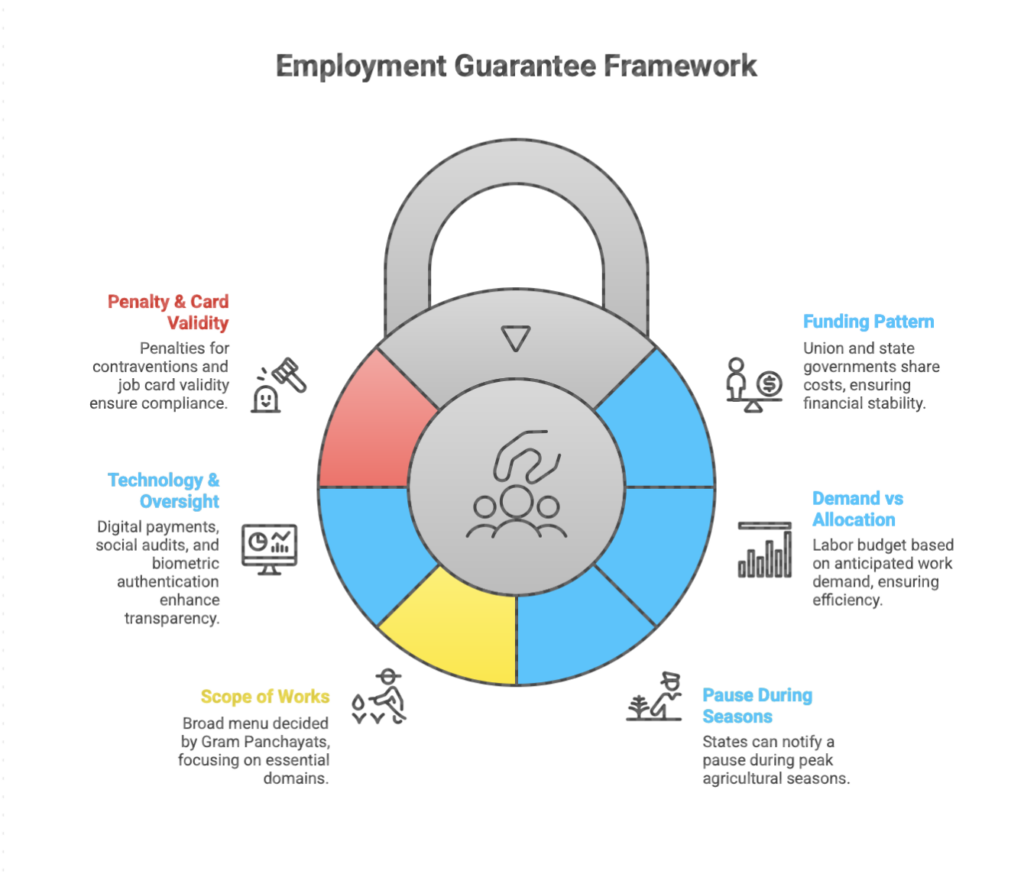
The programme will be implemented as a Centrally‑sponsored scheme. Funding is shared 60:40 between the Centre and states (90:10 for North‑Eastern and Himalayan states; 100 % central funding for Union territories without legislatures). Unlike MGNREGA, where the Centre bore the entire wage bill, states must now contribute to wages, materials and administrative costs. The Act introduces a state‑wise “normative allocation” – the Union government determines annual allocations based on objective parameters and states bear any expenditure above this allocation. - Pause during peak agricultural seasons
To prevent shortages of farm labour, states may notify a 60‑day aggregated pause each year during peak sowing and harvesting seasons. During this period no works under the scheme can be undertaken. Workers still remain entitled to the full 125 days in the remaining period. - Timely and enhanced wage provisions
Wages must be paid weekly or at most within 15 days; delay compensation is payable. Several reports suggest the daily wage rate may rise; the initial draft proposed an increase from ₹205 to ₹240. The Act retains provisions for unemployment allowance if work is not provided within 15 days of application. - Thematic focus and integrated planning
Public works must fall into four priority domains—(a) water security, (b) core rural infrastructure, (c) livelihood‑related infrastructure and (d) mitigation of extreme weather events. Gram Panchayats prepare Viksit Gram Panchayat Plans that are aggregated up to block, district and state levels and integrated into the Viksit Bharat National Rural Infrastructure Stack. Plans align with the PM Gati Shakti National Master Plan, promoting convergence and avoiding fragmentation. - Digital and technology‑enabled oversight
The Act codifies use of biometric authentication, geospatial mapping, real‑time dashboards and artificial intelligence for planning, monitoring and social audits. It establishes National and State level Steering Committees to oversee implementation and normative allocations. - Gramin Rozgar Guarantee Card and penalties
Each adult member willing to undertake unskilled manual work receives a Gramin Rozgar Guarantee Card, including special cards for single women, persons with disability, senior citizens and other vulnerable groups. The card is valid for three years and must be renewed. The penalty for contravention has been increased from ₹1 000 to ₹10 000.
How VB‑G RAM G differs from MGNREGA
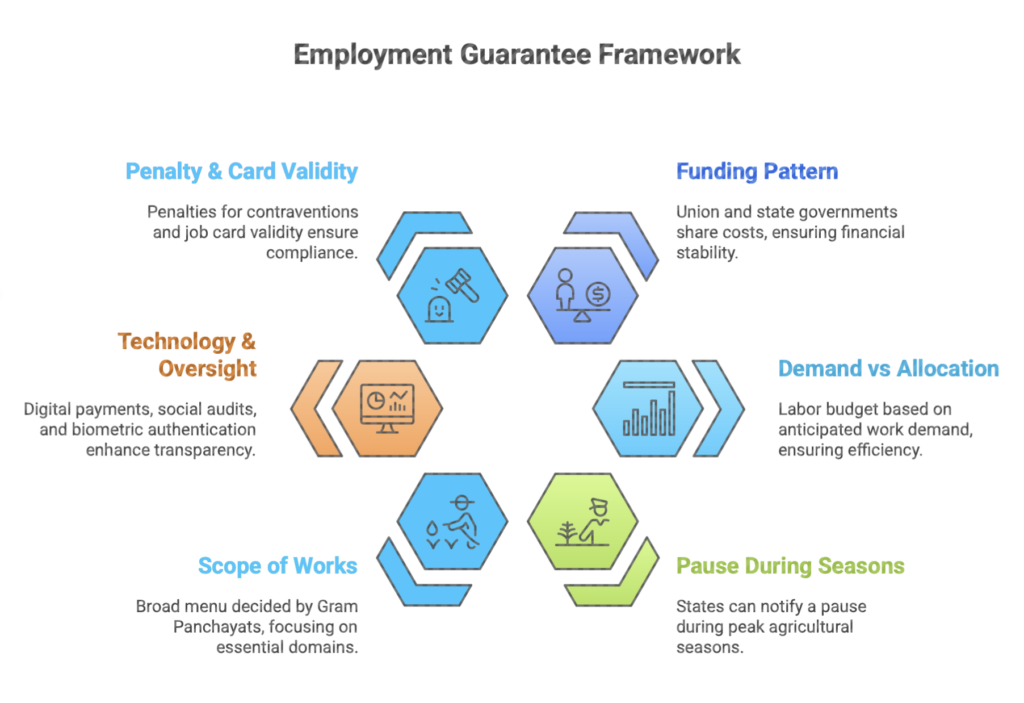
| Aspect | MGNREGA (2005) | VB‑G RAM G Act (2025) |
| Employment guarantee | 100 days of wage employment per rural household per year. | 125 days statutory guarantee; state must pay unemployment allowance if work not provided. |
| Funding pattern | Union government pays entire wage bill and up to three‑fourths of material costs; states pay one‑fourth of material cost and unemployment allowance. | Centrally sponsored with 60:40 Centre‑state cost‑sharing (90:10 for special states); normative allocations fix annual budgets and any excess must be borne by states. |
| Demand vs normative allocation | Demand‑driven; labour budget based on anticipated work demand. | Top‑down normative allocation where Centre determines state‑wise funding based on prescribed parameters. |
| Pause during agricultural seasons | No mandatory pause; works could be undertaken year‑round. | States may notify a 60‑day aggregated pause each year during peak sowing/harvesting. |
| Scope of works | Broad menu decided by Gram Panchayats; often unskilled manual labour. | Works limited to four domains—water security, core infrastructure, livelihood infrastructure and climate resilience; integrated with national plans. |
| Technology & oversight | Use of digital payments and job cards; social audits mandated but often weakly enforced. | Biometric authentication, geospatial mapping, AI‑based dashboards and weekly public disclosure mandated; National and State Steering Committees oversee implementation. |
| Penalty & card validity | ₹1 000 penalty for contraventions; job card valid for five years. | Penalty increased to ₹10 000 and job card (Gramin Rozgar Guarantee Card) valid for three years with special categories. |
Potential benefits and opportunities for rural livelihoods
- More days of work and income security – A 25 day increase means rural households can earn additional wages, potentially raising annual income by roughly 25 %. Weekly wage payments and compensation for delays reduce cash‑flow crises.
- Durable and climate‑resilient assets – Focusing on water security, core infrastructure and climate‑resilience ensures that labour invested under the programme creates enduring assets (ponds, rainwater harvesting structures, rural roads, markets and shelters). Such assets can boost agricultural productivity, reduce climate‑related risks and support diversified livelihoods.
- Integrated planning and convergence – Aligning Gram Panchayat plans with national infrastructure strategies can leverage resources from other schemes (e.g., PM Gati Shakti, Jal Jeevan Mission, PM Awas Yojana). This may reduce duplication, improve asset quality and help achieve saturation of basic services.
- Inclusivity and special provisions – Special Gramin Rozgar Guarantee Cards for single women, disabled persons and vulnerable groups enable targeted support. The retention of unemployment allowance ensures households receive compensation when work is not provided.
- Skill development and technology – By integrating digital tools and geospatial mapping, the Act may encourage skill development in record‑keeping, site supervision and digital literacy. Over time, aligning works with livelihood infrastructure could open avenues for skill‑based employment and self‑employment beyond unskilled labour.
- Predictable budgeting – Normative allocations provide states with predictable funding streams, aiding budgetary planning and enabling long‑term projects. This may improve the efficiency of payment systems and reduce delays.
Concerns and points of debate
While the VB‑G RAM G Act presents an ambitious framework, several issues have triggered debate:
- Top‑down funding may cap demand: Critics argue that normative allocations and state liability for excess expenditure may convert an open‑ended right to work into a rationed scheme. States facing fiscal stress might limit work applications to avoid liabilities.
- Increased burden on states: Shifting from 100 % central wage funding to 60:40 cost‑sharing could strain state finances. Some states fear this may lead to fewer workdays being offered or delayed payments.
- 60‑day pause reduces access: Although intended to ensure farm‑labour availability, the mandatory pause shortens the window for availing 125 days of work. Different agricultural calendars across regions mean that a uniform pause may not suit all contexts.
- Technological exclusion: Mandating biometric authentication and real‑time digital platforms may exclude workers facing connectivity issues or biometric failures deccanherald.com. Without reliable alternatives, vulnerable groups could be denied work or wages.
- Delinking from rights‑based framework: Scholars note that the Act emphasises development planning and infrastructure over the original rights‑based, demand‑driven ethos of MGNREGA. Ensuring that workers’ voices and local needs remain central will be critical.
Concluding analysis
The VB‑G RAM G Act marks a significant evolution in India’s rural employment policy. By raising the guaranteed workdays to 125 and embedding public works within a broader development vision, it aims to transform a safety‑net programme into a driver of infrastructure and livelihood creation. Integrated planning and technology‑enabled oversight could yield more durable assets, better targeting and transparency. However, the shift from a demand‑driven, fully‑funded entitlement to a centrally‑controlled, cost‑sharing model carries risks: states may struggle with additional fiscal burdens, normative allocations could ration work and technological mandates may exacerbate exclusion. Realising the Act’s promise will require robust safeguards—timely fund releases, protection for those excluded by digital systems, flexible implementation that respects diverse agrarian calendars and strong social audits—to ensure that rural workers remain at the centre of this mission.
Also Read Political Party/Trust Donations in ITR: Now Under Tax Scanner
#VBGRAMG #ViksitBharatGuarantee #RuralEmployment #RuralLivelihoods #MGNREGA #MGNREGAreplaced #RuralJobsIndia #RuralDevelopment #LivelihoodSecurity #RightToWork #RuralEconomy #GraminRozgar #VBGRAMGAct #VillageDevelopment #IndiaPolicy #InclusiveGrowth #EmploymentGuarantee
Leave a Reply