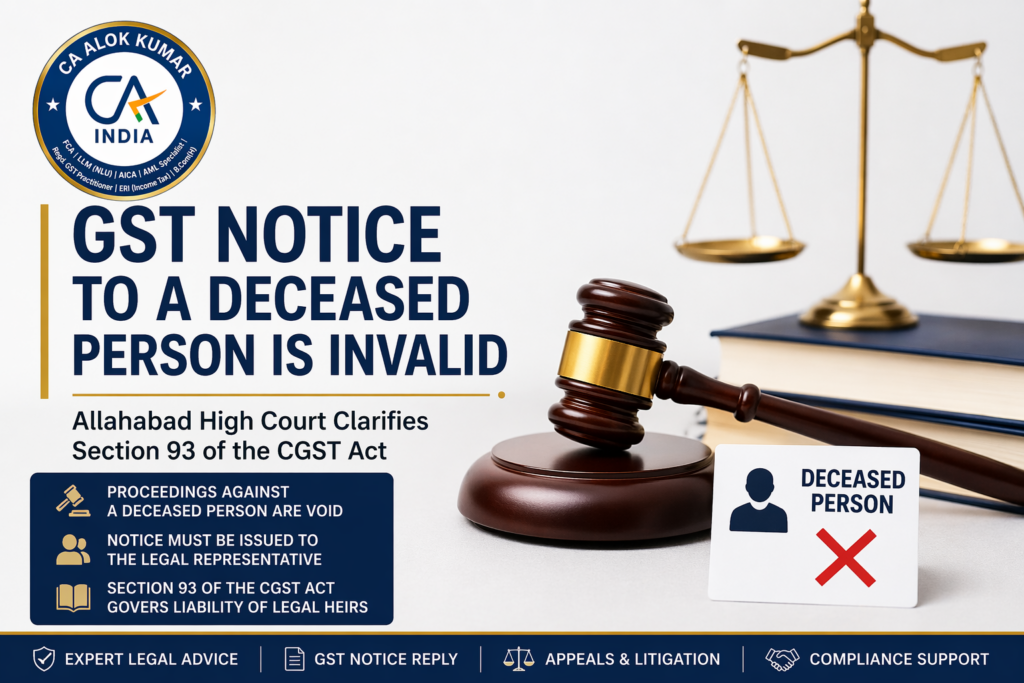
GST Notice to a Deceased Person Is Invalid: Allahabad High Court Clarifies the Law in P.B. Sethi Plastics
A very important GST ruling has reaffirmed a basic legal principle: no proceedings can be validly initiated against a deceased person. In P.B. Sethi Plastics v. State of U.P., the Allahabad High Court held that where a show cause notice and adjudication order were issued in the name of a proprietor who had already died, the entire proceedings were void in law. The Court also clarified that if the department wants to proceed, it must do so against the legal representative in accordance with Section 93 of the CGST Act. (Tax Information Portal)
This judgment is highly relevant for proprietorship firms, legal heirs, GST practitioners, and families handling old tax disputes. It makes it clear that while tax liability may still be dealt with as per law, the department cannot bypass the statutory process by issuing a notice to a dead person. For businesses and legal heirs facing a GST notice, this ruling provides strong legal support in cases where proceedings are initiated in the name of a deceased proprietor.
Background of the Case
The case related to a sole proprietorship firm, P.B. Sethi Plastics, whose proprietor had passed away in July 2020. After his death, the GST registration of the concern was cancelled in October 2020. Despite this, the department later issued a show cause notice under Section 73 for the tax period 2017–18 in the name of the deceased proprietor and subsequently passed an order confirming demand. The legal heir later challenged the matter, and the issue ultimately reached the Allahabad High Court.
The central legal question was simple but crucial: can GST adjudication proceedings continue in the name of a deceased person, or must the department proceed against the legal representative under law? The High Court answered this in clear terms.
Legal Position Under Section 93 of the CGST Act
The answer lies in Section 93 of the CGST Act, 2017, which deals with liability to pay tax, interest, or penalty in certain cases where the taxable person has died. The provision recognises that tax dues may, in appropriate cases, be enforceable against the legal representative or successor. However, the law does not authorise the department to determine such liability by issuing a show cause notice to a deceased person. (Tax Information Portal)
Broadly, Section 93 provides that:
- if the business is continued after the death of the taxable person by the legal representative or any other person, such person may be liable for tax, interest, or penalty due from the deceased; and
- if the business is discontinued, the legal representative may be liable only to the extent the estate of the deceased is capable of meeting the liability. (Tax Information Portal)
Therefore, the law preserves liability in specified cases, but the proceedings must be directed against the legal representative or successor, not against the deceased person himself.
If you need professional assistance in handling such matters, proper GST registration and return filing support and timely notice review become very important, especially in legacy or succession-related tax matters.
What the High Court Clarified
The Allahabad High Court held that the entire proceedings were legally unsustainable because the show cause notice itself had been issued against a dead person. Once the notice was void, the adjudication order based on that notice also could not survive. The Court further held that the department was free to initiate fresh proceedings in accordance with law, if otherwise permissible, but only by following the proper statutory route.
This is a very important distinction. The Court did not say that tax liability automatically disappears after death. Rather, it clarified that the method adopted by the department must be legally valid. The law may permit proceedings against the legal representative, but it does not permit determination of liability against a person who is no longer alive. (Tax Information Portal)
Why the Limitation Argument Did Not Save the Department
A significant aspect of the case was that the legal heir’s appeal had been rejected as time-barred. However, where the original proceedings are fundamentally void, a technical objection of limitation cannot cure that defect. The High Court effectively recognised that an invalid proceeding cannot be legitimised merely because the legal heir came to know of it later or because an appeal was filed after some delay.
This principle is practically very important. In many cases involving deceased proprietors, family members become aware of a GST demand only when recovery action starts, bank attachment is threatened, or records are reviewed much later. If the original proceedings were initiated against a deceased person, that defect goes to the root of the matter.
Practical GST Implications After Death of a Sole Proprietor
The issue is not only about litigation. It is also about proper GST compliance after the death of a sole proprietor. The official position has been clarified by CBIC Circular No. 96/15/2019-GST dated 28 March 2019, which deals with transfer of input tax credit and related procedural issues where a sole proprietor dies. The circular recognises that legal heirs may need to cancel registration, continue business through a successor registration, and deal with transfer of eligible ITC where applicable. (cbic-gst.gov.in)
This means that after the death of a proprietor, the family or legal representative should immediately review:
- whether the business is being continued or discontinued;
- whether GST registration has been properly cancelled;
- whether a new registration is required in the hands of the successor;
- whether any pending notices, returns, or liabilities exist; and
- whether ITC transfer and related compliance need to be addressed under the law. (cbic-gst.gov.in)
In many cases, early professional intervention can prevent invalid proceedings from becoming complicated litigation later.
Why This Judgment Matters
This ruling is important because it protects both natural justice and statutory discipline. A deceased person cannot receive a notice, file a reply, submit evidence, or defend himself. Any adjudication started in such a name is inherently defective. The department must identify the correct legal person against whom proceedings can lawfully continue. (Tax Information Portal)
For legal heirs, the judgment is equally important. It confirms that they are not expected to defend an order passed against a dead person merely because the department failed to follow the proper process. At the same time, it reminds them that GST issues should not be ignored after the death of a proprietor, because the law does contain a framework for continuation of liability in appropriate cases under Section 93. (Tax Information Portal)
Key Takeaways
A GST show cause notice issued in the name of a deceased proprietor is legally vulnerable and may be void from the very beginning. The department must proceed against the legal representative if it wants to determine and recover liability in accordance with law. Section 93 of the CGST Act preserves liability in specified circumstances, but it does not validate adjudication against a dead person. The ruling in P.B. Sethi Plastics therefore reinforces both procedural fairness and correct statutory compliance. (Tax Information Portal)
For taxpayers, legal heirs, and business families, the practical lesson is clear: if a proprietor has died and any GST notice, demand, or order is later issued in his name, the matter should be examined immediately from both a jurisdictional and compliance perspective. In such situations, proper defence of a GST notice and review of ongoing GST registration and return filing compliance can make a significant difference.
Conclusion
The Allahabad High Court’s ruling in P.B. Sethi Plastics is a strong reminder that tax administration must operate strictly within the law. Proceedings against a deceased person are not a mere technical irregularity; they go to the very root of legality. Where the law provides a mechanism to proceed against the legal representative, that route must be followed. Anything short of that is open to challenge. (Tax Information Portal)
For anyone dealing with GST issues after the death of a sole proprietor, this judgment offers both legal clarity and practical guidance. The correct approach is not to ignore the matter, but to review it carefully under Section 93 of the CGST Act and the applicable CBIC circulars, and then take timely legal and compliance action. (Tax Information Portal)
FAQs
1. Can the GST department issue a show cause notice in the name of a deceased proprietor?
No. The Allahabad High Court has reaffirmed that proceedings initiated against a deceased person are void. The notice must be issued to the legal representative if the department seeks to proceed in accordance with law.
2. Does death of the proprietor wipe out GST liability?
Not necessarily. Section 93 preserves liability in certain situations, especially where business is continued by a legal representative or another person, or where liability can be met from the estate of the deceased.
3. What if the appeal against such an order is dismissed as time-barred?
Where the original proceedings are fundamentally void because they were initiated against a deceased person, limitation may not save the illegal order. That is precisely what happened in P.B. Sethi Plastics.
4. What compliance steps should be taken after death of a sole proprietor?
The family or successor should examine cancellation of GST registration, successor registration if business continues, and ITC transfer procedure where applicable. CBIC Circular No. 96/15/2019-GST gives important guidance on REG-16 and ITC-02 in such cases.
Section 93 of the CGST Act
CBIC Circular No. 96/15/2019-GST
GST notice to deceased person, GST notice to legal heir, Section 93 CGST Act, deceased proprietor GST case, Allahabad High Court GST ruling, GST proceedings against deceased person, legal representative under GST, GST liability after death of proprietor
#GST #GSTNotice #ShowCauseNotice #Section93GST #AllahabadHighCourt #GSTonLegalHeir #GSTLaw #TaxCompliance #CAAlokKumar #CANearMe #CAinDwarka #CAinDelhi #CAinIndia #GSTConsultant #GSTAdvisory #GSTRegistration #GSTReturnFiling #TaxNoticeReply
Leave a Reply