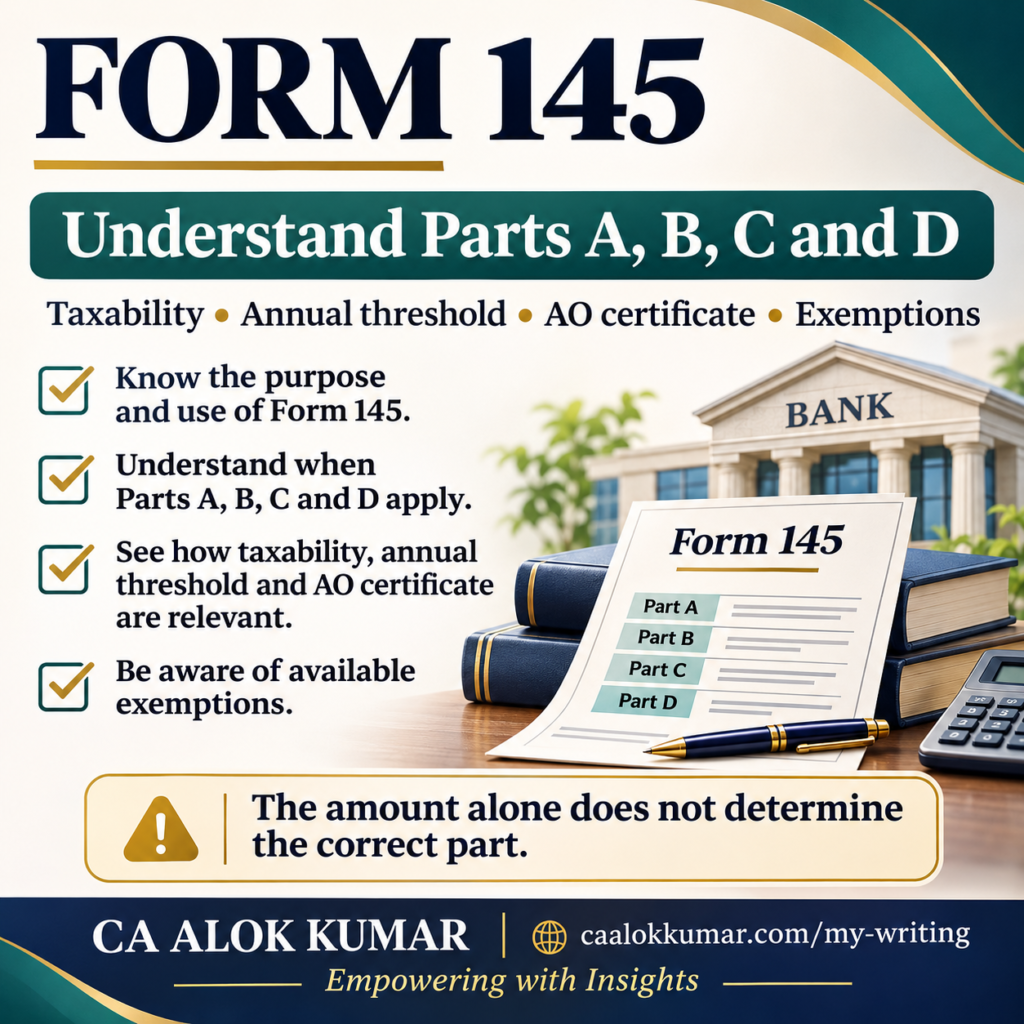
Form 145 parts depend on the tax treatment of a payment, the relevant annual aggregate and the supporting certificate or order. Choosing a part solely from the amount being transferred can produce the wrong result.
Form 145 is the information form corresponding to the earlier Form 15CA. It is filed by the person responsible for the payment where the reporting requirements apply. Form 146, corresponding to Form 15CB, is the accountant’s certificate used for the Part C route.
The framework is section 397(3)(d) of the Income-tax Act, 2025 and Rule 220 of the Income-tax Rules, 2026. Start with the reporting obligation and exemptions, then select the appropriate part.
Form 145 parts at a glance
| Part | Broad situation | Main document point |
|---|---|---|
| A | Chargeable payment or relevant aggregate does not exceed ₹5 lakh in the tax year | Form 146 is not required for this route |
| B | Chargeable payment or relevant aggregate exceeds ₹5 lakh and the applicable section 395(1)/(2) AO certificate or order is obtained | Refer to the valid AO document |
| C | Chargeable payment or relevant aggregate exceeds ₹5 lakh and Part B is not used | Obtain Form 146 for the Part C route |
| D | Non-chargeable payment for which reporting remains required | First check Rule 220(3) exemptions |
The table is a guide. Apply the actual rule to the transaction, rather than treating a bank’s short description as a final classification. The official Form 145 manual provides the Department’s explanation of the four parts.
First decide whether the payment is chargeable
A payment to an overseas recipient is not automatically taxable in India. Examine the nature and source of the income, the applicable domestic provision and relevant treaty relief.
Likewise, paying from an Indian account does not prove that the entire amount is taxable. Asset proceeds may include capital and gain; a business invoice may cover different items. Record a reasoned conclusion before choosing the part.
For a review of taxability and reporting, refer to Form 145 and Form 146 foreign remittance assistance.
Part A and the ₹5 lakh threshold
Part A applies to the chargeable-payment route within the prescribed tax-year threshold. It should not be interpreted as a general “small payment” category for all transfers.
The limit concerns the payment or relevant aggregate specified in the rule. A series of instalments should not be reviewed as if every instalment starts a new threshold. Keep an annual record of relevant payments and revisit the reporting route when further payments are proposed.
Selecting Part A also does not grant a tax exemption. Any withholding requirement must be examined independently.
Part B and the Assessing Officer route
Part B is relevant where the chargeable-payment threshold is exceeded and the prescribed section 395 certificate or order has been obtained.
Confirm that the document covers the payer/payee, payment, period and amount concerned. An application awaiting disposal should not be treated as an issued certificate. A document for a different transaction does not automatically support this route.
Rule 220 expressly provides that where Part B information is furnished, Part C information is not required. Avoid obtaining a Part C certificate solely because a checklist assumes both routes apply together.
Part C and Form 146
Where the chargeable-payment threshold is exceeded and the Part B route is not used, the Part C route involves the accountant’s certificate in Form 146.
The practical preparation should include the contract or source explanation, recipient details, tax computation, treaty records where relevant and bank instructions. The remitter and CA should reconcile the figures before filing.
The existing Form 146 filing-process guide explains the portal process in greater detail.
Part D and Rule 220 exemptions
Part D is the non-chargeable-payment reporting route, but an exemption check comes first. Rule 220(3) removes the information requirement for specified non-chargeable sums in the circumstances it describes.
Those circumstances include qualifying individual remittances not requiring prior RBI approval under the relevant current-account framework, IFSC-unit cases and specified purpose-code categories. The conditions and introductory requirement that the sum is non-chargeable must be read together.
An overseas payment should not be labelled exempt merely because a purpose code appears convenient. Use the actual nature of the payment. The notified Income-tax Rules, 2026 contain Rule 220 and its specified list.
Illustrative decisions
These examples assume the stated taxability and exclude special facts:
- A chargeable payment within the relevant annual limit points to Part A. Tax deduction may still be required.
- A chargeable payment above that limit with a valid, applicable AO document points to Part B.
- A chargeable payment above the limit without the Part B route points to Part C with Form 146.
- A non-chargeable payment not covered by Rule 220(3) points to Part D.
- A qualifying non-chargeable payment covered by Rule 220(3) does not require the information form under that exemption.
These are outcomes after review, rather than assumptions to make before examining the payment.
Bank documentation is a separate step
Form A2 and the authorised dealer’s supporting documents serve the FEMA and banking process. Form 145 does not itself replace that process.
For the relationship between the two, see the published RBI Form A2 update and bank documentation guide. The bank may ask for evidence explaining why a reporting exemption or particular tax position applies.
Frequently asked questions
Is Part A a nil-tax declaration
No. It is a route for chargeable payments within the prescribed threshold. Taxability and withholding remain separate questions.
Does every non-taxable transfer require Part D
No. Check the Rule 220(3) exemptions before deciding that Part D is required.
Can an AO application receipt support Part B
An application receipt should not be treated as the required issued certificate or order. Verify the actual document and its scope.
Can a large NRO transfer automatically be put in Part C
No. The source, taxability and reporting conditions require review. A large amount alone does not establish Part C applicability.
Where can a local client seek help
See Form 145 and Form 146 filing services in Delhi. Share the payment purpose and basic facts so the appropriate route can be examined.
Select the part after completing the review
Document the taxability conclusion, exemption check, annual aggregate and supporting certificate position. This sequence is more reliable than selecting a form from a transfer amount alone.
This article provides general information. Apply the law and bank requirements relevant to the facts and transaction date. Prepared by CA Alok Kumar, Partner, S.K. Mehta & Co., Chartered Accountants.
Leave a Reply