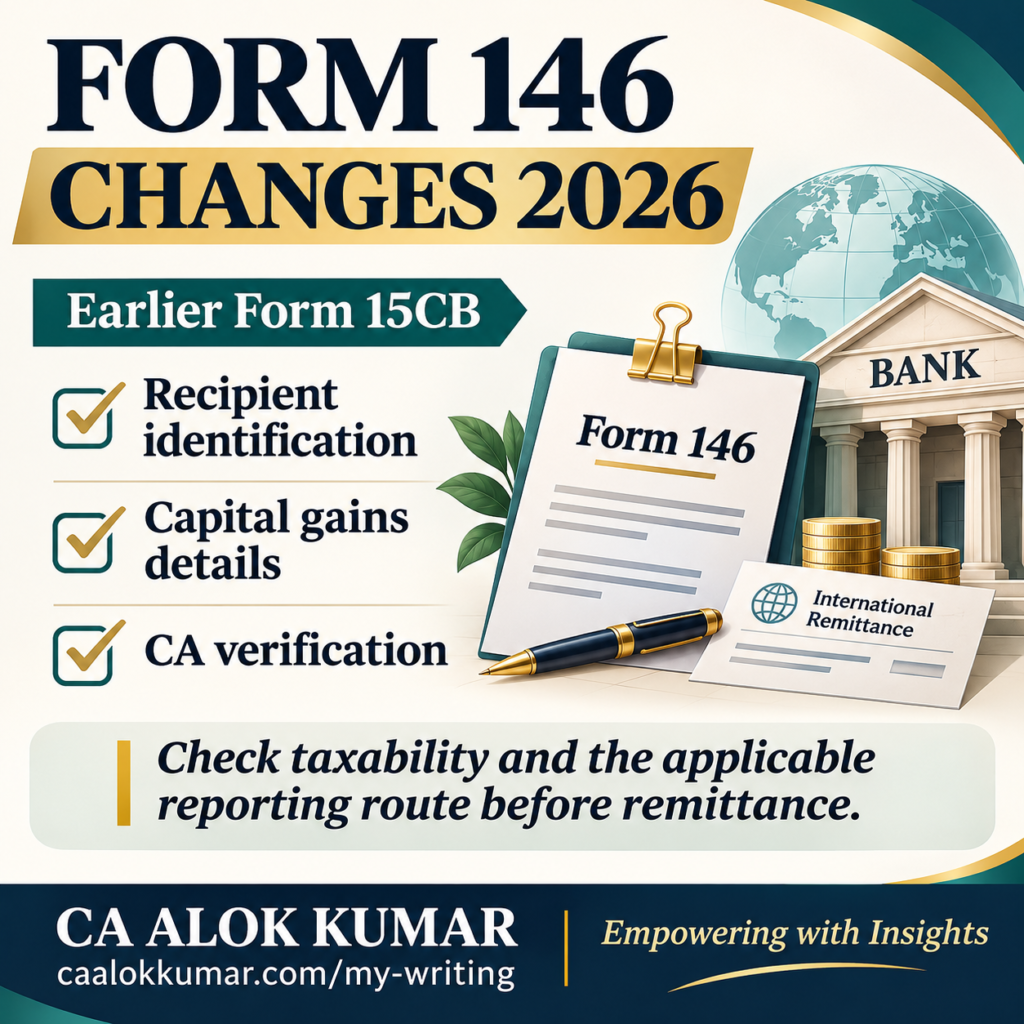
Form 146 changes matter because preparing a CA certificate for foreign remittance involves more than replacing the old form number. A remitter should be ready to explain the payment, establish the recipient’s details and support the tax treatment with relevant documents.
For payments handled under the new framework, Form 146 corresponds to the earlier Form 15CB. Form 145 corresponds to Form 15CA. The reporting framework is under Rule 220 of the Income-tax Rules, 2026, read with section 397(3)(d) of the Income-tax Act, 2025.
The practical starting point is an applicability review. A certificate should follow the facts of the transaction, rather than be ordered automatically because a transfer is large.
When is Form 146 required
Form 146 supports the Part C route where the payment is chargeable to tax, the payment or relevant annual aggregate exceeds ₹5 lakh, and the applicable Assessing Officer certificate or order route under section 395(1) or (2) has not been used. The threshold is a reporting threshold; it does not by itself make income taxable.
The Income Tax Department’s explanatory note on Form 146 sets out its purpose and disclosures. Whether a particular NRO transfer or foreign payment falls within this route requires separate examination.
Readers requiring a transaction-specific review can consult the detailed Form 145 and Form 146 foreign remittance service guide.
Five practical Form 146 changes and preparation checks
1 Confirm the recipient’s identification
The revised form captures recipient information including a foreign Tax Identification Number or equivalent identification, subject to the form instructions. Collect the recipient’s legal name, country of residence, overseas address and PAN or relevant identification details before starting.
Where the recipient has no PAN, examine the conditions under Rule 217 and section 397(2), rather than assuming that a foreign passport or an invoice alone resolves the withholding position. Rule 217 applies to specified payment categories and requires prescribed details and documents.
2 Keep the capital gains records ready
The form contains additional capital-gains particulars, including acquisition and sale information and relevant consideration details. For a property or investment transaction, the CA therefore needs more than the amount credited to the bank.
Prepare a chronology connecting acquisition, transfer, sale proceeds, tax computation and taxes already deducted or paid. Identify inherited assets and earlier ownership records wherever relevant. This is a practical preparation step: the documents needed will depend on the asset and transaction.
3 Reconcile the payment with the contract
The description in the certificate should match the underlying arrangement. An invoice headed “consultancy”, for example, may cover several activities with different tax implications.
Provide the agreement, scope of work, invoice and explanation of the services or rights acquired. Identify whether the amount is gross or net of tax. If the contract places the tax cost on the Indian payer, the computation requires a separate gross-up review.
4 Complete accountant verification and UDIN requirements
Form 146 captures the accountant’s identification and verification details, including firm registration particulars and UDIN-related information. UDIN supports certificate authenticity; it does not substitute for the underlying tax analysis.
The official Form 146 user manual describes assignment to the CA, digital verification and the portal’s UDIN validation workflow. Follow the current workflow at filing. Do not confuse a field being optional at a particular portal stage with the professional obligation to complete the applicable UDIN process.
5 Coordinate Form 146 with Form 145 and the bank
Before submission, reconcile the recipient, payment purpose, amount, currency, tax particulars and bank instructions. Correct inconsistencies before they flow into subsequent forms.
The forms and bank documents should tell one coherent story. For a practical explanation of the separate authorised dealer process, read the published RBI Form A2 update and foreign remittance checks.
Form 146 documents required
Prepare the following records to the extent relevant:
- Remitter and recipient identification and contact details.
- Agreement, invoice, payment schedule and an explanation of the transaction.
- Tax computation and evidence of withholding or tax payment where applicable.
- Treaty documentation, including the TRC and applicable prescribed information, where relief is claimed.
- Asset acquisition and sale records where capital gains are involved.
- Proposed bank instructions, currency, amount and intended remittance date.
This is a working checklist, not a requirement to collect every document for every case. For portal navigation, the existing Form 146 user-manual guide provides a useful companion explanation.
Common mistakes to avoid
Avoid applying last year’s tax conclusion to a different recipient or revised contract without review. Check the tax year and the law relevant to the underlying income; a payment date alone does not resolve every transition issue.
Similarly, a bank request for a certificate should trigger a review of the actual requirement. Non-taxable payments and exempt reporting categories need careful treatment. Neither the foreign location of a recipient nor the size of a transfer is a complete answer.
Frequently asked questions
Is Form 146 simply the renamed Form 15CB
It is the corresponding accountant’s certificate under the new framework, with revised disclosures and verification particulars. The preparation should account for those changes.
Is Form 146 necessary for every transfer above ₹5 lakh
No. Taxability, the annual aggregate, the AO route and the applicable reporting conditions must be examined together.
Does the CA’s certificate mean RBI has approved the remittance
No. Tax certification and FEMA or bank requirements have separate purposes. Any required approval must be considered independently.
What if documents and bank instructions contain different amounts
Reconcile the difference before filing. Determine whether it arises from tax, bank charges, currency conversion, instalments or an error.
Where can a Delhi client obtain assistance
Clients can seek Form 145 and Form 146 filing assistance in Delhi and Dwarka, with the scope determined after reviewing the proposed payment.
Prepare the transaction before preparing the certificate
A complete payment explanation and consistent supporting records make the review more effective. Establish the tax position and applicable reporting route first, then coordinate the certificate, remitter information and bank submission.
This article provides general information. Apply the law and bank requirements relevant to the facts and transaction date. Prepared by CA Alok Kumar, Partner, S.K. Mehta & Co., Chartered Accountants.
Leave a Reply