Foreign Remittance Income Tax Scrutiny 2026: CBDT Verifies 394 Entities and 36 Professionals
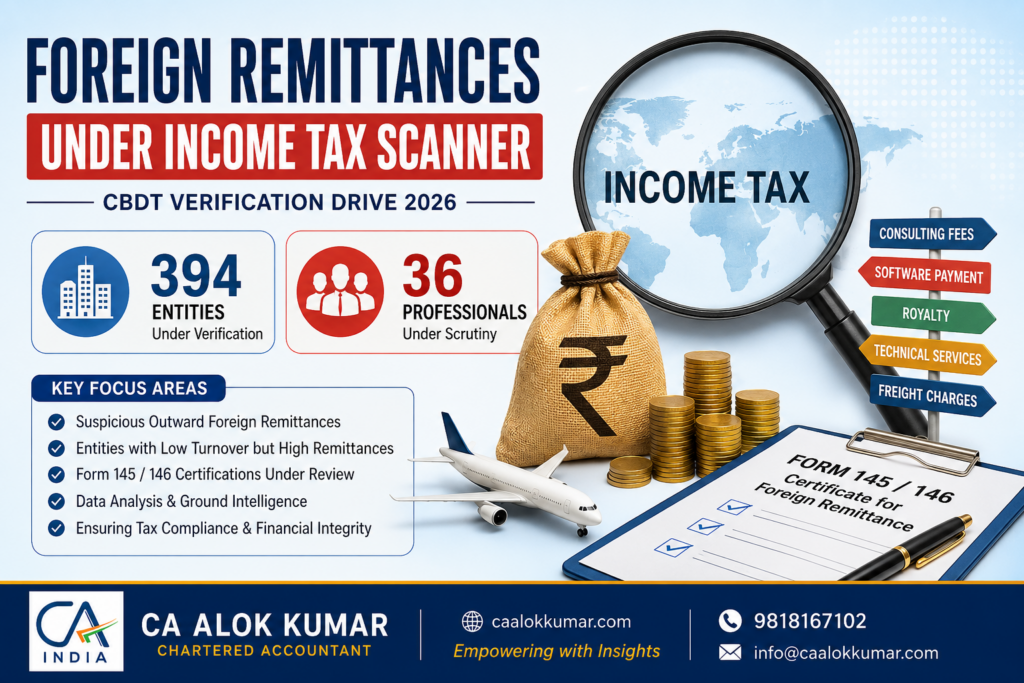
The Foreign Remittance Income Tax compliance framework has come under heightened scrutiny after the Income Tax Department launched a nationwide verification exercise into suspicious outward remittances involving hundreds of entities and professionals.
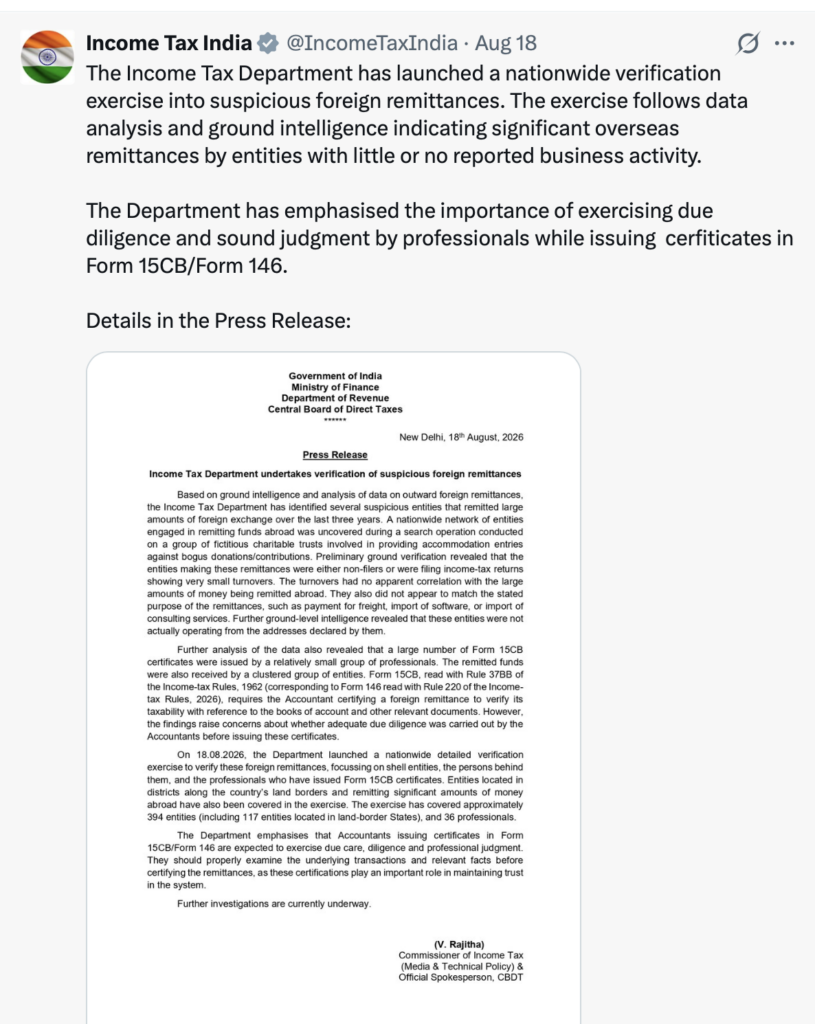
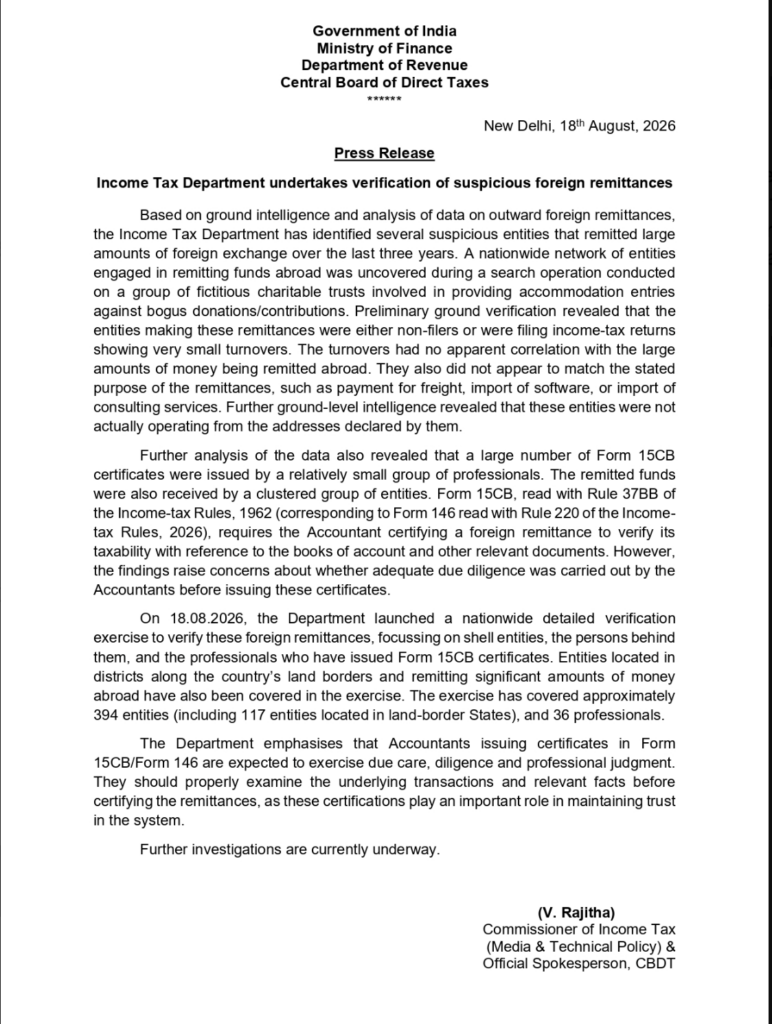
In a press release dated 18 August 2026, the Central Board of Direct Taxes (CBDT) stated that analysis of outward foreign-remittance data, supported by ground-level intelligence, had identified entities sending substantial sums overseas despite having little or no corresponding business turnover. The Department’s official communication confirms that the exercise is examining suspicious foreign remittances as well as professionals associated with Form 15CB/Form 146 certification.
The exercise reportedly covers approximately 394 entities, including 117 entities situated in land-border States, and 36 professionals connected with foreign-remittance certificates. Importantly, this is presently a verification and investigation exercise. Inclusion in the exercise does not, by itself, establish tax evasion, FEMA violation or professional misconduct. CBDT has stated that further investigation is underway.
The development is particularly significant because, from 1 April 2026, the old Form 15CA and Form 15CB framework has transitioned to Form 145 and Form 146 under the Income-tax Act, 2025 and Income-tax Rules, 2026.
What Triggered the Foreign Remittance Income Tax Verification?
Interestingly, the investigation did not apparently begin as a standalone review of overseas remittances.
According to CBDT’s disclosure, a wider network of entities remitting funds outside India surfaced during a search operation involving a group of alleged fictitious charitable trusts. These trusts were suspected of facilitating accommodation entries against bogus donations or contributions.
Analysis of information arising from that investigation was then combined with data relating to outward foreign remittances.
The Department reportedly noticed a number of unusual patterns. Some remitters were non-filers of income-tax returns, while others were showing very small turnovers that appeared inconsistent with the substantial foreign exchange remitted by them. In certain cases, even the stated purpose of remittance—such as freight charges, software imports or consulting services—did not appear to correspond with the business profile or turnover of the remitter. Some entities were also reportedly not found operating from their declared addresses.
This explains an important feature of the present exercise: the Department is apparently looking beyond whether a Form 15CB/Form 146 was merely filed. It is examining whether the underlying commercial transaction itself was genuine and supported by the financial capacity and business substance of the remitter.
Why Form 15CB and Form 146 Have Become Important in the Investigation
CBDT has also highlighted another significant pattern: a substantial number of the relevant Form 15CB certificates had reportedly been issued by a comparatively small group of professionals.
That concentration appears to have triggered questions about whether adequate verification and professional due diligence had been undertaken before certifying the remittances.
This point deserves attention because a foreign-remittance certificate is not intended to be a routine or mechanical certification based solely on documents handed over by a client.
Under the current framework, Form 146 is an accountant’s certificate used where a taxable payment to a non-resident or foreign company exceeds the prescribed ₹5 lakh threshold and the remitter proposes to file Part C of Form 145. The Income Tax Department’s own Form 146 manual explains that the Chartered Accountant is expected to review the nature of payment, its taxability and the amount of tax required to be deducted.
Businesses and individuals making overseas payments can refer to our detailed guide on Form 145 and Form 146 – CA Certificate for Foreign Remittance for the current compliance framework.
Form 15CA/15CB Is Now Form 145/146 From 1 April 2026
The terminology used in CBDT’s press release may create some confusion because the underlying transactions extend over the preceding three years, when Form 15CA and Form 15CB were applicable.
For remittances made on or after 1 April 2026, the new Income-tax Act, 2025 applies to the procedural filing requirement. The Income Tax Department has officially clarified the following transition:
| Earlier framework | From 1 April 2026 |
| Form 15CA | Form 145 |
| Form 15CB | Form 146 |
| Section 195 withholding framework | Section 393 |
| Section 195(6) reporting requirement | Section 397(3)(d) |
| Rule 37BB | Rule 220 |
| Section 197 lower/nil deduction | Section 395 |
The Income-tax Act, 2025 came into force from 1 April 2026, except where otherwise specifically provided.
There is also an important transitional rule. Where a liability accrued before 1 April 2026 but payment is actually remitted after that date, the Department has clarified that the procedural filing requirement follows the law in force on the date of remittance, while the taxability of the underlying income follows the law applicable to the year in which the income accrued.
For quick identification of old and new form numbers, taxpayers may also use the Income Tax Form Finder – 1961 Act to 2025 Act.
When Is Form 146 Required?
Under Rule 220 and the current Form 145 framework, the treatment broadly depends upon the nature and amount of the remittance.
The Income Tax Department has clarified that Form 145 contains four parts. Part A generally applies to taxable remittances within the ₹5 lakh threshold; Part B applies where the taxable remittance exceeds ₹5 lakh and an Assessing Officer’s certificate under section 395 has been obtained; Part C applies where the taxable remittance exceeds ₹5 lakh and a Form 146 certificate from an accountant has been obtained; and Part D applies to non-taxable remittances, subject to the exceptions specified in Rule 220.
Where Part B is used on the strength of an Assessing Officer’s certificate, a separate Form 146 is not required.
The new system also integrates UDIN verification through the ICAI API, providing an additional authentication layer for Form 146 certificates.
Professional assistance for Form 145/Form 146 foreign remittance filing and CA certification should therefore involve examination of the transaction and tax position rather than merely preparation of the online forms.
What Should a Chartered Accountant Verify Before Issuing Form 146?
The present CBDT action reinforces the need for a proper transaction-level working paper file.
The official Form 146 framework requires consideration of the nature and purpose of payment, taxability under Indian law, applicable DTAA provisions, TDS liability and supporting documentation. The portal’s Form 146 guidance specifically describes the CA’s role as reviewing the payment and confirming the applicable tax responsibility.
In practical terms, a robust certification file should ordinarily address the following:
- Identity and business profile of the Indian remitter and foreign recipient.
- Invoice, contract, engagement letter, purchase order or other underlying commercial document.
- Nature and actual purpose of the remittance.
- Correlation between the remittance and the remitter’s books, turnover and business activity.
- Whether the payment is chargeable to tax in India under the applicable provisions dealing with scope and deemed accrual of income.
- Relevant DTAA Article, if treaty benefit is claimed.
- Tax Residency Certificate and other prescribed treaty documentation, wherever required.
- Applicable withholding-tax rate and computation of TDS.
- RBI/AD-bank purpose code and its consistency with the commercial documents.
- Evidence demonstrating that the overseas recipient and transaction have genuine economic and commercial substance.
This is particularly relevant after the present CBDT exercise because a perfectly completed certificate may still attract questions if the economic reality of the transaction does not correspond with the documents on record.
What Red Flags Is the Income Tax Department Apparently Looking For?
The CBDT action provides useful insight into the risk parameters that businesses and professionals should now take seriously.
A high-value overseas payment by itself is not suspicious. The risk arises where the transaction does not make commercial or financial sense when compared with other available data.
For example, a company reporting turnover of only a few lakh rupees but regularly remitting several crores overseas for consulting or software services would naturally require explanation. Similar questions may arise where the registered office is non-operational, the overseas recipients are concentrated among a small group, the business has little evidence of the service allegedly received, or a large number of certificates originate from a limited group of certifying professionals.
This increasingly reflects data-driven tax administration, where information reported in tax returns is capable of being compared with TDS records, banking/remittance information, financial reporting and intelligence gathered during investigation.
Possible Income-Tax Consequences for the Remitter
The consequences will depend entirely upon what the verification ultimately establishes.
Where a remittance and its supporting transaction are genuine and correctly taxed, the taxpayer should be able to substantiate the position with proper documentation. But if discrepancies are established, the exposure can extend beyond merely correcting Form 145.
1. Penalty for incorrect Form 145 information
Section 397(3)(d) of the Income-tax Act, 2025 contains the information-reporting framework relevant to payments to non-residents.
Section 462 specifically provides that where a person required to furnish information under section 397(3)(d) fails to furnish it or furnishes inaccurate information, the Assessing Officer may impose a penalty of ₹1,00,000.
2. TDS consequences
Where a payment to the overseas recipient was taxable in India but appropriate tax was not deducted or deposited, section 398 becomes relevant.
Under section 398, a person who fails to deduct, collect or pay tax as required may be treated as an assessee in default, in addition to other consequences prescribed under the Act.
Accordingly, a foreign-remittance investigation may ultimately involve examination not only of Form 145/146 but also the underlying withholding-tax position under section 393, treaty entitlement and the true character of the foreign payment.
3. Wider assessment or investigation
Where the transaction reveals unexplained or unreported income, bogus expenditure, non-genuine arrangements or other discrepancies, the Department may proceed under the applicable assessment, reassessment, penalty or investigation provisions depending upon the evidence and relevant tax year.
Taxpayers facing information-based selection may review the current Income Tax Scrutiny Guidelines for FY 2026-27.
Consequences for Chartered Accountants Issuing Incorrect Form 146 Certificates
Professionals are a distinct focus of the 18 August 2026 verification exercise.
Section 463 of the Income-tax Act, 2025 provides that an accountant, merchant banker or registered valuer may be liable to a ₹10,000 penalty for incorrect information contained in a report or certificate. Importantly, the penalty applies for each report or certificate in which incorrect information is found during proceedings under the Act.
Therefore, where multiple Form 146 certificates are involved, the statutory exposure is not necessarily confined to one ₹10,000 penalty.
At the same time, the existence of an incorrect commercial representation by the client does not automatically mean that the certifying professional has committed wrongdoing. The crucial questions would include what documents were available, what verification was reasonably undertaken, whether warning signs were apparent and whether professional judgment and due diligence were appropriately exercised.
The CBDT announcement should therefore be understood as a strong reminder that Form 146 certification carries substantive professional responsibility.
Can FEMA Proceedings Also Arise?
Possibly—but not automatically.
CBDT’s present exercise is an Income Tax Department verification. A suspicious tax profile does not by itself establish a contravention of the Foreign Exchange Management Act, 1999.
However, if further investigation establishes that foreign exchange was remitted contrary to FEMA, applicable rules, RBI regulations, directions or the conditions of an authorised transaction, separate FEMA consequences may arise.
Section 13 of FEMA provides that, upon adjudication, a contravention may attract a penalty of up to three times the sum involved where the amount is quantifiable, or up to ₹2 lakh where it is not quantifiable. For a continuing contravention, an additional penalty of up to ₹5,000 per day may apply. RBI also provides a statutory compounding mechanism for eligible FEMA contraventions.
Businesses dealing with NRI payments, repatriation and cross-border transactions may therefore consider an integrated NRI taxation and FEMA advisory, rather than examining income tax and foreign-exchange compliance in isolation.
What Businesses Should Do After the CBDT Foreign Remittance Alert
Businesses that have made substantial overseas remittances—particularly during the last three years—should consider conducting a foreign-remittance compliance review before receiving a notice.
The objective should not be to generate documents retrospectively, but to ensure that transactions already undertaken can be reconciled with genuine contemporaneous records.
A useful review would compare the bank’s outward-remittance records with the general ledger, invoices, agreements, Form 15CA/15CB or Form 145/146, applicable TDS returns, foreign-party ledger balances and income-tax returns. Particular attention should be given to transactions where remittances are unusually high relative to turnover, payments are made to newly incorporated or related overseas entities, the purpose code does not correspond with the invoice, or services received from the foreign party cannot be independently demonstrated.
Received an Income Tax Notice on Foreign Remittances? Do Not Reply in Isolation
Where the Department seeks clarification, the response should ideally explain the entire transaction trail rather than answer individual questions in fragments.
The reconciliation should connect:
agreement → invoice → accounting entry → taxability analysis → TDS → Form 15CB/Form 146 → Form 15CA/Form 145 → bank remittance → evidence of receipt of goods/services.
Any inconsistency among these records can itself create additional questions.
Where a notice has already been issued, professional assistance for income-tax scrutiny and verification, tax litigation and notice defence or an income-tax demand notice response may be appropriate depending upon the stage of proceedings.
Why This CBDT Action Matters Beyond the 394 Entities
The larger message from the 18 August 2026 action is more significant than the number of entities presently under verification.
Historically, Form 15CB was sometimes perceived primarily as a bank-remittance compliance certificate. The present action demonstrates that the Department may analyse the certificate together with the financial capacity of the remitter, tax-return profile, business activity, registered address, overseas recipient, transaction purpose and the pattern of certificates issued by the professional.
That means future compliance is likely to be judged on substance rather than form alone.
A taxpayer may therefore have a properly uploaded Form 146 and still face scrutiny if the transaction itself appears commercially implausible.
Conversely, a genuine high-value remittance supported by authentic contracts, actual business activity, proper withholding-tax analysis and verifiable commercial evidence should be capable of being explained even if selected for verification.
Frequently Asked Questions on Foreign Remittance Income Tax Scrutiny
What has CBDT announced regarding suspicious foreign remittances?
CBDT announced a nationwide verification exercise beginning on 18 August 2026 involving suspected irregularities in outward foreign remittances. Approximately 394 entities and 36 professionals have reportedly been covered, including 117 entities in land-border States.
Does CBDT’s verification mean all 394 entities have evaded tax?
No. The announcement concerns verification and ongoing investigation. A final adverse finding cannot be presumed merely because an entity or professional is covered by the exercise.
Is Form 15CB still applicable in 2026?
For remittances made on or after 1 April 2026, Form 15CB has been replaced by Form 146, while Form 15CA has been replaced by Form 145 under the Income-tax Act, 2025 and Income-tax Rules, 2026.
What is the new section for Form 145/Form 146 reporting?
The corresponding reporting requirement is under section 397(3)(d) of the Income-tax Act, 2025, read with Rule 220 of the Income-tax Rules, 2026.
When is Form 146 generally required?
Form 146 is relevant where a payment to a non-resident or foreign company is chargeable to tax and the payment or aggregate of payments exceeds ₹5 lakh during the tax year, where the remitter uses Part C of Form 145.
What is the penalty for inaccurate information in Form 145?
Section 462 provides for a penalty of ₹1,00,000 where information required under section 397(3)(d) is not furnished or inaccurate information is furnished.
What is the penalty for an incorrect Form 146 certificate?
Under section 463, an accountant may be liable to ₹10,000 for each report or certificate containing incorrect information, where the statutory conditions are satisfied.
Should genuine businesses also review past foreign remittances?
Yes. A preventive reconciliation is advisable where material overseas remittances have been made, especially if the amounts are substantial relative to turnover or involve consulting, software, royalty, technical services, freight or other payments whose tax treatment depends upon the nature of the transaction.
Conclusion: Foreign Remittance Compliance Has Moved From Form-Based to Data-Based Verification
The Foreign Remittance Income Tax scrutiny announced by CBDT on 18 August 2026 marks an important compliance development for Indian businesses, remitters and Chartered Accountants.
The immediate exercise covers around 394 entities and 36 professionals, but its broader message is clear: the Income Tax Department is capable of testing an overseas remittance against the taxpayer’s turnover, return-filing history, business profile, registered address, recipient pattern, stated remittance purpose and professional certification.
For remittances made on or after 1 April 2026, taxpayers should ensure correct compliance through Form 145/Form 146 under section 397(3)(d) and Rule 220, together with proper TDS and DTAA analysis.
For Chartered Accountants, the development reinforces a fundamental principle: Form 146 should be issued only after sufficient examination of the taxability, documentation and commercial substance of the underlying transaction.
For businesses, the safest approach is equally straightforward—every foreign remittance should tell the same story across the books of account, invoice, contract, tax deduction, Form 145/146 and banking documents.
That consistency may prove to be the most effective defence in an increasingly data-driven income-tax environment.
Taxpayers with overseas bank accounts, investments, properties or other foreign assets should also ensure correct reporting of foreign assets and foreign income in their income-tax returns. With increasing data sharing and scrutiny of cross-border transactions, non-disclosure can lead to significant tax and compliance consequences. Taxpayers may also review the Foreign Assets Disclosure Scheme 2026 to understand the available framework for reporting previously undisclosed foreign assets and income and regularising past non-compliance.
Disclaimer: This article is intended for professional and educational information. Taxability of a foreign remittance depends upon the nature of payment, residential status of the recipient, applicable provisions of the Income-tax Act, relevant DTAA, FEMA/RBI requirements and the specific facts of each transaction. The CBDT verification referred to above is ongoing as of 19 August 2026 and should not be treated as a final finding against any particular entity or professional.
Leave a Reply