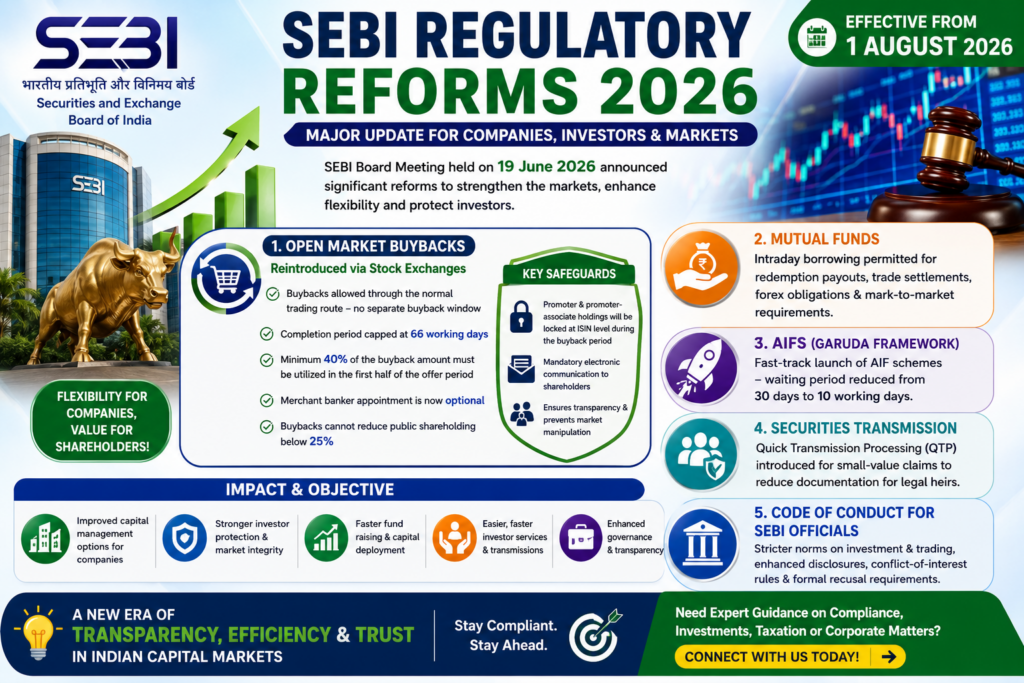
SEBI Regulatory Reforms 2026: Important Update on Buybacks, AIFs, Mutual Funds and Investor Protection
The SEBI regulatory reforms 2026 announced after the SEBI Board meeting dated 19 June 2026 mark an important shift in India’s capital market framework. The most significant change is the reintroduction of open market buybacks through stock exchanges from 1 August 2026, along with new safeguards for promoter holdings, public shareholding, investor communication and execution discipline. SEBI’s own press-release listing confirms the June 19 Board meeting update as PR No. 35/2026. (Securities and Exchange Board of India)
The reforms also cover mutual fund liquidity management, Alternative Investment Fund scheme launches, simplified transmission of securities, municipal debt, securitisation and a stricter governance framework for SEBI officials. Reuters reported that open market buybacks through stock exchanges will restart from 1 August 2026, with a 66-working-day completion window and a requirement to deploy at least 40% of the buyback amount in the first half of the offer period. (Reuters)
For companies, CFOs, investors, merchant bankers, fund managers and tax professionals, these reforms are not merely procedural. They affect capital allocation, shareholder exits, investor communication, mutual fund liquidity, AIF fund launch timelines and tax planning around buybacks. Companies considering buybacks or other capital restructuring should also review their financial statements, board approvals, audit position and tax impact with professional support through audit and assurance services and virtual CFO services.
Table of Contents
- What are the key SEBI regulatory reforms 2026?
- Open market buybacks through stock exchanges return from 1 August 2026
- Key safeguards for buybacks
- Tax impact of buybacks for shareholders
- Mutual funds allowed intraday borrowing for liquidity mismatches
- GARUDA framework for faster AIF scheme launches
- Quick Transmission Processing for legal heirs
- Stricter code of conduct for SEBI officials
- Practical impact for companies, investors and professionals
- FAQs on SEBI regulatory reforms 2026
What are the Key SEBI Regulatory Reforms 2026?
The SEBI regulatory reforms 2026 are part of a wider effort to balance ease of doing business with investor protection. The reforms cover corporate actions, fund management, investor services and regulator governance.
The uploaded note summarises the reforms under four broad heads: reintroduction of open market buybacks, enhanced safeguards, stricter conduct rules for SEBI officials and additional market reforms covering mutual funds, AIFs and securities transmission.
The most market-sensitive reform is the comeback of open market buybacks through stock exchanges. SEBI had invited public comments in April 2026 on the reintroduction of open market buybacks through stock exchanges, and the Board later approved the reform at its June 2026 meeting. (Securities and Exchange Board of India)
Open Market Buybacks Through Stock Exchanges Return from 1 August 2026
SEBI has approved amendments to the SEBI buyback framework to allow listed companies to undertake buybacks through stock exchanges from 1 August 2026. This gives companies an additional route for returning surplus capital to shareholders, along with existing routes such as tender offer and book-building. (ICICI Direct)
Under the revised framework:
| Particular | SEBI Reform |
| Effective date | 1 August 2026 |
| Route | Open market buyback through stock exchanges |
| Separate buyback window | Not required |
| Execution | Normal trading market |
| Completion period | 66 working days |
| Fund deployment | Minimum 40% of earmarked amount in first half |
| Merchant banker | Optional |
| Promoter trading | Promoter and promoter-associate holdings frozen at ISIN level |
| Public shareholding | Buyback cannot breach minimum 25% public float |
This is important for listed companies because the open market route may reduce execution complexity and compliance cost. However, it also requires careful planning of board approvals, public announcements, fund deployment, promoter restrictions, public shareholding checks and shareholder communication.
For companies planning capital restructuring, buybacks, fundraising or pre-IPO compliance, virtual CFO and accounting outsourcing services can be contextually linked because the service page covers investor-ready financials, due diligence, board-level reporting, funding support and pre-IPO readiness.
Key Safeguards for Buybacks
SEBI has not restored open market buybacks without safeguards. The framework is designed to prevent token buybacks, price manipulation and promoter participation during the buyback window.
Three safeguards are particularly important.
First, companies must complete the buyback within 66 working days. Second, they must deploy at least 40% of the earmarked amount during the first half of the buyback period. Third, promoter and promoter-associate holdings will remain frozen at the ISIN level during the buyback period. Reuters and ICICI Direct both report these safeguards. (Reuters)
SEBI has also required electronic dissemination of information to shareholders, in addition to newspaper advertisements, and the buyback must not cause a breach of the minimum public shareholding requirement. (ICICI Direct)
Companies should therefore treat the new route as a structured corporate action, not merely a treasury decision. The buyback plan should be supported by proper financial analysis, board papers, statutory audit readiness, secretarial compliance and tax working.
Tax Impact of Buybacks for Shareholders
The tax angle is especially important because SEBI’s buyback reform is aligned with changes in the taxation framework. Several professional updates have noted that from FY 2026-27, buyback proceeds are expected to be taxed as capital gains in the hands of shareholders rather than as dividend-style income. (KPMG)
For individual investors, this means buyback participation should be reviewed along with holding period, cost of acquisition, capital gains classification, grandfathering where relevant, AIS/TIS reporting and ITR schedules. Investors can use the capital gain tax calculator for an indicative estimate of capital gains on listed shares, mutual funds and other assets. The page also covers LTCG/STCG computation, Schedule CG reporting and document-backed capital gains review. (caalokkumar.com)
Where buyback proceeds, listed equity gains or mutual fund gains are to be reported in the income-tax return, the correct service backlink is ITR filing for capital gains, because that page specifically covers capital gains from shares, equity mutual funds, F&O, AIS/TIS reconciliation and ITR filing for taxpayers with investment income. (caalokkumar.com)
Companies subject to tax audit should also evaluate the reporting implications of buybacks and capital transactions. The tax audit services page is relevant because it covers tax audit reporting and specifically discusses buyback-related reporting points in audit context. (caalokkumar.com)
Mutual Funds Allowed Intraday Borrowing for Liquidity Mismatches
Another important part of the SEBI regulatory reforms 2026 relates to mutual funds. SEBI has approved amendments permitting mutual funds to use intraday borrowing to manage temporary liquidity and settlement mismatches. LiveLaw reports that the facility can be used for differences arising from pay-in/pay-out settlement timings, forex settlements and mark-to-market payment obligations. (Live Law Biz)
This reform is not intended to allow leverage for return enhancement. JSA’s analysis notes that intraday borrowing is meant for operational liquidity management and must ordinarily be repaid before close of business; any borrowing extending beyond the day must remain within existing regulatory limits. (JSA)
For investors, this reform should improve operational efficiency in mutual fund settlement without changing the basic principle that mutual fund investments remain market-linked. Investors with substantial mutual fund portfolios should also maintain accurate tax reporting, especially where units are sold, switched or redeemed.
GARUDA Framework for Faster AIF Scheme Launches
SEBI has approved the GARUDA framework, which stands for Green-Channel: AIF Rollout Upon Document Acknowledgement. This framework aims to reduce the time required for launching Alternative Investment Fund schemes.
Under the approved framework, regular AIF schemes may be launched within 10 working days after the prescribed filing process, while certain accredited-investor-only schemes and angel funds receive additional flexibility. JSA reports that the GARUDA mechanism reduces timelines while retaining disclosure and investor protection standards. (JSA)
This is significant for fund managers because private capital deployment often depends on speed. A faster AIF launch process may help fund managers capture investment opportunities more efficiently.
For startups, SMEs and companies preparing for fund raising, the relevant internal backlink is virtual CFO services, as that page covers investor-ready financials, due diligence, cap table support, funding readiness and coordination with merchant bankers and legal teams. (caalokkumar.com)
Quick Transmission Processing for Legal Heirs
SEBI has also approved a simplified mechanism called Quick Transmission Processing for small-value claims involving securities of deceased investors. The aim is to reduce documentation burden and speed up transmission of securities to legal heirs and claimants.
LiveLaw reports that SEBI introduced QTP for small-value claims and approved relaxations to enable faster transfer of securities to legal heirs with reduced documentation. (Live Law Biz)
This is a useful investor protection reform. In many families, transmission of shares, mutual funds and demat holdings becomes difficult due to procedural delays, missing nominations, inconsistent KYC details or absence of proper documentation. Investors should review nominations, joint holdings, demat details, PAN, Aadhaar and succession documents periodically.
For families and investors requiring broader financial documentation and ITR support, CA in Dwarka is a useful local backlink because the page covers ITR filing, capital gains, net worth certificates, audit, company registration, NRI/FEMA and CA services in Dwarka. (CA in Dwarka — caindwarka.com)
Stricter Code of Conduct for SEBI Officials
SEBI has also adopted a stricter code of conduct for senior officials. Reuters reports that SEBI approved voluntary adoption of stricter conduct rules requiring senior officials to liquidate or freeze equity holdings and refrain from trading while in office. (Reuters)
This governance reform is important because a regulator’s credibility depends not only on rules imposed on market participants but also on its own internal independence, conflict-of-interest management and disclosure standards.
In governance-sensitive matters such as board reporting, internal controls, related-party review, special audits and regulatory readiness, audit and assurance services is a relevant backlink because the page covers statutory audit, internal audit, forensic audit, due diligence, regulatory assignments and certified reports for SEBI/NCLT contexts. (caalokkumar.com)
Practical Impact for Companies, Investors and Professionals
The SEBI regulatory reforms 2026 will have different implications for different stakeholders.
For listed companies, open market buybacks may become a practical tool for capital management. However, companies must review liquidity, shareholder base, minimum public shareholding, tax impact and compliance readiness before announcing a buyback.
For promoters, the ISIN-level freeze during the buyback period is a major safeguard. Promoters and promoter associates must avoid any direct or inadvertent trading during the buyback window.
For retail investors, buybacks should be evaluated from both price and tax perspectives. The post-tax outcome may differ depending on holding period, acquisition cost and capital gains treatment.
For mutual funds, intraday borrowing can reduce settlement friction but cannot be treated as leverage for scheme performance.
For AIFs, GARUDA may reduce time-to-market and support faster capital deployment.
For legal heirs and claimants, QTP should simplify transmission in small-value cases, provided KYC and succession documentation are kept updated.
Businesses planning incorporation, fundraising or eventual listing should also establish proper accounting, ROC compliance and governance systems from the beginning. New entrepreneurs may refer to Company Formation & Business Registration in Dwarka, which covers private limited company registration, LLP registration, DSC, DIN, MCA filing, compliance setup and post-incorporation support. (CA in Dwarka — caindwarka.com)
Practical Checklist
Before acting on the SEBI buyback and capital-market reforms, companies and investors should check:
- Whether the company is eligible for open market buyback
- Whether public shareholding will remain at or above 25%
- Whether promoters and promoter associates are properly restricted
- Whether the 66-working-day execution period is feasible
- Whether 40% deployment in the first half can be achieved
- Whether shareholder communication is ready
- Whether buyback taxation has been computed correctly
- Whether ITR reporting for shareholders is properly planned
- Whether audit, secretarial and board documents are aligned
- Whether demat nomination and securities transmission records are updated
For end-to-end compliance support, the article should contextually link to ROC filing and annual compliance services, especially where listed or unlisted companies also need Companies Act filings, annual ROC compliance, director KYC, financial statement filing and related corporate compliance. (caalokkumar.com)
FAQs on SEBI Regulatory Reforms 2026
1. What is the most important SEBI regulatory reform announced in June 2026?
The most important reform is the reintroduction of open market buybacks through stock exchanges from 1 August 2026. The framework allows companies to buy back shares through normal stock exchange trading, subject to safeguards. (ICICI Direct)
2. What is the timeline for completing open market buybacks?
Companies undertaking open market buybacks through stock exchanges must complete the buyback within 66 working days. (Reuters)
3. What is the 40% deployment rule?
At least 40% of the earmarked buyback amount must be utilised during the first half of the buyback period. This reduces the risk of companies announcing buybacks without meaningful execution. (Reuters)
4. Can promoters sell shares during an open market buyback?
Promoter and promoter-associate holdings will be frozen at the ISIN level during the buyback period to prevent trading during the buyback. (ICICI Direct)
5. What is GARUDA in SEBI reforms?
GARUDA stands for Green-Channel: AIF Rollout Upon Document Acknowledgement. It is a faster mechanism for launching AIF schemes, with regular AIF schemes capable of launch within 10 working days after the prescribed filing process. (JSA)
6. What is Quick Transmission Processing?
Quick Transmission Processing is a simplified process approved by SEBI for small-value securities transmission claims by legal heirs and claimants. It is intended to reduce documentation and speed up securities transmission. (Live Law Biz)
7. What should investors do after these reforms?
Investors should review buyback tax impact, capital gains reporting, demat nominations, PAN/KYC status and ITR reporting. For capital gains and share transactions, ITR filing for capital gains is the most relevant service page.
Practical Takeaway
The SEBI regulatory reforms 2026 reflect a balanced approach: easier corporate actions and faster fund launches, but with stronger safeguards, better disclosures and improved investor protection. The return of open market buybacks from 1 August 2026 is the headline reform, but the impact of GARUDA, mutual fund intraday borrowing, QTP and SEBI’s code of conduct will also be significant.
For companies, the next step is not merely to welcome the reform but to prepare proper compliance, audit, tax and governance systems. For investors, the key is to evaluate buybacks after considering both market price and capital gains tax impact.
Leave a Reply