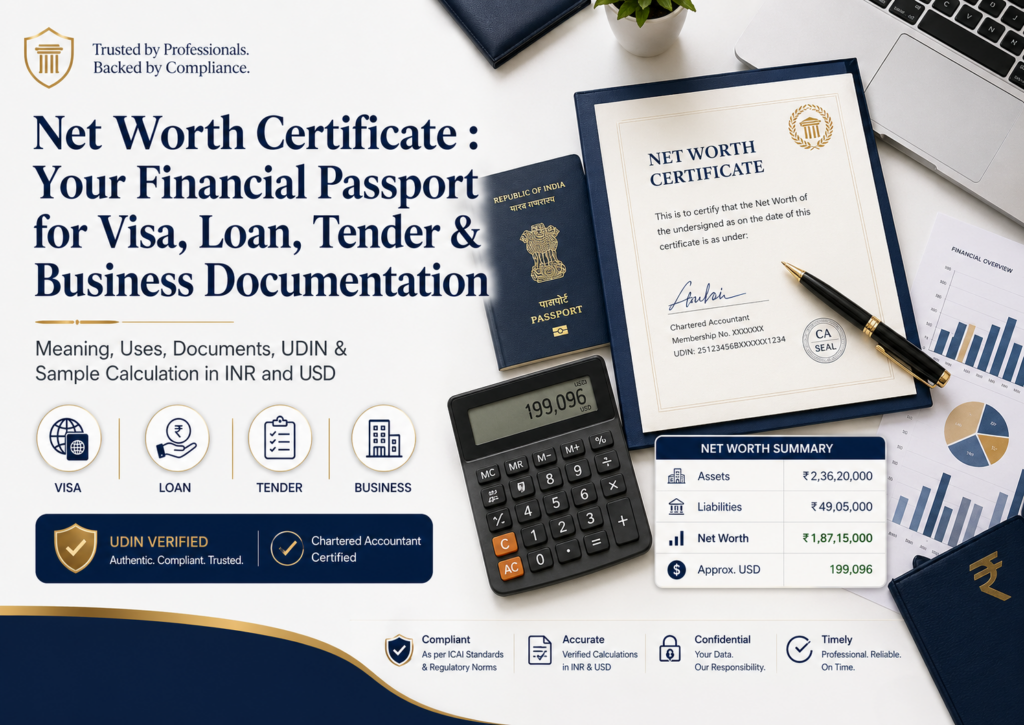
Net Worth Certificate by CA: Why This Document Matters
In many financial, immigration, banking and business situations, a simple declaration of assets is not enough. Banks, embassies, tender authorities, financial institutions, investors and regulators may require a professionally certified statement showing the actual financial strength of a person or entity.
This is where a Net Worth Certificate issued by a Chartered Accountant becomes important.
A Net Worth Certificate shows the value of assets, liabilities and the resulting net worth as on a specific date. When it is issued by a practising Chartered Accountant with UDIN, it becomes a more reliable and verifiable financial document.
For professional assistance, you may refer to our dedicated service page on Net Worth Certificate by Chartered Accountant.
What is a Net Worth Certificate?
A Net Worth Certificate is a certificate issued by a practising Chartered Accountant certifying the financial worth of an individual, HUF, firm, LLP, company or other entity as on a particular date.
In simple words:
Net Worth = Total Assets – Total Liabilities
For an individual, assets may include bank balance, fixed deposits, mutual funds, shares, immovable property, PPF, EPF, NPS, gold, jewellery, insurance surrender value and business capital. Liabilities may include home loan, personal loan, vehicle loan, education loan, business loan, credit card outstanding, tax dues and other obligations.
For companies, the term “net worth” has a statutory meaning under section 2(57) of the Companies Act, 2013. Therefore, in company-related matters, the calculation should be aligned with the statutory definition, audited balance sheet and applicable corporate law requirements.
Why UDIN is Important
A Net Worth Certificate should generally be issued with UDIN — Unique Document Identification Number.
ICAI made UDIN mandatory for all certificates issued by practising Chartered Accountants with effect from 1 February 2019. ICAI introduced UDIN to prevent misuse of CA signatures and fake financial certificates.
ICAI’s UDIN directions also clarify that members in practice must generate UDIN for certificates, GST and tax audit reports and other audit, assurance and attestation functions from the notified dates.
Therefore, for banks, embassies, tender authorities and other users, a UDIN-based Net Worth Certificate provides an additional layer of authenticity.
Common Uses of Net Worth Certificate
1. Visa and Immigration Applications
A Net Worth Certificate is often used to support visa documentation, especially where the applicant or sponsor needs to show financial capacity.
For example, Canada’s study permit guidance requires proof of funds for tuition, living expenses and transportation. It recognises documents such as bank statements, GIC, education loan proof and financial support documents.
Similarly, UK student visa guidance clarifies that certain assets such as cryptocurrency, stocks and shares, pensions and overdrafts are not acceptable as financial evidence for that specific route.
Therefore, a Net Worth Certificate may support the overall financial profile, but it should not be treated as a substitute for country-specific visa proof of funds.
2. Bank Loan and Credit Facilities
Banks may ask for a Net Worth Certificate while processing home loans, business loans, overdraft limits, cash credit facilities, bank guarantees or project finance.
It helps the bank understand the borrower’s overall financial position, repayment capacity and asset-liability strength.
Related service pages:
3. Government Tenders and PSU Contracts
Many tenders require bidders to prove minimum net worth. Contractors, service providers, suppliers, MSMEs and companies may be required to submit a CA-certified Net Worth Certificate in the prescribed format.
Where tender documents also require tax, GST or business compliance, the following pages may be useful:
4. NRI and Foreign Remittance Documentation
NRIs may require a Net Worth Certificate for immigration, overseas investment, family settlement, Indian asset declaration, NRO fund repatriation or bank documentation.
For resident individuals, RBI’s Liberalised Remittance Scheme permits remittance up to USD 2,50,000 per financial year for permitted current or capital account transactions. RBI also states that PAN is mandatory for LRS transactions, and authorised dealers must comply with applicable tax law requirements.
Related reading:
- CA Certificate for Remittance of Funds Outside India
- CA Certificate & Foreign Remittance
- RBI Law on Foreign Money Transfer – LRS Scheme
- NRE vs NRO Account Guide for NRIs
5. Company, Director and Promoter Documentation
Companies, directors and promoters may need net worth details for bank finance, investor due diligence, private placement, guarantees, business restructuring or regulatory documentation.
However, where valuation is required under corporate law, a registered valuer’s report may also be required depending on the nature of the transaction. A CA Net Worth Certificate and a registered valuation report should not be casually treated as the same document.
Documents Required for Net Worth Certificate
The documents depend on the purpose, asset profile and authority requiring the certificate. Common documents include:
Identity and Tax Documents
- PAN card
- Aadhaar card
- Passport, especially for visa or NRI cases
- latest ITR acknowledgement
- computation of income
- Form 26AS
- AIS and TIS
- salary slips or business financial statements
- audited financial statements, if applicable
Asset Documents
- bank statements
- fixed deposit receipts
- demat holding statement
- mutual fund portfolio statement
- property documents
- property valuation report, where required
- PPF, EPF, NPS and other investment statements
- insurance surrender value certificate
- gold or jewellery valuation report
- vehicle ownership documents
- capital account in firm, LLP or proprietorship
Liability Documents
- home loan outstanding certificate
- personal loan statement
- vehicle loan statement
- business loan statement
- credit card outstanding
- tax demand, if any
- GST liability, if any
- guarantee or contingent liability details, where relevant
Sample Net Worth Calculation in Rupees and Dollars
Below is a hypothetical example only for understanding how net worth may be calculated. Actual figures, valuation basis and exchange rate must be verified and disclosed in the certificate.
For this illustration, we have assumed:
Exchange Rate: ₹94 = USD 1
This is only an illustrative rate. For an actual certificate, the rate should be taken from the prescribed source, bank rate, FBIL/RBI reference basis or as required by the receiving authority. RBI has stated that FBIL computes and disseminates the USD/INR reference rate and exchange rate of major currencies from 10 July 2018.
Hypothetical Case
Applicant: Mr. A
Purpose: Visa / Bank / Financial Documentation
Date of Net Worth: 31 March 2026
Currency Conversion Used for Illustration: USD 1 = ₹94
| Particulars | Amount in ₹ | Amount in USD |
|---|---|---|
| Bank balance and savings account | ₹18,50,000 | USD 19,681 |
| Fixed deposits | ₹32,00,000 | USD 34,043 |
| Mutual funds | ₹21,75,000 | USD 23,138 |
| Shares and demat holdings | ₹9,80,000 | USD 10,426 |
| PPF / EPF / NPS balance | ₹16,40,000 | USD 17,447 |
| Residential property | ₹1,25,00,000 | USD 1,32,979 |
| Gold and jewellery | ₹8,25,000 | USD 8,777 |
| Vehicle value | ₹4,50,000 | USD 4,787 |
| Total Assets | ₹2,36,20,000 | USD 2,51,277 |
| Less: Home loan outstanding | ₹41,00,000 | USD 43,617 |
| Less: Vehicle loan outstanding | ₹2,80,000 | USD 2,979 |
| Less: Personal loan | ₹4,50,000 | USD 4,787 |
| Less: Credit card outstanding | ₹75,000 | USD 798 |
| Total Liabilities | ₹49,05,000 | USD 52,181 |
| Net Worth | ₹1,87,15,000 | USD 1,99,096 |
Result of the Above Calculation
Based on the above hypothetical figures:
Net Worth = Total Assets – Total Liabilities
Net Worth = ₹2,36,20,000 – ₹49,05,000
Net Worth = ₹1,87,15,000
In USD terms:
₹1,87,15,000 ÷ 94 = USD 1,99,096 approximately
Therefore, the hypothetical net worth of Mr. A is:
₹1.87 crore approximately
USD 1.99 lakh approximately
Important Drafting Note for Dollar Conversion
Where a Net Worth Certificate is required for visa, immigration, foreign education, foreign investment or NRI documentation, the certificate may mention the net worth in both Indian Rupees and foreign currency.
However, the certificate should clearly disclose:
- the exchange rate used;
- the source of the exchange rate;
- date of conversion;
- whether the USD value is only indicative; and
- whether the authority has prescribed any specific conversion method.
This avoids confusion because exchange rates change regularly.
Net Worth Certificate vs Solvency Certificate
A Net Worth Certificate shows the difference between total assets and total liabilities.
A Solvency Certificate generally certifies whether a person or entity is financially capable or solvent up to a specified amount.
For example, if a tender asks for a “Net Worth Certificate from CA”, a CA certificate may be appropriate. But if it specifically asks for a “Solvency Certificate from Bank”, then a CA Net Worth Certificate may not be a substitute unless the tender conditions allow it.
Key Precautions Before Obtaining a Net Worth Certificate
1. Do Not Inflate Asset Values
Property, jewellery, shares, investments and business assets should be valued on a reasonable and supportable basis.
2. Do Not Ignore Liabilities
Loans, credit card dues, tax demands and other liabilities must be properly considered. A certificate showing only assets and ignoring liabilities may be misleading.
3. Keep Documents Traceable
Asset values should be supported by bank statements, investment reports, property documents, valuation reports and tax records.
4. Check the Authority’s Format
Banks, embassies, courts and tender authorities may prescribe their own format. If a format is prescribed, it should be followed.
5. Use Recent Data
A Net Worth Certificate reflects financial position as on a particular date. If there is a major change in assets or liabilities, a fresh certificate may be required.
For related tax-documentation issues, you may also read: Faceless Assessment Cannot Be Faceless Justice: ITAT Relief to Salaried Taxpayer.
Step-by-Step Process to Get a Net Worth Certificate
Step 1: Identify the Purpose
The format and content may differ depending on whether the certificate is required for visa, bank loan, tender, NRI documentation, company matter or legal use.
Step 2: Share the Prescribed Format
If the authority has provided a format, share it with the Chartered Accountant.
Step 3: Submit Documents
Provide identity documents, tax records, asset proofs, liability statements and valuation documents.
Step 4: Verification and Calculation
The CA reviews the documents, prepares the asset-liability statement and calculates net worth.
Step 5: Drafting of Certificate
The certificate is prepared with date, purpose, details of assets and liabilities, assumptions, limitations and currency conversion note, if applicable.
Step 6: UDIN Generation
The CA signs the certificate and generates UDIN for verification.
For professional support, visit: Net Worth Certificate by CA in Delhi.
Frequently Asked Questions
1. Who can issue a Net Worth Certificate in India?
A practising Chartered Accountant can issue a Net Worth Certificate based on documents, verification and professional judgement.
2. Is UDIN required for Net Worth Certificate?
Yes, UDIN is generally required because ICAI made UDIN mandatory for certificates issued by practising Chartered Accountants from 1 February 2019.
3. Can net worth be shown in both INR and USD?
Yes. Where required for visa, immigration, NRI or foreign documentation, net worth may be shown in both Indian Rupees and USD. The exchange rate and source should be clearly mentioned.
4. Can property be included in net worth?
Yes, property can be included if ownership and valuation are properly supported.
5. Can mutual funds and shares be included?
Yes, mutual funds and shares can be included based on latest portfolio or demat statements. However, some visa authorities may not accept such investments as liquid proof of funds.
6. Is Net Worth Certificate sufficient for visa approval?
No. It is a supporting document. Visa authorities may require specific bank statements, loan sanction letters, sponsor documents, GIC or other prescribed evidence depending on the country and visa category.
7. Can NRIs get a Net Worth Certificate from India?
Yes. NRIs can obtain a Net Worth Certificate based on Indian assets, bank balances, investments, properties and liabilities.
8. What is the validity of Net Worth Certificate?
There is no universal validity period. It depends on the receiving authority. Since the certificate is issued as on a specific date, a recent certificate is usually preferred.
Conclusion: Net Worth Certificate Should Be Correct, Not Merely Impressive
A Net Worth Certificate is a powerful financial document. It can support visa applications, bank finance, tender eligibility, NRI documentation, business negotiations and legal matters.
However, its value depends on proper documentation, fair valuation, correct disclosure of liabilities, professional drafting and UDIN verification.
A well-prepared Net Worth Certificate should be:
- purpose-specific;
- supported by reliable documents;
- transparent about assets and liabilities;
- properly valued;
- issued by a practising Chartered Accountant;
- UDIN-verified; and
- clear about INR and USD conversion, wherever applicable.
For a professionally drafted and UDIN-verified certificate, visit: Net Worth Certificate by Chartered Accountant.
- Net Worth Certificate by Chartered Accountant
- CA Certificate for Remittance of Funds Outside India
- ITR Filing & CPC Notice Reply
- Audit & Assurance Services
- GST Registration & Return Filing
- TDS Filing & TDS Notice Reply
- Company & LLP Registration
- CA Certificate & Foreign Remittance
- RBI Law on Foreign Money Transfer – LRS Scheme
- NRE vs NRO Account Guide for NRIs
Leave a Reply