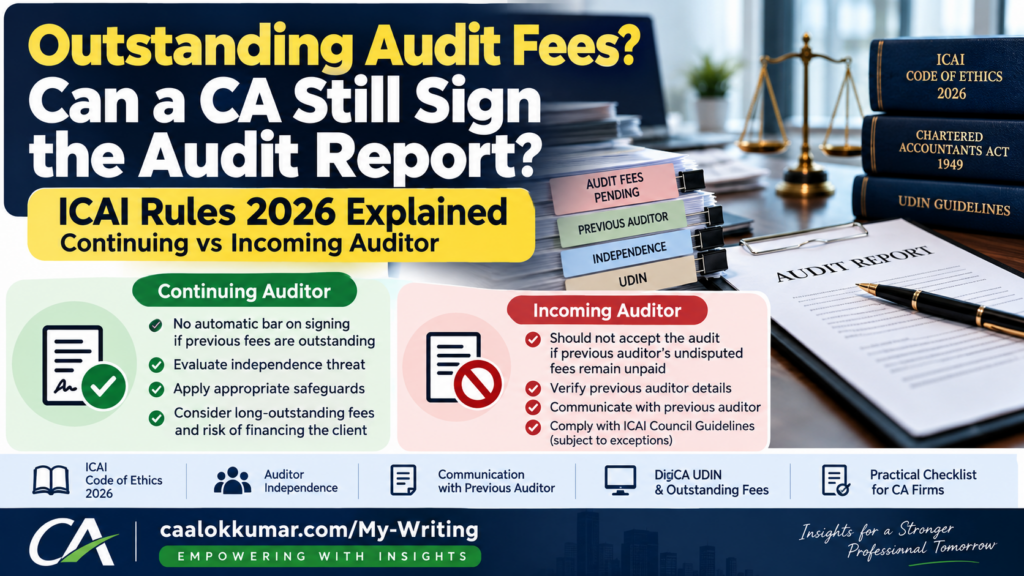
Outstanding Audit Fees : Can a CA Sign the Audit Report? ICAI Rules Explained
Can a CA Sign an Audit Report if Fees Are Outstanding? ICAI Rules 2026 Explained
Outstanding audit fees before signing an audit report have become an important compliance issue for Chartered Accountants, particularly after changes in ICAI’s UDIN system brought greater attention to previous auditors, communication and unpaid audit fees.
But is it really mandatory that 100% of the previous audit fee must be cleared before a Chartered Accountant can sign the next audit report?
Not necessarily.
The ICAI has specifically clarified that a continuing auditor is not automatically prohibited from signing an audit report merely because professional fees of earlier years remain unpaid.
However, significant or prolonged unpaid fees may create a self-interest threat to auditor independence under the ICAI Code of Ethics.
Further, a substantially different rule applies where a new Chartered Accountant is being appointed in place of the previous auditor and the previous auditor’s undisputed statutory audit fees remain unpaid.
Let us understand the Outstanding Audit Fees ICAI Rules applicable in 2026.
ICAI Code of Ethics 2026: The Current Position
The revised ICAI Code of Ethics, 13th Edition, 2026 is applicable from 1 April 2026.
The revised Code has been issued in three volumes and incorporates provisions of the Chartered Accountants Act, 1949, Regulations, Council Guidelines and decisions, along with the converged international ethical framework.
For Chartered Accountants undertaking Tax Audit under Section 44AB, statutory audits and other assurance engagements, auditor independence remains fundamental to the audit process.
Outstanding professional fees therefore need to be examined from an independence perspective, not merely as an issue of recovery of professional dues.
Official reference: ICAI – Revised Code of Ethics, 13th Edition, 2026.
Can a Continuing Auditor Sign if Previous Audit Fees Are Outstanding?
Yes — there is no automatic prohibition.
This point needs to be clearly understood.
The ICAI Ethical Standards Board issued a specific clarification on 7 September 2021 after messages circulated suggesting that a continuing auditor could not sign an audit report where professional fees of earlier years were pending.
ICAI categorically clarified that this proposition was not correct.
ICAI further clarified:
“There is no bar on signing the Audit Report in these circumstances.”
Therefore, an existing auditor does not automatically become ineligible to sign the subsequent audit report simply because the client’s earlier professional fees remain unpaid.
However, this should not be interpreted to mean that unpaid audit fees have no ethical consequences.
Why Can Outstanding Audit Fees Affect Auditor Independence?
The fundamental concern is auditor independence.
Where a significant amount of professional fees remains unpaid for an extended period, the auditor acquires a substantial financial interest in recovering money from the audit client.
That financial dependence can create a self-interest threat.
For example, suppose an audit client has not paid a substantial portion of its audit fees for the previous two or three years.
Before signing another audit report, the auditor must consider whether the accumulated outstanding fees have become significant enough to affect—or reasonably appear to affect—the auditor’s independence and objectivity.
The issue therefore moves beyond:
“Has my client paid my bill?”
to the much more important question:
“Can I continue to demonstrate independence while a significant amount remains recoverable from this audit client?”
What Should a Continuing Auditor Do if Fees Are Outstanding?
A continuing auditor should evaluate the circumstances rather than mechanically treating every unpaid invoice in the same manner.
Important factors may include:
- amount of professional fees outstanding;
- length of time for which the amount has remained unpaid;
- significance of the amount to the CA or audit firm;
- reasons for non-payment;
- whether the amount is genuinely disputed;
- whether substantial fees have accumulated over several audit periods; and
- whether the outstanding balance threatens actual or perceived independence.
The auditor should then consider appropriate safeguards to protect independence.
Safeguards Where Audit Fees Remain Unpaid
Depending upon the facts and circumstances, safeguards may include obtaining payment—at least partly—of the overdue professional fees before the subsequent audit report is issued.
Another safeguard may involve an appropriate review of the audit work by a person who did not participate in the engagement.
The appropriate response will depend upon the significance of the threat.
Therefore:
Payment before signing can be a sound professional and risk-management practice, but it should not be represented as a universal ICAI rule requiring “zero outstanding fees” in every continuing audit.
That distinction is important.
When Can Long-Outstanding Audit Fees Become More Serious?
A considerably more serious situation arises when significant professional fees remain unpaid for a long period.
The auditor must consider whether the unpaid balance has effectively become similar to financing or a loan to the audit client.
The auditor may also need to evaluate whether it remains appropriate to:
- continue the engagement;
- accept reappointment; or
- undertake another audit cycle without resolving the outstanding fees.
Therefore, repeatedly carrying substantial audit fees as receivables year after year should not be treated merely as an ordinary commercial collection issue.
It can eventually become an auditor independence issue.
This principle assumes greater significance in statutory audits and other regulated audit and assurance engagements, where independence is fundamental to the credibility of the audit opinion.
Incoming Auditor: The Rule Is Different
This is where considerable confusion arises.
Suppose CA Firm A conducted the statutory audit for the previous financial year.
The company now proposes to appoint CA Firm B.
If the undisputed statutory audit fees payable to CA Firm A remain unpaid, the ethical position applicable to CA Firm B is materially different from that applicable to a continuing auditor.
Under the applicable ICAI Council Guidelines, a Chartered Accountant should not accept a statutory audit assignment previously held by another Chartered Accountant where the undisputed audit fee of the previous auditor has not been paid, subject to prescribed exceptions.
Thus, the practical distinction is:
Continuing Auditor
Previous year’s audit fee remains outstanding.
Result: There is no automatic bar on signing. The auditor must evaluate the independence threat and apply appropriate safeguards.
Incoming Auditor
Previous auditor’s undisputed statutory audit fee remains unpaid.
Result: The incoming auditor should not accept the statutory audit assignment, subject to the exceptions provided under the applicable ICAI requirements.
This distinction is central to correctly understanding the Outstanding Audit Fees ICAI Rules.
What Does “Undisputed Audit Fee” Mean?
Another practical question is what constitutes an undisputed audit fee.
The ICAI ethical framework has clarified that where a provision for audit fees appears in accounts signed by both the auditee and the auditor, such audit fees can be considered undisputed audit fees for this purpose.
Therefore, merely describing the amount later as “disputed” may not necessarily resolve the issue.
The incoming auditor should carefully examine:
- financial statements;
- audit fee provision;
- correspondence with the previous auditor;
- management’s explanation; and
- other available documentation.
Proper documentation is crucial.
Is NOC From Previous Auditor Enough?
Another common misconception is that obtaining an NOC from the previous auditor automatically resolves every professional issue.
That is not necessarily correct.
The obligation regarding communication with the previous auditor and the requirement concerning unpaid undisputed statutory audit fees need to be considered separately.
An incoming auditor should therefore not restrict the procedure merely to obtaining an email or letter stating “NOC”.
The professional requirements relating to acceptance of an audit engagement must independently be complied with.
Communication With Previous Auditor Is Important
The Chartered Accountants Act, 1949 separately deals with communication with the previous auditor.
Clause (8) of Part I of the First Schedule to the Chartered Accountants Act, 1949 addresses acceptance of an audit position previously held by another Chartered Accountant without first communicating with him in writing.
Accordingly, before accepting such an audit engagement, the incoming Chartered Accountant should ensure appropriate written communication with the previous auditor.
The engagement-acceptance process should therefore examine at least three separate issues:
Communication with previous auditor → Professional reasons for change → Outstanding undisputed statutory audit fees.
These checks should form part of the firm’s audit acceptance documentation.
Major Practical Change: DigiCA UDIN Now Captures Outstanding Audit Fee Details
The issue has become particularly relevant following the updated ICAI DigiCA UDIN Portal.
For applicable audits, ICAI’s current UDIN workflow captures information relating to the preceding year’s audit.
Where the member did not issue the previous year’s audit report, the system may require details such as:
- MRN/FRN of the previous auditor;
- whether communication with the previous auditor has been made;
- date of communication; and
- whether any outstanding audit fee relating to the previous year’s audit exists as per the financial statements.
For the outstanding-fee field, the DigiCA UDIN manual shows the options:
Yes / No / Not Known
The functionality applies to specified categories including:
GST & Tax Audit and Audit & Assurance Functions.
This makes verification of previous-auditor information an increasingly important part of the audit completion process.
Does UDIN Require Zero Outstanding Audit Fees Before Generation?
This point also requires caution.
The fact that the UDIN portal asks whether previous audit fees are outstanding should not automatically be interpreted as an ICAI declaration that every outstanding fee must be cleared before UDIN can be generated or an audit report can be signed.
Indeed, the availability of Yes / No / Not Known as responses itself demonstrates that the portal is capturing information rather than simply creating a universal “zero dues” validation.
The substantive ethical position must still be determined under:
- ICAI Code of Ethics;
- applicable Council Guidelines;
- Chartered Accountants Act, 1949;
- ICAI announcements and ethical guidance; and
- facts of the particular engagement.
For professionals undertaking tax audits under Section 44AB, this distinction is particularly relevant during the audit-signing and UDIN-generation process.
Should CA Firms Follow a “No Dues Before Signing” Policy?
Even though there is no blanket ICAI prohibition applicable to every continuing auditor, CA firms may adopt an internal policy requiring professional fees to be substantially or fully cleared before releasing the final audit report.
Such a policy can be commercially and professionally useful because it:
- prevents accumulation of old professional dues;
- reduces financial dependence on audit clients;
- protects auditor independence;
- avoids disputes regarding professional fees;
- strengthens engagement discipline;
- improves receivable management; and
- reduces the possibility of outstanding fees assuming the character of financing to the client.
However, there is an important difference between:
Firm Policy: “Our firm requires clearance of audit fees before release of the signed report.”
and
ICAI Rule: “No CA can sign an audit report unless every outstanding audit fee is zero.”
The first can be a legitimate internal professional policy.
The second is not an accurate statement of ICAI’s general rule for continuing auditors.
Practical Checklist for Chartered Accountants Before Signing an Audit Report
Before signing a statutory audit, tax audit or other applicable assurance report, a CA firm should consider the following:
1. Check Previous Year’s Professional Fees
Verify whether any previous audit fees remain outstanding.
2. Identify Whether You Are Continuing or Incoming Auditor
This determines which ethical requirements become relevant.
3. Assess Independence
For continuing audits, determine whether overdue fees create a significant self-interest threat.
4. Consider Appropriate Safeguards
Consider recovery of overdue amounts, independent engagement review or other safeguards appropriate to the circumstances.
5. Examine Long-Outstanding Balances Carefully
Determine whether prolonged unpaid fees have effectively assumed characteristics similar to financing of the audit client.
6. Verify Previous Auditor’s Undisputed Fees
For a new statutory audit appointment, verify whether the predecessor’s undisputed statutory audit fees have been paid.
7. Communicate With Previous Auditor
Complete written communication in accordance with the professional requirements before accepting the audit.
8. Verify UDIN Information
Ensure information relating to the preceding auditor, communication and outstanding fees entered in the DigiCA UDIN Portal is accurate.
9. Document the Independence Assessment
The audit file should demonstrate that the firm identified the threat, evaluated its significance and applied appropriate safeguards.
Good documentation becomes particularly important if the firm’s professional judgment is subsequently examined.
Example: Continuing Auditor With Previous Year’s Fees Pending
Suppose a Chartered Accountant audited ABC Pvt Ltd for FY 2024-25 and continues as auditor for FY 2025-26.
Part of the previous year’s audit fee remains unpaid.
Does that fact alone prohibit the CA from signing the FY 2025-26 audit report?
No.
ICAI has expressly clarified that there is no automatic bar merely because earlier professional fees are pending.
However, if the outstanding amount is substantial and has remained unpaid for a prolonged period, the auditor should evaluate the resulting independence threat and appropriate safeguards before proceeding.
Example: New Auditor and Previous Auditor’s Fee Is Unpaid
Now suppose ABC Pvt Ltd replaces its previous statutory auditor and approaches another CA firm.
The new auditor discovers that the previous auditor’s undisputed statutory audit fees remain unpaid.
This is not merely the same “overdue fee” situation applicable to a continuing auditor.
The incoming auditor must examine the applicable ICAI restrictions concerning acceptance of an audit where the predecessor’s undisputed statutory audit fee remains unpaid.
Therefore, continuing auditor and incoming auditor situations should never be treated as identical.
Outstanding Audit Fees: Key Takeaways for 2026
The professional position can be summarised as follows:
1. Outstanding previous-year fees do not automatically prevent a continuing auditor from signing an audit report.
2. Significant overdue fees can create a self-interest threat to auditor independence.
3. Appropriate safeguards should be considered and documented.
4. Substantial fees remaining unpaid for a prolonged period may require consideration of whether they effectively constitute financing of the audit client and whether continuance or reappointment remains appropriate.
5. An incoming auditor faces a separate restriction where the previous auditor’s undisputed statutory audit fees remain unpaid, subject to applicable exceptions.
6. Written communication with the previous auditor remains an important professional requirement.
7. ICAI’s DigiCA UDIN system now specifically captures information concerning the preceding auditor, communication and outstanding audit fees for applicable audit categories.
Frequently Asked Questions
Is it mandatory to clear all audit fees before a CA signs an audit report?
Not in every case. ICAI has clarified that there is no automatic bar on a continuing auditor signing merely because earlier professional fees are pending. However, overdue fees can create an independence threat that must be appropriately evaluated and safeguarded.
Can a CA generate UDIN if previous audit fees are outstanding?
The DigiCA UDIN workflow captures whether previous-year audit fees are outstanding and provides Yes, No and Not Known options in the applicable workflow. The existence of outstanding fees should therefore not by itself be equated with a universal technical prohibition on UDIN generation. The applicable ethical requirements must nevertheless be complied with.
Can a new auditor accept an audit if the previous auditor has not been paid?
Where the previous auditor’s undisputed statutory audit fees remain unpaid, the incoming Chartered Accountant should examine and comply with the applicable ICAI Council Guidelines before accepting the assignment. The position is different from that of a continuing auditor.
Does an NOC from the previous auditor solve the unpaid-fee issue?
Not necessarily. Communication with the previous auditor and compliance regarding unpaid undisputed statutory audit fees are separate professional considerations.
Why do unpaid audit fees affect auditor independence?
A substantial amount remaining unpaid for an extended period creates a financial interest in recovering money from the client and may therefore create a self-interest threat to the auditor’s independence and objectivity.
Conclusion
The statement “zero outstanding audit fee is mandatory before signing every audit report” oversimplifies the ICAI ethical framework.
For a continuing auditor, outstanding earlier-year professional fees do not automatically prohibit signing the subsequent audit report. The real requirement is to evaluate whether overdue fees create a threat to auditor independence and, where necessary, apply appropriate safeguards.
For an incoming auditor, however, unpaid undisputed statutory audit fees of the previous auditor raise a separate and more restrictive professional issue that must be resolved in accordance with the applicable ICAI requirements before accepting the engagement.
With the ICAI Code of Ethics 2026 now applicable and DigiCA UDIN capturing information relating to preceding auditors and outstanding fees, CA firms should make fee verification, previous-auditor communication, independence assessment and documentation an integral part of their audit acceptance and sign-off procedures.
The practical rule for 2026 is therefore not simply “No dues, no audit report.”
It is:
Check the dues. Identify whether you are the continuing or incoming auditor. Evaluate independence. Comply with ICAI requirements. Document the conclusion—and only then proceed with the audit engagement and signing.
Official References
ICAI Revised Code of Ethics, 13th Edition, 2026 – applicable from 1 April 2026. ICAI — Revised Code of Ethics 2026 announcement
ICAI Ethical Standards Board – Continuing Audit in case of pending Fees of earlier year(s), dated 7 September 2021 – specifically clarifying that there is no automatic bar on signing the audit report merely because earlier fees are pending. ICAI — Continuing Audit in Case of Pending Fees
ICAI DigiCA UDIN Portal Manual – detailing preceding-auditor information, communication and outstanding-audit-fee fields applicable to specified audit categories. ICAI — Ethical FAQs on Previous Auditor and Unpaid Fees
Chartered Accountants Act, 1949 – First Schedule, Part I, Clause (8) – professional misconduct provision concerning acceptance of an audit position previously held by another Chartered Accountant without first communicating with him in writing. ·· ICAI DigiCA UDIN Portal Manual
Leave a Reply