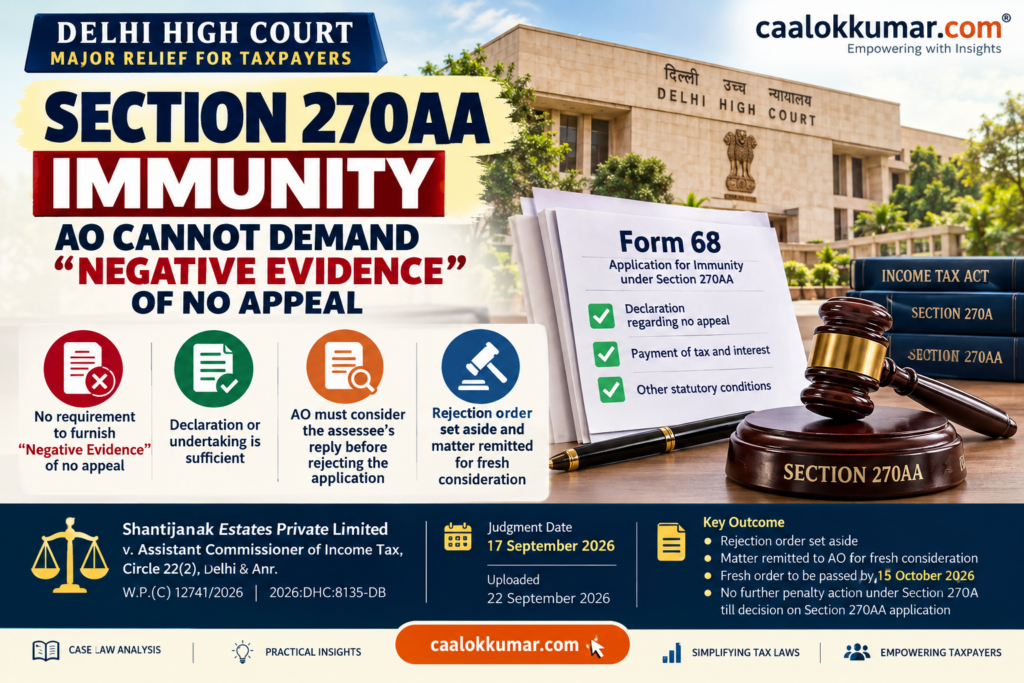
Section 270AA Immunity – Negative Evidence Not Required : Delhi HC Gives Major Relief on Penalty Immunity
The Delhi High Court has delivered an important ruling on Section 270AA immunity from income-tax penalty, holding that an Assessing Officer cannot require an assessee to furnish impossible “negative evidence” to prove that no appeal has been filed against an assessment order.
In Shantijanak Estates Private Limited v. Assistant Commissioner of Income Tax, Circle 22(2), Delhi & Anr., the High Court set aside the Assessing Officer’s order rejecting the assessee’s application for immunity from penalty proceedings under Section 270A.
The Court observed that a declaration from the assessee regarding non-filing of an appeal can be obtained. More importantly, the prescribed Form 68 itself contained the relevant declaration.
The judgment is particularly significant for taxpayers dealing with Section 270A penalty proceedings, applications under Section 270AA and faceless income-tax proceedings where documents and replies filed electronically are sometimes overlooked.
Readers dealing with the wider statutory framework may also refer to our detailed analysis of Section 270AA immunity and the Finance Act 2026 amendments.
Case at a Glance
Case: Shantijanak Estates Private Limited v. Assistant Commissioner of Income Tax, Circle 22(2), Delhi & Anr.
Court: Delhi High Court
Case No.: W.P.(C) 12741/2026, CM APPL. 59208/2026 & CM APPL. 59209/2026
Neutral Citation: 2026:DHC:8135-DB
Date of Decision: 17 September 2026
Date of Uploading: 22 September 2026
Assessment Year: 2024-25
Relevant Sections: Sections 270A and 270AA of the Income-tax Act, 1961
Issue: Whether the AO could reject an application for immunity because the assessee did not furnish documentary evidence proving that no appeal had been filed.
Outcome: Rejection order set aside and matter remitted to the Assessing Officer for fresh consideration.
The judgment can be verified through the official Delhi High Court judgment records.
What Is Section 270AA Immunity?
Section 270AA provides a statutory mechanism under which an eligible assessee can seek immunity or waiver from penalty under Section 270A and, subject to the applicable statutory conditions, immunity from specified prosecution proceedings.
The current statutory provision should be read carefully because Section 270AA was substantially amended by the Finance Act, 2026 with effect from 1 March 2026.
Under the amended Section 270AA, broadly, the relevant conditions include payment of the tax and interest arising from the assessment or reassessment within the prescribed period and non-filing of an appeal against the relevant order. Special provisions now also deal with cases involving circumstances covered by Section 270A(9).
The current statutory text is available on the Income Tax Department’s official Section 270AA page.
Taxpayers should therefore not rely mechanically on older judicial decisions concerning Section 270AA without checking whether the application is governed by the pre-amendment or post-amendment provisions.
Facts of Shantijanak Estates Case
Shantijanak Estates Private Limited was engaged in the business of letting out immovable property.
For Assessment Year 2024-25, the company filed its return declaring total income of ₹5,43,52,210 under the head “Profits and Gains of Business or Profession.”
Assessment was completed under Section 143(3) read with Section 144B by an order dated 27 March 2026.
The income was assessed under the head “Income from House Property” at ₹6,68,07,690.
While completing the assessment, the Assessing Officer initiated proceedings under Section 270A for alleged under-reporting of income.
For a detailed understanding of the difference between under-reporting and misreporting, readers may also refer to our guide on Section 270A penalty notices and under-reporting versus misreporting.
Entire Tax Demand Paid Before the Due Date
An important fact in the case was the payment of the assessment demand.
The assessee paid the entire demand of ₹37,99,340 on 22 April 2026, whereas the due date for payment was 26 April 2026.
Thereafter, on 27 April 2026, the assessee filed the prescribed Form 68, seeking immunity under Section 270AA.
The dispute therefore was not merely about non-payment of the assessed demand. It centred substantially around the manner in which the immunity application and the assessee’s subsequent reply were dealt with by the Assessing Officer.
AO Asked for Documentary Evidence That No Appeal Had Been Filed
On 28 July 2026, the Assessing Officer issued a notice asking the assessee why its application for immunity should not be rejected.
Among other things, the AO required the assessee to furnish documentary evidence establishing that no appeal had been filed against the assessment order.
This created the central legal issue before the Delhi High Court:
How does an assessee produce documentary proof of something that has not happened?
The assessee filed its reply on 29 July 2026 and claimed that all the statutory conditions for immunity had been fulfilled.
Nevertheless, the Assessing Officer rejected the Section 270AA application on 30 July 2026 and recorded, inter alia, that the assessee had not filed a reply.
The electronic record, however, showed otherwise.
Delhi High Court: AO Cannot Demand “Negative Evidence”
The Delhi High Court disagreed with the approach adopted by the Assessing Officer.
After examining the record, the Court found that the AO had required the petitioner to establish that it had not filed an appeal.
The Court questioned how an assessee could reasonably be expected to furnish negative evidence showing that an appeal had not been filed.
Accordingly, the High Court directed the Assessing Officer not to insist upon such negative evidence.
This is the most important principle emerging from the judgment.
A Declaration Can Be Obtained Instead
The High Court clarified that the AO could, at the most, obtain a declaration from the assessee confirming that:
- no appeal had been filed against the assessment order; and
- if any appeal had been filed, it would be withdrawn or treated as withdrawn in accordance with law.
This provides a practical approach to verification without imposing an impossible evidentiary burden upon the taxpayer.
Form 68 Already Contained the Relevant Declaration
The High Court went a step further.
It noted that Form 68 filed by the petitioner already contained the relevant detail and declaration.
Consequently, requiring additional negative evidence regarding non-filing of an appeal served little practical purpose in the facts before the Court.
Form 68 is the prescribed application relating to Section 270AA. The prescribed form and statutory framework can be traced to the official Income Tax Department notification prescribing Form 68.
This part of the judgment is particularly useful for taxpayers and tax professionals because it reinforces the importance of examining what has already been declared in the prescribed statutory form before calling for further evidence.
AO Failed to Consider the Assessee’s Reply
The second important aspect of the judgment concerns non-consideration of the taxpayer’s response.
The Assessing Officer’s order stated that the assessee had not filed a reply.
However, the High Court found from the record that a reply had actually been filed on 29 July 2026.
The petitioner had also produced the acknowledgement evidencing the filing.
The Court therefore found that the impugned order had been passed without considering the reply already available on record.
Accordingly, the rejection order dated 30 July 2026 was set aside.
This aspect of the decision has relevance beyond Section 270AA proceedings. In faceless proceedings especially, taxpayers should preserve acknowledgements, response IDs and copies of every electronic submission made through the Income Tax portal.
Taxpayers facing assessment, reassessment or penalty proceedings may refer to our detailed Tax Litigation and Faceless Assessment services for the broader procedural framework.
What Did the Delhi High Court Finally Order?
The Delhi High Court allowed the writ petition and:
- set aside the order dated 30 July 2026 rejecting the Section 270AA application;
- directed the Assessing Officer to reconsider the application objectively and in accordance with law;
- directed the AO to consider the material already available on record;
- directed that a fresh order be passed on or before 15 October 2026; and
- directed the Faceless Assessing Officer not to proceed further with the Section 270A penalty proceedings until the Section 270AA application was decided.
Importantly, the High Court did not itself grant immunity to the assessee. It set aside the defective rejection and remitted the application to the AO for a fresh decision.
That distinction is important while interpreting the judgment.
Why This Section 270AA Judgment Matters
The ruling establishes two useful procedural principles.
First, an assessee seeking Section 270AA immunity should not be required to prove a negative by producing documentary evidence that an appeal does not exist. A proper declaration can serve that purpose, subject to verification and the statutory conditions.
Second, an Assessing Officer must properly consider replies and material already placed on record before rejecting an immunity application.
An administrative order stating that no response was filed, when the electronic record shows that a response was actually submitted, is vulnerable to judicial scrutiny.
Practical Checklist for Filing Form 68 Under Section 270AA
Taxpayers considering an application under Section 270AA should carefully verify the following before filing:
- Examine the assessment order carefully and identify whether the penalty proposed under Section 270A relates to under-reporting or circumstances amounting to misreporting.
- Check the applicable version of Section 270AA, particularly because the Finance Act, 2026 amendments took effect from 1 March 2026.
- Pay the tax and interest within the period specified in the notice of demand, where required under the applicable statutory provision.
- Where Section 270A(9) circumstances are involved, examine the amended provisions concerning additional income-tax and the other conditions introduced by the Finance Act, 2026.
- Check the appeal position carefully. The statutory condition relating to non-filing of an appeal is fundamental to Section 270AA.
- File Form 68 within the prescribed statutory time limit.
- Preserve the Form 68 acknowledgement, payment challans, assessment order, notice of demand and all portal submissions.
- If the AO issues a clarification or show-cause notice, submit a proper point-wise reply and preserve the electronic acknowledgement.
- Where the Department asks for proof that no appeal has been filed, specifically refer to the declaration already made and the principle recognised in Shantijanak Estates.
- Before choosing immunity instead of appellate proceedings, evaluate the merits of the underlying assessment addition because acceptance of immunity can affect appellate remedies.
Important 2026 Amendment to Section 270AA
This judgment should also be read alongside the important amendment made by the Finance Act, 2026.
With effect from 1 March 2026, Section 270AA was amended to extend the statutory framework to circumstances involving misreporting under Section 270A(9), subject to additional conditions, including payment of prescribed additional income-tax.
The amended provision also contains Section 270AA(3A), dealing with cases where proceedings have been initiated under Chapter XXII.
Therefore, taxpayers should distinguish between:
ordinary under-reporting cases, misreporting cases, the applicable statutory version of Section 270AA, and the particular assessment/penalty proceedings involved.
Our earlier detailed analysis of the amendment and the Rajasthan High Court decision in Spunwell Syntex Pvt. Ltd. is available in this article on Section 270AA immunity after the Finance Act 2026 amendment.
Key Takeaways
The Delhi High Court ruling in Shantijanak Estates Private Limited provides important procedural protection to taxpayers applying for immunity under Section 270AA.
An Assessing Officer cannot insist upon impossible documentary proof merely to establish that no appeal has been filed. A declaration can be obtained for this purpose, and the Court specifically noticed that Form 68 itself contained the relevant declaration.
Equally important, an application cannot be rejected by ignoring a reply that has actually been filed and is available on the departmental record.
For taxpayers, the judgment highlights three practical lessons: comply with the statutory conditions, preserve every electronic acknowledgement, and carefully evaluate the choice between Section 270AA immunity and appellate remedies before proceeding.
The ruling does not mean that every Form 68 application must automatically be accepted. Eligibility still depends upon satisfaction of the statutory requirements applicable to the particular case. What the judgment does establish is that the decision-making process must be objective, based on the record, and free from unreasonable demands for evidence that an assessee cannot practically furnish.
Case Reference
Shantijanak Estates Private Limited v. Assistant Commissioner of Income Tax, Circle 22(2), Delhi & Anr.
W.P.(C) 12741/2026
CM APPL. 59208/2026 & CM APPL. 59209/2026
Neutral Citation: 2026:DHC:8135-DB
Delhi High Court
Decision dated: 17 September 2026
Uploaded: 22 September 2026
Disclaimer: This article is intended for professional and educational information and should not be treated as legal or tax advice for any particular case. Eligibility under Section 270AA depends upon the applicable statutory provisions, assessment order, nature of penalty proceedings and facts of each case.
Leave a Reply