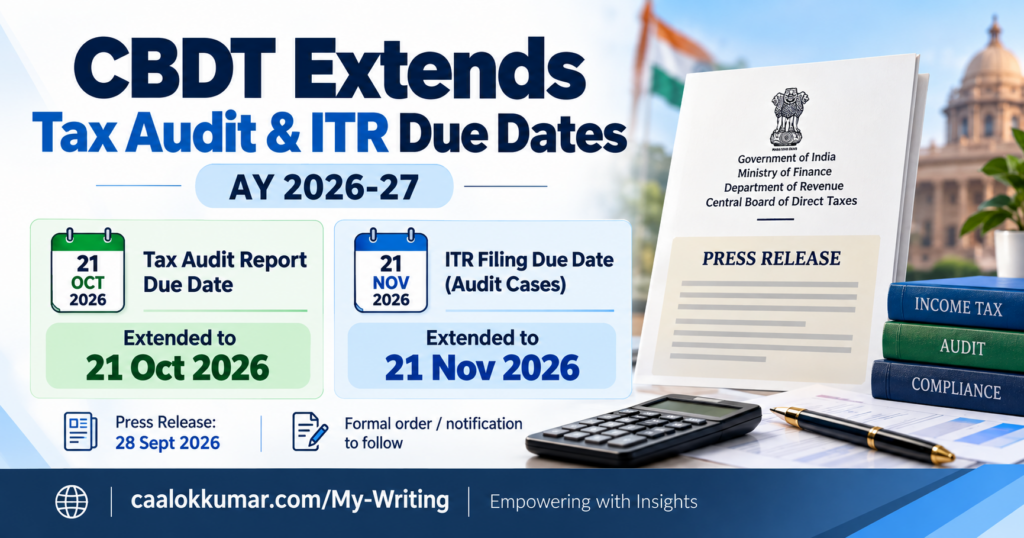
Big CBDT Relief: Filing Tax Audit Due Date Extended to 21 October & ITR Due Date to 21 November 2026
Updated on: 28 September 2026
The Central Board of Direct Taxes (CBDT) has announced a significant extension of the Tax Audit Due Date for AY 2026-27 and the corresponding deadline for filing the Income Tax Return by specified taxpayers whose accounts are required to be audited.
As per the CBDT announcement dated 28 September 2026, the due date for furnishing the Return of Income for the relevant audit cases has been extended from 31 October 2026 to 21 November 2026.
Consequently, the specified date for furnishing the tax audit report has also been extended from 30 September 2026 to 21 October 2026.
Taxpayers and businesses covered by tax audit provisions should use the additional time for proper reconciliation of books of account, GST data, TDS records, AIS/TIS, Form 26AS and other financial information instead of postponing compliance until the revised deadline.
For detailed professional guidance on audit applicability, readers may also refer to our dedicated page on Tax Audit under Section 44AB.
Tax Audit and ITR Due Dates Extended for AY 2026-27
The revised dates announced by CBDT are:
| Compliance | Earlier Due Date | Revised Due Date |
|---|---|---|
| Tax Audit Report – specified audit cases | 30 September 2026 | 21 October 2026 |
| Income Tax Return – specified audit cases | 31 October 2026 | 21 November 2026 |
This effectively provides an additional 21 days for completing the tax audit as well as filing the corresponding return of income.
The extension has been widely reported on 28 September 2026 based on the CBDT/Income Tax Department communication. Moneycontrol
What Exactly Has CBDT Announced?
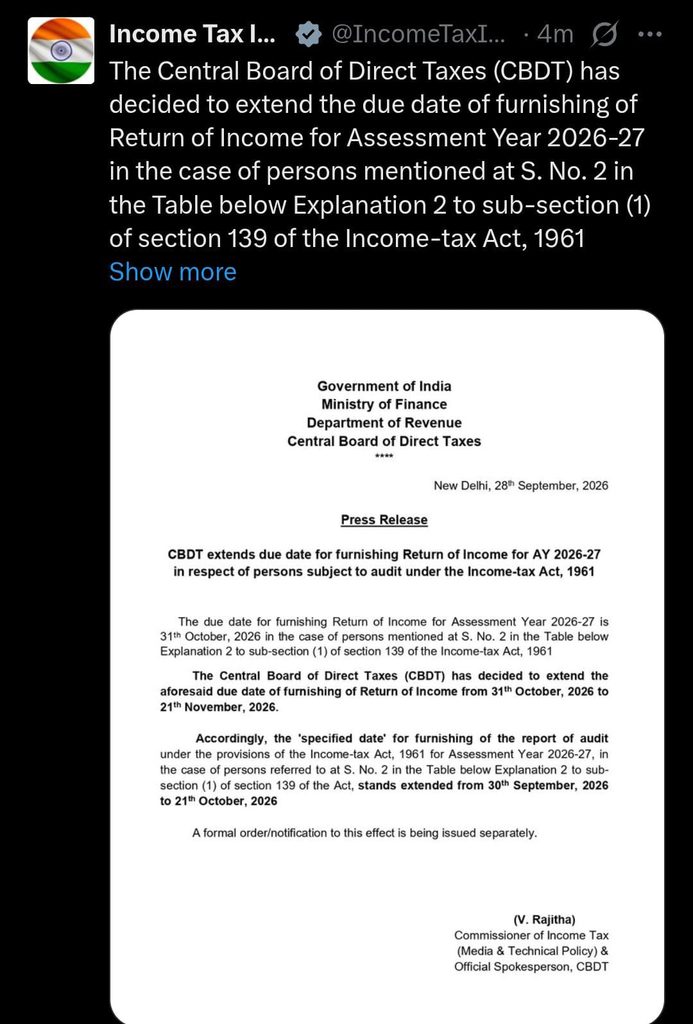
The CBDT communication states that the due date for furnishing the Return of Income for Assessment Year 2026-27 in the case of persons mentioned at S. No. 2 of the Table below Explanation 2 to Section 139(1) of the Income-tax Act, 1961 has been extended:
From 31 October 2026
to 21 November 2026.
Accordingly, the corresponding “specified date” for furnishing the report of audit stands extended:
From 30 September 2026
to 21 October 2026.
CBDT has further stated that a formal order/notification will be issued separately to give statutory effect to the extension. CAclubindia
Taxpayers may access the official Income Tax e-Filing Portal for filing and compliance-related services.
Who Gets the Benefit of the Tax Audit Due Date Extension?
The extension principally applies to taxpayers falling within the specified audit category under Section 139(1), where the return was otherwise due on 31 October 2026.
These may typically include eligible:
- companies whose accounts are required to be audited;
- partnership firms and LLPs covered by audit requirements;
- proprietorships and businesses requiring tax audit;
- professionals covered by the applicable audit provisions;
- partners of firms in applicable cases; and
- other taxpayers whose due date falls within the specified audit category.
The exact applicability should, however, be determined with reference to the taxpayer’s status, nature of income, audit requirement and the relevant provisions of the Income-tax Act.
For an overview of applicable return categories, forms and deadlines, see our detailed ITR Filing AY 2026-27 Guide.
Taxpayers looking for professional return filing assistance can also refer to our ITR Filing Services for AY 2026-27.
Is the Extension Applicable to All ITR Filers?
No.
This is one of the most important points taxpayers should understand.
The present CBDT announcement specifically refers to the category covered by S. No. 2 of the Table below Explanation 2 to Section 139(1).
Therefore, it should not be interpreted as a general extension of every ITR deadline for AY 2026-27.
For example, taxpayers who were required to file returns under separate non-audit deadlines are not covered merely because CBDT has extended the audit-case deadline.
Similarly, taxpayers covered by transfer-pricing reporting requirements should separately verify the due dates applicable to them.
Tax Audit under Section 44AB
Tax audit requirements are governed primarily by Section 44AB of the Income-tax Act, 1961 for FY 2025-26/AY 2026-27.
Depending upon the taxpayer’s business turnover, professional receipts, presumptive taxation position and other statutory conditions, an audit may become mandatory.
A tax audit generally involves examination and reporting of matters such as:
- turnover and gross receipts;
- accounting method;
- depreciation;
- inadmissible expenditure;
- TDS/TCS compliance;
- Section 43B payments;
- MSME-related disclosures;
- loans and deposits;
- related-party transactions;
- deductions and allowances; and
- reconciliation with tax and regulatory records.
Our detailed Tax Audit Section 44AB service page explains the applicability and compliance requirements for AY 2026-27.
Why the Revised Tax Audit Deadline Matters
The extension is particularly important because modern tax audits increasingly require reconciliation across multiple data sources rather than merely examining the financial statements.
Before finalising the audit report, taxpayers should preferably reconcile:
1. Books of Account with GST Returns
Turnover appearing in the financial statements should be reconciled with applicable GST returns, including GSTR-1 and GSTR-3B.
Material differences should be identified, explained and documented.
2. AIS and TIS
The Annual Information Statement and Taxpayer Information Summary may contain information relating to:
- interest;
- securities transactions;
- property transactions;
- foreign remittances;
- dividend;
- TDS/TCS;
- high-value transactions; and
- other reported financial information.
Differences should be examined before filing the return.
3. Form 26AS
TDS and TCS credits appearing in the books should be reconciled with Form 26AS.
Unmatched tax credits should be followed up before return filing wherever practicable.
4. MSME Payments
Amounts payable to Micro and Small Enterprises should be examined carefully, particularly in the context of the applicable provisions relating to delayed payments and tax deductibility.
5. TDS Compliance
Expenses susceptible to tax deduction at source should be reviewed for:
- applicability of TDS;
- correct rate;
- date of deduction;
- date of deposit; and
- possible disallowance consequences.
Revised Compliance Calendar for Audit Cases
For taxpayers benefiting from the CBDT extension, the practical compliance sequence will now generally be:
Up to 21 October 2026:
Complete audit, finalise Form 3CA/3CB and Form 3CD, upload the audit report and ensure acceptance by the taxpayer where required.
After Audit Finalisation:
Reconcile the final audited accounts with AIS, TIS, Form 26AS, TDS, GST and other information.
Up to 21 November 2026:
File the Income Tax Return under Section 139(1) for the specified category.
Taxpayers should still avoid treating 21 October or 21 November as target dates. These are statutory outer limits and last-minute filings can expose taxpayers to portal congestion, reconciliation problems and incomplete documentation.
Does the Extension Change AY 2026-27?
No.
The extension relates only to the compliance due dates.
The relevant period remains:
Financial Year: 2025-26
Assessment Year: 2026-27
Returns relating to income earned during FY 2025-26 continue to be filed for AY 2026-27.
Readers may refer to our ITR Filing Deadline 2026 guide for a broader explanation of return deadlines, late filing consequences, interest and other compliance issues.
Income-tax Act, 1961 Continues to Govern AY 2026-27 Returns
Another point that may cause confusion is the commencement of the Income-tax Act, 2025 from 1 April 2026.
Income earned during FY 2025-26 pertains to AY 2026-27, and the return and related audit compliances for this period continue to operate under the relevant provisions of the Income-tax Act, 1961, subject to the applicable transition provisions.
This is why the CBDT press release itself refers to Section 139 of the Income-tax Act, 1961.
For a broader understanding of the transition to the new tax law, readers can refer to our article on Income-tax Act 2025 – New Forms and Compliance Statements.
Important: Formal CBDT Order/Notification to Follow
The CBDT press release specifically states that:
A formal order/notification to give effect to the extension is being issued separately.
Accordingly, taxpayers and professionals should also review the formal CBDT notification/order once published.
Official updates may be checked through the Government’s Income Tax Department portal and the Income Tax Department/CBDT website.
At the time of this update on 28 September 2026, the CBDT announcement itself clearly confirms the revised dates; the separate statutory order/notification is to follow. CAclubindia
What Taxpayers Should Do Now
The additional time should preferably be used for improving the quality of compliance rather than simply postponing filing.
Taxpayers covered by the revised deadline should:
- finalise books of account and pending entries;
- reconcile turnover with GST returns;
- reconcile TDS/TCS with Form 26AS;
- verify AIS and TIS information;
- identify possible Section 43B and other disallowances;
- review MSME-related balances and reporting;
- examine capital gains, foreign assets and other specialised disclosures;
- complete tax audit documentation;
- approve/upload the audit report within the revised deadline; and
- file the final Income Tax Return by 21 November 2026.
Businesses and taxpayers requiring professional assistance may also consult a Chartered Accountant in Dwarka for ITR, Tax Audit and Income Tax Compliance.
Frequently Asked Questions
What is the new Tax Audit Due Date for AY 2026-27?
CBDT has extended the specified date for furnishing the audit report for the relevant category from 30 September 2026 to 21 October 2026.
What is the new ITR due date for audit cases?
For the specified taxpayers covered by the CBDT announcement, the ITR filing deadline has been extended from 31 October 2026 to 21 November 2026.
Has CBDT extended the deadline for all taxpayers?
No. The announcement applies to the specified category referred to at S. No. 2 of the Table below Explanation 2 to Section 139(1).
Is 21 October 2026 the new tax audit deadline for every audit-related case?
The CBDT announcement relates to the specified taxpayers whose corresponding return due date has been extended to 21 November 2026. Other specialised categories should verify their applicable statutory deadlines separately.
Has the formal notification been issued?
The CBDT press release dated 28 September 2026 states that a formal order/notification will be issued separately.
Where can the Income Tax Return and audit report be filed?
The applicable forms are filed electronically through the official Income Tax e-Filing Portal.
Conclusion
The CBDT Tax Audit Due Date Extension for AY 2026-27 provides important compliance relief to specified taxpayers whose accounts are required to be audited.
The revised deadlines are:
Tax Audit Report: 21 October 2026
Income Tax Return: 21 November 2026
The extension should, however, not be treated as a blanket extension for every taxpayer. Applicability should be checked according to the taxpayer’s statutory category under Section 139(1).
The additional period should ideally be utilised to complete proper reconciliation of audited accounts with GST returns, Form 26AS, AIS, TIS, TDS records and other financial information, ensuring that the final ITR is accurate and consistent with the audit report.
CBDT Update – AY 2026-27:
Tax Audit Report due date extended from 30 September 2026 to 21 October 2026.
ITR Filing due date for specified audit cases extended from 31 October 2026 to 21 November 2026. CBDT has stated that the formal order/notification will be issued separately.
Leave a Reply