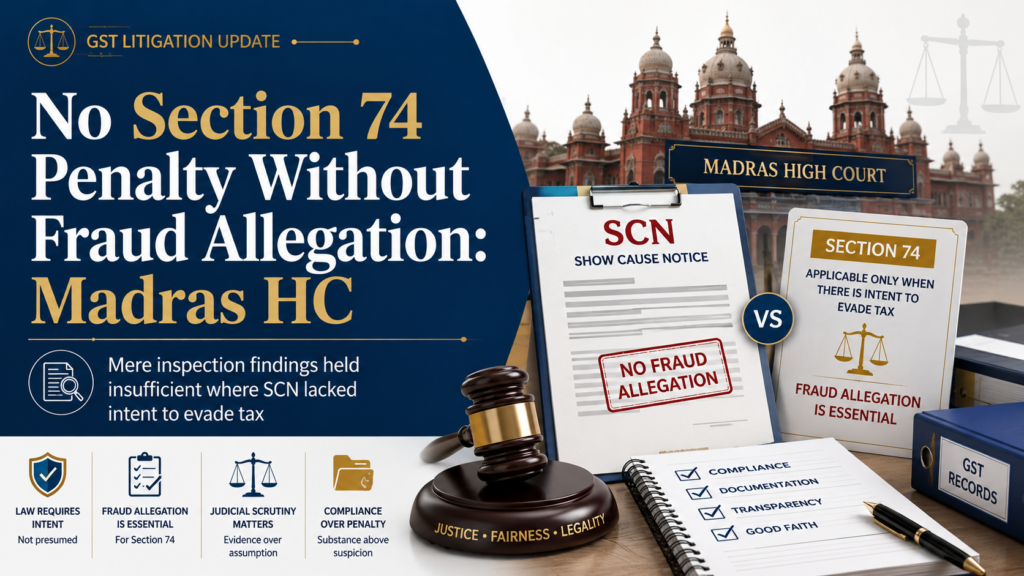
Section 74 GST Notice Cannot Be Based Only on Inspection Findings: Madras High Court
The Madurai Bench of the Madras High Court, in Tvl. T. Balasubramanian v. The State Tax Officer (Roving Squad-2), decided on 11 March 2026, has delivered an important ruling on the invocation of Section 74 of the GST law. The Court held that penalty proceedings under Section 74 cannot be sustained merely on the basis of inspection findings where the show cause notice does not expressly allege fraud, wilful misstatement, suppression of facts or intention to evade tax.
This judgment is highly relevant for taxpayers facing GST notices, GST assessment proceedings, GST return filing mismatch issues and penalty proceedings arising from turnover differences between GSTR-3B, financial statements and income-tax records.
Case Details
Case Name: Tvl. T. Balasubramanian v. The State Tax Officer (Roving Squad-2)
Court: Madurai Bench of Madras High Court
Judge: Hon’ble Mr. Justice D. Bharatha Chakravarthy
Date of Decision: 11 March 2026
Writ Petitions: W.P.(MD) Nos. 6708 and 6710 of 2026
Relevant Provisions: Section 73 and Section 74 of the CGST / TNGST Act, 2017
The judgment concerned GST proceedings initiated under Section 74 for the assessment years 2018-19 and 2020-21. The Department alleged turnover difference between GSTR-3B and the profit and loss account / Form 26AS data. The taxpayer had already paid the pending tax through DRC-03 before issuance of the show cause notice. The dispute was mainly whether Section 74 could still be invoked for penalty merely because the difference came to light during inspection. The judgment records these facts and the taxpayer’s payment before notice.
Legal Background: Difference Between Section 73 and Section 74
Under GST law, Section 73 applies where tax has not been paid, short paid, erroneously refunded, or input tax credit has been wrongly availed or utilised for reasons other than fraud, wilful misstatement or suppression of facts. In such cases, the proceedings are generally non-fraud proceedings. The CBIC’s official GST law portal describes Section 73 as applying to cases not involving fraud, wilful misstatement or suppression of facts.
On the other hand, Section 74 applies where tax has not been paid, short paid, erroneously refunded, or input tax credit has been wrongly availed or utilised by reason of fraud, wilful misstatement or suppression of facts to evade tax. The official CBIC text of Section 74 specifically uses the words “fraud”, “wilful-misstatement” and “suppression of facts to evade tax”.
Therefore, every tax difference or reporting mismatch does not automatically become a Section 74 case. For invoking Section 74, the Department must clearly bring out the element of fraud, wilful misstatement, suppression of facts or intention to evade tax.
This distinction is very important for taxpayers, consultants and professionals handling GST compliance, GST audit support, accounting reconciliation and tax litigation matters.
Facts of the Case
In this case, show cause notices were issued to the taxpayer alleging turnover difference between GSTR-3B and the profit and loss account as reflected in income-tax records. The notice itself recorded that the defect was communicated to the taxpayer and that the taxpayer had paid pending tax through DRC-03 before issuance of the show cause notice.
The Department invoked Section 74 and proposed penalty on the ground that the turnover difference came to light during inspection. The taxpayer argued that even if there was a turnover difference, Section 74 could not be invoked unless the show cause notice and order clearly alleged fraud, wilful misstatement, suppression or intention to evade tax.
The taxpayer further argued that, at best, the matter could fall under Section 73 and not Section 74, especially when the tax had already been paid before issuance of the show cause notice.
Main Issue Before the High Court
The key issue before the Madras High Court was:
Whether mere inspection findings and turnover difference, without any express allegation of intent to evade tax in the show cause notice, are sufficient to invoke Section 74 of the GST law?
This issue is important because many GST notices are issued mechanically under Section 74 merely on the basis of differences found during inspection, audit, scrutiny, reconciliation or data comparison. However, Section 74 is not meant for every mismatch. It is a serious provision involving allegations of fraud, wilful misstatement or suppression.
Arguments of the Taxpayer
The taxpayer submitted that the show cause notice and assessment order merely referred to turnover difference between GSTR-3B and the profit and loss account. There was no clear allegation that the taxpayer had acted fraudulently or had wilfully suppressed facts with intention to evade tax.
The taxpayer also submitted that tax was voluntarily paid before issuance of the show cause notice. Therefore, the Department could not automatically invoke Section 74 only because the matter was detected during inspection.
The taxpayer relied on earlier Madras High Court rulings, including Neeyamo Enterprises Solutions Private Limited v. Commercial Tax Officer (State Tax) (Intelligence), Madurai, for the proposition that Section 74 cannot be invoked unless the show cause notice and order disclose the essential ingredients of fraud, wilful misstatement or suppression of facts.
Arguments of the Department
The Department contended that the transactions were not properly reported under GST and that the difference was detected only after inspection and verification of profit and loss account / Form 26AS details. According to the Department, this showed misstatement of particulars and suppression of transactions.
The Department argued that the reference to surprise inspection in the show cause notice was sufficient and that the authorities were justified in invoking Section 74.
High Court’s Findings
The Madras High Court held that the important question was whether the non-reporting or misstatement was with a wilful intention to evade tax. The Court clearly observed that wilfulness or intention to evade tax cannot be assumed or presumed merely by referring to the inspection report in the show cause notice.
The Court further held that the very purpose of issuing a show cause notice under Section 74 is to put the taxpayer on notice regarding the element of fraud, wilful suppression and evasion of tax. Therefore, this aspect must be expressly mentioned in the show cause notice.
The Court referred to the principle that presence of fraud, wilful misstatement or suppression of facts is a sine qua nonfor action under Section 74. It is not necessary that the exact statutory language must be reproduced, but the show cause notice and the order must indicate the offending conduct of the taxpayer.
Tax Already Paid Before SCN: Why It Mattered
An important factual point in this case was that the taxpayer had already paid the tax before issuance of the show cause notice. The High Court observed that, in such a factual scenario, the show cause notice should have expressly and clearly mentioned wilfulness or intention to evade tax.
Since the show cause notice and the impugned order did not expressly record the intention to evade tax, wilful misstatement or suppression of facts, the Section 74 proceedings could not be sustained in their existing form.
This does not mean that every payment before notice will automatically protect the taxpayer from all proceedings. However, where the Department wants to invoke Section 74 despite pre-notice payment, the Department must clearly allege and justify the ingredients of Section 74.
Decision of the High Court
The Madras High Court set aside the impugned orders. However, the Court granted liberty to the Department to issue a fresh show cause notice either under Section 73 or Section 74, as the case may be, after prima facie satisfying itself and after making proper averments in the notice.
The taxpayer was also given liberty to raise all contentions, including the contention that the matter falls only under Section 73 and not under Section 74. The Court directed that fresh orders should be passed in accordance with law.
CBIC Circular Also Supports Re-Determination Under Section 73 Where Section 74 Fails
The principle is also consistent with CBIC Circular No. 185/17/2022-GST dated 27 December 2022. The circular explains the effect of Section 75(2) of the CGST Act. It clarifies that where a notice under Section 74 is found unsustainable because the charges of fraud, wilful misstatement or suppression of facts to evade tax are not established, the proper officer may be required to re-determine the tax as if the notice had been issued under Section 73, subject to limitation and other legal requirements.
This circular is important because it shows that the law itself recognises a clear distinction between fraud-based proceedings under Section 74 and non-fraud proceedings under Section 73.
Key Legal Principle Emerging from the Judgment
The key principle from this judgment is simple but powerful:
Section 74 cannot be invoked merely because tax difference is found during inspection. The show cause notice must clearly allege fraud, wilful misstatement, suppression of facts or intention to evade tax.
In other words, inspection may provide material for investigation, but inspection alone does not automatically prove wilful tax evasion. The Department must clearly put the taxpayer on notice regarding the alleged offending conduct.
This principle is important for businesses receiving GST show cause notices, GST penalty notices, GST demand ordersand proceedings arising out of return mismatches, audit findings or inspection reports.
Practical Impact for Taxpayers
This judgment provides important protection to taxpayers in genuine mismatch or reconciliation cases. Many businesses may face differences between GST returns, books of accounts, Form 26AS, income-tax data, e-way bills, GSTR-1, GSTR-3B and financial statements. Such differences may arise due to accounting treatment, timing difference, classification issue, clerical mistake, reconciliation gap or reporting error.
However, every difference cannot be treated as fraud or suppression. If the Department wants to invoke Section 74, the show cause notice must clearly explain why the case involves fraud, wilful misstatement or suppression with intention to evade tax.
Taxpayers should carefully examine whether the notice contains:
- Specific allegation of fraud;
- Specific allegation of wilful misstatement;
- Specific allegation of suppression of facts;
- Clear allegation of intention to evade tax;
- Material relied upon by the Department;
- Proper reasoning for invoking Section 74 instead of Section 73;
- Proper opportunity to reply to the allegation.
If these elements are missing, the taxpayer may have a strong ground to challenge the invocation of Section 74.
Practical Checklist for Replying to Section 74 GST Notices
Taxpayers receiving a Section 74 notice should not reply casually. A proper response should be fact-based, legally structured and supported by documents. The reply should generally cover:
- Nature of alleged mismatch or difference;
- Explanation for turnover difference, if any;
- Reconciliation between GSTR-3B, GSTR-1, books and financial statements;
- Whether tax has already been paid through DRC-03;
- Whether interest has been paid, if applicable;
- Absence of fraud, wilful misstatement or suppression;
- Absence of intention to evade tax;
- Request to treat the matter under Section 73, if applicable;
- Request for personal hearing;
- Reliance on relevant judicial precedents.
Professional assistance in GST return reconciliation, GST notice reply drafting, GST assessment representation, audit and assurance services and accounting review can help taxpayers prepare a stronger defence.
Why This Judgment Is Important for GST Litigation
This ruling strengthens the principle that penal provisions must be invoked carefully and not mechanically. Section 74 carries serious consequences, including higher penalty exposure. Therefore, the Department cannot simply rely on inspection findings and proceed under Section 74 unless the show cause notice clearly puts the taxpayer on notice regarding the allegation of fraud or intentional evasion.
The judgment also reinforces the importance of natural justice. A taxpayer must know the exact allegation against him. If the notice does not allege intent to evade tax, the taxpayer cannot be expected to defend an allegation that was never properly made.
For businesses and professionals, this case is a reminder that GST compliance, proper accounting records, timely reconciliation and documented explanations are essential for defending GST proceedings.
Professional Takeaway
The decision in Tvl. T. Balasubramanian v. State Tax Officer is a useful precedent for taxpayers facing Section 74 proceedings based on inspection reports, turnover mismatch or data reconciliation differences. The judgment does not say that Section 74 can never be invoked after inspection. Rather, it says that if the Department wants to invoke Section 74, the notice must clearly allege and disclose the basis of fraud, wilful misstatement, suppression or intention to evade tax.
Therefore, taxpayers should examine Section 74 notices carefully and verify whether the notice contains the necessary jurisdictional allegations. If not, the taxpayer may seek relief by arguing that the case should be considered under Section 73 instead of Section 74.
Conclusion
The Madras High Court has rightly held that mere inspection findings are not sufficient to invoke Section 74 where the show cause notice does not expressly allege fraud, wilful misstatement, suppression of facts or intention to evade tax.
This judgment will help taxpayers in genuine reconciliation and mismatch cases where tax differences are treated as fraud cases without proper allegation. At the same time, it also reminds taxpayers to maintain proper GST records, reconcile returns with financial statements and respond to notices with clear facts and legal support.
For professional assistance in GST notice reply, GST assessment proceedings, GST return filing, GST reconciliation, audit services and accounting and CFO support, taxpayers should obtain timely guidance before submitting any reply or accepting a penalty demand. CA in Dwarka Mutual Fund Distributor in Dwarka Delhi
Leave a Reply