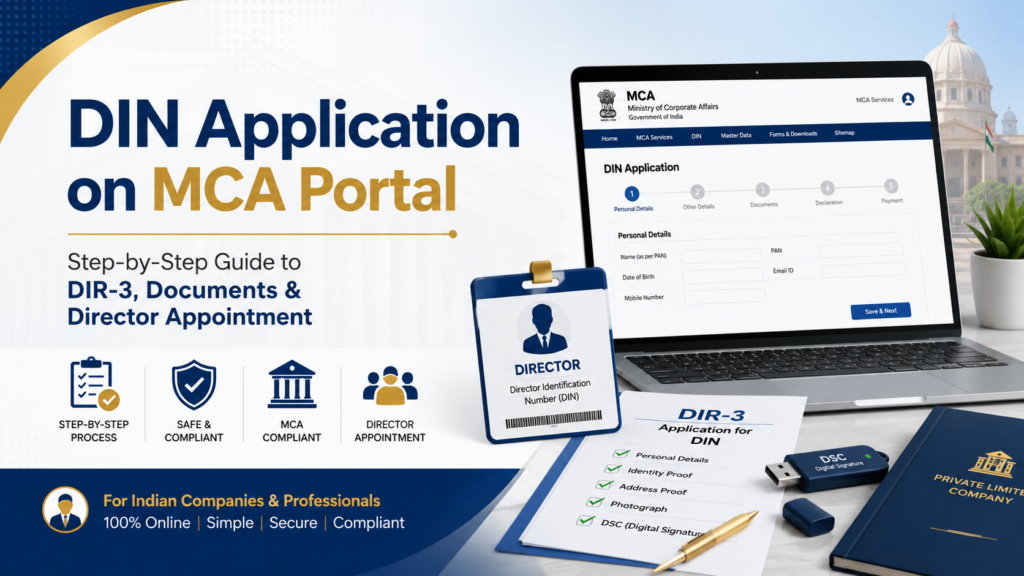
DIN Application on MCA Portal: Simple Guide to Apply Director Identification Number in India
A Director Identification Number (DIN) is a unique identification number allotted to an individual who intends to become a director of a company in India. Under Section 153 of the Companies Act, 2013, every person intending to be appointed as a director is required to apply for DIN in the prescribed manner. Further, Section 155 prohibits a person from obtaining or holding more than one DIN. Therefore, before applying for fresh DIN, it is important to verify whether the applicant already has a DIN. (India Code)
DIN is required for director appointment, ROC records, MCA filings and company law compliance. If the DIN application is filed with wrong details, incorrect form selection, PAN mismatch or incomplete documents, the application may be delayed or sent for resubmission. For a new business setup, promoters may take professional assistance for company registration in India, LLP registration and Startup India registration.
When is Form DIR-3 Used for DIN Application?
If a person is proposed to be appointed as a director in an existing company, DIN is generally applied through Form DIR-3 on the MCA portal. Rule 9 of the Companies (Appointment and Qualification of Directors) Rules provides that an applicant intending to be appointed as director of an existing company shall apply electronically for allotment of DIN. (CAIRR)
However, if DIN is required for proposed first directors at the time of incorporation of a new company, DIN is normally applied through SPICe+ / INC-32 as part of the incorporation process. Therefore, for an existing company, Form DIR-3 is used; for a new company, DIN is generally processed through SPICe+ at the time of incorporation. For entrepreneurs, proper guidance in Private Limited Company registration, OPC registration, LLP formation and startup compliance helps avoid mistakes at the initial stage itself.
Difference Between DIR-3 and DIR-3 KYC
Many applicants confuse Form DIR-3 with DIR-3 KYC, but both are different. Form DIR-3 is used for fresh DIN application where the person does not already have DIN and is proposed to be appointed as director in an existing company. DIR-3 KYC is used by a person who already holds DIN and is required to complete KYC compliance.
Therefore, if your client does not have DIN, the correct form is DIR-3, not DIR-3 KYC. For existing companies, filings such as DIR-3 KYC, DIR-12, AOC-4, MGT-7, DPT-3, MSME-1 and other MCA forms are part of regular ROC filing services and MCA compliance services.
Documents Required for DIN Application
Before filing Form DIR-3, the applicant should keep all documents ready, including passport size photograph, PAN card, proof of identity, proof of residence, board resolution proposing appointment as director, verified specimen signature, applicant’s Digital Signature Certificate, CIN of the company in which appointment is proposed, valid mobile number and email ID. The MCA DIR-3 instruction kit also refers to identity proof, residence proof and company-side digital verification requirements for the form. (Companies House India)
For Indian nationals, PAN details are very important. The applicant’s name, father’s name, date of birth and other personal details should match with PAN and identity documents. Any mismatch may lead to resubmission or delay. Professional review before filing helps companies avoid errors in director appointment compliance, ROC compliance and MCA records.
Step-by-Step Process to Apply DIN on MCA Portal
To apply DIN, first login to the MCA V3 portal with registered credentials and go to the DIN-related filing section. Select Form DIR-3 for fresh DIN application. Do not select DIR-3 KYC if DIN has not yet been allotted.
After selecting Form DIR-3, fill the applicant’s personal details carefully, including name, father’s name, date of birth, PAN, nationality, occupation, educational qualification, mobile number, email ID and address. The name should be exactly as per PAN and identity proof. Spelling differences, initials, short names or mismatch in documents should be avoided.
Next, enter the CIN of the existing company in which the applicant is proposed to be appointed as director. The company details should be verified before proceeding. Thereafter, attach photograph, identity proof, residence proof, board resolution and verified specimen signature. All attachments should be clear, readable and valid.
Form DIR-3 must be digitally signed by the applicant using his or her own Digital Signature Certificate. It must also be digitally verified by the authorised person of the company, such as the company secretary in full-time employment, Managing Director, Director, CEO or CFO, as applicable. After validation, submit the form on the MCA portal, pay the prescribed fee and save the SRN, challan and acknowledgement for records.
What to Do After DIN Allotment?
DIN allotment does not automatically appoint the person as director. After DIN is allotted, the company must complete the director appointment process separately. This generally includes consent to act as director, declaration of non-disqualification, board or shareholder approval as applicable, filing of Form DIR-12 with ROC, updating statutory registers and updating company, bank, GST, income tax and other business records wherever required.
For professional support in DIR-12 filing, director appointment compliance, ROC filing and corporate compliance advisory, companies should ensure proper documentation and timely filing.
Common Mistakes in DIN Application
DIN application may get delayed due to avoidable mistakes such as applying for fresh DIN when the person already has DIN, selecting DIR-3 KYC instead of Form DIR-3, PAN mismatch, name mismatch, unclear identity proof, missing board resolution, wrong CIN, incorrect DSC usage, incomplete company-side verification and treating DIN allotment as director appointment.
These mistakes may affect MCA filing, ROC compliance and company records. Therefore, DIN application should be filed only after checking all details, documents and form requirements carefully.
DIN Application for Startups and New Companies
For a new company, DIN for proposed first directors is generally applied through SPICe+ as part of the incorporation process. Promoters planning to start a Private Limited Company, OPC, Section 8 Company or LLP should choose the correct business structure before filing incorporation documents.
A wrong structure may create unnecessary tax, funding, ownership or compliance issues later. Therefore, founders should take proper advice before proceeding with company incorporation, LLP formation in India, Startup India DPIIT registration and post-incorporation compliance. Growing businesses may also consider Virtual CFO services for financial planning, MIS, budgeting and compliance monitoring.
DIN Application Consultant in Dwarka, Delhi
Businesses searching for CA in Dwarka, ROC consultant in Delhi, MCA filing consultant in Dwarka, DIN application assistance, director appointment filing or company registration support should ensure that the entire process is handled correctly from documentation to final filing.
CA Alok Kumar provides professional assistance for ROC filing services in Delhi, company registration in India, LLP registration, DIN application, DIR-12 filing, MCA V3 portal filing and corporate compliance advisory for clients in Dwarka, Delhi-NCR and across India.
Conclusion
DIN application on the MCA portal is a basic but important compliance step for becoming a director in India. If the appointment is in an existing company, Form DIR-3 is generally used. If DIN is required during new company incorporation, it is usually applied through SPICe+ / INC-32.
Before filing, always check whether the applicant already holds DIN, verify PAN and identity details, keep documents ready, use the correct DSC and ensure proper company-side verification. For assistance in DIN application, Form DIR-3 filing, director appointment, ROC filing services, company registration, startup registration and MCA portal compliance, you may book a consultation with CA Alok Kumar.
Leave a Reply