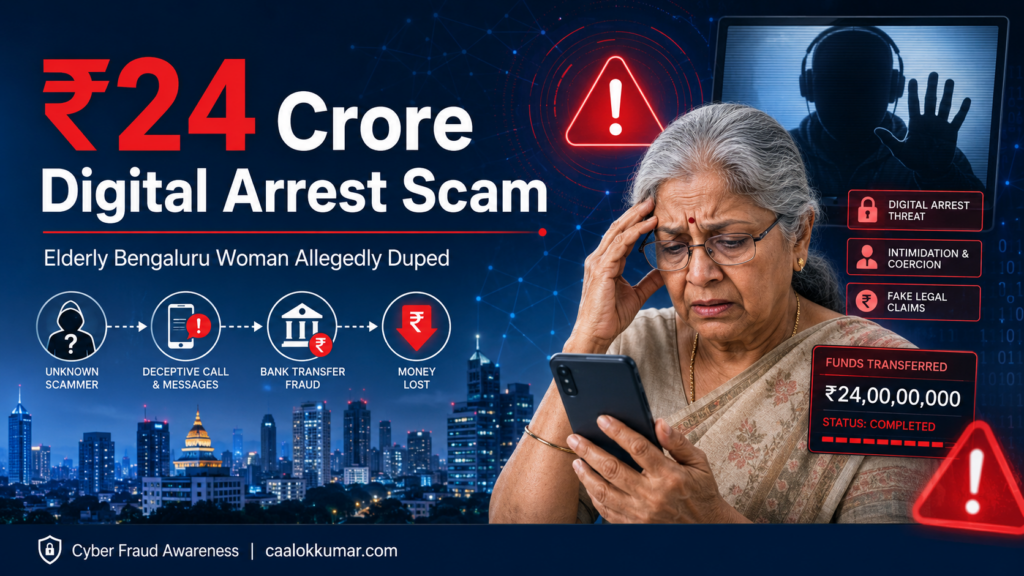
₹24 Crore Digital Arrest Scam in Bengaluru: A Wake-Up Call for Senior Citizens and Families
Cyber fraud in India is no longer limited to OTP theft, fake links, or small online payment scams. A recent Bengaluru case shows how organised cybercriminals are now using fear, fake law-enforcement identity, video calls, and psychological pressure to target senior citizens and high-net-worth individuals.
As reported in the recent Bengaluru case, an elderly woman was allegedly cheated of nearly ₹24 crore after fraudsters convinced her that she was under investigation in a money laundering matter and placed her under so-called “digital arrest”. The case came to light when she reportedly approached a bank to pledge about 1.30 kg of gold jewellery for arranging more funds, which made bank officials suspicious and led to police intervention.
This incident is not merely a cybercrime story. It is a serious reminder for families, senior citizens, banks, tax professionals, and wealth advisers to strengthen financial safety checks.
What Happened in the Bengaluru ₹24 Crore Cyber Fraud Case?
According to available reports, the victim had recently received substantial funds after selling a property. Fraudsters allegedly contacted her in January 2026 and impersonated officials of investigation agencies. They claimed that her bank accounts were linked to a money laundering case and warned her not to discuss the matter with family members or outsiders.
Between January and May 2026, she reportedly transferred nearly ₹24 crore through multiple transactions into several accounts controlled by the accused network. Police later traced the money trail through 22 different bank accounts, and five accused were reportedly arrested from Mumbai, Allahabad and Delhi, with one account containing about ₹60 lakhfrozen during the investigation.
The most alarming part is that the victim was not cheated through one wrong click. She was allegedly kept under continuous psychological pressure through calls and video surveillance for months.
What Is a “Digital Arrest” Scam?
“Digital arrest” is not a legal process. It is a fraud.
NITI Aayog has described digital arrest as a scam where fraudsters impersonate law-enforcement officials and use threats of arrest, frozen bank accounts, passport cancellation, money laundering allegations, or fake legal proceedings to force victims to pay money as “fine”, “security deposit”, or “verification amount”.
In most such cases, fraudsters use one or more of the following methods:
- Fake police, CBI, ED, RBI, customs, courier, or bank identity.
- False allegation of money laundering, drug trafficking, illegal parcel, Aadhaar misuse, or bank-account misuse.
- Threat that the victim should not inform family members.
- Long video calls to create fear and isolation.
- Fake arrest warrant, FIR, court order, or government ID.
- Demand for transfer of money for “verification”, “safe custody”, or “clearance”.
No genuine government agency asks a citizen to transfer money to a private bank account for verification.
Why Senior Citizens Are Becoming Easy Targets
Senior citizens are often targeted because criminals believe they may have accumulated savings, fixed deposits, property sale proceeds, jewellery, pension money, or family wealth. Many elderly persons also live alone or have children living in another city or abroad.
The fraudsters exploit three factors:
1. Fear of law and reputation
When someone is told that their name is involved in money laundering or criminal investigation, the immediate reaction is fear. Fraudsters use this fear to control the victim.
2. Isolation from family
The victim is instructed not to tell anyone. This is a major red flag. Genuine police or government agencies do not stop a person from seeking legal or family assistance.
3. Confusion due to fake documents and video calls
Fake ID cards, video calls, uniforms, legal-looking documents, and aggressive language create a false sense of authenticity.
Legal and Regulatory Angle
Cyber fraud cases involving impersonation, cheating, extortion, identity misuse, and unauthorised financial transfers may attract provisions under the Bharatiya Nyaya Sanhita, 2023, the Information Technology Act, 2000, and other applicable laws depending on the facts of each case.
The Ministry of Home Affairs has also stated that the National Cyber Crime Reporting Portal has been launched under I4C to enable reporting of cybercrime incidents, and that the conversion of such complaints into FIRs and further action is handled by the concerned State/UT law-enforcement agencies.
For financial cyber fraud, the Government’s official cybercrime portal clearly states that immediate reporting can be made by calling 1930, which is available 24×7.
Family Safety Checklist for Senior Citizens
Every family should create a simple fraud-prevention protocol for elderly parents or relatives:
- No major bank transfer above a fixed limit without informing at least one family member.
- No liquidation of FD, mutual fund, property proceeds, jewellery, or gold loan without family discussion.
- No video call with unknown officials.
- No sharing of Aadhaar, PAN, bank statement, OTP, debit card, password, or screen access.
- Keep bank branch manager and family contact numbers easily available.
- Enable SMS/email alerts for all major transactions.
- Review bank accounts and investments periodically.
- Educate domestic staff and caretakers not to assist unknown callers.
Key Takeaway
The Bengaluru ₹24 crore digital arrest case is a strong reminder that cyber fraud is now psychological, organised and highly professional. The safest rule is simple:
No genuine police officer, court, RBI, ED, CBI, customs officer, or tax authority will ask you to remain on video call and transfer money to prove your innocence.
If such a call comes, disconnect immediately, inform your family, call 1930, and report the matter through the official cybercrime portal.
Leave a Reply